
A new graduate C++ engineer can now land $300k to $550k in first-year compensation at top high-frequency trading firms, with base salary, sign-on, and bonus all doing meaningful work in the package, according to the 2025 HFT Salary Guide. That number changes the frame. These roles aren’t being priced like ordinary software jobs. They’re being priced like revenue infrastructure.
That’s the key to understanding what quant firms are paying for c++ engineers. Firms aren’t rewarding language preference. They’re paying for engineers who can make market data arrive sooner, orders leave faster, and systems fail less often under pressure. In quant, a stronger C++ engineer doesn’t just write cleaner code. That engineer can change trading outcomes.
For candidates, this creates a market where technical depth matters more than title inflation. For hiring managers, it creates a budgeting problem that cannot be solved with generic software salary bands. The compensation logic is different, especially in the mid-level market where strong but not yet famous engineers often create the best hiring opportunities. Readers mapping a route into the field can start with this guide on how to become a quant, then use the benchmarks below to understand how the engineering side is priced.
Table of Contents
- The High-Stakes World of Quant C++ Compensation
- Deconstructing Quant C++ Compensation in 2026
- Why Elite C++ Skills Command a Massive Premium
- How Location Shapes Your C++ Compensation Package
- Benchmarking and Negotiating Your Offer
- A Hiring Manager’s Guide to Budgeting for C++ Talent
- Navigating the Quant Market with an Expert Partner
The High-Stakes World of Quant C++ Compensation
The fastest way to misunderstand quant hiring is to compare it to mainstream software hiring. In most software markets, compensation tracks scope, company stage, and management path. In quant, C++ compensation tracks proximity to the trading path and the engineer’s ability to improve it.
A junior engineer writing internal tools and a junior engineer working on exchange connectivity may both have “software engineer” on the offer letter. They are not competing in the same labor market. The second role touches the system that captures edge in microseconds, which is why firms keep stretching comp for people with low-latency depth.
The market pays for profit adjacency
Top firms have become more explicit about how they value these engineers. The large entry-level packages aren’t generosity. They reflect a hiring view that low-latency C++ engineering is a direct profit driver, not a support function. That’s why compensation often arrives as a blend of base salary, sign-on, and a meaningful first-year bonus instead of a flatter software-style package.
Practical rule: The closer an engineer sits to market data, order routing, exchange connectivity, hardware integration, or latency-sensitive infrastructure, the less useful generic software benchmarks become.
For candidates, the useful question isn’t “What does a quant firm pay?” It’s “How expensive is this exact skill in this exact part of the stack?” For employers, the mirror question is “Which part of the trading system justifies premium compensation, and which part doesn’t?”
Mid-level is where the market gets opaque
The public conversation usually fixates on eye-catching new grad offers or star senior engineers. That misses the most strategic part of the market. Mid-level C++ engineers often produce the biggest gap between market value and employer expectations, because they’re expensive enough to hurt a budget but still undervalued if the firm only looks at years of experience.
That’s why a useful compensation discussion has to separate headline pay from pay drivers. Firm tier matters. Geography matters. But skill depth matters most.
Deconstructing Quant C++ Compensation in 2026
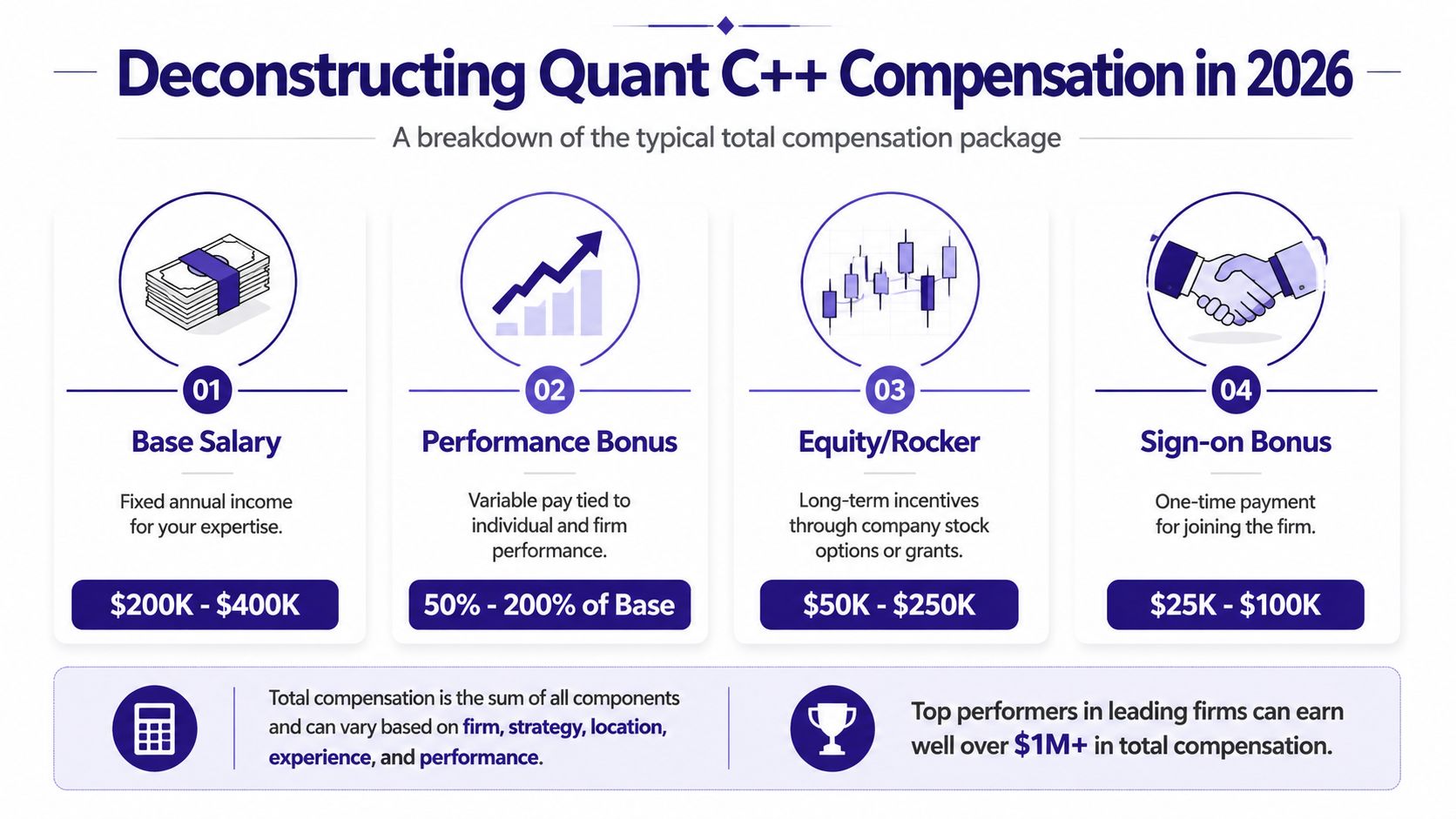
A top-end quant C offer can reach $550k in year-one compensation for a new graduate, but that headline number hides the part of the market that matters more in practice. Mid-level hiring is where firms misprice talent, candidates misread offers, and compensation diverges most sharply based on what an engineer can do in production, not just how many years appear on a CV.
What sits inside the package
Analysts at HuntingCube, in its 2025 HFT salary guide, report that entry-level C++ software engineers at top firms earn $300k to $550k in first-year total compensation, including $150k to $250k base salaries and sign-on bonuses up to $150k. That same guide states that these packages can run 2 to 3 times above general software engineering roles.
The useful lesson is not just that top firms pay more. It is how they pay more.
A quant C++ package usually combines three different hiring signals:
- Base salary reflects how the firm values the role before any trading-year variance.
- Sign-on bonus solves a market-timing problem. Firms use it to close candidates who are running parallel processes and to offset forfeited bonus or deferred compensation.
- Year-one or guaranteed bonus prices expected impact, but it also reveals how aggressive the firm wants to be right now.
This structure is why two offers with similar total compensation can carry very different risk. A candidate should separate fixed pay from discretionary pay, then ask whether bonus depends on firm performance, desk assignment, review timing, or a manager’s judgment. Hiring managers should do the same exercise in reverse before opening a search, because a budget that assumes “$X total comp” often collapses once candidates ask how much of that number is guaranteed.
Compensation ranges by firm type
Clean, firm-by-firm 2026 disclosures remain limited outside the very top of the market. The better way to benchmark is to anchor on verified HFT data, then compare how compensation logic changes by firm type, role proximity to trading, and seniority.
| Seniority Level | Elite HFT (e.g., Jane Street, Citadel) | Prop Trading Shop (e.g., DRW, IMC) | Quant Hedge Fund (e.g., Two Sigma, D.E. Shaw) |
|---|---|---|---|
| New Grad | $300k to $550k first-year total comp at top firms, with $150k to $250k base and sign-on up to $150k | Often competitive for strong systems candidates, though bonus design and desk placement create wider variation | Strong offers for high-end engineering talent, usually with less emphasis on pure execution-path latency |
| Mid-Level | Large upside for engineers tied to exchange connectivity, market data, order routing, or critical infrastructure bottlenecks | Often the most competitive segment for candidates with measurable latency wins and real production ownership | Pays well for engineers who connect platform stability, research infrastructure, and trading effectiveness |
| Senior | Premium compensation for architectural influence, trusted incident judgment, and direct impact on trading throughput | Senior pay rises fast when the engineer has business trust and a record of improving live systems | Often competitive on scope and platform complexity, with economics shaped less by raw speed and more by breadth of system ownership |
The non-obvious conclusion is that “mid-level” is not a stable compensation category in quant C++. It is a sorting mechanism. One engineer with four years of generic C++ backend work may benchmark against strong buy-side software roles. Another engineer with four years of kernel bypass work, feed handling, lock-free systems, or exchange connectivity can benchmark against a much smaller and more expensive labor pool.
That distinction affects both sides of the hiring table. Candidates should benchmark themselves by production relevance, not title. Hiring managers should budget by scarcity of skill, not generic C++ seniority bands.
The package, in other words, is a pricing model for business impact.
Why Elite C++ Skills Command a Massive Premium
A standard C++ developer and a quant C++ developer may both work close to the machine. The difference is the economic consequence of the work. One is improving software. The other may be improving execution speed on systems where tiny delays can change whether a trade is captured, missed, or repriced.

Why C++ pays differently from general quant engineering
The most useful analogy is motorsport. A family-car mechanic and a Formula 1 engineer both understand engines. The pay gap comes from the stakes of fractional improvement. Quant firms price C++ talent the same way when the engineer is optimizing systems that sit on the critical path.
Verified compensation data shows just how large the premium can be. The Levels.fyi quantitative developer benchmark notes that the scarcity of C++ engineers who can optimize systems to the nanosecond creates a 40 to 100 percent compensation uplift over generalist quant developers. In the same benchmark, a typical quant developer might earn a $200k base, while a C++ specialist with 3 to 5 years of experience can command a $200k to $350k base and 100 to 300 percent bonuses, reaching $400k to $800k total compensation.
That isn’t a language premium in the abstract. It’s a scarcity premium tied to technical outcomes. Firms need engineers who understand memory layout optimization, CPU cache hierarchies, SIMD vectorization, and lock-free concurrent programming because those skills reduce latency in live trading systems.
Which skills separate good from expensive
Not all low-latency C++ skills are valued equally. The market tends to pay most aggressively for engineers who can point to specific performance-sensitive work, especially when they’ve done it in production.
The skills that usually move compensation into a different category include:
- Memory and cache awareness. Engineers who can reason about memory layout and cache behavior write code that behaves predictably under load.
- Concurrent systems depth. Lock-free patterns and careful multithreading matter because trading infrastructure doesn’t get to pause when volume spikes.
- Vectorized performance thinking. SIMD and instruction-level efficiency become commercially relevant when the code path repeats continuously.
- Hardware-adjacent engineering. FPGA integration, NIC behavior, and exchange connectivity push a candidate closer to the part of the business that earns premium pay.
A hiring manager rarely pays extra for “strong C++.” They pay extra for proof that the engineer can remove latency where latency matters.
That distinction is why some candidates with ordinary titles still attract extraordinary offers, while others with more prestigious resumes don’t.
How Location Shapes Your C++ Compensation Package
Geography still matters in quant, even in a market that has become more global in sourcing. The same technical profile can be valued very differently depending on whether the role sits in New York, Chicago, or London.

New York and Chicago versus London
The verified gap between the top U.S. market and London is wide enough to influence both hiring strategy and career planning. According to this QuantNet discussion of C++ HFT compensation, top-tier C++ quant roles in New York can exceed $600k in total compensation, while London packages for similar roles often top out around £250,000, or about $320k USD, representing a 30 to 50 percent discount.
That spread exists even when the underlying engineering problem looks similar. A London-based engineer may still be working on exchange connectivity, low-latency data handling, or performance-sensitive infrastructure. The compensation difference reflects market structure, tax assumptions, and talent competition, not a simple difference in technical rigor.
For candidates, the implication is straightforward. A move to a U.S. hub can still produce the biggest upside if maximizing cash compensation is the goal. For firms, the implication is more strategic: geography can become a pricing lever.
What firms should do with the geography gap
A hiring manager who treats all elite C++ hiring as New York-priced may overpay in some markets and lose candidates in others. The sharper approach is to identify which roles require local presence near a trading hub and which roles can be built around a broader talent map.
The verified source above makes the arbitrage case directly. A London-based C++ developer can deliver comparable low-latency expertise for much less than a New York-based hire. That doesn’t mean every firm should shift headcount abroad. It means firms should decide deliberately where premium location spend creates real advantage.
A few practical implications follow:
- Reserve top U.S. budgets for roles tied tightly to the fastest-moving production environments or firm-critical rebuilds.
- Use London selectively when the role needs strong low-latency skill but doesn’t require the most expensive market clearing price.
- Benchmark by market, not brand. A prestigious firm in a cheaper hub may still pay below a less famous U.S. competitor.
For candidates, location is no longer just a lifestyle choice. It’s part of the compensation strategy.
Benchmarking and Negotiating Your Offer
A quant C++ offer is rarely won or lost on base salary alone. The bigger mistakes happen earlier, when candidates benchmark against generic software roles and miss the two variables that drive real pricing power: how close the work is to revenue, and how hard the underlying C++ skill is to replace.
That matters most at mid-level, where compensation starts to separate sharply. Two engineers with the same title can sit in very different bands if one has worked on feed handlers, exchange connectivity, lock-free concurrency, or kernel-sensitive paths, while the other has stayed in peripheral tooling.
How engineers should assess an offer
Start by translating the role into business value. Titles hide more than they reveal in quant.
A useful review process looks like this:
- Map the role to the production path. Work tied to market data ingestion, order routing, networking, or latency bottlenecks usually clears at a higher level than internal platforms or developer tooling.
- Break compensation into fixed and variable pieces. In many firms, bonus is not a side component. It is a large share of total pay. Ask what drives it, who sets it, and whether past payouts have tracked written targets.
- Assess replacement cost. If the desk would struggle to find another engineer with the same systems depth, the offer often has room to improve.
- Prepare evidence of direct impact. The strongest negotiation material is specific production work: reduced tail latency, improved throughput stability, removed packet loss, or fixed contention under load.
Candidates who want a stronger framework for these conversations can review these salary negotiation tactics for technical roles.
One more point is easy to miss. A larger base can still be the weaker offer if the bonus mechanics are vague, discretionary, or poorly aligned with the team you are joining.
How mid-level engineers reach the next band
The biggest jump often happens when an engineer moves from broadly competent C++ work to demonstrable low-latency specialization. Verified market commentary from this discussion on C++ quant progression places junior total compensation around $200k to $350k, while noting that mastery of kernel bypass or advanced NIC tuning is the threshold for $500k-plus packages.
The practical implication is straightforward. Firms do not pay a premium for “C++” in the abstract. They pay for a narrower set of skills that affect execution quality, throughput, determinism, and hardware efficiency.
For mid-level candidates, that changes how to build a case for more money:
- Show specialization, not general effort. “Improved performance” is too broad. A credible story names the bottleneck, the system constraint, the change made, and the result in production.
- Use portfolio evidence carefully. Public low-latency repositories or systems work can help, especially for candidates without elite-brand credentials, but only if you can explain the engineering tradeoffs in detail.
- Anchor negotiation on scarcity. The strongest framing is replacement difficulty and production relevance, not personal need or market chatter.
- Target the right firms. A candidate with true kernel-bypass or NIC-level experience should benchmark against firms that buy that depth explicitly, not against generalist platform teams that happen to use C++.
Many mid-level engineers underprice themselves at this stage. They present as solid developers when they should present as scarce infrastructure talent.
For employers outside the most expensive hubs, broader sourcing can improve the tradeoff between budget and skill availability. Options such as Hire LATAM developers can expand the funnel for strong C++ talent, although roles closest to the live trading path still require unusually specific experience and tighter evaluation.
A Hiring Manager’s Guide to Budgeting for C++ Talent
Hiring managers usually make one of two mistakes with C++ quant talent. They either anchor on general software compensation and lose every serious candidate, or they panic at headline numbers and assume every strong engineer now requires a top-of-market package. Both reactions are expensive.

Build the budget around impact not title
The better model is to budget by production consequence. If the hire will touch components that affect execution quality, throughput stability, or hardware-aware optimization, the role belongs in a different compensation band from a generic backend engineer, even if both use C++.
That doesn’t mean every opening should be written as elite HFT. It means the hiring manager should answer three questions before compensation is approved:
| Budget question | Why it matters |
|---|---|
| Does the role sit on the critical trading path? | Roles closer to revenue generation clear at higher pay levels. |
| Is the firm buying proven specialization or trainable potential? | Paying premium rates for a trainable profile often wastes budget. |
| What would failure to fill cost the desk? | Delayed launches and fragile infra can cost more than an aggressive offer. |
This framing helps a firm avoid overpaying for broad “strong engineer” profiles while still moving decisively for true specialists. For baseline context across software markets, hiring teams can compare against a broader software development salary guide, then adjust sharply upward where low-latency depth justifies it.
What a compelling offer includes when cash is tight
Not every firm can win a pure bidding contest. Some still close strong candidates by making the job itself more attractive.
What tends to matter:
- Technical ownership. Engineers care whether they'll own exchange connectivity, networking decisions, feed architecture, or just maintain inherited code.
- Quality of the surrounding team. Strong C++ engineers want peers who understand performance engineering, not a generalist environment that treats latency work as mysterious.
- Research and implementation proximity. Some candidates value being closer to traders and researchers because it shortens the loop between engineering work and business impact.
- Clear advancement logic. The market rewards skill thresholds. Firms that can articulate how an engineer moves from solid execution to strategic ownership often win trust.
A practical support layer helps here. Teams trying to make compensation decisions with less guesswork often benefit from better internal visibility into hiring pipelines, approval bottlenecks, and performance data. Tools in the AI reporting software for teams category can help leadership organize that decision-making more cleanly.
The most effective offer isn't always the highest number. It's the offer where compensation, scope, and technical credibility all line up.
That's especially true in the mid-level market, where candidates often compare not only cash but also whether the next role will move them into a higher skill tier.
Navigating the Quant Market with an Expert Partner
The compensation story for C++ engineers in quant is easy to distort because the market compresses several very different realities into one headline. A new graduate at a top HFT firm, a mid-level engineer who has mastered kernel-sensitive optimization, and a senior systems developer at a hedge fund may all be labeled “quant engineer,” but firms are buying different forms of value in each case.
For candidates, the main lesson is that negotiation works best when it is tied to evidence. The market pays for scarce technical capability, especially when that capability affects latency-sensitive systems in production. Mid-level engineers should treat that as good news. The biggest compensation jumps often come from crossing a concrete technical threshold, not from waiting for another title change.
For hiring managers, the lesson is to budget with precision. The right question isn't whether C++ talent is expensive. It's whether the role creates enough trading, reliability, or execution advantage to justify specialist pricing. Teams that answer that question clearly tend to hire faster and waste less compensation on the wrong profiles.
Industry leaders who want a broader view of how AI and engineering are changing technical workflows can also track adjacent thinking through resources like the ParakeetAI blog, especially when hiring plans involve automation-heavy environments.
The firms that win in this market usually do one thing better than their competitors. They understand exactly what they are buying. The candidates who win do the same.
Whether the need is a low-latency C++ engineer, a quant developer with production systems depth, or a compensation benchmark that reflects today's market, nexus IT group helps firms and candidates address hard-to-price technical roles with more clarity.