Coursera’s 2026 salary summary puts the average DevOps engineer base salary at $139,000, with $32,714 in supplemental pay, placing the role firmly in a high-compensation tier rather than a niche technical specialty (Coursera DevOps salary summary). That single number is useful, but it’s also where most salary discussions go wrong.
A realistic view of devops engineer salary in 2026 has to account for scope, seniority, adjacent specialization, and package design. A candidate who automates deployments in a narrow lane isn’t priced the same way as one who owns Kubernetes, Terraform, observability, cloud administration, and production reliability. A hiring manager filling a broad “DevOps” title also isn’t necessarily competing for the same talent pool as a team hiring for platform engineering or SRE.
That’s why salary should be treated as a strategy question, not a lookup exercise. Candidates need a way to translate technical depth into stronger compensation outcomes. Employers need a framework for building offers that close. For a useful primer on role scope before salary enters the picture, Nexus IT Group’s overview of who a DevOps engineer is and what a DevOps engineer does helps clarify the operational breadth behind these pay levels.
Table of Contents
- Introduction
- DevOps Salary Benchmarks for 2026
- Beyond the Base Understanding Total Compensation
- The Value Drivers Skills That Command Premium Pay
- Market Trends Shaping DevOps Pay
- For Candidates How to Negotiate Your DevOps Salary
- For Employers How to Craft a Competitive Offer
- Conclusion Your Next Move in the DevOps Market
Introduction
The headline number gets attention, but the more important point is what it represents. DevOps compensation has reached a level where mistakes in benchmarking are expensive. If a company anchors too low, strong candidates exit the process early. If a candidate negotiates off title alone, substantial value can be left on the table.
In 2026, the devops engineer salary conversation works best when both sides stop asking for a single average and start asking better questions. What systems does this person own? How close is the role to uptime, deployment velocity, cloud spend, and incident response? How much cross-functional trust does the job require?
Practical rule: A DevOps salary band is credible only when it reflects ownership, not just title.
The strongest salary decisions come from interpreting the market, not copying it. That’s where the available salary data becomes useful. It doesn’t just tell candidates what to ask for. It tells employers what kind of role they’re trying to hire.
DevOps Salary Benchmarks for 2026
The market is mature, not experimental
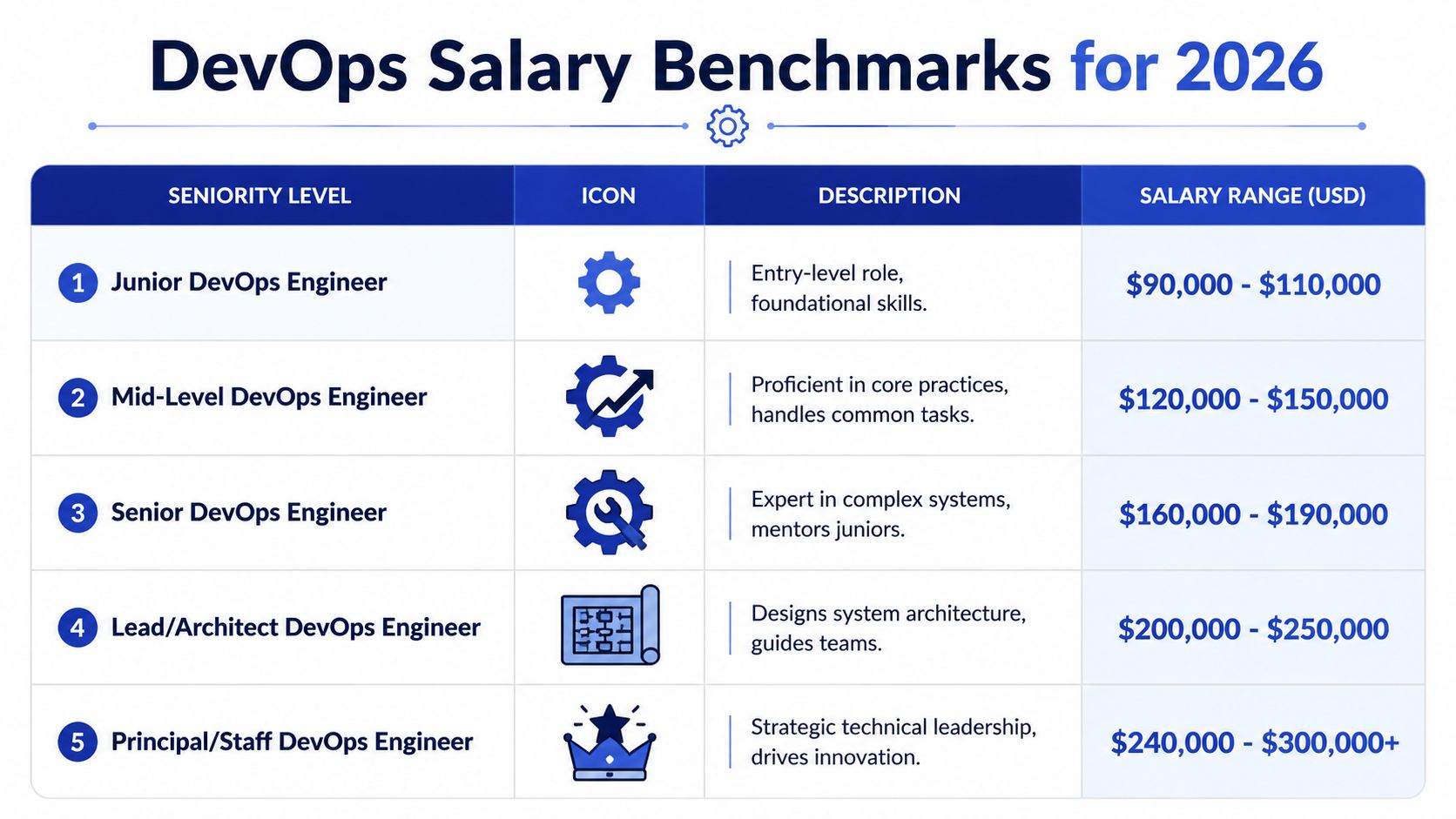
The most useful salary benchmark for 2026 is that DevOps pay has settled into a durable, high-value tier. Motion Recruitment’s 2026 guide places mid-level remote DevOps Engineer roles at $132,408 to $163,684 and senior remote roles at $145,653 to $172,958, while its national figures show mid-level roles at roughly $129,000 to $159,000 and senior roles at about $142,000 to $168,000 (Motion Recruitment DevOps salary guide). Robert Half’s 2026 guide, cited in the same verified data set, frames the broader U.S. market at $118,000 to $173,750, with low, mid, and high bands of $118,000, $145,750, and $173,750.
That matters because it changes how both sides should interpret the role. DevOps isn’t being compensated like a speculative discipline. Employers are paying for a function tied directly to software delivery, platform stability, and cloud operations. Candidates aren’t entering a market that still needs to justify the role’s value.
A practical benchmark table helps frame the discussion:
| Level | National Average Range | High-Cost Hub (SF/NYC) Range |
|---|---|---|
| Mid-level DevOps Engineer | roughly $129,000 to $159,000 | use the higher end of competitive market bands where local competition is strongest |
| Senior DevOps Engineer | about $142,000 to $168,000 | use the upper band when the role includes broad production ownership |
| Broad U.S. market view | $118,000 to $173,750 | often influenced by scope, specialization, and offer structure |
How to read the ranges correctly
These ranges aren’t interchangeable. A senior engineer at the low end of one company’s band may still be underpaid if the role expects incident leadership, infrastructure as code ownership, Kubernetes operations, and mentoring. Conversely, a role labeled “senior” can benchmark closer to mid-market if it’s narrower and heavily standardized.
The cleanest way to interpret devops engineer salary data is to separate title, scope, and operating environment.
- Title is the weakest signal. “DevOps Engineer” can describe a broad platform operator or a narrower CI/CD support function.
- Scope is the strongest signal. Ownership of cloud infrastructure, uptime, and deployment systems usually justifies the upper half of a band.
- Environment changes the band. Remote roles, enterprise roles, and startup roles can all sit in similar ranges, but their cash mix and risk profile differ.
Salary guides are starting points, not pricing engines. The right benchmark is the one that matches the actual work.
For hiring managers, that means salary bands should be written after role design, not before. For candidates, it means the most effective negotiation prep starts with documenting production responsibility, not listing tools in isolation.
Beyond the Base Understanding Total Compensation
Base salary is only one line item
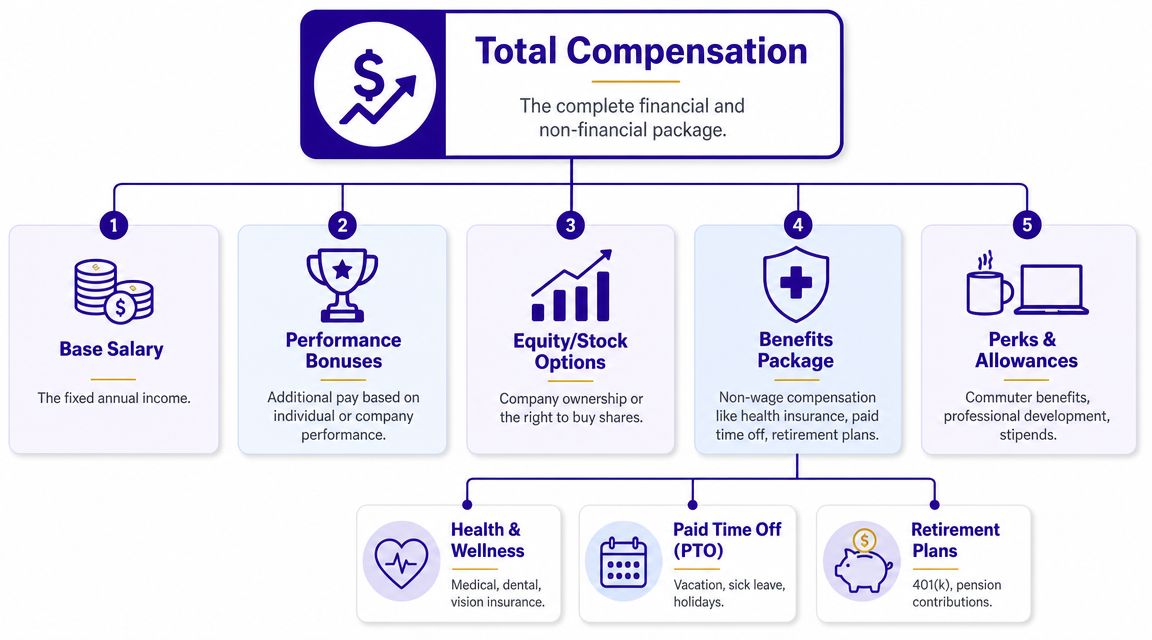
One of the biggest errors in any devops engineer salary discussion is treating base pay as the whole offer. In major U.S. markets, total cash compensation often tells the more accurate story because bonuses and profit sharing can create a material uplift. One industry summary reports a median base salary of $103,994 plus about $28,514 in additional pay, while Coursera reports $139,000 in average base pay and $32,714 in supplemental pay, producing $142,104 in average total annual compensation (Boot.dev DevOps salary analysis).
The arithmetic matters, but the interpretation matters more. A compensation package works like a portfolio. Base salary is the stable core holding. Bonus is variable cash tied to performance or company results. Equity can offer upside, but that upside depends on company trajectory and vesting terms. Benefits and perks affect real quality of life even when they don’t appear in headline salary comparisons.
A candidate comparing two offers should ask what each component is designed to do. A lower base with meaningful upside may fit one risk profile. A stronger fixed number with less variable comp may fit another.
How candidates and employers should evaluate the package
The most disciplined compensation reviews focus on package mechanics, not just the top-line number.
- Base salary anchors predictability. It affects monthly cash flow, future raises, and often bonus calculations.
- Bonuses change the true market position. If a company consistently pays variable cash, the offer may be more competitive than the base suggests.
- Equity needs interpretation. The grant type, vesting schedule, and company stage matter more than broad claims about upside.
- Benefits carry decision weight. Health coverage, retirement support, and paid time off can materially change offer quality.
- Perks influence long-term growth. Training budgets, certification support, and conference access matter in a field where tool depth compounds career value.
A DevOps offer should be compared as a package of cash, upside, and operating conditions. Base alone is too narrow.
For employers, this is operational, not cosmetic. Teams that benchmark only salary often lose candidates to firms that structure a clearer total-comp story. For candidates, the smart move is to rank each offer by certainty, upside, and relevance to career growth.
The Value Drivers Skills That Command Premium Pay

The title matters less than the operating surface area
A useful contrarian point in the salary market is that “DevOps Engineer” often hides more than it reveals. Glassdoor data cited in the verified set places U.S. DevOps Engineer pay at about $139,144 in total compensation, with a typical range of $111,738 to $175,013, while the broader issue is that modern roles are fragmenting into cloud DevOps, platform engineering, SRE, and infrastructure automation (Glassdoor U.S. DevOps salary page). Coursera also cites cloud DevOps engineers at about $128,890 in base pay in the U.S., which reinforces that adjacent specialization can move compensation materially.
That leads to a sharper conclusion. Employers frequently aren’t paying for “DevOps” as a generic label. They’re paying for a combination of cloud depth, platform ownership, reliability responsibility, and automation maturity. Candidates who negotiate from title alone undersell themselves when their work maps more closely to platform engineering or SRE responsibilities.
What actually signals higher value
The strongest pay signals are usually combinations of skills that reduce operational risk and increase delivery speed. In practice, that often means experience with tools such as AWS, Azure, or Google Cloud, plus Terraform, Pulumi, Kubernetes, Docker, and observability platforms such as Datadog, Prometheus, Grafana, or New Relic.
What changes salary isn’t exposure to those tools. It’s ownership.
- A candidate who has used Terraform in a limited support capacity is different from one who has designed reusable infrastructure modules.
- A Kubernetes résumé keyword is weaker than real ownership of cluster operations, upgrade planning, workload reliability, and deployment policy.
- Observability experience matters more when the engineer has built alerting standards, service health views, and incident workflows used across teams.
The better question isn’t “What does a DevOps engineer make?” It’s “Which adjacent discipline is this person already performing?”
For hiring managers, this reframes job design. A role that needs cloud administration, CI/CD, IaC, and production reliability should be priced for broader platform ownership. For candidates, compensation rises fastest when skill development moves from tool familiarity to cross-system accountability.
Market Trends Shaping DevOps Pay
The generic DevOps title is losing precision
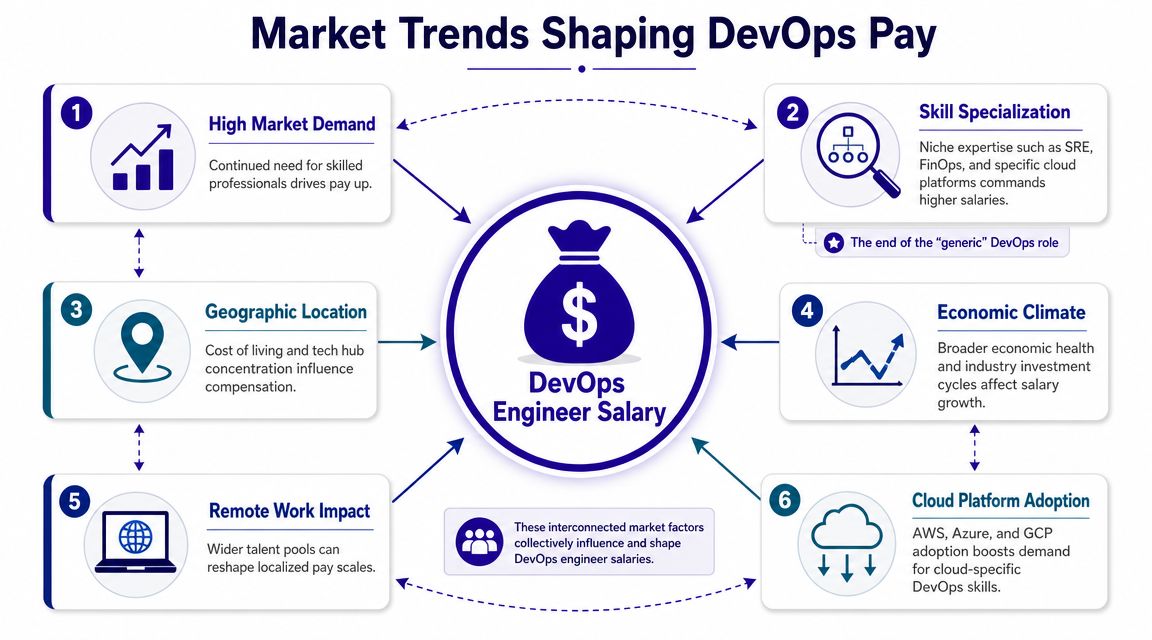
One market shift matters more than most salary pages admit. The generic DevOps title is becoming less precise as companies split work into platform engineering, SRE, cloud infrastructure, and security-oriented automation roles. That fragmentation changes compensation because employers compare candidates against different peer groups depending on the operating model they need.
A platform team building internal developer tooling won’t evaluate candidates the same way as a reliability team focused on availability and incident management. A cloud-heavy environment with strong governance needs may reward one profile. A product-led SaaS company trying to reduce deployment friction may reward another.
This shift also changes salary negotiations. A candidate who says “DevOps engineer” may sound broad. A candidate who can credibly say “platform ownership,” “reliability engineering,” or “cloud automation leadership” sounds aligned to a more valuable business problem.
A practical negotiation framework for candidates
Candidates navigating this market should use a simple sequence when discussing pay.
- Define the actual role. Clarify whether the company needs CI/CD support, platform engineering, SRE-style reliability, or broad cloud operations.
- Map experience to business outcomes. Tie work to uptime, deployment quality, release consistency, developer productivity, or infrastructure control.
- Anchor to scope, not ego. Strong negotiation sounds more credible when it reflects responsibility than when it sounds like title inflation.
- Ask how compensation is structured. That creates room to negotiate base, bonus, and other package elements without forcing a single-number debate too early.
- Confirm the growth path. A role with expanding ownership can outperform a slightly higher offer with static scope.
AIOps and automation tooling are also entering more conversations, but the compensation effect still depends on practical application. Employers usually pay more for engineers who can operationalize automation inside delivery and reliability workflows, not for candidates who merely mention AI tools.
For Candidates How to Negotiate Your DevOps Salary
Lead with business impact, not tool lists
The strongest candidate negotiations don’t sound like certification catalogs. They sound like an amplification of operational effectiveness. A DevOps professional gets more traction when describing how Jenkins, GitHub Actions, Terraform, Kubernetes, Argo CD, or Datadog were used to support a team’s shipping cadence, infrastructure consistency, or incident response discipline.
That’s especially important when the recruiter or hiring manager asks for salary expectations. The answer shouldn’t be a rigid number detached from context. It should connect compensation to the role’s scope, package structure, and level of ownership. Candidates who want a practical prep framework can review Nexus IT Group’s guide on how to negotiate salary with 10 practical tips.
A concise approach works well:
Based on the scope described, especially the cloud infrastructure, CI/CD ownership, and production reliability elements, the candidate is targeting a package aligned with senior market rates and is most interested in the full compensation structure.
That language does two things. It preserves the candidate’s advantage, and it signals that the candidate understands compensation as a package.
Negotiate the package in the right order
Many candidates weaken their position by jumping straight to base salary and stopping there. A better sequence is to establish fit first, then package design, then final economics.
- Start with role clarity. Confirm what systems, tooling, and on-call or reliability expectations are attached to the job.
- Frame value in outcomes. Discuss reduced deployment friction, stronger automation, better platform consistency, or improved production ownership.
- Move to full package review. Ask how the company handles bonus, equity, benefits, flexibility, and development support.
- Use specificity when countering. If the offer is light, point to the mismatch between compensation and the operational breadth required.
- Stay consistent. Candidates who change their rationale between calls lose credibility fast.
Counteroffers should also be handled carefully. If a current employer responds only after a resignation risk appears, the underlying market mismatch may remain. The more durable decision usually comes from comparing scope, trust, growth path, and total package together.
For Employers How to Craft a Competitive Offer
Build the offer around the actual scope
Employers miss strong DevOps candidates when the compensation band is anchored to a title instead of the work. A posting may say “DevOps Engineer,” but the interview process may reveal ownership of cloud cost controls, Kubernetes administration, CI/CD architecture, incident response, security hardening, and cross-team platform standards. That is not a mid-level support role. It is a higher-value infrastructure position, and the offer should be priced that way.
The U.S. Bureau of Labor Statistics projects faster-than-average growth across computer and information technology occupations from 2023 to 2033, a useful signal that hiring pressure is structural rather than short-lived (BLS occupational outlook for computer and IT jobs). Employers should read that correctly. The market does not reward broad DevOps ownership because the title sounds current. It pays more for roles that reduce deployment risk, improve reliability, and support revenue-producing systems.
That changes how a competitive offer should be built.
- Price the responsibilities, not the label. If the role includes platform design, production accountability, or multi-cloud governance, use a salary band aligned to senior infrastructure ownership.
- Specify the environment clearly. Candidates assess compensation against the actual stack. AWS, Azure, GCP, Kubernetes, Terraform, Ansible, Python, Bash, observability tooling, and security expectations all affect market value.
- Define the operating burden. On-call rotations, incident command, weekend maintenance, and compliance work increase the cost of the role and should be reflected in cash compensation or time-off structure.
- Separate build work from support work. Teams often combine automation engineering with reactive operations, then wonder why close rates fall. The blended role usually needs either more pay or narrower scope.
Design the offer as a retention tool
A competitive offer needs to answer a candidate’s main risk question. “Why should I take this job instead of staying where I am or choosing another team?” Base salary matters, but serious candidates also test for decision authority, technical maturity, manager quality, and whether the company understands the function it is hiring.
Strong employers reduce uncertainty early. Show the reporting line. Explain what is already working and what is broken. State whether the engineer will inherit legacy tooling, build a platform from scratch, or stabilize an environment after rapid growth. Those details shape acceptance rates because experienced DevOps professionals know that poorly defined ownership often leads to burnout, not advancement.
Retention starts before day one. Employers that want better offer acceptance and longer tenure should also review practical guidance on retaining DevOps engineers after the hire, because compensation loses value quickly if the role itself is poorly structured.
One final point is operational. For companies filling hard-to-close infrastructure roles, Nexus IT Group can support direct placement, contract staffing, and confidential search across DevOps, SRE, cloud, and adjacent engineering functions. Used well, a specialist recruiting partner helps tighten scope, calibrate compensation bands, and reduce costly resets after weak offers fail.
Conclusion Your Next Move in the DevOps Market
The devops engineer salary story in 2026 isn’t about finding one number. It’s about matching compensation to ownership, specialization, and package design. Candidates who translate technical work into business value negotiate better. Employers who price the actual role, not a vague title, hire faster and retain longer.
Nexus IT Group helps technology employers and experienced engineers with difficult hiring decisions across DevOps, SRE, cloud, and adjacent infrastructure roles. Teams that need sharper compensation benchmarking or candidates exploring their next move can learn more through nexus IT group.