
A cybersecurity team can’t out-interview a broken market. ISC2’s 2024 workforce study reported 5.5 million cybersecurity professionals employed globally, while a 4.8 million worker gap remained unfilled. That means only about 53.5% of the estimated 10.2 million roles needed worldwide were filled, according to StationX’s summary of the ISC2 workforce study. For a CTO, that changes the conversation. The problem isn’t just recruiting effort. The problem is access, validation, and decision speed in a market where strong candidates rarely stay available for long.
That’s why a cybersecurity recruitment agency should be evaluated like a business partner, not a resume vendor. The right firm helps a company decide what it needs, reach talent that won’t apply through a job board, and reduce expensive mistakes in technical screening. The wrong firm adds noise, extends the search, and burns candidate goodwill.
Teams hiring across adjacent deep-tech functions face a similar issue. A company building crypto infrastructure, for example, often needs hiring support that understands protocol engineering and security trade-offs, not just generic software recruiting. That’s the same logic behind this guide to staffing blockchain projects, which shows why specialist talent markets usually punish broad, surface-level recruiting approaches.
For employers reviewing current hiring conditions, Nexus IT Group’s perspective on cybersecurity hiring trends and how to find the right talent for your business is a useful companion to this decision framework.
Table of Contents
- Why Finding Cyber Talent Is Harder Than Ever
- Beyond the Job Board What a Specialized Recruiter Does
- Choosing Your Engagement Model Contingency vs Retained
- Evaluating Agency Expertise Beyond the Pitch
- Measuring What Matters Agency KPIs and SLAs
- Red Flags to Watch For and Key Questions to Ask
- From Transactional Hiring to Strategic Partnership
Why Finding Cyber Talent Is Harder Than Ever
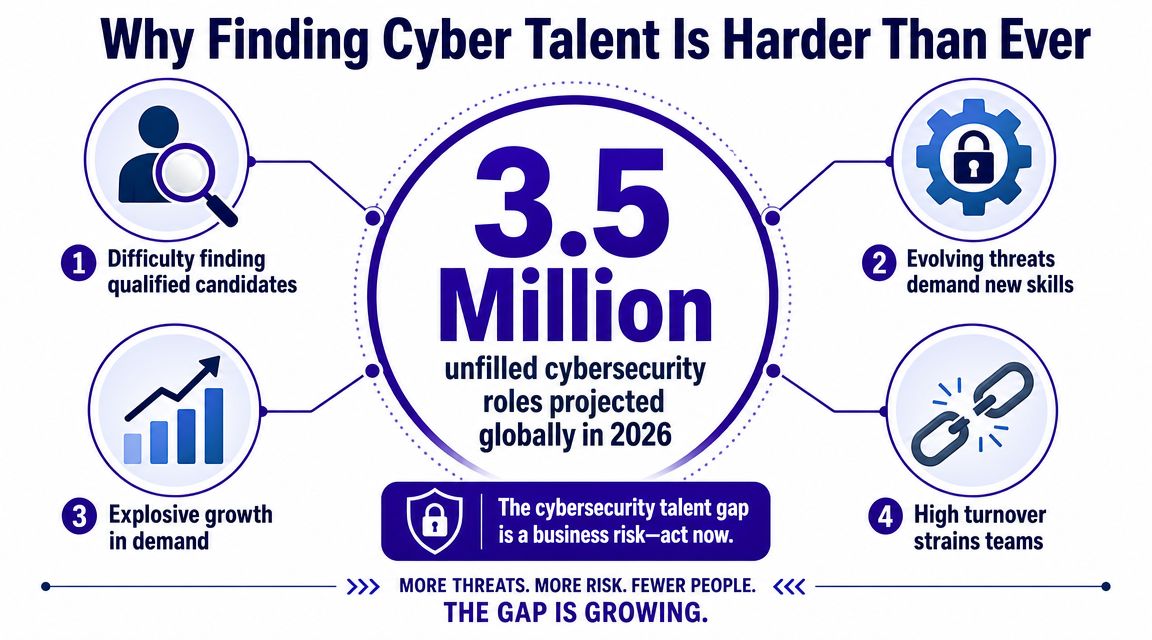
Hundreds of thousands of cyber roles remain open in the U.S., and that headline only explains part of the problem. The harder issue for hiring managers is precision. A company is rarely hiring for “cybersecurity” in the abstract. It is hiring for a narrow risk problem that carries real delivery and business consequences if the match is wrong.
Scarcity hits specialized roles first
The market gets tight fastest at the intersection of depth and context. A security engineer who has worked with cloud posture management is not automatically a fit for an appsec role in a fast-release DevSecOps environment. An incident responder from a lightly regulated SaaS company may struggle in a healthcare setting where auditability and compliance shape every workflow.
That is where searches break. The title looks standard. The success profile is not.
CyberSeek’s live supply-and-demand view continues to show a large volume of open cybersecurity roles in the U.S. market, which keeps pressure on employers trying to close the same capability gaps at the same time. For hiring teams, the implication is straightforward. Speed matters, but specificity matters more. A vague req attracts volume. A clear req attracts the right kind of scrutiny from the right candidates.
This is also why adjacent talent pools can be misleading. A candidate may check the boxes for SIEM, IAM, threat hunting, or cloud security and still miss the actual mandate of the role. The hiring decision is less about keyword overlap and more about whether the person has solved the same class of problem, under similar constraints, with similar stakeholders.
Why internal recruiting alone often stalls
Internal recruiting teams usually run process well. The breakdown happens earlier, in role definition and early-stage qualification.
A common pattern looks like this:
- The req carries too many jobs at once: architecture, engineering, detection, incident response, and compliance end up bundled into one headcount.
- The sourcing funnel fills with plausible profiles: resumes look strong until the interview team tests depth, ownership, and environment fit.
- Security leaders become the first real filter: technical managers spend interview cycles sorting out avoidable mismatches.
- Time-to-fill expands while candidate quality drops: strong candidates exit during recalibration, and the remaining pipeline gets weaker.
I have seen this most often when leadership tries to optimize for cost first. Keeping the search fully internal feels efficient until the CTO, CISO, and senior engineers are each spending hours per week rejecting candidates who never should have reached panel.
That is the trade-off buyers need to assess. A slower, cheaper search is not cheaper if the role protects revenue, audit readiness, customer trust, or engineering velocity. Teams reviewing current cybersecurity hiring trends and talent market pressure points usually find the same thing. Delay has an operating cost.
The lesson applies beyond cyber as well. Any niche technical search gets harder when the market demands domain depth plus business context, which is why even adjacent references like this guide to staffing blockchain projects are useful for buyers comparing specialist talent partners across scarce-skill markets.
A cybersecurity recruitment agency earns its place when it helps a hiring manager make sharper decisions early. Value begins before resumes show up. It starts with narrowing the target, defining trade-offs, and preventing a six-week search from turning into a six-month one.
Beyond the Job Board What a Specialized Recruiter Does
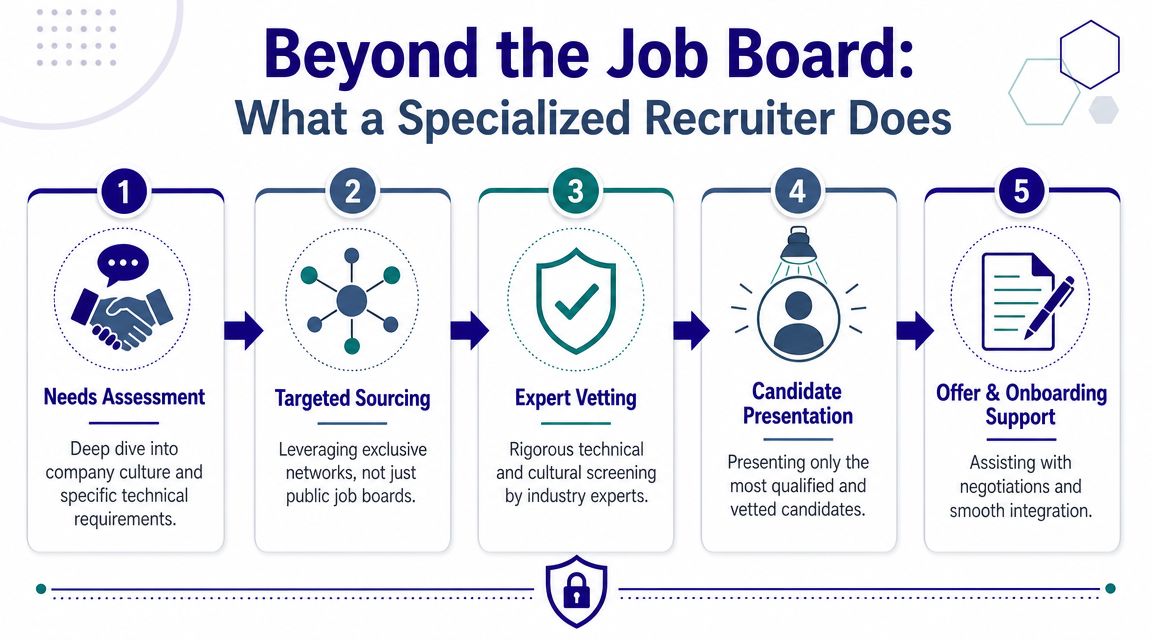
A specialized recruiter doesn’t just search faster. Its primary value is that the recruiter works the full chain from role calibration to technical validation. Job boards can surface interest. They can’t tell a CTO whether a candidate who mentions SIEM, Python, and incident response did meaningful work in those areas.
Access matters more than posting reach
Most strong security candidates aren’t spending their week refreshing job boards. They’re working, fielding recruiter outreach, and evaluating only the opportunities that sound materially better than their current situation. That means a recruiter has to do more than push a listing live.
The process usually starts with market mapping. Which companies employ the right profile? Which adjacent backgrounds could convert? Where is the role too narrow for the compensation band? Good recruiters answer those questions before they send the first outbound message.
For employers comparing sourcing channels, broad boards still have a place. Trackside Careers’ job board guide for engineers is a useful reminder that distribution helps at the top of funnel. It just doesn’t replace specialist qualification when the role is security-critical.
Validation is what justifies the fee
The best agencies screen for substance, not keyword density. According to Right Fit Advisors’ guide to cybersecurity recruitment agencies, specialized recruiters add value by pairing domain-specific screening with role-specific technical validation, using practical tests such as coding challenges or simulated threat-response scenarios to verify that a candidate can do the work.
That matters because cyber resumes are full of overlapping language. “Worked on incident response” can mean led real containment work, or it can mean attended meetings while another team ran the response. “Cloud security” can mean built policy and guardrails, or focused on remediating misconfigurations handed over by someone else.
A specialist recruiter should be able to separate those cases before the interview team gets involved.
Candidate management is part of the product
Security candidates assess the company while the company assesses them. A recruiter who knows the market can accurately describe the role, manage concerns about on-call load, clarify reporting lines, and keep a search from collapsing over preventable confusion.
The best submissions are concise and specific. They explain why this candidate fits this role now, not why the resume looked busy.
That is why a cybersecurity recruitment agency should be measured on access and validation, not just candidate volume.
Choosing Your Engagement Model Contingency vs Retained
The engagement model sets the incentives for the search. For cybersecurity hiring, where searches often run for 3 to 6 months and fee structures commonly range from 15% to 30% for contingency and 25% to 35% for retained, that incentive design affects speed, candidate quality, and how much market coverage you get, as summarized in Gogloby’s cybersecurity recruitment agency analysis.
A hiring manager should treat this as a risk decision first and a pricing decision second.
Contingency works best when the role is clear, the market is broad enough to support fast outreach, and the business can tolerate some variance in candidate quality. A security engineer, SOC analyst, or established GRC role often fits that model. You get quick activity, the option to run multiple firms at once, and no fee unless someone closes the hire. The trade-off is predictable. Agencies spend time where they see the highest chance of placement, so a search with slow feedback, shifting requirements, or internal disagreement will lose priority fast.
Retained search is the better fit when failure is expensive. That usually means leadership hires, confidential replacements, or niche roles where the recruiter needs time to map the market, calibrate the brief, and approach candidates carefully. For a Head of Security, a product security leader, or a senior architect in a regulated environment, the buyer is not just paying for candidate flow. The buyer is paying for search focus, tighter process control, and a partner who will stay engaged through a harder close.
Contingency vs retained search a comparison
| Factor | Contingency Search | Retained Search |
|---|---|---|
| Fee structure | Paid on successful placement | Paid in stages tied to milestones |
| Typical use case | Mid-level, repeatable, or broader searches | Senior, niche, confidential, or business-critical searches |
| Agency attention | Often split across multiple active roles | More dedicated search time and planning |
| Candidate outreach | Faster volume, wider net | More targeted outreach and market mapping |
| Buyer risk | More duplicate submissions and uneven screening | Higher upfront spend and greater reliance on one firm |
| Best internal setup | Fast feedback, stable brief, clear interview process | Strong intake alignment and executive sponsorship |
The practical test is simple. Ask what failure would cost. If an unfilled role delays cloud migration, weakens incident response coverage, or leaves a compliance gap open for another quarter, the cheaper model may be the more expensive decision. If the role is well defined and the team can review candidates quickly, contingency may be the right economic choice.
I usually advise CTOs to choose based on three variables:
- Search difficulty: How small is the qualified talent pool?
- Business impact: What breaks if this role stays open or is filled poorly?
- Process maturity: Can your team run fast, consistent interviews and close decisively?
If all three are high, retained is usually the safer model. If only one is high, contingency can still work. The mistake is using contingency for a hard, high-stakes search and expecting retained-level attention without retained-level commitment.
Evaluating Agency Expertise Beyond the Pitch
Most agencies sound specialized in the first call. The real test is whether they can discuss the role with enough precision to improve the search. If they can't sharpen the brief, they won't sharpen the candidate pool.
Listen for functional fluency
A legitimate specialist should understand the difference between common cyber lanes without turning the intake into a vocabulary game. The recruiter doesn't need to be a practitioner. The recruiter does need to understand enough to probe for the actual work behind the title.
Useful signs include questions like these:
- About scope: Is this person building controls, operating them, or auditing them?
- About environment: Is the role tied to product, internal enterprise security, cloud platform work, or compliance delivery?
- About failure points: What would make this hire unsuccessful after six months?
A weak agency asks for the job description and compensation range. A strong one asks what the team can't do today because this role is missing.
Regulated context separates specialists from generalists
Cybersecurity recruiting gets harder when the company operates in healthcare, finance, government, or another regulated setting. The recruiter should understand why environment matters. A candidate who was excellent in a startup may still be wrong for a company that needs structured documentation, audit readiness, or tightly governed change control.
That doesn't mean recruiters need to act like consultants. It does mean they should understand enough to avoid sending high-skill candidates who will hate the operating model.
A credible partner can explain why a strong candidate might still be wrong for the environment.
Pipeline quality includes community-building ability
An overlooked signal of agency quality is whether the firm thinks beyond poaching. NASCIO's 2024 report, covered by Route Fifty's reporting on cyber training for underserved communities, emphasizes that state leaders should intentionally develop and train cybersecurity officials in underserved communities. That has a direct implication for employers evaluating agencies. The strongest partners don't just recycle the same experienced candidates. They can help build local, inclusive pipelines over time.
That matters for employers with public-sector exposure, regional hiring constraints, or long-term workforce planning goals.
A practical evaluation checklist
Use a scorecard instead of relying on chemistry.
| What to evaluate | What good looks like |
|---|---|
| Cyber role fluency | Can distinguish GRC, detection, AppSec, architecture, IR, and DevSecOps in practical terms |
| Intake quality | Challenges vague requirements and helps tighten the role |
| Industry understanding | Understands regulated environments and why those constraints affect fit |
| Network credibility | Talks about active relationships and talent communities, not just databases |
| Screening approach | Can explain how candidates are qualified before submission |
| Pipeline development | Can discuss inclusive and local talent development, not only direct poaching |
A buyer doesn't need an agency that says the right buzzwords. A buyer needs one that improves decisions.
Measuring What Matters Agency KPIs and SLAs
Most agency relationships drift because the company measures activity instead of progress. “We sent eight resumes” isn't a result. It's a workload report. If the shortlist is off-target, more submissions just create more review time for the hiring team.
KPIs that reflect search quality
Good metrics show whether the agency understands the brief and whether the employer is making clean decisions. Useful KPIs include:
- Time to first qualified slate: Not first resume. First group the hiring manager would seriously interview.
- Submission-to-interview ratio: If too many submissions are being rejected, the intake is off or the screening is weak.
- Interview-to-offer ratio: This shows whether the process is identifying the right people early.
- Offer acceptance rate: Low acceptance usually points to poor candidate calibration, weak employer sell, or slow process control.
- Candidate dropout patterns: If strong candidates disengage mid-process, the employer or agency is creating friction.
These KPIs work because they expose where the search is failing. They also keep both sides honest.
Build the SLA around behavior
A good SLA should define operating rules, not just response promises. The practical pieces usually include:
- Role intake depth: How the brief is gathered, validated, and updated.
- Candidate submission format: What evidence comes with each profile.
- Feedback timing: How quickly interview teams must respond after resumes and interviews.
- Communication rhythm: Weekly search reviews, candidate status updates, and market feedback.
- Escalation path: What happens if the role changes, interviewers go silent, or compensation is misaligned.
Buyer's lens: If the agency can't describe how it wants to be managed, it probably can't manage a complex search well.
Avoid vanity metrics
A CTO should be cautious with metrics that reward noise. Resume count, call count, and outreach volume matter only if they lead to better interviews and accepted offers. Otherwise, they create the illusion of motion.
This is one area where a provider like Nexus IT Group can be assessed on practical terms. It offers cybersecurity recruiting within a broader IT staffing model, so an employer should ask how its team defines qualified candidate delivery, handles feedback loops, and reports progress for hard-to-fill cyber roles. That same standard should apply to any agency under consideration.
Red Flags to Watch For and Key Questions to Ask
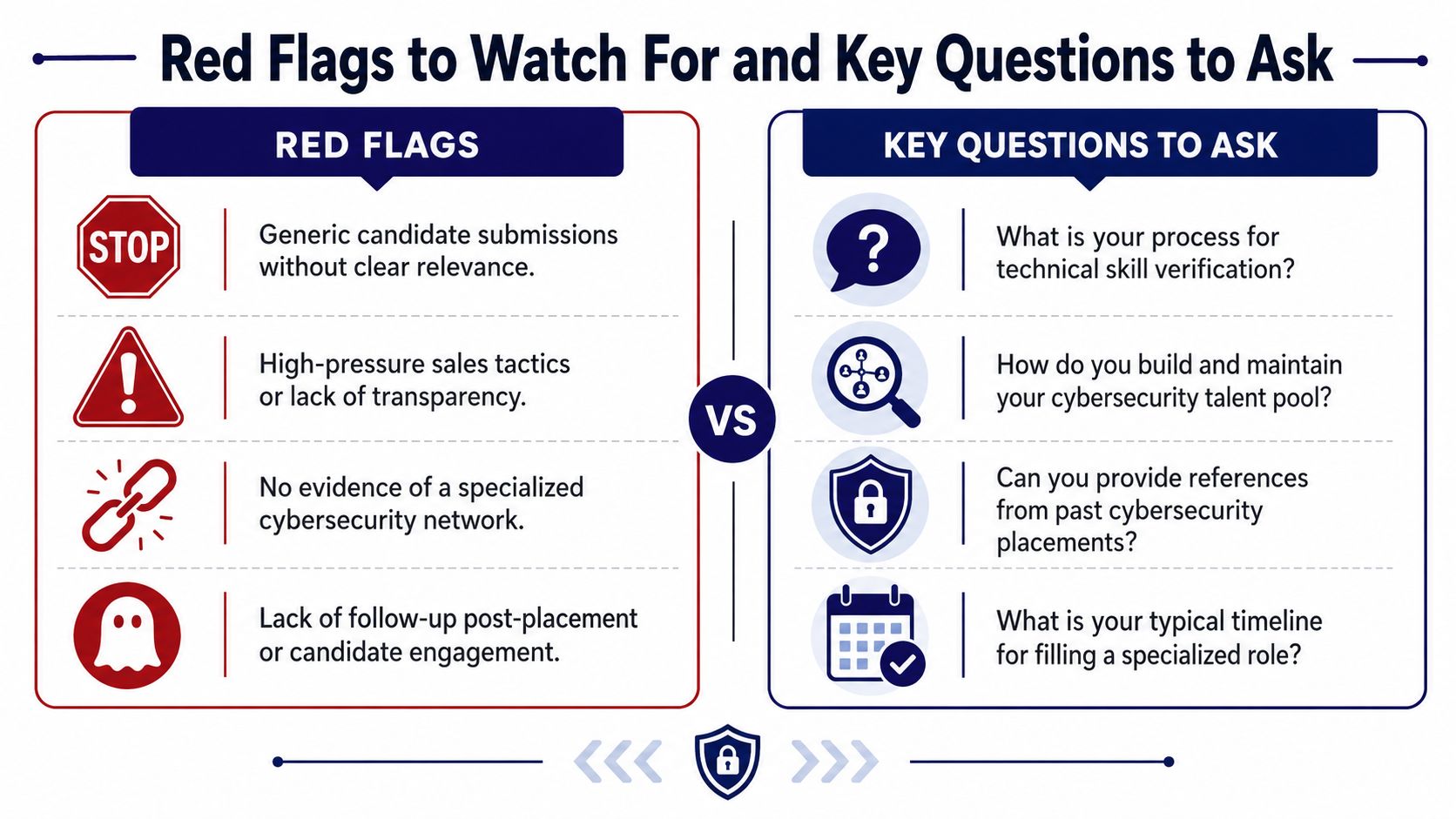
A weak agency usually reveals itself early. The warning signs are rarely dramatic. They show up as shallow intake questions, generic candidate writeups, and a lot of urgency without much substance.
Red flags that should slow the decision
Some problems can be fixed with tighter process. Others are signs to walk away.
- They don't interrogate the role: If the recruiter accepts a vague brief without challenge, the search will likely be vague too.
- Every candidate looks “great on paper”: Strong recruiters explain fit and risk. They don't just forward polished resumes.
- They can't explain screening: If the answer is some version of “we have a strong network,” that's not enough.
- They rely on title matching: Cybersecurity titles are inconsistent across companies. A recruiter who works by title alone will miss and misfire.
- They push speed over precision: Fast is useful. Fast and sloppy burns interview cycles.
- Post-placement support is unclear: Candidate management shouldn't end when the offer letter is signed.
For employers who want another lens on recruiter selection, Nexus IT Group's article on five tips for hiring top cybersecurity recruiters is a practical secondary checklist.
Questions that reveal the real operating model
Ask questions that force specifics.
-
How do you verify technical fit before submission?
A real answer should include structured screening, practical validation, or subject-matter input. -
What does your candidate brief include beyond the resume?
The recruiter should provide context on motivations, compensation position, notice factors, and role-specific strengths. -
How do you prevent duplicate outreach or brand confusion in the market?
This matters if multiple agencies may touch the same candidate pool. -
What would make you push back on this req?
Strong partners challenge bad scopes, unrealistic combinations, and misaligned compensation. -
How do you keep passive candidates engaged through a long interview cycle?
This reveals whether the recruiter manages process or just introduces people.
What strong answers tend to sound like
They sound precise. The recruiter can describe how they screen, what they look for, where searches commonly fail, and how they advise clients when the market won't support the brief as written.
If a recruiter can't clearly describe how a candidate gets from first outreach to final shortlist, the client shouldn't assume the process is rigorous behind the scenes.
A buyer doesn't need perfect certainty before signing. A buyer does need enough evidence to know the agency operates with discipline.
From Transactional Hiring to Strategic Partnership
A cybersecurity recruitment agency is easy to treat like a transactional vendor. Send a req. Review resumes. Pay a fee. That approach usually fails when the role is critically important.
Critical cyber hiring requires sharper decisions than most companies expect. The employer has to define the role with discipline, choose the right engagement model, evaluate agency substance over sales polish, and manage the relationship with clear metrics. Without those pieces, even a capable recruiter will struggle to produce the right result.
The bigger shift is strategic. A strong agency doesn't only help fill one opening. It gives the hiring team live feedback on market reality, candidate expectations, search friction, and role design. That information helps a CTO make better workforce decisions beyond the immediate hire.
The same principle applies after the offer is accepted. The company still has to retain what it worked hard to hire. Employers thinking beyond placement should also review Nexus IT Group's perspective on how to retain top cybersecurity talent, because the best recruiting process can still be undone by weak onboarding, vague scope, or mismatched leadership expectations.
The right partnership lowers risk in three ways. It improves candidate quality. It shortens wasted cycles. It helps the company make clearer decisions earlier. In a scarce market, that combination matters more than finding the cheapest fee arrangement or the fastest inbox full of resumes.
The next critical security hire shouldn't rely on luck, generic sourcing, or overloaded internal bandwidth. nexus IT group supports employers hiring across cybersecurity and other hard-to-fill technology functions with staffing, direct placement, and executive search options that can be evaluated against the same standards outlined here: role clarity, market insight, screening rigor, and accountable process.