Cloud architect salary in the United States typically falls between $124,156 and about $145,771, and top-paying roles can exceed $200,000 when bonuses are included. The central question isn’t whether cloud architects earn strong pay. It’s how candidates move toward the top end of the market, and how employers build offers that close.
That gap between average pay and top-end compensation is where most hiring mistakes happen. Candidates often anchor too low on base salary averages. Employers often assume a market-average base is enough, then lose strong architects to firms that present a better total package.
From a recruiter’s seat, cloud architect compensation only makes sense when the title is treated as a business-critical role rather than a generic infrastructure job. These professionals shape platform design, resilience, migration strategy, governance, cost control, and the handoff between engineering and operations. That’s why the pay spread is wide, and why title alone doesn’t tell the whole story.
This guide takes both sides seriously. It gives candidates a practical framework for pricing their value, and it gives employers a working model for structuring compensation that attracts senior cloud talent without creating internal pay chaos.
Table of Contents
- Understanding the Cloud Architect Salary Opportunity
- 2026 Cloud Architect Salary Benchmarks
- How Location and Company Size Affect Your Pay
- The Levers of Higher Earnings Skills Certifications and Total Comp
- For Candidates A Framework for Salary Negotiation
- For Employers How to Structure a Winning Offer
- Architecting Your Career and Compensation Strategy
Understanding the Cloud Architect Salary Opportunity
The strongest signal in this market is simple. Cloud architect pay is firmly in six-figure territory across major U.S. benchmarks, and that changes how both candidates and employers should approach the role.
For candidates, this isn’t a title to evaluate casually. It usually sits at the intersection of architecture, platform engineering, security, operations, and stakeholder management. For employers, it’s rarely just another requisition. A weak hire in this seat can slow migrations, complicate governance, and create expensive rework across engineering teams.
Why this role commands attention
A cloud architect usually arrives after someone has already built depth in systems, DevOps, infrastructure, or cloud engineering. That matters because the compensation discussion isn’t about paying for theoretical knowledge. It’s about paying for judgment.
A practical way to understand that judgment is to read real role scopes rather than title-only summaries. A standard cloud architect job description shows how often employers expect architectural design, cloud governance, performance planning, and collaboration across technical teams.
Practical rule: When a role combines design authority, platform accountability, and cross-team influence, pay usually tracks business risk more than task volume.
Why average numbers can mislead
The average salary gives a floor for discussion, not the final answer. A candidate with migration leadership experience, multi-cloud exposure, or strong stakeholder communication will often sit in a different compensation conversation than someone whose experience is narrower, even if both hold the same title.
That’s also why niche searches stay active. Employers looking for broader architecture depth often end up reviewing more specialized openings, including multi-cloud architect opportunities that show how some organizations define the role around distributed systems, resilience, and cross-environment design rather than a single-platform implementation focus.
For both sides, the opportunity isn’t just that cloud architects are well paid. It’s that the market rewards clarity. Candidates who can explain business impact negotiate better. Employers who define the role precisely hire faster and with fewer resets.
2026 Cloud Architect Salary Benchmarks
The benchmark data is clear. U.S. cloud architect pay has moved into a durable six-figure band across independent salary references, and experience still acts as the strongest baseline signal.
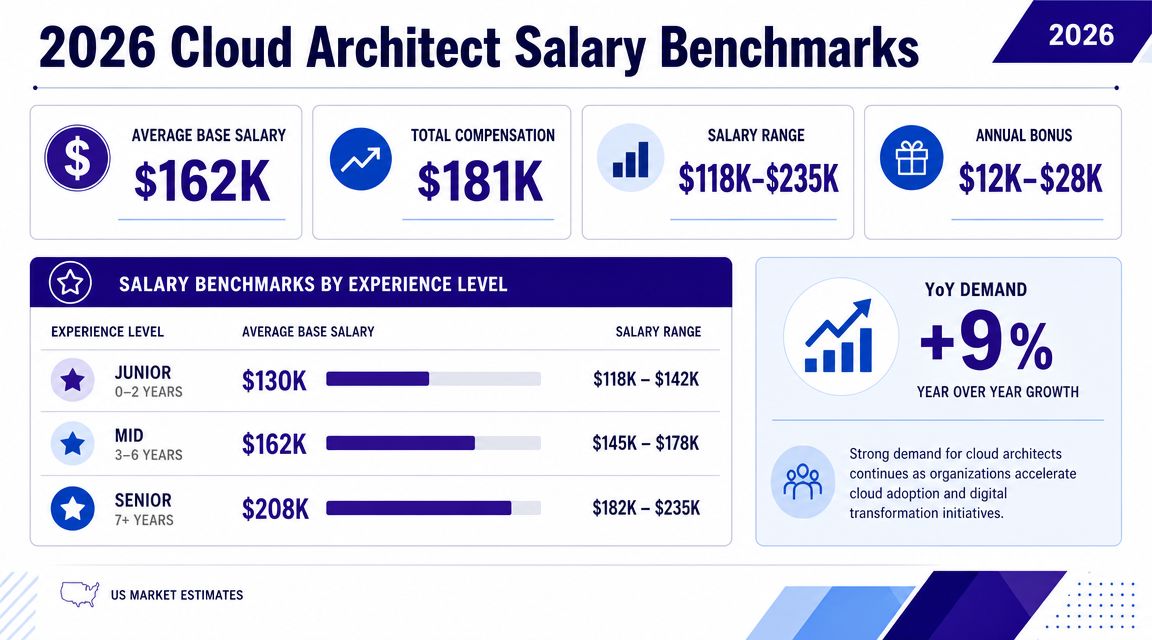
According to Coursera’s cloud architect salary guide, the average salary is about $145,771, while Salary.com reported an average U.S. cloud architect salary of $124,156 as of June 1, 2026, with a typical range of $117,486 to $143,180. Read together, those figures establish a useful market baseline rather than a single “correct” number.
The experience ladder matters
The same Coursera guide shows a progression from $106,930 for 0 to 1 year of experience to $158,029 for 15+ years of experience in cloud architect roles, with the progression described in the source as a clear earnings ladder. This provides a significant recruiting insight because it confirms what most hiring teams see in practice. Cloud architect isn’t usually an entry-level destination.
Candidates often make the mistake of benchmarking themselves only by title. Employers make the opposite mistake by posting “cloud architect” roles that are really senior engineer positions with architecture language layered on top. Both errors distort salary expectations.
What the benchmark should tell candidates
Candidates should treat the published average as a reference point, then adjust for three practical questions:
- Role depth: Is the work architecture-led, or mostly hands-on implementation?
- Decision authority: Does the architect set standards and patterns, or just advise?
- Scope: Is the remit limited to one platform team, or does it span security, networking, DevOps, and application modernization?
A candidate who can answer those questions with concrete examples has a stronger compensation case than one who repeats years of experience.
For a broader market context on adjacent pay bands and hiring patterns, the Nexus IT Group cloud salary guide is useful as a directional reference when comparing cloud roles across an organization.
Cloud architect pay sits high because employers usually buy prior depth, not raw potential.
What the benchmark should tell employers
Employers should use the range as a sanity check, not as a shortcut. If a team needs someone to own migration planning, landing-zone design, cloud governance, and executive communication, a low-band offer will usually attract either underqualified candidates or strong engineers who don’t want architecture accountability.
The smarter move is to benchmark the actual responsibilities first, then align the title and pay band. That reduces candidate confusion and improves close rates because the offer matches the role the business needs.
How Location and Company Size Affect Your Pay
National benchmarks are useful, but actual offers are shaped by labor market reality. Two companies can post the same title and reach very different compensation outcomes because they hire in different talent markets and package the role differently.

Tech hub logic versus distributed hiring
In larger tech hubs, employers usually compete against firms with mature cloud estates, heavier compliance requirements, and deeper architecture layers. That tends to raise expectations around both pay and role complexity. Candidates in those markets often compare multiple offers across enterprise software, finance, healthcare, and regulated environments, so employers need cleaner positioning.
Outside major hubs, the title can be broader. One architect may cover platform design, vendor selection, and mentoring across a smaller team. In those cases, compensation may look different, but the role can offer faster scope growth and more direct visibility to leadership.
A remote-first environment complicates things further. Some companies peg pay to headquarters. Others pay by regional labor market. Others create national bands and accept that they’ll attract a more competitive candidate slate. The important point is that “remote” doesn’t automatically mean “market-neutral.”
Company size changes the structure of pay
The better comparison isn’t just city versus city. It’s company model versus company model.
| Employer type | Typical compensation pattern | Candidate tradeoff |
|---|---|---|
| Startup | Lower guaranteed cash is possible, stronger equity pitch is possible | More upside, more volatility |
| Mid-market company | Balanced base salary, moderate bonus potential | Clearer scope, often leaner teams |
| Large enterprise | More structured salary bands and approval layers | Greater stability, sometimes slower hiring |
| Public company or major tech employer | More layers in total compensation structure | Stronger upside if stock is meaningful |
The same base salary can mean very different things depending on whether the role includes bonus eligibility, equity, promotion path, and internal influence.
How candidates and employers should adjust
Candidates should ask questions that expose compensation structure early:
- Band ownership: Who set the range, finance, HR, or the hiring manager?
- Location policy: Is pay tied to office location, residence, or a national band?
- Growth path: Does the role lead toward principal architecture, enterprise architecture, or platform leadership?
Employers should ask a different set of questions before posting:
- Market comparator: Is the company competing for candidates against local firms, remote-first firms, or both?
- Internal alignment: Will the offer survive approval if a finalist expects more than the initial budget?
- Package design: Is there enough flexibility outside base salary to stay competitive?
A company doesn’t lose cloud architects only on salary. It loses them when the compensation structure doesn’t match the level of responsibility in the role.
The Levers of Higher Earnings Skills Certifications and Total Comp
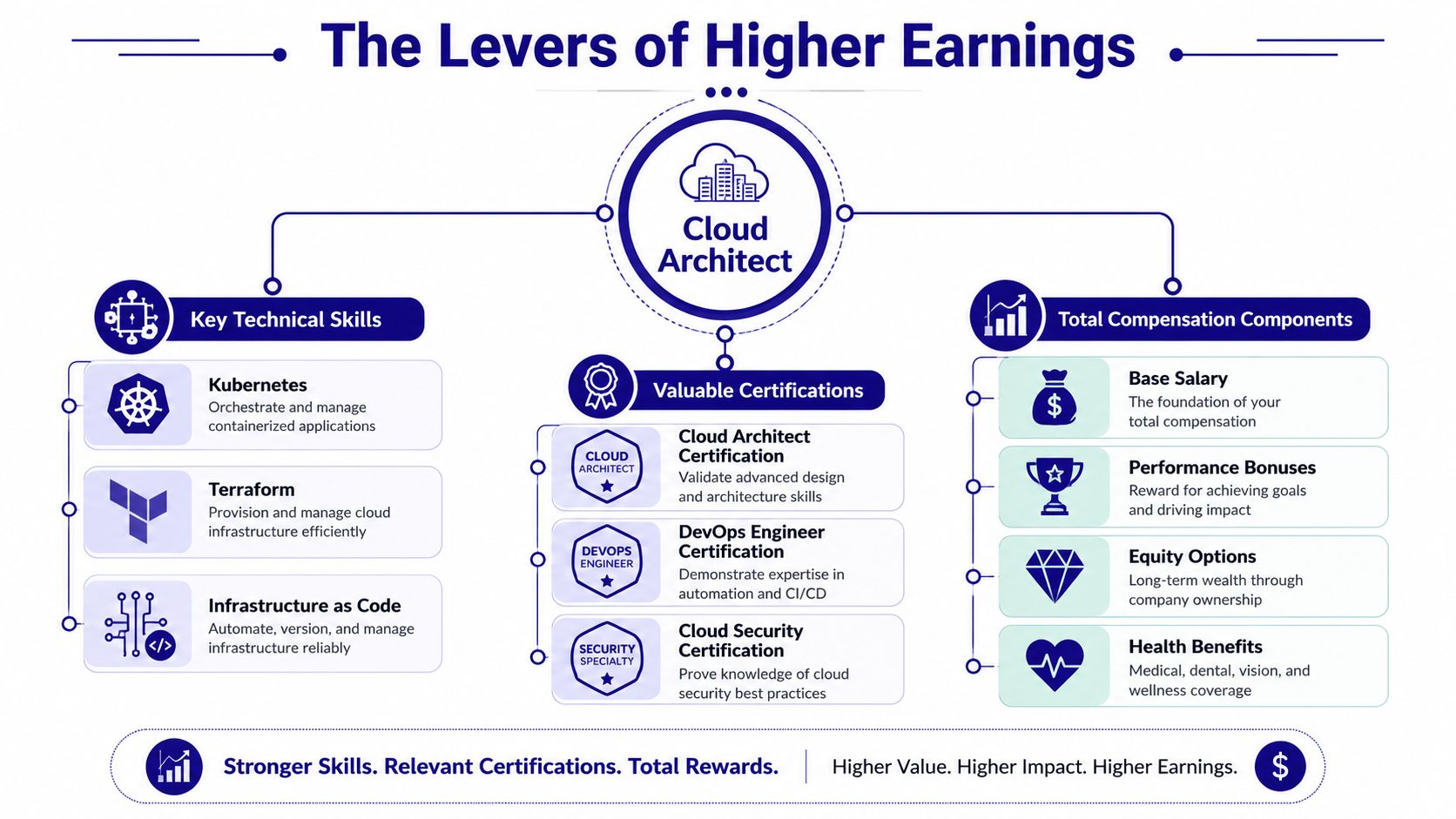
The fastest way to misunderstand cloud architect salary is to focus only on base pay. The highest-value candidates usually win because they combine technical breadth, architectural judgment, and an informed view of total compensation.
Skills that change the conversation
Hiring managers don’t stretch compensation for a long keyword list. They stretch it for combinations that reduce delivery risk. In this market, that often means strong command of AWS, Azure, or Google Cloud paired with architecture decisions around Kubernetes, Terraform, infrastructure as code, security design, and migration sequencing.
The premium comes from integration, not isolated tools. A candidate who can connect identity, networking, cost governance, CI/CD, observability, and recovery design is easier to justify at the high end of a range than someone who knows one platform thoroughly but can’t operate across functions.
Useful differentiators often include:
- Multi-platform fluency: Employers value architects who can evaluate tradeoffs instead of forcing every design into one vendor pattern.
- Cloud security judgment: Knowledge of segmentation, access control, and compliance design often carries more weight than another generic platform project.
- FinOps awareness: Teams want architects who understand that elegant design still has to survive budget scrutiny.
- Communication under pressure: Architecture leaders who can explain decisions to engineering, security, finance, and executives tend to command stronger offers.
Certifications help when they validate depth
Certifications are most valuable when they confirm real delivery experience. AWS Solutions Architect, Azure architecture credentials, Google Cloud Professional Cloud Architect, and security-oriented certifications can all support a compensation case if the candidate can translate them into architecture outcomes.
Employers shouldn’t over-index on badges alone. Candidates shouldn’t assume certifications substitute for project ownership. The market usually treats them as evidence, not proof.
Total compensation is where top offers separate
The most overlooked pay lever is total compensation. According to Fortune’s analysis of cloud architect salary, some cloud architect roles can exceed $200,000 with bonuses, a posted Salesforce cloud architect role in Washington reaches up to $266,300, and Levels.fyi reports a median cloud architect total compensation of $220,000. Against a Salary.com average base salary of $124,156 cited in the same discussion, the difference is large enough to change how any serious candidate should evaluate an offer.
That gap matters because two offers with similar base salary can produce very different financial outcomes.
Compensation lens: Base salary answers “What’s guaranteed?” Total compensation answers “What is this role actually worth if the company delivers on its package?”
A practical review of total comp should include:
-
Base salary
This is the stability anchor. It matters most when comparing risk across employers. -
Annual bonus
Candidates should ask how bonus targets are set, measured, and historically paid. -
Equity or stock
This can be meaningful, especially in large tech or high-growth environments, but it shouldn’t be treated as cash equivalent without understanding vesting and liquidity. -
Benefits and development support
Certification budgets, conference access, and education support won’t replace salary, but they can strengthen a package and accelerate future earning power.
For employers, this section carries a warning. If the company can’t lead on base salary, it must communicate the rest of the package with precision. Vague promises about upside rarely close strong cloud architects.
For Candidates A Framework for Salary Negotiation
Compensation gaps in cloud architecture are wide enough that a loosely handled negotiation can cost a candidate far more than a standard annual raise would recover. The candidates who perform best usually treat negotiation as a benchmarking exercise tied to scope, level, and total compensation.

Build your case before the first number is discussed
Hiring teams pay more when the value case is specific. A cloud architect should be able to explain not just what tools they used, but what business problem they solved, what decisions they owned, and how much complexity sat inside the role.
A strong negotiation brief usually covers four points:
- Architecture authority: Which design decisions were yours, and which required approval?
- Delivery complexity: Did you lead a migration, set standards for a hybrid estate, or work inside a regulated environment?
- Technical judgment: How did you use Terraform, Kubernetes, IAM, networking, or observability to shape the target state?
- Business effect: Did your work reduce risk, improve reliability, lower cloud waste, or speed up delivery?
This level of detail matters because employers do not price “cloud architect” as a generic title. They price a defined problem set.
Present a compensation range tied to role scope
A single number often narrows the discussion too early. A range works better because it leaves room to adjust based on title, reporting line, variable pay, and equity.
The strongest version is evidence-based. State that your target range reflects the role’s architecture scope, the level of decision-making authority, and the market rate for similar positions. That framing keeps the discussion commercial rather than personal.
Candidates who want help with phrasing can use these salary negotiation tips and scripts alongside their own market research.
Ask questions that uncover negotiating room
Strong candidates diagnose an offer before they respond to it. That means asking questions that show how the package was built and where flexibility may exist.
Useful questions include:
- How is the role leveled internally against other architecture positions?
- Where does this offer sit inside the salary band?
- What percentage of total compensation is fixed versus performance-based?
- Which components have the most approval flexibility: base, sign-on, bonus, equity, or title?
- What outcomes would support a compensation review after six or twelve months?
These questions do more than surface options. They signal that the candidate understands compensation mechanics at a senior level.
Evaluate the full package, not just base salary
Base salary carries obvious weight, but many cloud architect offers become meaningfully better or worse once the rest of the package is examined. In these instances, candidates and employers often misread each other. A company may have limited room on salary but more room on sign-on, equity, title, remote structure, or review timing. A candidate may reject an offer that looks average on base even though the total package is above market.
Use a simple review table before responding:
| Component | What to verify |
|---|---|
| Base salary | Is the offer near the bottom, midpoint, or top of the band? |
| Bonus | How is it calculated, and how often is target actually paid? |
| Equity | What is the vesting schedule, and is there any refresh policy? |
| Title and level | Does the level match the scope and internal peer group? |
| Review timing | Is there a defined salary review after probation or major delivery milestones? |
| Benefits | Are certification budgets, training support, and remote-work terms clearly defined? |
For employers, this is also a signal. Candidates who ask these questions are usually evaluating long-term fit, not just trying to push base salary upward.
A response script that keeps the discussion professional
The best reply is calm, specific, and easy for the recruiter or hiring manager to take back internally.
I'm very interested in the role and the scope looks aligned with my background. Based on the level of architecture responsibility, the complexity of the environment, and the overall compensation structure, I'd like to discuss whether there is room to improve the offer in the areas that matter most.
That wording works because it keeps the conversation tied to business value and package design. It also gives the employer clear room to adjust more than one component, which often produces a better outcome than focusing on salary alone.
For Employers How to Structure a Winning Offer
Hiring a strong cloud architect usually fails long before offer stage. It fails when the company under-defines the role, under-scopes the compensation discussion, or waits too long to align finance, HR, and the hiring manager.
Start with role design, not salary data
The title “cloud architect” covers too much ground to benchmark in the abstract. One company needs a migration strategist with governance authority. Another needs a hands-on platform architect embedded with DevOps. Another needs a stakeholder-facing design lead who can translate technical tradeoffs to executives.
Those are different jobs. If employers skip that distinction, they create one of two problems. The offer is too low for the full scope, or the job attracts candidates whose background doesn't match what the business needs.
A better intake process asks:
- Decision scope: Will this person set standards or just recommend them?
- Technical breadth: Is this multi-cloud, single-platform, or hybrid?
- Org placement: Does the role sit in infrastructure, engineering, security, or enterprise architecture?
- Influence level: Will the hire work mainly with engineers, or regularly with directors and executives too?
Build an offer around certainty and clarity
Cloud architects evaluate employers the same way employers evaluate them. They want to know whether the company understands the role, whether leadership is aligned, and whether the package is coherent.
The strongest offers usually share three traits:
-
A credible salary band
The band should reflect the actual level of responsibility, not the lowest number the company hopes might work. -
Transparent total compensation
If bonus, stock, or long-term incentives matter, spell them out clearly. Don't rely on vague upside language. -
A convincing mandate
Strong architects care about what they'll own. If the role lacks decision authority, the employer needs another reason to make the job compelling.
Employers win more often when they present compensation as part of a clear operating model, not as a disconnected HR figure.
A practical job description template
A posting for this role should be explicit enough to attract aligned candidates and narrow enough to avoid title inflation.
Suggested salary-range language
- Role summary: Seeking a cloud architect to lead architecture decisions across cloud infrastructure, platform standards, and modernization initiatives.
- Core scope: Owns design patterns, governance input, scalability planning, and collaboration across engineering, security, and operations.
- Candidate profile: Prior experience in cloud engineering, infrastructure, DevOps, or systems architecture with a record of making production design decisions.
- Compensation note: Base salary is one part of the package. Bonus eligibility, equity where applicable, and professional development support are also included in total compensation review.
That format helps candidates self-qualify. It also reduces late-stage surprises because the package is framed transparently.
Where employers usually lose finalists
Most lost finalists can be traced to one of these patterns:
| Hiring mistake | What the candidate hears |
|---|---|
| Range is too low for scope | “This company doesn’t understand the role.” |
| Bonus or equity is vague | “The upside is probably overstated.” |
| Internal leveling is unclear | “There may be title compression or promotion risk.” |
| Process takes too long | “Leadership may not be aligned.” |
Employers don't need to outspend every competitor. They do need to remove ambiguity. Senior cloud candidates usually respond well to precise ranges, realistic timelines, and hiring managers who can explain why the role matters.
The practical takeaway is simple. When the business needs architecture leadership, the offer has to communicate more than compensation. It has to communicate seriousness.
Architecting Your Career and Compensation Strategy
Cloud architect compensation stays high because these roles influence cost control, security posture, platform reliability, and the speed of future delivery. That combination changes how both sides should approach the market.
For candidates, stronger pay usually follows stronger evidence. Hiring teams pay more readily when they can see architectural decisions tied to business outcomes such as migration success, lower cloud spend, reduced incident exposure, or cleaner governance across teams. Career positioning also matters. Technical depth is easier to price when it is presented clearly, and curated personal branding resources can help translate complex project work into a marketable profile.
For employers, compensation strategy starts earlier than the offer stage. It begins with a clear mandate for the role, realistic scope, and a level that matches the decisions the architect will own. A company that prices the role as an individual contributor but expects enterprise-wide standards, cross-functional influence, and platform direction will usually miss the market and lose qualified finalists.
The practical conclusion is straightforward. Candidates should build a case around measurable architecture impact and negotiate the full package, not just salary. Employers should define scope precisely, align pay to that scope, and present the offer with enough detail to reduce uncertainty. Nexus IT Group supports both sides of that process across cloud, DevOps, cybersecurity, AI, and related technology leadership hiring.