
The most common advice about attracting candidates is still too narrow. Raise the salary, polish the title, add a few perks, and the right people will say yes. That playbook still matters, but it no longer explains what candidates are seeking when they compare serious opportunities.
Candidates are screening for something deeper. They want to know whether the job fits their life, whether the team communicates clearly, and whether support exists when work gets hard. Salary gets them into the conversation. Trust determines whether they stay in it.
Table of Contents
- The Great Re-evaluation of Work
- The New Hierarchy of Candidate Needs
- Translating Priorities into Credible Promises
- Showcase Your Culture with Employee Stories
- Adapting Your Offer for Different Roles and Seniorities
- Redesign Your Hiring Process to Prove You Mean It
The Great Re-evaluation of Work
Compensation hasn’t stopped mattering. It has become baseline. Once a role clears that bar, candidates start judging the parts employers often describe poorly: manager quality, pace, flexibility, communication, and whether support is real or just branding.
Broader recruitment ecosystems increasingly emphasize guided, supportive pathways into roles rather than purely transactional applications, which points to a trust problem between company messaging and candidate reality, as noted by Run for Something. Candidates aren’t only looking for higher pay. They want clearer role fit, faster feedback, and proof that the lived culture matches the marketed one.

A hiring manager can see this shift in candidate behavior. The strongest candidates ask sharper questions earlier. They want to know how decisions get made, how remote collaboration works, who helps new hires ramp, and what happens when workload spikes. Those questions aren’t soft. They’re risk management.
The old pitch breaks down fast
“Great culture,” “competitive compensation,” and “flexible environment” are too vague to carry weight anymore. Candidates hear those phrases from every employer. If the recruiter can’t explain what those words mean inside a specific team, the message feels scripted.
That matters because support is no longer separate from retention. Teams trying to improve hiring outcomes usually need the same systems that matter for boosting employee engagement: visible manager support, employee voice, and routines that make belonging tangible rather than implied.
Practical rule: If a recruiter can’t explain how flexibility works on Tuesday afternoon, candidates won’t trust the claim on Friday morning.
Candidates are reading for signals, not slogans
Working parents read a job ad differently than a new graduate. A caregiver looks for schedule control. A remote worker looks for documentation, not just Zoom-heavy language. A candidate returning to work looks for proof that ramp-up support exists and that career gaps won’t be treated as a character flaw.
The mistake many companies make is treating those concerns as objections to overcome. They’re not objections. They’re part of what candidates are seeking when they decide whether an offer is sustainable.
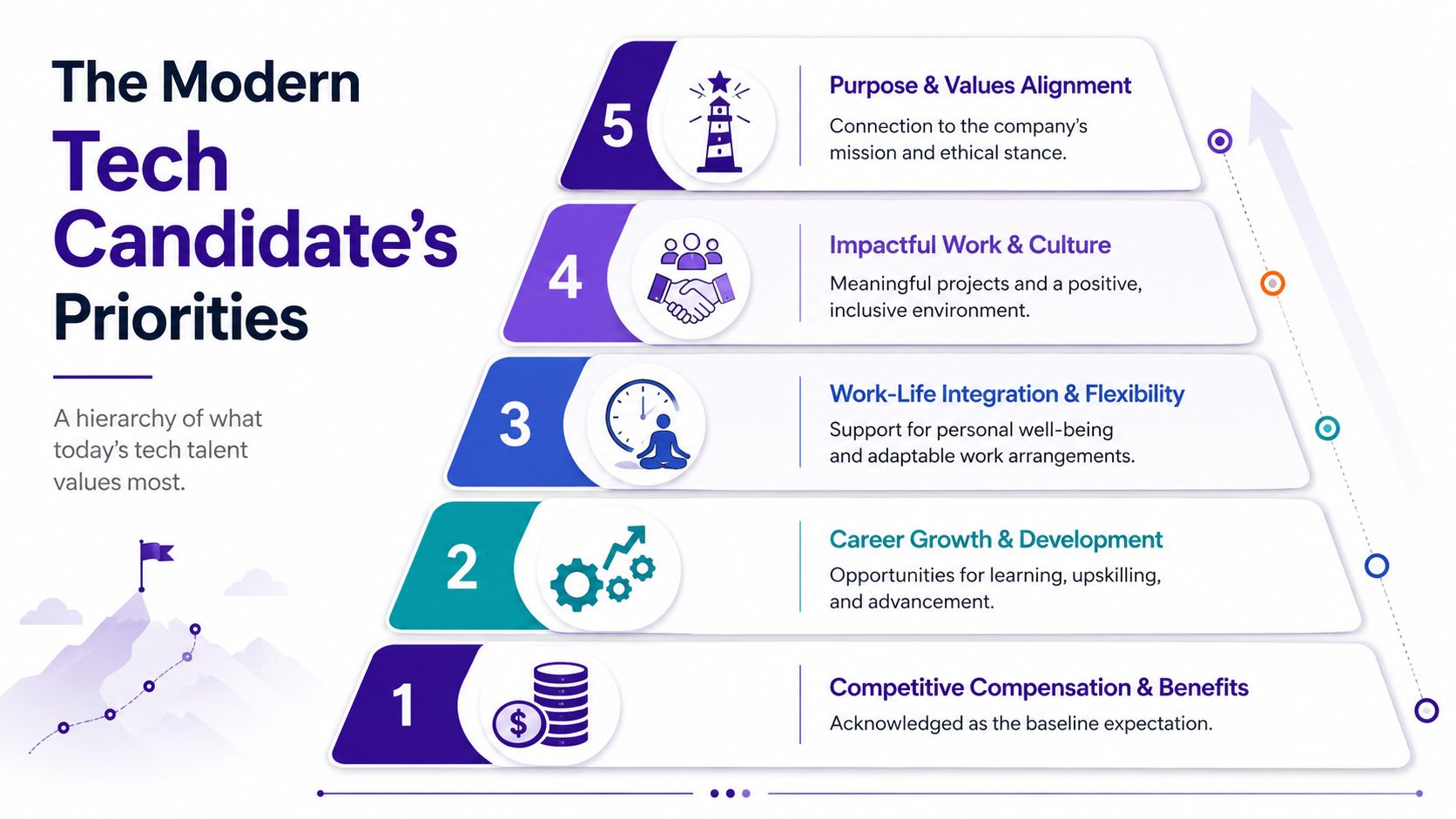
The New Hierarchy of Candidate Needs
The phrase “supportive culture” sounds nice and says almost nothing. Candidates translate it into practical questions: Can they ask for help without being punished? Can they shape how work gets done? Will the team make room for life outside work when real constraints show up?
Support has become a decision factor
The demand for support reflects lived constraints, especially for underrepresented candidates who may face structural barriers before their careers fully begin, as discussed in Rewire News Group’s reporting on the barriers candidates face. That lens applies in hiring just as much as in public life. People want evidence that an employer understands constraints, not just credentials.
Many hiring teams misread the market. They assume support is a “nice to have” after compensation and scope are settled. For a lot of candidates, support changes whether the opportunity is workable at all.
A useful reference point for employers refining that environment is this roundup of top employee engagement strategies for 2026, because it pushes past perks and into systems that shape daily experience.
What support looks like in practice
Support usually shows up in five forms.
- Flexibility with boundaries: Not vague talk about work-life balance. Candidates want to know who controls the calendar, which meetings are fixed, and when focus time is protected.
- Belonging through community: Employee resource groups, peer networks, and team rituals matter when they are active and visible, not buried in a benefits deck.
- Psychological safety in the work itself: Candidates listen for whether people can question assumptions, admit mistakes, and raise risks without getting tagged as difficult.
- Employee voice: Strong candidates care whether teams can influence policy, process, or tooling, especially when a company says it values inclusion.
- Manager access and support systems: Onboarding buddies, skip-levels, documented expectations, and regular check-ins tell candidates more than polished values statements.
For hiring managers that want a direct view into recruiter-side expectations, this breakdown of what job seekers expect from recruiters is useful because it shows how candidates experience communication gaps in real time.
Support isn’t an abstract benefit. It’s the difference between a role that looks good on paper and a role someone can actually sustain.
The hierarchy matters because candidates don’t evaluate each factor in isolation. They stack them. A strong salary cannot fully offset a manager who seems unavailable, a process that feels chaotic, or a team that cannot explain how people succeed there.
Translating Priorities into Credible Promises
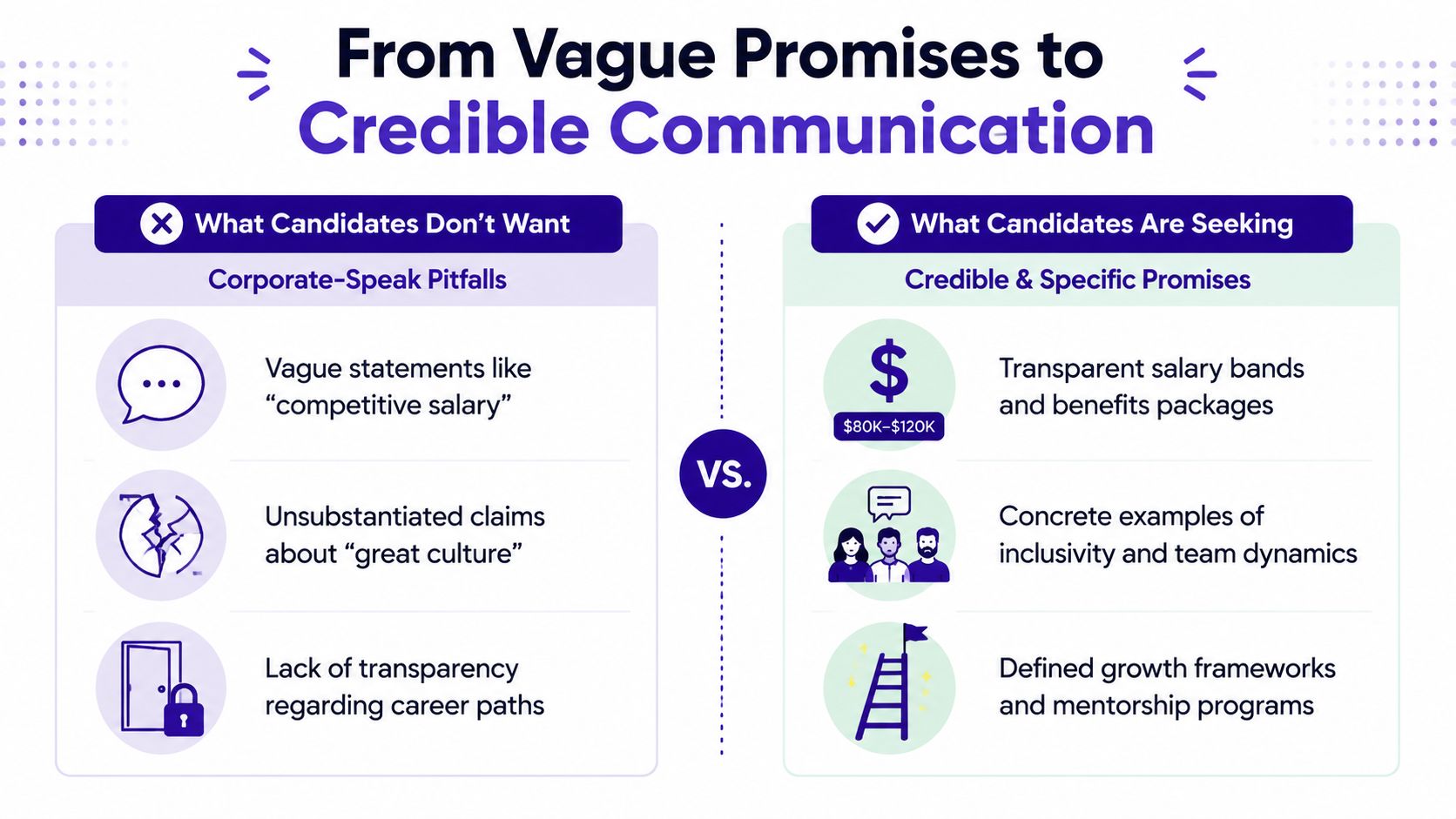
The biggest communication problem in recruiting isn’t lack of effort. It’s low-trust language. Employers often know they offer decent flexibility, reasonable support, and solid growth, but they describe all of it in phrases so broad that candidates discount them immediately.
Why vague language fails
“Flexible hours” can mean freedom or confusion. “Collaborative culture” can mean shared ownership or nonstop meetings. “Great parental benefits” can mean meaningful support or a policy nobody feels safe using.
Candidates trust specifics because specifics can be tested. Recruiters should write and speak in a way that lets a candidate imagine the actual job, the actual manager, and the actual support around them.
A useful discipline is simple: replace adjectives with operating detail.
Better recruiting advice: If a claim can’t be pictured, it won’t be believed.
From Corporate Speak to Credible Proof
| Instead Of This (Generic & Low-Trust) | Say This Instead (Specific & High-Trust) |
|---|---|
| We offer flexible hours | Most of the team works asynchronously, and managers expect calendar blocking for uninterrupted work |
| We have great parental benefits | The company has an active caregiver community, and employee feedback has shaped policy changes |
| We care about growth | New hires get a defined ramp plan, regular manager check-ins, and access to mentorship |
| We value collaboration | Engineers document decisions, demos are open to partner teams, and questions are expected in review meetings |
| We support remote work | Teams use written updates, recorded knowledge sharing, and clear response-time norms so remote employees aren’t disadvantaged |
| We have an inclusive culture | Employee communities are active, leaders participate, and candidates can meet team members who can describe the experience directly |
A recruiter can also tighten outbound messaging with short proof statements like these:
- For flexibility: “The team uses async updates for routine status sharing, so meetings are used for decisions, not narration.”
- For employee voice: “Employees can raise workflow issues in retrospectives, and managers are expected to close the loop on changes.”
- For belonging: “Candidates can speak with team members involved in internal communities before final interviews.”
- For support: “New hires are paired with a peer contact during onboarding, not left to figure out tools and norms alone.”
This is one of the few areas where process discipline matters as much as messaging. A staffing partner such as nexus IT group can help translate role requirements into candidate-facing language during search, but the hiring team still has to supply the proof. No recruiter can invent credibility that the team itself can’t demonstrate.
Showcase Your Culture with Employee Stories
Candidates trust employees more than brand copy because employees reveal texture. They mention what meetings feel like, how escalation works, whether a manager gives room to think, and what happened when they needed support. That kind of detail is hard to fake and easy to believe.
What candidates believe
A polished careers page can introduce the company. It rarely closes the trust gap. Candidates want to hear from people doing the work now, especially people who can speak plainly about onboarding, collaboration, flexibility, and trade-offs.
The strongest stories are low-production and specific. A short day-in-the-life clip from a remote engineer. A candid account from a caregiver on how meeting schedules work. A product manager explaining how feedback moves upward. Those assets don’t need a studio. They need honesty.
How to bring employee voice in earlier
Hiring teams don’t have to build a huge employer brand machine to do this well. They can insert real employee perspective into the process in practical ways.
- Use short employee clips in outreach: A recruiter email with a short video from the hiring manager or a team member feels more credible than a polished paragraph about culture.
- Add AMA sessions before final rounds: Let candidates ask team members about workload, decision-making, documentation, and onboarding.
- Introduce the onboarding buddy early: If the role uses a buddy system, let the candidate meet that person before accepting.
- Embed quotes in job descriptions carefully: Keep them concrete. “My manager gives written context before changing priorities” says more than “Leadership is supportive.”
- Offer team exposure beyond the manager: Candidates often decide based on peers as much as leaders.
A practical guide to this broader challenge appears in ways to make a company attractive to prospective IT professionals, especially for employers trying to make their culture visible without overselling it.
Candidates don’t need a flawless story. They need a believable one.
One caution matters here. Employee stories should include trade-offs. If a team moves fast, say that, then explain what support exists around the pace. If the environment is highly autonomous, say that, then explain how new hires get context. Credibility rises when the company stops sounding like a brochure.
Adapting Your Offer for Different Roles and Seniorities
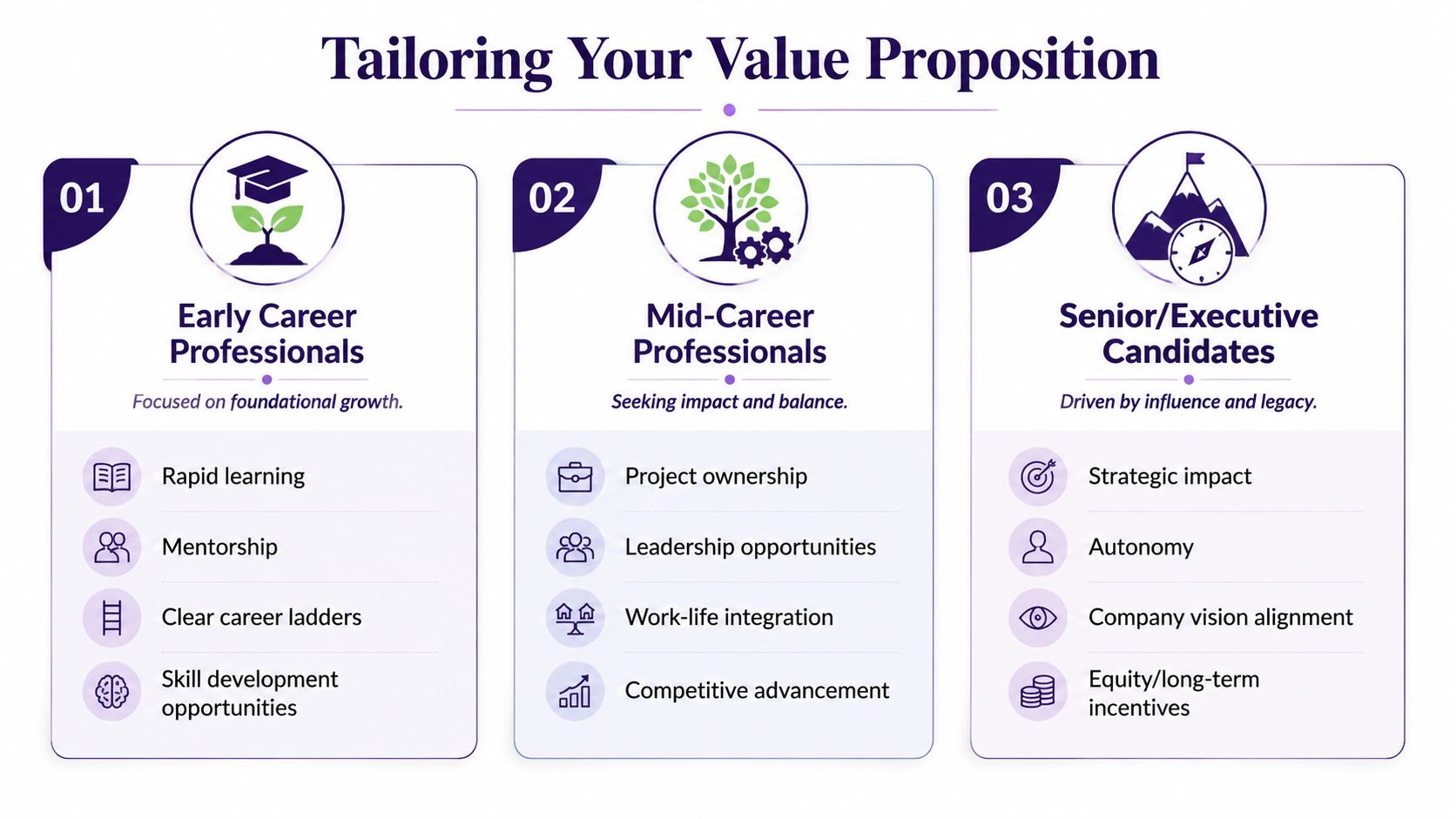
Candidate priorities aren’t uniform. The same pitch won’t land with a junior analyst, a staff engineer, and a VP of data. Good recruiters calibrate the message to career stage, family context, and the scarcity of the underlying skill set.
For data-analytic roles, employers are converging on a stacked technical profile. SQL appears in 52.9% of postings, Python in 31.2%, and R in 24.9%, according to 365 Data Science’s analysis of the data analyst job market. Candidates with those in-demand skills know they have options, which makes non-compensation factors more visible during the hiring process.
Early career candidates want traction
Junior candidates often care less about abstract mission statements and more about whether they will learn fast without being set up to fail. They look for clear ramp plans, modern tooling, access to mentors, and a manager who won’t disappear after week one.
A good pitch for this group highlights:
- Learning exposure: Which tools, systems, and workflows they will touch.
- Feedback rhythm: How often they will get coaching.
- Career clarity: What progression looks like beyond the first role.
Mid-career candidates test sustainability
This group usually presses harder on practical fit. They may be balancing family logistics, team leadership, or a desire to grow without burning out. They often want ownership, but not chaos disguised as autonomy.
The message should answer questions like these:
| Candidate concern | Stronger employer response |
|---|---|
| Can this schedule work with real life? | Explain meeting norms, remote expectations, and how flexibility is handled by the team |
| Will growth require constant overextension? | Show how promotion, scope, and visibility are earned |
| Will the manager create clarity? | Describe decision rights, communication cadence, and prioritization habits |
Senior candidates evaluate scope and operating reality
Executives and senior technical leaders don't just assess the role. They assess the organization's honesty. They want to know whether leadership alignment exists, what constraints are real, where authority starts and stops, and whether they will have support to execute.
For this group, vague culture language is especially costly. Senior candidates want direct discussion of:
- Strategic influence: Which decisions they will own.
- Organizational friction: What is currently hard.
- Team readiness: Whether the team can absorb change.
- Longer-term alignment: Why the company is making this hire now.
What candidates are seeking at this level is rarely comfort. It's clarity.
Redesign Your Hiring Process to Prove You Mean It
A company can say it values people, flexibility, and transparency. The hiring process tests whether any of that is true. Candidates treat every step as evidence: how quickly the recruiter replies, whether the interview panel is prepared, whether expectations are clear, and whether anyone respects their time.
Employers increasingly use predictive, multi-signal screening to rank candidates, but candidates are evaluating the experience of that process at the same time, as explained in Pierpoint's discussion of data analytics in recruiting. If the process feels slow, opaque, or transactional, candidates infer that the culture works the same way.
The process is the message
Many teams lose strong candidates they could have hired. Not because the offer was weak, but because the journey felt careless. A delayed follow-up suggests indecision. An interviewer who hasn't read the resume signals disrespect. A surprise assessment signals disorganization.
Candidates don't separate process from culture. They use process to predict culture.
A practical redesign checklist
A hiring manager doesn't need a full rebuild to improve this. A few operational changes go a long way.
- Publish real ranges and real expectations: If compensation, schedule expectations, or travel requirements matter, state them early.
- Set a timeline upfront: Tell candidates how many stages there are, who they will meet, and when decisions are expected.
- Use assessments selectively: Skills tests should reflect actual work, be proportionate to the role, and come with context.
- Make interviews accessible: Teams evaluating accessibility tools may find practical options in this guide to best speech to text software options, especially for note-taking, accommodation support, and more candidate-friendly coordination.
- Close loops consistently: Even brief updates preserve trust better than silence.
- Train interviewers: A good process fails when interviewers improvise or ask overlapping questions.
For teams working on the mechanics, this resource on how to improve the hiring process is a practical place to start.
The core point is simple. What candidates are seeking isn't just a better job. It's a believable system around the job. When the process itself is clear, human, and well run, candidates don't have to guess whether support exists. They've already seen it.
For employers hiring in competitive technology markets, nexus IT group supports specialized recruiting across roles such as AI, cloud, cybersecurity, data, software engineering, and IT leadership. When internal teams need help clarifying role fit, improving candidate communication, or reaching hard-to-find technical talent, that kind of recruiting support can reduce friction on both sides of the process.