
Fractional CIO services typically cost $5,000 to $15,000 per month, or about $43,200 annually, and can deliver approximately 60% to 90% cost savings compared with a full-time senior technology executive. That’s why more mid-market companies are using the model to get senior IT leadership without taking on a permanent C-suite cost structure.
That decision isn’t being driven by budget pressure alone. The global market for fractional executive services was valued at $9.4 billion in 2025 and is projected to reach $24.7 billion by 2034, with a projected 11.3% CAGR from 2026 to 2034 according to fractional executive market projections from Dataintelo. Companies aren’t treating on-demand leadership as a stopgap anymore. They’re using it as a deliberate operating model.
The smartest buyers also know the usual conversation around fractional CIO services is too shallow. Cost matters, but it’s not the whole case. The true test is whether the leader can improve technology decision-making in regulated environments, tighten governance during growth, and prevent drift during M&A, executive turnover, or post-incident recovery. That’s where the hiring decision gets strategic.
Table of Contents
- The Rise of On-Demand IT Leadership
- What a Fractional CIO Actually Does
- Common Fractional CIO Engagement Models
- Comparing Your IT Leadership Options
- Calculating the ROI of Fractional CIO Services
- How to Hire the Right Fractional CIO
- Is a Fractional CIO Right for Your Business
The Rise of On-Demand IT Leadership
Analysts are projecting fast growth in fractional executive hiring. The point for buyers is simpler. Companies are changing how they buy leadership because the old model breaks down during periods of risk, scrutiny, and change.
That shift is strongest in businesses with real operational exposure. A manufacturer integrating an acquisition, a healthcare group tightening controls, or a financial services firm preparing for an audit still needs senior technology judgment. It needs someone to set priorities, control vendor sprawl, reduce security exposure, and tie technology spending to measurable business outcomes. It does not always need a full-time CIO on payroll to get those results.
This is why fractional CIO services have moved from a budget workaround to a deliberate operating model.
The trigger is rarely “we need advice.” The trigger is usually pain with financial consequences. Systems stop talking to each other after a deal closes. Cybersecurity decisions get made without a risk owner. ERP, cloud, and data projects keep getting funded without a clear return thesis. In regulated industries, those gaps are not just inefficient. They create audit exposure, delay integration, and increase the odds of an expensive incident.
A practical rule applies here. If your business carries enterprise-grade risk, you need enterprise-grade IT leadership.
For many mid-market companies, the smartest answer is not a permanent hire yet. It is targeted executive oversight with clear accountability. That is especially true during M&A, compliance remediation, leadership turnover, or a major systems transition. In those moments, the question is not “full-time or part-time?” The question is whether your current technology leadership model reduces risk fast enough.
For organizations comparing temporary and ongoing executive coverage, interim executive hiring during critical inflection points is a useful adjacent framework. Interim fills a seat. Fractional CIO services provide standing strategic leadership without committing to a permanent executive structure before the business is ready.
If you run an SMB and need a baseline for what strong planning looks like, this expert advice on IT strategy for SMBs is useful context. But for regulated businesses and companies in transition, the evaluation standard is sharper. Ask whether the leadership model will lower risk, improve decision quality, and protect deal value within the next 6 to 12 months. If the answer is yes, the engagement can pay for itself long before a full-time CIO hire would.
What a Fractional CIO Actually Does
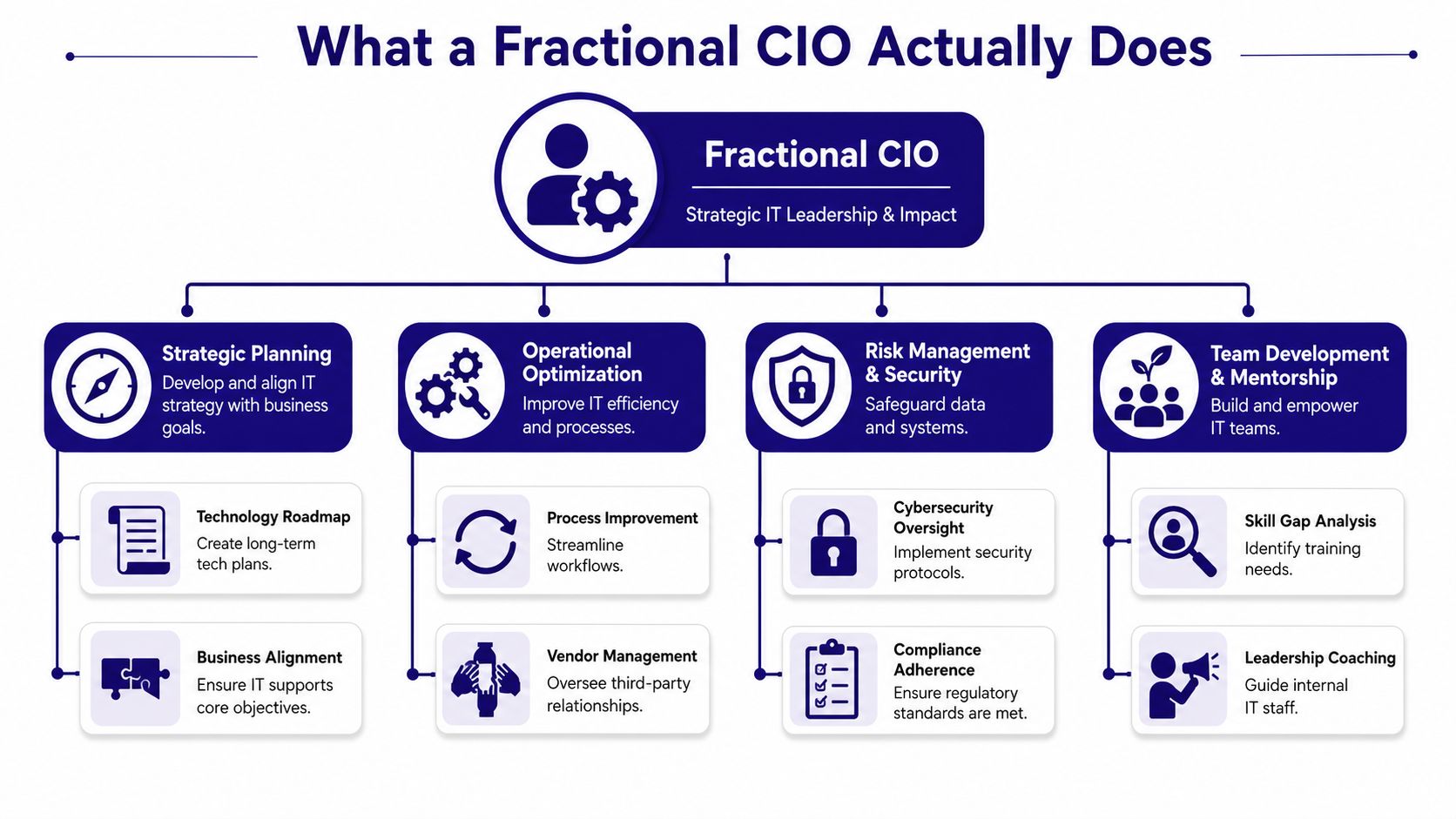
A fractional CIO is best understood as a strategic quarterback on retainer. The role doesn’t handle every ticket, approve every laptop, or sit in every standup. It calls the plays that determine whether technology supports growth or blocks it.
The role is strategic, not just advisory
The job starts with alignment. A capable fractional CIO ties the technology roadmap to business outcomes such as expansion, margin protection, customer experience, or compliance readiness. That means prioritizing systems, sequencing projects, and deciding what shouldn’t be funded just as much as what should.
The second responsibility is governance. That includes cybersecurity oversight, data governance, risk ownership, and standards for vendor selection. In many companies, chaos hides. Different teams buy tools independently, contracts renew without scrutiny, and no one owns the architectural consequences.
A strong operator also develops internal talent. The best fractional CIOs don’t create dependency. They raise the quality of the existing IT leader, infrastructure lead, security manager, or engineering manager by setting expectations, clarifying decision rights, and coaching the team through execution.
A useful outside perspective on this broader planning discipline appears in expert advice on IT strategy for SMBs from IT Cloud Global, LLC. The value isn’t in having a strategy document. The value is in forcing the business to choose, sequence, and govern.
What separates a fractional CIO from a one-off consultant
Consultants usually answer a bounded question. A fractional CIO owns an evolving leadership mandate.
That distinction matters. One-off consulting can support a cloud migration, ERP selection, or security assessment. It rarely gives the CEO, CFO, or board a single accountable executive voice who can translate technology tradeoffs into business decisions over time. Managed fractional CIO models are different because they provide continuous strategic IT leadership that evolves with the business, as noted by Ten Hats on ongoing fractional CIO support.
A concise way to judge the role is this:
- Roadmap ownership: The leader decides what the company should do next, and why.
- Governance discipline: The leader creates decision structure around vendors, security, architecture, and spend.
- Team effectiveness: The leader makes the existing IT function more effective without replacing it.
- Executive translation: The leader turns technical complexity into board-level choices.
A good fractional CIO doesn’t just recommend tools. The role makes sure the business funds the right priorities, governs the risk, and follows through.
Common Fractional CIO Engagement Models
Most companies shouldn’t start by asking, “Should this be fractional?” They should ask, “What problem needs executive technology leadership right now?” The engagement model follows from that answer.
According to SCH Group’s overview of fractional CIO structures, fractional CIO engagements typically run on a flexible hour-retainer model of 8 to 20 hours per week, with an initial stabilization phase often requiring 15 to 20 hours weekly before scaling down to 10 to 15 hours for ongoing governance. That heavier early cadence matters because it speeds up roadmap creation and vendor contract negotiations.
Retainer model for steady governance
This is the most effective model for companies that need recurring executive oversight but not a full-time seat. The CIO works on a regular cadence with leadership, finance, operations, and IT management. The company gets continuity without carrying a permanent executive role.
This model fits companies dealing with:
- Technology sprawl: Too many systems, unclear ownership, and duplicative spend.
- Security accountability gaps: Risks are known, but no executive is driving decisions.
- Board pressure: Leadership needs someone who can explain IT priorities in business terms.
The retainer model works because it creates rhythm. Monthly operating reviews, budget checkpoints, security governance, and vendor reviews don’t happen by accident. They happen when one person owns them.
Project and transition models
Some companies need a fractional CIO for a defined event rather than steady-state governance. That often includes M&A integration, ERP replacement, cloud migration, post-incident stabilization, or preparation for a compliance effort.
This model can still start with high weekly involvement, especially when the company needs quick decisions across architecture, vendors, or staffing. After the critical phase, the scope can narrow into oversight, handoff, or advisory support.
A practical way to choose the model is simple:
- Use a retainer when the business lacks ongoing strategic IT leadership.
- Use a project engagement when a major initiative needs executive ownership.
- Use an advisory model when the internal team is strong but senior leadership needs board-level judgment on risk, spend, or sequencing.
The mistake is buying fractional CIO services as abstract advice. The engagement should attach to operating cadence, decision rights, and specific business outcomes.
Comparing Your IT Leadership Options
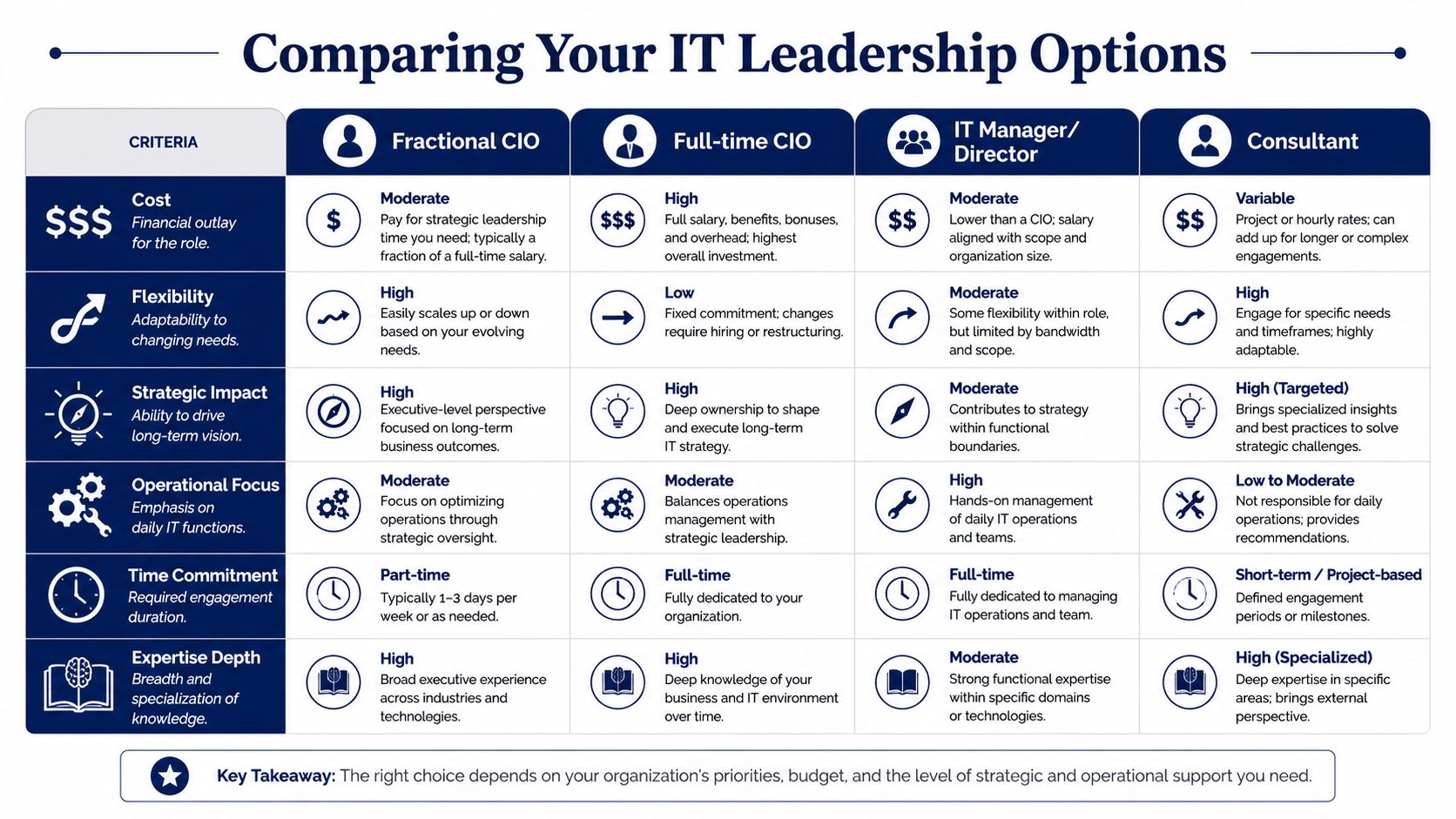
There isn’t one correct leadership model. There’s only a model that fits the company’s stage, risk profile, and execution burden. Buyers who treat every technology leadership need as a full-time CIO requirement usually overspend. Buyers who push everything onto managers or consultants usually under-lead.
When each model makes sense
A full-time CIO makes sense when technology complexity is permanent, broad, and central to company performance. That usually means sustained multi-function leadership across infrastructure, applications, security, vendor management, budgeting, and executive planning. It is the highest-commitment option and should be treated that way.
An interim CIO is different. This is a vacancy, disruption, or transition solution. It fits executive departures, restructuring, turnaround periods, and situations where the company needs someone in the seat now while a longer-term answer is decided.
A fractional CIO fits companies that need executive-grade strategy and governance but don’t need that person present every day. It’s particularly useful in growth periods, digital transformation, and operating environments where risk is significant but executive overhead needs to stay flexible.
A fractional CTO is often the better fit when the center of gravity is product engineering rather than enterprise IT. If the company’s biggest challenge is software architecture, engineering velocity, platform design, or product technical leadership, a CTO model may be more relevant.
A traditional consultant still has a place. For companies exploring a specific workstream, benefits of IT consultancy for businesses can help clarify where project-based expertise adds value. The limitation is that consulting rarely replaces accountable executive ownership.
Decision filter: If the business needs someone to own ongoing tradeoffs across security, systems, spend, and leadership communication, it needs a CIO model, not just a consultant.
For teams that want to see what efficient leadership support can look like in practice, a case example of IT leadership support for a growing manufacturer is a useful reference point.
IT Leadership Models Compared
| Model | Best For | Typical Cost | Focus |
|---|---|---|---|
| Fractional CIO | Mid-market firms needing strategic IT leadership without a permanent executive hire | Lower than a full-time executive commitment; variable based on scope | Business-aligned IT strategy, governance, security, vendors, roadmap |
| Full-time CIO | Companies with constant enterprise-level complexity and sustained leadership demand | Highest fixed commitment | End-to-end executive ownership of IT |
| IT Manager/Director | Businesses with solid operations needs but limited strategic complexity | Salary-based operational role | Daily IT execution, support, infrastructure management |
| Consultant | Organizations solving a defined problem or short-term initiative | Project or advisory fees | Specialized advice, limited-duration delivery |
The cleanest distinction is ownership. A manager runs operations. A consultant advises. An interim leader stabilizes. A fractional CIO governs and prioritizes without forcing the company into a permanent executive structure before it’s ready.
Calculating the ROI of Fractional CIO Services
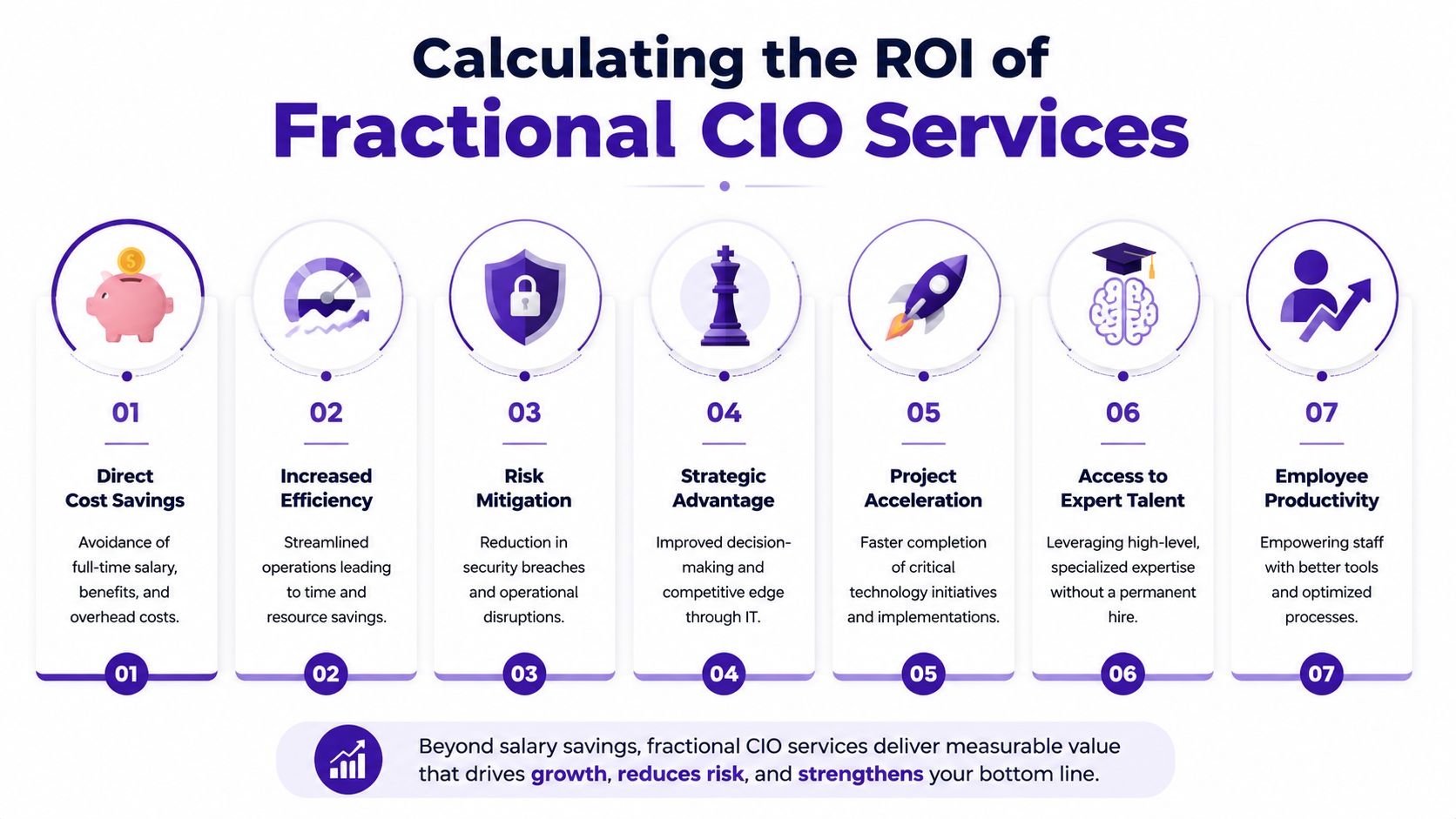
Most ROI conversations stop at salary arbitrage. That’s too narrow. The direct savings are real, but the stronger business case comes from better decisions and avoided mistakes.
According to Sentry Tech Solutions on fractional CIO pricing and savings, fractional CIO services typically cost $5,000 to $15,000 per month, or approximately $43,200 annually, and represent about 60% to 90% cost savings compared with hiring a full-time senior technology executive. The same source notes that full-time CIO compensation has jumped more than 20% since 2019.
Direct savings are only the first layer
Those cost figures justify a first conversation. They don’t justify a hiring decision on their own.
The better question is whether the executive changes outcomes in areas that already drain money or create risk. That includes unnecessary software spend, weak vendor contracts, delayed projects, mis-sequenced initiatives, compliance slippage, and cybersecurity governance gaps. The savings from avoiding one bad technology decision can outweigh months of advisory cost, even if the exact value depends on the company’s environment.
Fortium Partners argues that the model removes the salary, benefits, and long-term commitment tied to a permanent executive while preserving strategic rigor, and that the scope often includes data governance, cybersecurity frameworks, AI oversight, cloud migration, automation, and integration planning in its review of fractional CIO services and enterprise governance needs. That’s the right lens. ROI comes from disciplined governance, not just cheaper leadership.
A practical ROI framework for leadership teams
A CFO or board committee should evaluate fractional CIO services across four buckets.
- Cost takeout: Reduced executive payroll commitment, tighter vendor negotiations, and less duplicate tooling.
- Risk avoidance: Better security ownership, stronger policy enforcement, and more credible compliance preparation.
- Execution quality: Faster prioritization, fewer stalled projects, and cleaner decision-making across departments.
- Strategic upside: Technology investments tied more tightly to revenue, margin, or customer experience.
A practical internal scorecard might ask:
| ROI Area | What leadership should examine |
|---|---|
| Spend control | Are major contracts, renewals, and platform decisions governed centrally? |
| Risk posture | Is there executive ownership for security, compliance, and data governance? |
| Delivery discipline | Are key initiatives sequenced, funded, and reviewed against business goals? |
| Talent leverage | Is the internal IT team getting stronger under executive guidance? |
The fastest way to destroy technology ROI is to approve tools without governance, projects without sequencing, and risk without ownership.
That’s why a fractional CIO often outperforms a patchwork of consultants, vendors, and overloaded internal managers. The value sits in the decisions that get prevented, redirected, or accelerated.
How to Hire the Right Fractional CIO
The hiring mistake isn’t choosing the wrong personality. It’s choosing the wrong operating profile.
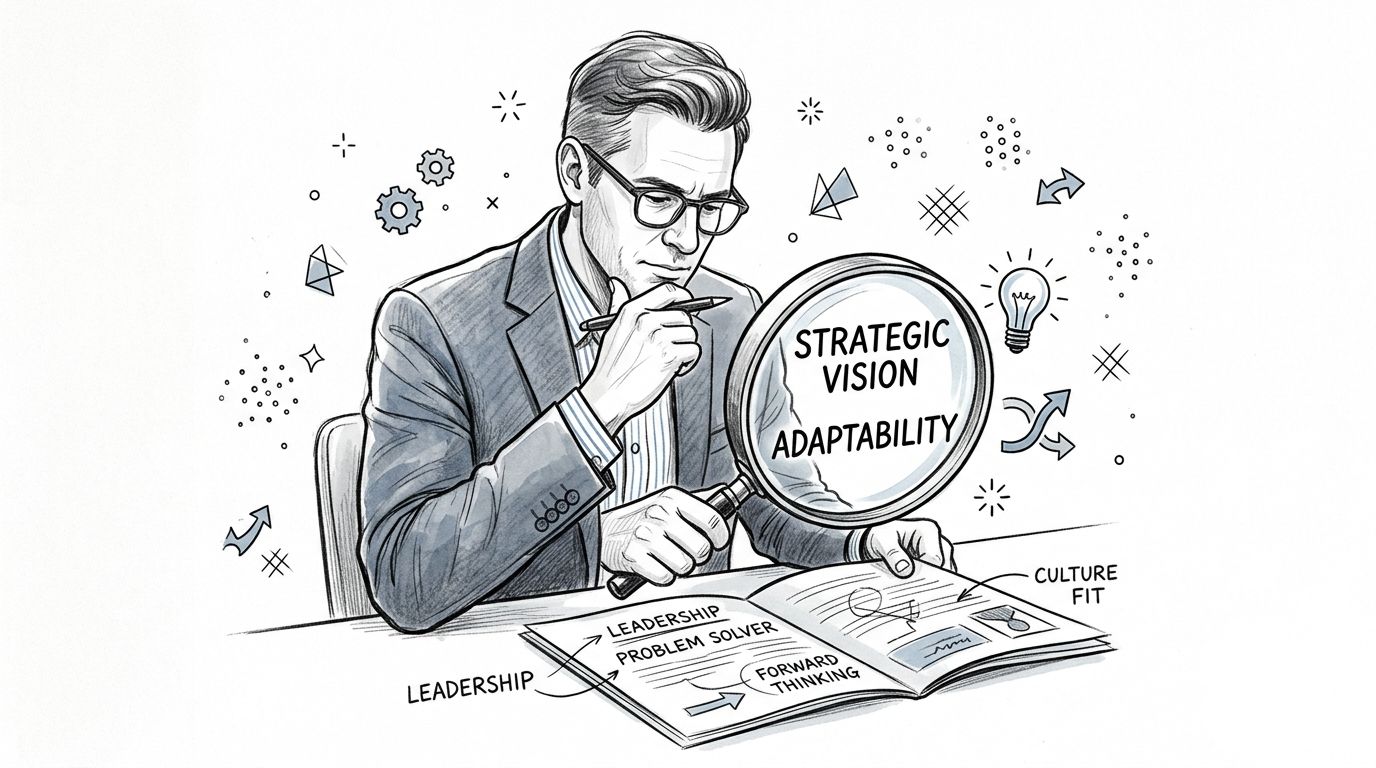
Many candidates can talk strategy. Fewer can govern risk in a regulated environment, lead through ambiguity, and leave behind a stronger internal function when the engagement ends. That difference matters most in healthcare, fintech, private equity-backed environments, and M&A situations.
What regulated businesses should test for
One of the biggest blind spots in the market is that there’s still limited hard evidence showing how fractional CIOs affect measurable ROI in regulated sectors. Network Right notes that content in this category rarely quantifies impact on compliance readiness or audit outcomes for frameworks such as SOC 2, ISO 27001, and NYDFS Part 500 in its discussion of fractional CIO gaps in regulated industry guidance. That gap should change how companies hire.
They shouldn’t settle for general claims about “strategic leadership.” They should test for operating evidence.
The shortlist should include candidates who can speak clearly about:
- Regulatory translation: How they turn compliance requirements into operating controls, ownership, and reporting.
- Risk prioritization: How they decide what must be fixed now versus what can wait.
- Board communication: How they present cyber, data, and audit risk to nontechnical executives.
- Execution management: How they convert assessments into funded roadmaps and accountable work.
Another essential aspect is continuity. During M&A, executive departure, or hypergrowth, the company can’t afford a leader who keeps critical context in their head. A qualified fractional CIO documents decisions, defines governance, and transfers ownership.
For companies evaluating providers as well as individuals, guidance on choosing top executive IT search firms is useful because the search process matters almost as much as the candidate profile.
Interview questions that expose fit fast
A good interview loop should pressure-test judgment, not charm.
Use questions like these:
- Walk through a regulated environment the candidate has supported. Ask how the candidate established ownership for compliance, security, and reporting.
- Ask for a first-90-day operating plan. Strong candidates should describe governance setup, risk review, vendor assessment, and roadmap sequencing.
- Test M&A discipline. Ask how the candidate would prevent strategic drift during integration, executive turnover, or team scaling.
- Probe knowledge transfer. Ask what artifacts the candidate leaves behind. Look for roadmaps, decision logs, ownership matrices, vendor frameworks, and executive reporting cadences.
- Challenge prioritization. Present too many simultaneous initiatives and ask what gets paused.
Hire the candidate who can explain how decisions get made, documented, funded, and handed off. Strategy without transferability creates dependency, not value.
The right fractional CIO should look less like a charismatic advisor and more like a disciplined operating executive who happens to work part time.
Is a Fractional CIO Right for Your Business
A lot of companies assume they have only two choices. Hire a full-time CIO or keep pushing technology leadership down into the existing team. That’s a false choice.
Tyson Martin notes that frequently asked but poorly answered questions around fractional CIOs center on knowledge continuity and execution rigor during M&A transitions or executive departures, and that 40% to 60% of fractional engagements are activated during critical inflection points such as M&A or rapid growth in its analysis of fractional CIO advisory use during high-change periods. That’s exactly when weak leadership models break.
A business might need fractional CIO services if any of these conditions are true:
- Technology spend keeps growing: Leadership can’t clearly connect budgets to business outcomes.
- Compliance pressure is rising: The company faces audits, customer security reviews, or formal governance demands.
- M&A is creating risk: Systems, vendors, and team ownership need executive-level coordination.
- The IT team is capable but under-led: Managers can run operations, but no one owns long-range strategy.
- The board expects better answers: Leadership needs someone who can represent technology risk and investment decisions credibly.
The model isn’t right for every company. If technology complexity is constant and enterprise-wide, a full-time CIO may be justified. If the issue is a short vacancy, interim may be cleaner. But when the business needs executive judgment without full-time overhead, fractional is often the smartest fit.
Companies that need to decide between fractional, interim, and full-time IT leadership should talk with nexus IT group. Their team helps employers evaluate the actual hiring need, define the right leadership profile, and move quickly when timing, risk, or growth pressure doesn’t leave room for a slow search.