$144,634 is the average annual U.S. salary for a quantitative analyst, and top Wall Street roles posted under New York City pay transparency laws list base salaries between $250,000 and $350,000 according to QuantInsti’s quantitative analyst researcher overview. That pay range changes how candidates should think about preparation and how employers should think about hiring. Quant roles aren’t just well-paid analyst jobs. They sit at the point where mathematics, software engineering, market structure, and risk all meet.
A quantitative analyst builds models that turn noisy market data into pricing logic, trading signals, execution rules, and risk controls. In one firm, that means derivatives pricing. In another, it means order-flow modeling, portfolio construction, or machine learning research. The title sounds singular. The work never is.
That’s why generic advice about quantitative analyst job requirements usually falls short. It treats every quant seat as interchangeable and every strong resume as a degree-plus-skills checklist. Hiring managers know better. Candidates need to know better too. Firms looking for talent in quantitative hedge funds also care about whether a candidate understands model risk, implementation constraints, and the disciplines behind books, execution, and controls. That’s also why practical resources on mastering trading risk matter. Strong quants don’t just generate ideas. They survive contact with real markets.
Table of Contents
- The High Stakes World of Quantitative Finance
- The Educational Foundation of a Quant
- Core Technical Skills You Must Master
- How Requirements Change Across Industries
- Decoding the Quantitative Analyst Interview
- Soft Skills and Certifications That Actually Matter
- Strategic Advice for Hiring and Getting Hired in 2026
The High Stakes World of Quantitative Finance
The compensation gets attention first, but money alone doesn’t explain why quant hiring is so selective. The main issue is consequence. A weak front-end developer might ship a clumsy interface. A weak quant can push bad assumptions into pricing, execution, or risk systems where the cost shows up later and often under pressure.
What the role actually looks like
Most firms use the term quantitative analyst as shorthand for one of several jobs:
- Research-driven roles focused on signal discovery, alpha modeling, and hypothesis testing.
- Strats or desk quant roles tied to pricing, hedging, derivatives analytics, and trader support.
- Execution and market microstructure roles where latency, order placement logic, and market behavior matter.
- Risk and portfolio roles where the work centers on exposure measurement, scenario analysis, and allocation.
That variety is where many hiring mistakes start. Employers write one broad job description and expect a candidate who can do all of it. Candidates study broad concepts and assume that’s enough. Neither side gets what it wants.
Practical rule: A quant seat should be defined by the decisions the person will influence, not by a generic title.
What hiring managers really screen for
On paper, most resumes look more similar than different. Degrees are often quantitative. Languages overlap. Everyone says they know Python. The primary separation comes from whether the candidate can connect tools to outcomes.
A hiring manager usually wants evidence of three things:
- Depth in a narrow domain. Not “familiar with machine learning.” More like time-series forecasting, options modeling, execution research, or portfolio construction.
- Implementation credibility. Can the candidate move from notebook research to reliable code, clean data, and production constraints?
- Judgment under uncertainty. Strong quants know where models fail, where assumptions break, and where market noise can fool them.
Candidates who understand that dynamic prepare better. Employers who understand it write tighter job specs, run better interviews, and attract stronger applicants.
The Educational Foundation of a Quant

The baseline is straightforward. A bachelor’s degree is the minimum entry point, usually in mathematics, statistics, physics, computer science, economics, or finance. That gets a candidate through the first filter. It rarely settles the question.
What the degree signals
The strongest academic backgrounds don’t just signal intelligence. They signal comfort with abstraction, proof-based thinking, and technical persistence. Quant work often involves incomplete data, ambiguous assumptions, and modeling choices that don’t come with clean answers. A transcript full of lightweight survey courses doesn’t reassure a serious hiring team.
While 53% of quants hold a bachelor’s degree as their highest level of education, 36% have a master’s and 9% hold a PhD, demonstrating that nearly half the field has pursued advanced education to remain competitive, a trend especially pronounced in quant hedge funds, according to Coursera’s quantitative analyst career guide.
That split matters. It shows why candidates with only an undergraduate degree need stronger proof elsewhere. If the degree is the floor, then projects, research, internships, coding depth, and interview performance have to carry more weight.
Master’s versus PhD
A master’s degree often works well for candidates targeting applied roles. Financial engineering, quantitative finance, statistics, or computer science programs can help candidates close gaps fast if they already have a solid quantitative base.
A PhD tends to matter more when the role involves original research, harder model development, market microstructure, or advanced statistical work. Employers don’t ask for it because they like credentials. They ask for it because some work is closer to research than to standard analytics.
Candidates who choose graduate school should choose for rigor, not branding. Hiring teams notice the coursework behind the label.
For earlier-stage candidates, even foundational reinforcement helps. Someone rebuilding probability or statistical intuition before a graduate program or technical interview can benefit from a structured elementary statistics final exam study plan, especially if the goal is to tighten fundamentals rather than skim formulas.
What employers should do with education requirements
Many firms hurt themselves by writing inflated credential demands. If the seat is implementation-heavy and the work is well-scoped, a bachelor’s plus strong code and real project work may be enough. If the job is research-heavy, then the posting should say so clearly and explain the domain.
A better job description separates required academic foundation from preferred research depth. That gives candidates a fair signal and improves the applicant pool.
Core Technical Skills You Must Master
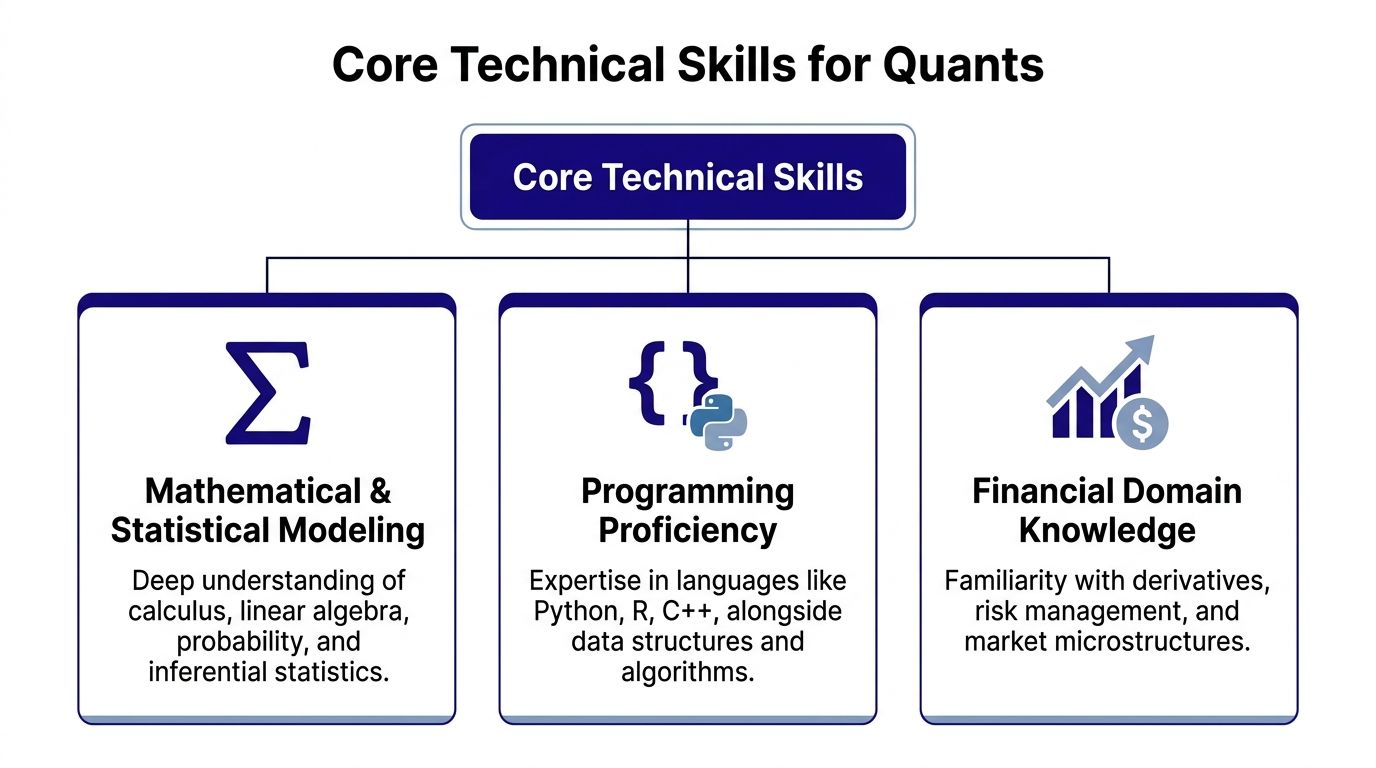
The technical side of quantitative analyst job requirements is where most candidates either become credible or expose gaps. Firms can teach internal workflows. They usually can’t teach mathematical maturity, coding discipline, and data judgment fast enough to justify a bad hire.
Candidates who want to understand what separates strong applicants from average ones should look at the traits discussed in what skills separate a good quant from a great one. The short version is simple. Technical breadth gets attention. Technical depth gets offers.
Mathematical and Statistical Modeling
At a minimum, employers expect fluency in calculus, linear algebra, probability, and statistics. In practice, they also want candidates who can use those tools to reason through noisy, imperfect market data.
That means more than memorizing distributions or naming models. It means being able to answer questions like these:
- Model choice: Why use one statistical framework over another for a specific market problem?
- Assumption control: What happens when stationarity breaks, correlations shift, or data quality deteriorates?
- Validation discipline: How would the candidate test stability, overfitting, and regime sensitivity?
A candidate who can derive but can’t interpret won’t help much. A candidate who can recite machine learning terminology but can’t explain error sources is just as risky.
Strong quants don’t worship elegant models. They ask whether the model survives bad inputs, changing regimes, and actual execution.
Programming Proficiency
Hiring teams stop listening to buzzwords and start testing. A firm might tolerate partial knowledge in one language. It won’t tolerate weak coding habits in a role that touches money, production systems, or execution.
Expert-level proficiency in Python and C++ is mandatory; C++ is used for high-frequency trading where sub-microsecond latency is key, while Python with libraries like Pandas and TensorFlow is used for backtesting and developing machine learning pipelines, according to iMocha’s breakdown of quantitative analyst skills.
That distinction matters because the languages solve different problems.
- Python is the research environment. It’s where many candidates test ideas, build prototypes, run backtests, and work through data analysis.
- C++ is the performance environment. In latency-sensitive contexts, it’s the difference between code that’s merely correct and code that’s useful.
- SQL remains foundational for querying, joining, and validating large datasets. Candidates who neglect it create headaches fast.
- R and MATLAB can still matter in some shops, especially where legacy workflows or research habits remain strong.
A practical analogy helps. C++ is the Formula 1 engine. Python is the simulation suite and test garage. A firm doesn’t always need both at elite depth for every role. But candidates need to know which side of that stack the job demands.
Machine Learning and Data Engineering
Machine learning isn’t a shortcut into quant work. It’s an extension of it. Candidates get rejected all the time because they can train models but can’t explain features, leakage, drift, or why the target should matter in the first place.
The same applies to data engineering. A model built on bad timestamps, survivorship bias, sparse joins, or inconsistent market data won’t become useful because it uses a modern framework.
The firms that hire well usually test for practical workflow discipline:
- Data sourcing and cleaning. Can the candidate explain where the data comes from and what’s wrong with it?
- Feature construction. Are the features economically sensible, or are they random transformations searching for significance?
- Backtesting logic. Does the test reflect turnover, slippage, and realistic sequencing?
- Deployment thinking. Can the candidate move beyond a notebook into maintainable code?
Candidates should build project portfolios around that full chain, not just final charts. Employers should interview the same way.
How Requirements Change Across Industries
A major mistake in quant hiring is pretending that all firms want the same person. They don’t. The programming emphasis, educational preference, and daily work all shift depending on the business model.
Quantitative analyst requirements by industry
| Industry Type | Primary Focus | Most Valued Programming Language | Common Educational Profile |
|---|---|---|---|
| Proprietary trading shop | Execution speed, signal implementation, market microstructure, low-latency systems | C++ | Math, physics, computer science, applied math. Advanced research training is often prized for the most technical seats |
| Large hedge fund | Alpha research, portfolio construction, statistical arbitrage, machine learning research | Python | Statistics, mathematics, computer science, physics, quantitative finance. Graduate study is common for research-heavy roles |
| Investment bank | Derivatives pricing, risk modeling, desk support, valuation frameworks | Python or C++ | Financial engineering, mathematics, physics, statistics, finance with deep quantitative training |
| Fintech startup | Applied modeling, product analytics, risk systems, scalable data workflows | Python | Computer science, statistics, applied math, economics. Employers may trade pedigree for versatility |
What matters in a prop shop
Prop shops often care less about polished storytelling and more about speed, precision, and implementation under tight constraints. Candidates who interview for these seats need to expect tougher coding scrutiny and more detailed questions around systems behavior, optimization, and market mechanics.
A resume heavy on dashboard analytics, light scripting, and generic machine learning language usually won't land well there. Firms want evidence that the candidate can work close to the metal or at least reason clearly about what happens in production.
What matters in a hedge fund
Hedge funds often put more weight on research process. They still care about code, but they also want to see hypothesis generation, statistical rigor, and evidence that a candidate can think independently around alpha decay, feature relevance, and portfolio effects.
Candidates often overstate experience. “Built a predictive model” isn't enough. Hiring managers want to know what the signal was meant to capture, how it was tested, how it degraded, and whether it held any economic logic.
What matters in banks and fintech
Banks still value serious quantitative depth, especially in pricing and risk. The difference is that communication with traders, risk teams, and non-research stakeholders often matters more. A candidate may be brilliant, but if that person can't explain a model limitation clearly, the desk won't trust the output.
Fintech is different again. Startups often hire for range. They may prefer someone who can code, model, ship, document, and work across product and infrastructure. That means candidates should tailor the resume to the environment instead of sending the same version to every employer.
The best quant resume is never “one-size-fits-all.” It's calibrated to the economics of the firm that's hiring.
For employers, the lesson is equally important. A hedge fund that writes a prop-shop job spec, or a fintech that copies a bank posting, will attract the wrong applicants and waste interview cycles.
Decoding the Quantitative Analyst Interview
Quant interviews are hard for a simple reason. Firms aren't just testing knowledge. They're testing whether the candidate can think under pressure without losing rigor.
Candidates preparing for detailed screening rounds often benefit from reviewing specialized quant interview questions that reflect how firms combine probability, coding, modeling, and business judgment in a single process.
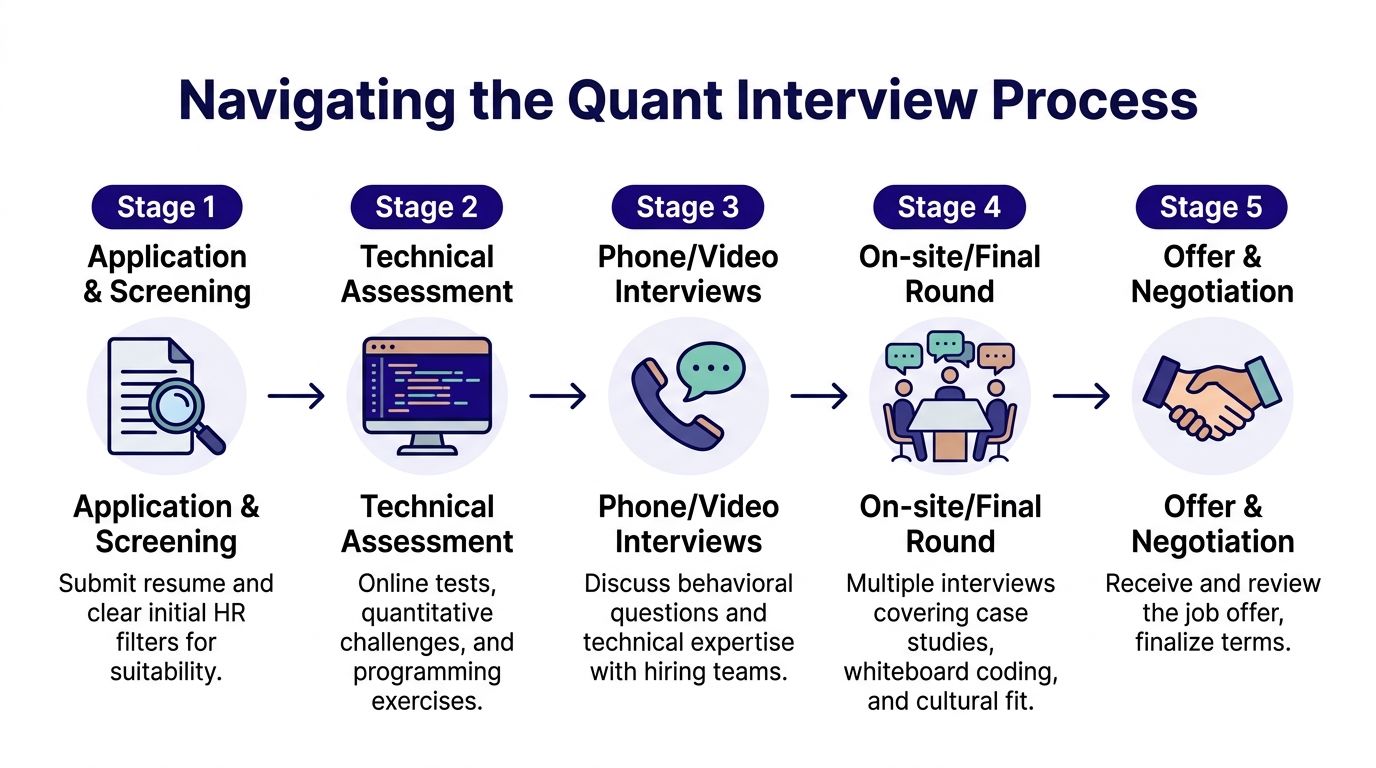
Stage one and stage two
The resume screen is less forgiving than many candidates expect. Hiring teams look for evidence that matches the seat. Good degrees help. Relevant projects help more. A GitHub profile with thoughtful code can support the resume. A generic list of libraries cannot.
Then comes the technical assessment. Depending on the firm, that may include coding exercises, probability problems, market intuition, or take-home work. The strongest candidates narrate assumptions clearly while solving. The weakest rush to an answer and reveal that they don't know how to structure thinking.
Stage three and stage four
Phone or video interviews usually combine behavioral questions with technical depth. In these settings, communication starts to matter. A candidate who knows the material but explains it in a chaotic way creates risk in the interviewer's mind.
On-site or final rounds usually widen the lens. Interviewers may probe:
- Research reasoning: How was a hypothesis formed and tested?
- Coding quality: How would the candidate structure, debug, or optimize a solution?
- Model skepticism: What could go wrong with a result that looks promising?
- Team fit: Can the candidate take pushback without becoming defensive?
A final round rarely goes wrong because a candidate missed one formula. It usually goes wrong because the candidate couldn't defend choices or handle ambiguity.
What employers should watch for
Many firms over-index on brainteasers and under-test workflow maturity. That produces false positives. Someone can be fast at puzzles and still be careless with data, brittle in production, or weak at collaboration.
A better interview process mixes theory with evidence of real work. Ask candidates to discuss a model they built, what failed, what they changed, and what trade-offs they accepted. That reveals much more than a riddle ever will.
Soft Skills and Certifications That Actually Matter
Technical skill gets a candidate through the door. Communication, restraint, and collaboration usually determine who gets hired.
The soft skills that prevent expensive mistakes
Quant teams don't work in isolation. They work with traders, engineers, risk managers, portfolio managers, and leadership. A candidate who can't explain assumptions to non-specialists creates friction and, in some cases, real operational risk.
The most valuable soft skills are usually these:
- Clear explanation: Can the candidate translate model logic into decisions and limitations?
- Challenge tolerance: Does the person handle critique like a researcher or like a student defending ego?
- Team awareness: Can they work with engineering, data, and business stakeholders without talking past them?
- Judgment: Do they know when not to trust a result?
Where certifications fit
Certifications can help at the margins. CQF or FRM may strengthen a profile when they reinforce a real gap, especially for candidates transitioning from adjacent roles. They don't replace advanced quantitative training, serious programming skill, or proof of applied work.
Employers should treat certifications as supporting evidence, not as a substitute for substance. Candidates should do the same. If a certification sharpens applied knowledge and helps frame a transition, it's useful. If it's being used to hide weak fundamentals, hiring teams will see through it quickly.
Strategic Advice for Hiring and Getting Hired in 2026

One hiring mistake at the quant level can cost a firm months of model delay, a failed strategy launch, or a bad handoff between research and production. In 2026, the teams that hire well are usually the teams that define the job precisely. The candidates who get hired fastest are usually the ones who position themselves for one specific class of quant work.
For employers
Start with the actual business need, not the title. "Quantitative analyst" is still used as a catch-all for research, desk analytics, model validation, execution, and risk. Hiring managers lose strong candidates when they bundle those jobs together and hope one person will cover all of them.
Write the posting around actual work. State whether the person will spend most of the week building signals, improving execution logic, validating models, or supporting a trading desk. Name the stack. Name the markets. Name the level of production ownership. Good candidates read vague descriptions as a sign that the team itself is unclear.
Broaden the search without lowering the bar. Firms that only screen for finance pedigrees miss strong applicants from physics, statistics, applied math, computer science, and engineering. The trade-off is obvious. Candidates from those paths often bring stronger research discipline or coding depth, but they may need more time to get fluent in market structure, portfolio context, or desk communication. Good hiring processes test for both sides of that equation instead of filtering too early.
Outside recruiting support can help, including firms such as nexus IT group. It does not fix a broken process. If interviewers disagree on what "good" looks like, if the take-home work is unrelated to the job, or if compensation is hidden until the final round, strong quants will exit and take other offers.
For candidates
Pick a lane before you polish your resume. A bank model risk team, a multi-manager hedge fund, and a prop shop may all post "quant" roles, but they hire for very different reasons. Your materials should show fit for one of those paths, not a broad interest in quantitative finance.
Proof beats claims. A clean GitHub repository, research memo, backtest write-up, Kaggle result, or production-quality code sample does more than a long skills section. Hiring managers want evidence that you can form a hypothesis, test it cleanly, handle messy data, and explain what failed.
Target the market with intent. Candidates interested in faster, execution-driven environments should discover prop trading roles in 2026 and study how those firms evaluate speed, risk judgment, and coding under pressure. Candidates aiming at banks or long-horizon hedge fund seats should tune their resume to the desk, asset class, and research style instead of sending the same generic version everywhere.
Background matters, but only if you frame it correctly. A physics PhD should show where stochastic modeling or empirical research maps to trading problems. A software-heavy candidate should show reliability, performance awareness, and production standards. A finance-trained candidate should prove technical depth with code, math, or serious project work, because the degree label alone rarely closes the case.
Employers and candidates are solving the same problem from opposite sides. Firms want signal instead of noise. Candidates want a fair shot at roles that match their skills. The hiring process works better when both sides state genuine requirements early and test for the work that will be done.
Nexus IT Group supports employers hiring specialized technical talent and works with candidates on role alignment, resume review, and interview preparation for hard-to-fill quant and technology searches.