A strong platform engineer interview doesn’t test whether a candidate can recite Kubernetes commands or name every Terraform feature. It tests judgment under operational constraints. That distinction matters because platform engineering has moved into a major hiring category. One market forecast estimates the global platform engineering and internal developer platform market at USD 10.44 billion in 2026, rising to USD 31.57 billion by 2031, while another projects the broader platform engineering solutions market from USD 10,534.0 million in 2025 to USD 41,410.0 million by 2032. These projections point to employers hiring people who can design, operate, and improve platform capabilities at enterprise scale, not merely maintain individual tools. (Cervicorn Consulting market forecast)
The most useful platform engineer interview questions separate implementation ability from senior-level architecture, reliability, security, cost control, and developer adoption. That last category is frequently missed. Google’s 2025 research found that 55% of global organizations had adopted platform engineering, and 90% of those adopters planned to expand it to more developers, which makes internal developer platforms, self-service workflows, golden paths, and rollout strategy central interview subjects. (Google Cloud platform engineering research)
Hiring teams can use each question below as a structured prompt. Candidates should answer with a concrete production example, explain constraints and trade-offs, then describe the outcome. Follow-ups reveal depth, seniority signals show the expected level, tech-stack variations help interviewers adapt the prompt, and observable evaluation criteria keep scoring focused on evidence rather than tool-name familiarity.
Table of Contents
- 1. Design a CI/CD Pipeline for a Microservices Architecture
- 2. Optimize Kubernetes Cluster Performance and Cost
- 3. Implement and Manage Infrastructure as Code at Scale
- 4. Design a Disaster Recovery and Business Continuity Strategy
- 5. Troubleshoot and Optimize Application Performance Under Load
- 6. Design a Secure and Compliant Platform Infrastructure
- 7. Implement Observability and Monitoring for Complex Distributed Systems
- 8. Lead Platform Architecture Evolution and Technology Strategy
- 9. Manage Multi-Cloud or Hybrid Cloud Infrastructure Complexity
- 10. Coach Engineering Teams on Platform Adoption and Best Practices
- Platform Engineer Interview Topics: 10-Point Comparison
- Turn Interview Questions Into Better Hiring Decisions
1. Design a CI/CD Pipeline for a Microservices Architecture
Question: How would you design a CI/CD platform for a microservices organization that needs safe, repeatable production releases?
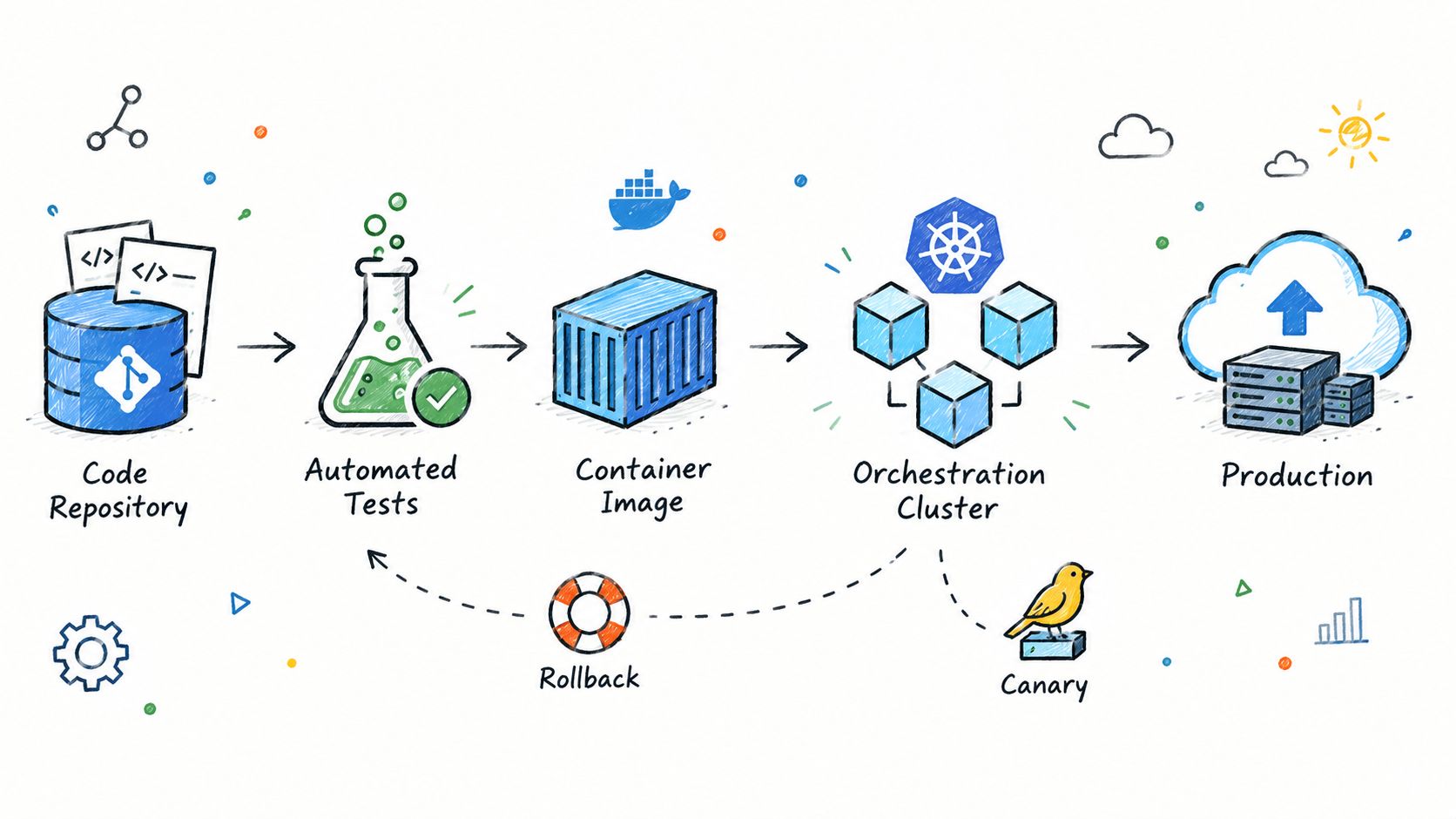
A strong answer should begin with the developer workflow, not a preferred product. The candidate should describe source control triggers, build isolation, container image creation, dependency and security scanning, automated unit and integration tests, artifact promotion, deployment orchestration, and production verification. The answer should explain how Kubernetes, GitHub Actions, GitLab CI, Jenkins, Argo CD, or another stack fits the organization’s constraints rather than treating a tool as the architecture.
The candidate should also discuss progressive delivery, such as canary or blue-green releases, feature flags, automated rollback, approval boundaries, and environment parity. Terraform or CloudFormation can provision the surrounding infrastructure, while the pipeline should keep application delivery separate from infrastructure changes when that separation reduces risk.
Practical rule: A pipeline isn’t mature because it deploys automatically. It’s mature when a failed deployment has a contained blast radius, a visible failure signal, and a tested recovery path.
Follow-ups and seniority signals
Ask what happens when a deployment fails at 2 AM, how the system identifies the last known good artifact, and whether rollback affects database schema changes. Request specific tool recommendations and ask why they fit the organization. Probe secrets handling, runner isolation, artifact immutability, approval policy, and infrastructure drift.
Mid-level candidates should explain a dependable pipeline implementation. Senior candidates should address shared platform abstractions, team autonomy, release governance, and migration from inconsistent pipelines without interrupting delivery.
Tech-stack variations and evaluation
For AWS, ask how CodeBuild, CodePipeline, ECR, and EKS would interact. For GitHub-centered teams, explore GitHub Actions, environments, reusable workflows, and OIDC. For multi-cloud teams, ask how deployment policy stays consistent without hiding provider-specific failure modes.
Evaluate whether the candidate names meaningful safety mechanisms, explains trade-offs clearly, and connects automation to developer self-service. Employers can also compare the discussion with broader DevOps interview questions for 2026, while checking that the candidate goes beyond basic pipeline construction.
2. Optimize Kubernetes Cluster Performance and Cost
Question: A Kubernetes platform is reliable but increasingly expensive and occasionally slow under variable traffic. How would you investigate and improve it?
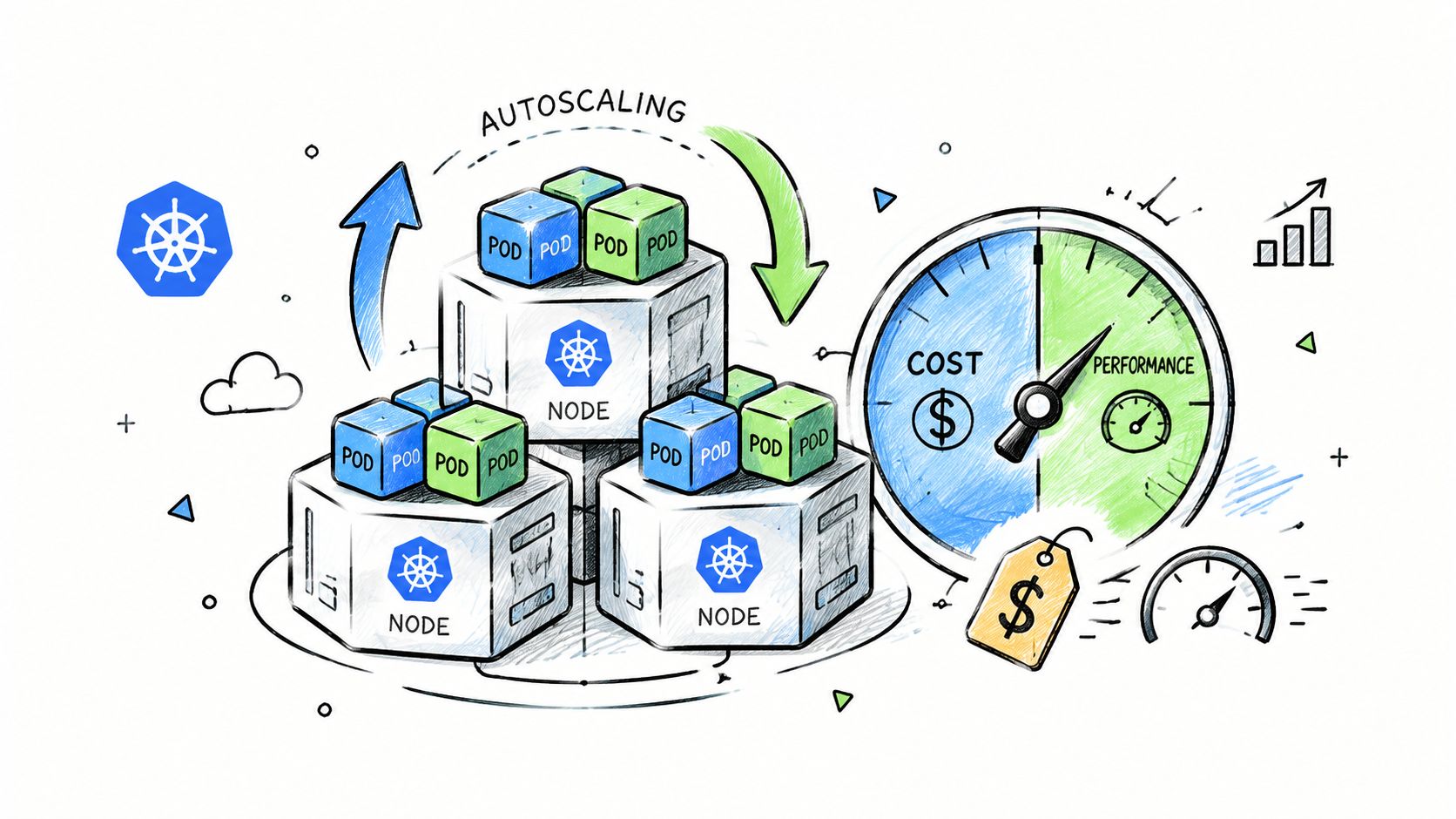
The candidate should establish a baseline before recommending changes. That means examining workload requests and limits, node utilization, pending pods, autoscaler behavior, scheduling constraints, network latency, storage performance, and application-level saturation. A strong response distinguishes wasted capacity from genuine demand. Lowering resources blindly can create throttling, evictions, noisy-neighbor problems, or latency regressions.
The best answers connect optimization to observability. The candidate should explain which signals would guide right-sizing, how vertical and horizontal pod autoscaling would interact, and when cluster autoscaling or separate node pools would be appropriate. Reserved capacity may support predictable workloads, while spot instances can reduce costs for interruptible jobs. Neither belongs everywhere.
Follow-ups and seniority signals
Ask the candidate to walk through an optimization from monitoring to implementation. Request the metrics used to validate the change, such as latency, error rates, utilization, pending workload time, or infrastructure spend, without accepting unsupported improvement figures. Probe the trade-off between reserved capacity and spot instances, and ask how chargeback or showback would influence team behavior.
A mid-level candidate should understand Kubernetes resource management and autoscaling. A senior candidate should design an operating model that includes workload ownership, budgets, exception handling, capacity forecasting, and developer feedback.
Tech-stack variations and evaluation
On Amazon EKS, discuss managed node groups, Karpenter, and EC2 purchase options. On Google Kubernetes Engine, explore node auto-provisioning and workload separation. On Azure Kubernetes Service, ask about node pools and autoscaler configuration. For on-premises clusters, shift the discussion toward capacity procurement, hardware constraints, and scheduling policy.
Evaluate methodology over memorized settings. The candidate should explain how cost changes will be validated against reliability and performance, and how teams will see the consequences of inefficient workloads. A proactive cloud finance approach can help frame this operational discipline beyond one-off savings exercises. (Cloud cost optimization strategies)
3. Implement and Manage Infrastructure as Code at Scale
Question: How would a platform team manage infrastructure as code across many environments while preventing drift, unsafe changes, and unreviewed access?
A capable candidate should compare declarative and imperative approaches, then explain why the chosen model supports repeatability and review. Terraform, CloudFormation, Pulumi, or Crossplane may fit different organizational needs. The important signal is whether the candidate understands module boundaries, reusable interfaces, provider behavior, dependency management, state isolation, and the risk of creating abstractions that hide too much.
State management deserves a detailed answer. The candidate should discuss remote backends, locking, access control, recovery, workspace or account separation, and the treatment of sensitive values. They should explain how plans are reviewed, how changes are tested, and how policy checks prevent insecure resources from reaching production.
Follow-ups and seniority signals
Ask how drift is detected and handled. Request a complex refactoring example, including how resource identity and state were preserved. Probe testing strategies, such as static validation, policy checks, ephemeral environments, plan review, and controlled apply stages. Secrets management should cover references to a dedicated secret store rather than embedding credentials in code or state.
Mid-level candidates should produce maintainable modules and safe workflows. Senior candidates should address organization-wide governance, ownership, migration strategy, exceptions, policy as code, and the balance between centralized controls and team autonomy.
Tech-stack variations and evaluation
For Terraform, discuss modules, providers, remote state, and plan pipelines. For CloudFormation, explore stacks, nested stacks, StackSets, and drift detection. For Crossplane, ask how compositions expose simpler platform APIs while preserving cloud-provider control. For Pulumi, probe language-level testing and dependency behavior.
The candidate should treat infrastructure code as a production software system, not a collection of scripts. A useful comparison point for employers is a platform engineer role description, especially when aligning interview depth with actual responsibilities.
4. Design a Disaster Recovery and Business Continuity Strategy
Question: A critical service loses its primary region during a high-demand period. How would the platform support recovery and business continuity?
The candidate should first ask what the service must protect, which dependencies matter, and what recovery objectives the business has approved. Recovery time objective and recovery point objective should be treated as business constraints that shape architecture, replication, backup, failover, and testing. A multi-region design isn’t automatically better if data consistency, operational complexity, or cost makes recovery less dependable.
A strong answer maps the failure path. It should cover traffic management, health checks, data replication, credential availability, infrastructure recreation, dependency isolation, queue behavior, and customer communication. Circuit breakers, bulkheads, rate limits, and graceful degradation can keep a regional failure from becoming a broader outage.
Follow-ups and seniority signals
Ask about a major incident the candidate managed. The response should explain detection, decision-making, communication, mitigation, and follow-up rather than presenting a heroic recovery story. Request evidence of recovery testing, including how the team verified that backups, runbooks, permissions, and dependencies worked.
Mid-level candidates should understand backup, failover, and incident procedures. Senior candidates should challenge unrealistic recovery assumptions, define ownership across teams, and explain how business leaders choose availability and recovery trade-offs.
Tech-stack variations and evaluation
For AWS, discuss multi-region traffic routing, backup services, replication, and infrastructure automation. For Google Cloud, ask how regional services and replicated data would support recovery. For Kubernetes, explore cluster recreation, GitOps recovery, persistent data, and external dependencies. For globally distributed databases, probe consistency expectations and application behavior during failover.
Evaluate whether the answer identifies hidden single points of failure. The candidate should discuss recovery as a practiced capability, not a diagram that exists only in documentation.
5. Troubleshoot and Optimize Application Performance Under Load
Question: A service meets normal traffic expectations but develops high latency during load tests. How would the candidate isolate and fix the bottleneck?
The strongest answers start with an observable hypothesis rather than an immediate infrastructure change. The candidate should compare application latency with dependency latency, CPU and memory behavior, database saturation, connection pools, queue depth, cache hit behavior, and network signals. Distributed tracing can reveal whether the slow path sits in the service, a downstream API, storage, or a synchronization point.
The candidate should distinguish profiling from load testing. Profiling helps identify expensive code paths and resource contention. Load testing validates capacity assumptions and failure behavior. Caching, indexing, batching, connection-pool tuning, asynchronous processing, and workload isolation may all help, but each can introduce staleness, complexity, consistency risk, or operational cost.
Follow-ups and seniority signals
Ask for a concrete optimization example and the evidence used to confirm the root cause. Probe tools such as language profilers, eBPF-based analysis, distributed tracing, database query plans, and cloud performance monitoring. Ask how production-like load is simulated without creating unsafe side effects.
Mid-level candidates should troubleshoot methodically and communicate findings. Senior candidates should improve the platform’s ability to prevent recurrence through capacity models, performance budgets, standard load-test workflows, and service-level objectives.
Tech-stack variations and evaluation
For Java services, explore JVM profiling and garbage collection. For Python, ask about application profiling, asynchronous execution, and worker models. For Go, discuss pprof and concurrency behavior. For database-heavy systems, focus on query plans, indexes, replication, and connection management. For serverless architectures, examine cold starts, concurrency limits, and downstream throttling.
Evaluation should reward clear diagnosis, controlled experimentation, and measurable validation. Candidates who jump directly to larger machines without examining workload behavior are missing the platform engineering signal.
6. Design a Secure and Compliant Platform Infrastructure
Question: How would a platform team make secure deployment and infrastructure practices the default without making developers bypass the platform?
A strong answer treats security as a platform capability embedded in normal workflows. Identity and access management, least privilege, network boundaries, encryption, secrets management, image provenance, vulnerability scanning, audit logging, and policy enforcement should appear as connected controls. The candidate should explain which safeguards are automatic, which require human review, and how exceptions are recorded and retired.
Compliance frameworks such as SOC 2, HIPAA, PCI-DSS, and GDPR impose different obligations, so the candidate shouldn’t claim that one control set satisfies every requirement. The answer should connect controls to evidence collection, ownership, retention, access review, and incident response. Policy as code through tools such as OPA Gatekeeper or Kyverno can make rules repeatable, but poorly designed policies can block legitimate delivery and encourage workarounds.
Follow-ups and seniority signals
Ask how credentials reach workloads, how secrets rotate, and how access is revoked. Request a security incident response walkthrough that includes detection, containment, investigation, remediation, and communication. Probe the trade-off between developer experience and restrictive controls, especially for local development, emergency access, and unusual workloads.
Mid-level candidates should implement secure defaults and follow established controls. Senior candidates should design a governance model, negotiate exceptions, explain risk to executives, and show how the platform reduces security friction instead of transferring it to application teams.
Tech-stack variations and evaluation
For AWS, discuss IAM roles, KMS, Organizations, and CloudTrail. For Google Cloud, explore service accounts, Cloud KMS, organization policies, and audit logs. For Azure, ask about managed identities, Key Vault, and policy enforcement. In Kubernetes, examine RBAC, network policies, admission controls, workload identity, and runtime monitoring.
Evaluate whether the candidate balances prevention, detection, and response. Tool lists without ownership, evidence, or user impact should score poorly.
7. Implement Observability and Monitoring for Complex Distributed Systems
Question: Design an observability platform that helps product teams understand their services while controlling alert noise and telemetry cost.
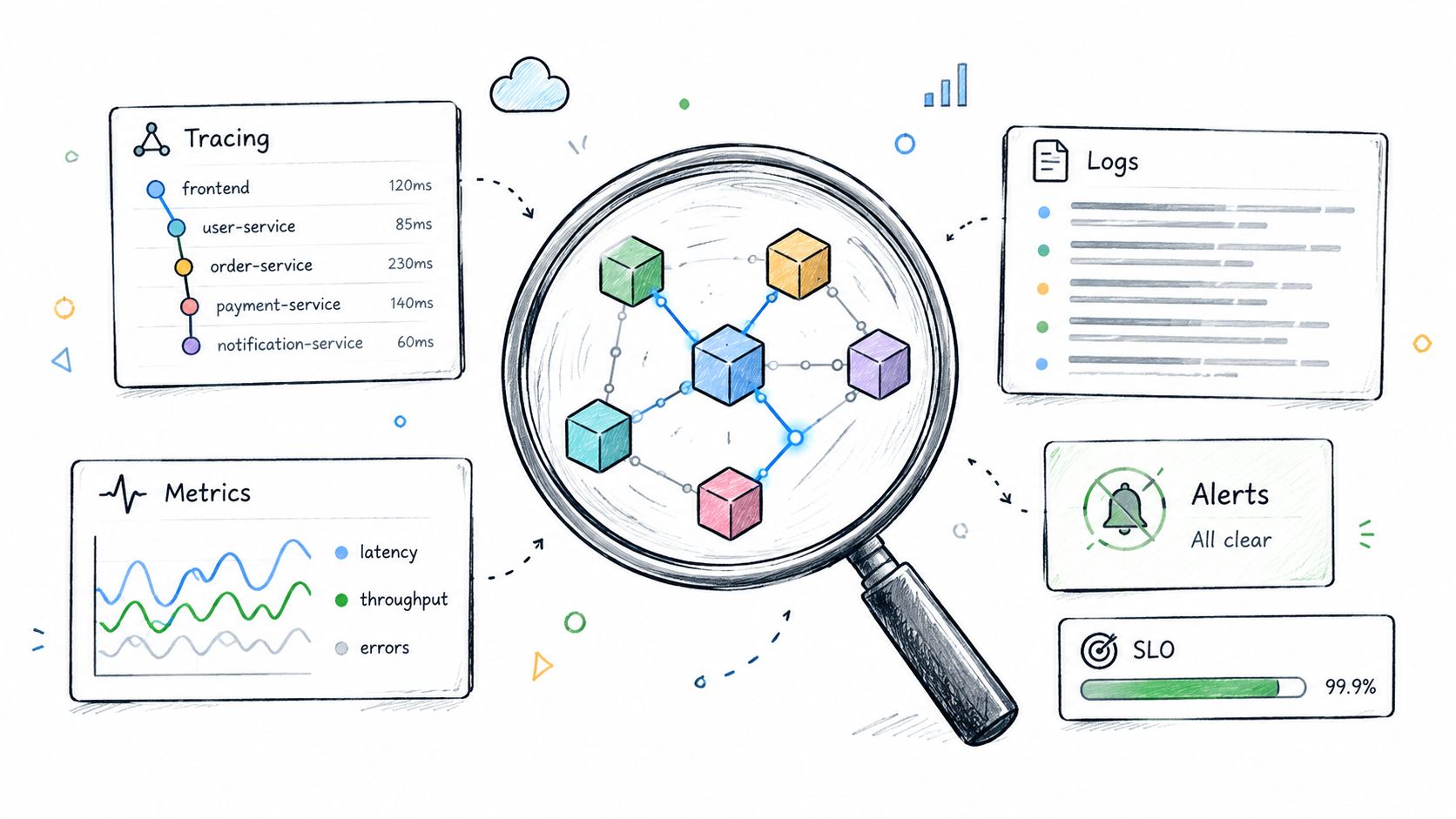
The candidate should cover metrics, logs, traces, correlation identifiers, dashboards, alert routing, service ownership, and service-level indicators. A good design gives teams useful defaults without forcing every engineer to become an observability specialist. For a payment service, useful indicators might include successful transaction behavior, latency, error behavior, and dependency health, not just whether a process is running.
The answer should separate operational signals from diagnostic detail. High-cardinality data can improve investigation while increasing storage and query costs. Retention, sampling, aggregation, and tiered storage should be part of the design. Alerting should focus on actionable symptoms and customer impact, with escalation paths tied to ownership.
Follow-ups and seniority signals
Ask how the candidate would define service-level objectives for a payment service and how those objectives would influence alerts. Probe alert tuning, duplicate suppression, maintenance windows, and post-incident review. Ask how teams can customize domain-specific dashboards without creating an inconsistent platform-wide experience.
Mid-level candidates should build dashboards, alerts, and instrumentation patterns. Senior candidates should standardize observability across teams, define platform interfaces, manage telemetry economics, and connect signals to reliability decisions.
Tech-stack variations and evaluation
For a Prometheus and Grafana stack, discuss recording rules, federation, and alert routing. For OpenTelemetry, examine instrumentation, collectors, context propagation, and backend portability. For commercial platforms, ask how indexing, sampling, retention, and access controls affect cost and usability. For serverless systems, focus on invocation traces and asynchronous workflows.
The 2026 labor-market dataset analyzed 2,337 live U.S. DevOps, SRE, and platform engineer postings and found observability in 25.4% of listings, alongside Kubernetes, Terraform, Python, AWS, and CI/CD as frequently named skills. (Live platform engineering job analysis) That makes observability a practical screening area, but evaluation should still focus on decisions and outcomes.
8. Lead Platform Architecture Evolution and Technology Strategy
Question: A platform has accumulated brittle tooling, inconsistent interfaces, and growing support demand. How would the candidate decide what to modernize, preserve, or remove?
The answer should begin with user and operational evidence. A technically elegant replacement can fail if it disrupts delivery, ignores existing workflows, or solves a problem developers don’t experience. The candidate should explain how they would gather feedback, map dependencies, assess reliability and security risk, estimate migration effort, and establish a transition path.
Technology selection should follow the problem. Kubernetes, Backstage, Crossplane, Argo CD, Terraform, and managed cloud services can each support different platform boundaries. The candidate should discuss build versus buy, open-source operating costs, vendor dependency, team capability, support burden, and the risk of creating a custom system that only its builders understand.
Follow-ups and seniority signals
Ask for an architectural decision the candidate led and request the constraints, alternatives, decision process, rollout, and outcome. Probe how a major refactoring would be sequenced while the existing platform continues serving teams. Ask how the candidate handles a stakeholder who wants innovation at the expense of stability.
Mid-level candidates should make scoped technical decisions and communicate impact. Senior candidates should set platform direction, establish decision principles, align executives and engineering teams, and deprecate low-value capabilities without damaging trust.
Tech-stack variations and evaluation
For a company moving from Jenkins to GitHub Actions, ask how migration sequencing and compatibility would work. For a Kubernetes platform adopting Crossplane, explore whether the abstraction reduces developer effort without concealing important failure states. For Backstage, ask whether the service catalog, scaffolding, or ownership model should come first.
Candidates should understand the distinction between DevOps responsibilities and platform product responsibilities. The DevOps versus platform engineering comparison can help hiring teams define that boundary before interviews begin.
9. Manage Multi-Cloud or Hybrid Cloud Infrastructure Complexity
Question: How would the candidate design a platform for workloads distributed across public cloud providers and on-premises infrastructure?
A strong answer challenges the premise before designing the solution. Multi-cloud can support regulatory requirements, acquisition integration, resilience, or a genuine service-specific fit. It can also multiply networking models, identity systems, observability integrations, deployment behaviors, and operational expertise. Portability should be justified by a business or risk requirement, not treated as an automatic virtue.
The candidate should define the abstraction boundary. A common deployment interface may hide routine provider differences, while advanced teams may need direct access to provider-specific capabilities. The platform should standardize identity, policy, delivery, telemetry, and service ownership where consistency creates value. It shouldn’t erase meaningful differences in storage, networking, availability, or managed-service behavior.
Follow-ups and seniority signals
Ask about a real multi-cloud or hybrid experience and the lesson that changed the design. Probe workload placement, data gravity, egress exposure, support ownership, and failover assumptions. Ask how the team would compare cost across providers without relying on headline compute prices alone.
Mid-level candidates should understand provider services and deployment portability. Senior candidates should create a placement framework, define exception processes, model operational complexity, and explain how standardization affects developer experience.
Tech-stack variations and evaluation
With Kubernetes, ask whether a common control plane, separate clusters, or a federated approach is appropriate. With Terraform, examine provider separation, module design, and state boundaries. With Crossplane, discuss how a platform API could expose common capabilities while allowing provider-specific compositions. In hybrid environments, explore connectivity, identity federation, and private service dependencies.
Evaluation should reward explicit trade-offs. A candidate who promises portability without discussing data, networking, and operations hasn’t addressed the problem.
10. Coach Engineering Teams on Platform Adoption and Best Practices
Question: A technically strong internal platform has low developer adoption. How would the candidate diagnose the problem and improve usage?
This is the question that separates a tooling operator from a platform product thinker. The candidate should investigate developer workflows, support tickets, onboarding friction, documentation quality, missing capabilities, migration cost, and trust in the platform. They should identify early adopter teams, create feedback loops, and test a golden path with real users before imposing a standard across the organization.
The candidate should also explain what success means. A 2025 survey of 326 software engineering leaders found the most common platform engineering success metrics were developer productivity at 64%, fewer security incidents or failures at 62%, software release frequency at 59%, and developer satisfaction at 58%. (Platform engineering leadership survey) Those measures show why platform evaluation should include flow, reliability, and internal customer experience.
Follow-ups and seniority signals
Ask for an example of a platform feature that developers rejected, how the candidate diagnosed the adoption failure, and what they changed. Probe how developer satisfaction is measured, how resistance is handled, and what happens when a team needs an exception. Ask which platform capability the candidate would deprecate if usage stayed weak.
Mid-level candidates should document workflows, run enablement sessions, and respond constructively to feedback. Senior candidates should build an adoption strategy, influence without authority, align security and product teams, and turn platform users into advocates.
Tech-stack variations and evaluation
For Backstage, evaluate service catalog quality, scaffolding, ownership data, and plugin governance. For GitHub Actions or GitLab CI, ask how reusable workflows can remain flexible without becoming confusing. For Kubernetes platforms, explore whether developers receive a simple application interface while retaining enough context to troubleshoot failures. For Terraform or Crossplane, assess whether self-service APIs reduce cognitive load or merely relocate infrastructure complexity.
A strong candidate explains not only what the platform does, but who uses it, why they trust it, and how the team knows it creates value.
Platform Engineer Interview Topics: 10-Point Comparison
| Item | Implementation complexity | Resource requirements | Expected outcomes | Ideal use cases | Key advantages |
|---|---|---|---|---|---|
| Design a CI/CD Pipeline for a Microservices Architecture | High, multiple integrations, pipelines, and orchestration | CI/CD servers, container registries, orchestration, test infra, skilled DevOps engineers | Automated builds/deploys, faster release cadence, safer rollouts | Microservices teams with frequent releases | Repeatable deployments, rollback/canary strategies, reduced MTTR |
| Optimize Kubernetes Cluster Performance and Cost | Medium–High, tuning autoscalers, resource settings, networking | Monitoring/cost tools, autoscaling config, cluster admins, cloud budget controls | Improved utilization, lower spend, consistent performance | Large k8s fleets, cost-sensitive workloads | Cost savings, better resource efficiency, improved SLAs |
| Implement and Manage Infrastructure as Code at Scale | High, state management, modularization, testing and governance | IaC tools, remote state backends, CI, governance, experienced engineers | Reproducible infrastructure, faster provisioning, fewer manual errors | Multi-account/cloud environments and repeatable deployments | Versioned infra, collaboration, safer disaster recovery |
| Design a Disaster Recovery and Business Continuity Strategy | High, multi-region/failover design and runbook automation | Redundant resources, replication, backups, DR testing infrastructure, runbooks | Defined RTO/RPO, faster recovery, minimized downtime | Mission-critical services, regulated businesses | Business continuity, risk mitigation, compliance readiness |
| Troubleshoot and Optimize Application Performance Under Load | Medium, profiling, load testing, database and cache tuning | APM/profiling tools, load test suites, observability, performance engineers | Lower latency, higher throughput, reduced cost per request | High-traffic applications and performance regressions | Better user experience, measurable performance gains, cost reduction |
| Design a Secure and Compliant Platform Infrastructure | High, defense-in-depth, audits, policy automation | IAM, encryption, vulnerability scanners, audit logging, compliance experts | Reduced security risk, compliance readiness, auditable controls | Regulated industries and enterprise customers | Increased trust, lower liability, enterprise market access |
| Implement Observability and Monitoring for Complex Distributed Systems | Medium–High, metrics, logs, traces, alerting and SLOs | Metrics/tracing/logging stack, storage, alerting, SREs | Faster detection and resolution, actionable telemetry, SLO visibility | Distributed microservices and incident-prone systems | Improved MTTR, system visibility, data-driven operations |
| Lead Platform Architecture Evolution and Technology Strategy | High, cross-team alignment, long-term planning, trade-off management | Senior architects, stakeholder time, roadmap resources, research/POC budget | Strategic alignment, reduced technical debt, scalable roadmaps | Scaling organizations, legacy-to-modern migrations | Sustainable growth, aligned tech choices, talent attraction |
| Manage Multi-Cloud or Hybrid Cloud Infrastructure Complexity | High, cross-provider networking, portability and failover design | Multi-cloud tooling, provider expertise, higher operational overhead | Reduced vendor lock-in, flexible workload placement, resilience | Organizations requiring portability, residency, or resilience | Resilience, cost-optimization options, decreased single-provider risk |
| Coach Engineering Teams on Platform Adoption and Best Practices | Medium, change management, training, governance | Documentation, training programs, platform advocates, feedback channels | Higher platform adoption, standardized practices, improved DX | Organizations rolling out internal platforms or standards | Multiplied platform impact, better developer experience, stronger standards |
Turn Interview Questions Into Better Hiring Decisions
Hiring teams should score platform engineer interview questions against capabilities, not brand-name familiarity. Kubernetes and Terraform may be common requirements, but a candidate who can only describe commands won’t necessarily design a platform that developers can safely use. The interview should reveal how the person reasons about reliability, security, cost, delivery, architecture, and adoption as connected concerns.
A structured evaluation starts with a production scenario. Ask the candidate to state assumptions, identify constraints, propose a design, and explain what could fail. Follow-up questions should then test whether the original answer survives pressure. What happens during a regional outage? Which team owns the rollback? How does a developer discover the supported path? What happens when the default abstraction doesn’t fit? Which signal proves that the platform improved the workflow?
Evidence of production ownership matters more than polished vocabulary. Candidates should be able to explain an incident, a migration, an infrastructure refactoring, a security control, or a platform feature that didn’t work as planned. Strong answers include the decision context, alternatives considered, operational consequences, communication approach, and follow-up measurement. Candidates who describe only successful launches may understand implementation, but they haven’t necessarily demonstrated judgment.
Seniority should change the scoring standard. A mid-level engineer should reliably implement pipelines, infrastructure automation, observability, and Kubernetes operations within established patterns. A senior engineer should design reusable platform capabilities, manage cross-team trade-offs, and improve adoption. Staff and principal candidates should connect architecture to business priorities, build coalitions, define strategy, and explain why the organization should fund one platform investment instead of another.
Interview design also benefits from restraint. Expert guidance recommends assessing platform engineers with 3 to 4 behavioral questions per interview session, spending about 10 to 15 minutes per question, which leaves space for deeper discussion of incidents, automation, and cross-team influence. (Platform engineer interview guidance) That format is more useful than rushing through a long list of shallow prompts.
Candidates can prepare in a similarly practical sequence:
- Map experience to the ten capabilities: Connect past work to delivery, Kubernetes, infrastructure as code, recovery, performance, security, observability, architecture, cloud complexity, and adoption.
- Practice trade-off explanations: Prepare to compare safety with speed, abstraction with control, resilience with cost, and standardization with team autonomy.
- Prepare incident examples: Cover detection, mitigation, communication, recovery, and the engineering changes that followed.
- Build adoption stories: Include one successful rollout and one platform feature that failed to gain trust. The lesson matters as much as the result.
- Adapt the vocabulary: Match examples to the employer’s cloud provider, orchestration layer, delivery system, compliance environment, and platform maturity.
Hiring managers should also test whether the role is platform engineering rather than infrastructure operations with a new title. The job should have internal customers, a product or roadmap mindset, self-service goals, and meaningful adoption measures. Candidates should ask who owns platform priorities, how developer feedback is collected, what the current platform maturity is, and how leadership defines value.
Nexus IT Group is a relevant staffing and interview-preparation partner for organizations hiring difficult-to-fill DevOps and SRE roles. Its resources include material such as 10 SRE interview questions and model answers, while its staffing services cover contract staffing, direct placement, executive search, and specialized technology recruiting. For employers, that combination can support clearer role definition and more focused evaluation. For candidates, hands-on guidance through role alignment and interview preparation can help translate DevOps or SRE experience into platform engineering evidence.
The best hiring decision comes from combining technical design, follow-up depth, production ownership, communication, and platform adoption judgment. Tool familiarity opens the conversation. The ability to make sound decisions under constraints determines whether the candidate can build a platform teams will trust and use.
Nexus IT Group connects employers with experienced DevOps, SRE, cloud, and platform engineering professionals through contract staffing, direct placement, and executive search. Visit nexus IT group for specialized talent support and practical interview resources for difficult technology hiring needs.
