
The popular advice to aspiring quant developers is to learn more mathematics and build a backtest. That’s incomplete advice, and employers make the same mistake when they turn it into a job description. A successful backtest doesn’t establish that a developer can operate a trading service, diagnose inconsistent market data, or prevent an execution failure. The hiring decision should start with production responsibility, not a generic checklist of Python, C++, and finance.
Table of Contents
- What a Quantitative Developer Really Does
- How the Role Emerged from Electronic Trading
- The Five Production Tracks Inside One Job Title
- Python for Research, C++ for Execution
- Engineering Under Microsecond Pressure
- Where AI Changes the Role and Where It Does Not
- Hiring, Compensation, and Interview Prep That Actually Works
What a Quantitative Developer Really Does
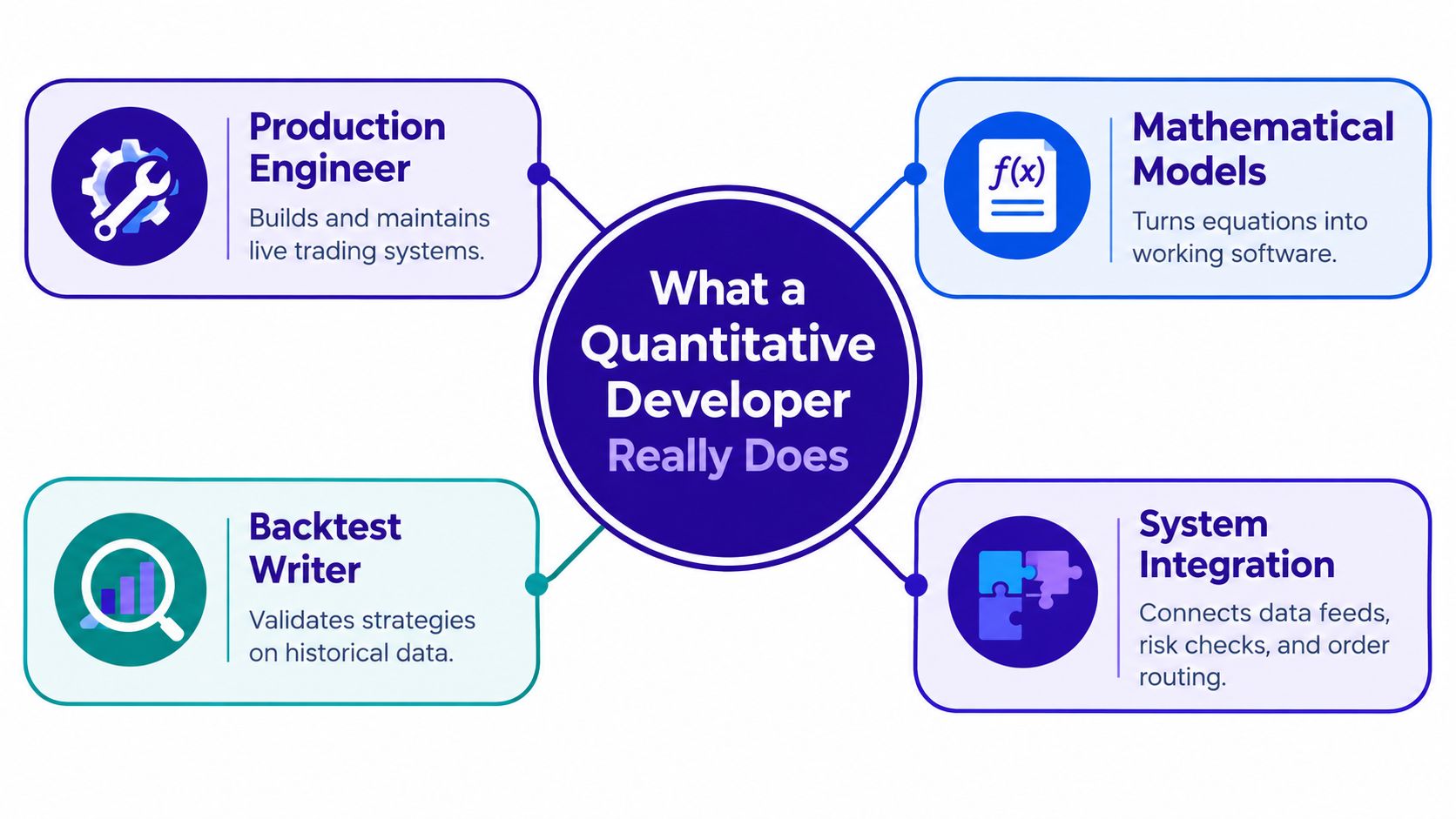
A quantitative developer, often called a quant developer, turns mathematical and statistical models into reliable production software for trading, valuation, or risk management. The role connects programming with quantitative reasoning and financial-market knowledge, but its defining responsibility is implementation beyond the research notebook. Quantitative developer role descriptions identify model implementation, backtesting infrastructure, market-data preparation, system integration, and maintenance as practical responsibilities.
The distinction becomes clear through an illustrative workflow. A quantitative researcher develops a signal from historical observations and explains why it might predict an outcome. The quant developer determines how the implementation receives inputs, handles incomplete observations, produces reproducible results, and integrates with downstream systems.
A conventional software engineer may build the surrounding service well but need help interpreting the model’s assumptions. A researcher may understand those assumptions in detail but need help designing deployment and operational safeguards. The quant developer must connect both disciplines without altering the model’s meaning.
Follow the model beyond the notebook
Consider a hypothetical signal that depends on current prices and a rolling historical calculation. Shipping it requires more than translating the formula into a function:
- Define the input contract. Specify timestamps, instrument identifiers, missing-value behavior, and acceptable data freshness.
- Preserve the research assumptions. Confirm that the live calculation uses the same information boundaries and numerical conventions as the research implementation.
- Connect the decision path. Establish how a calculated signal reaches portfolio, risk, or execution components.
- Own operational behavior. Decide what happens when dependencies fail, observations arrive late, or a service restarts.
These are recommended ownership questions, not a demand that every quant developer manage every component. A pricing-library developer might own numerical behavior and interfaces while another engineer owns deployment infrastructure. The important requirement is an explicit boundary.
Practical rule: A quant-developer job description should name the production artifact, its users, and the consequences of an incorrect result.
For employers searching “what is quantitative developer,” the useful answer isn’t a programmer who knows finance. It’s a developer whose engineering decisions must preserve a quantitative model’s intended behavior. Candidates should therefore present projects through assumptions, implementation choices, tests, and operational limits, not just charts showing strategy performance.
How the Role Emerged from Electronic Trading
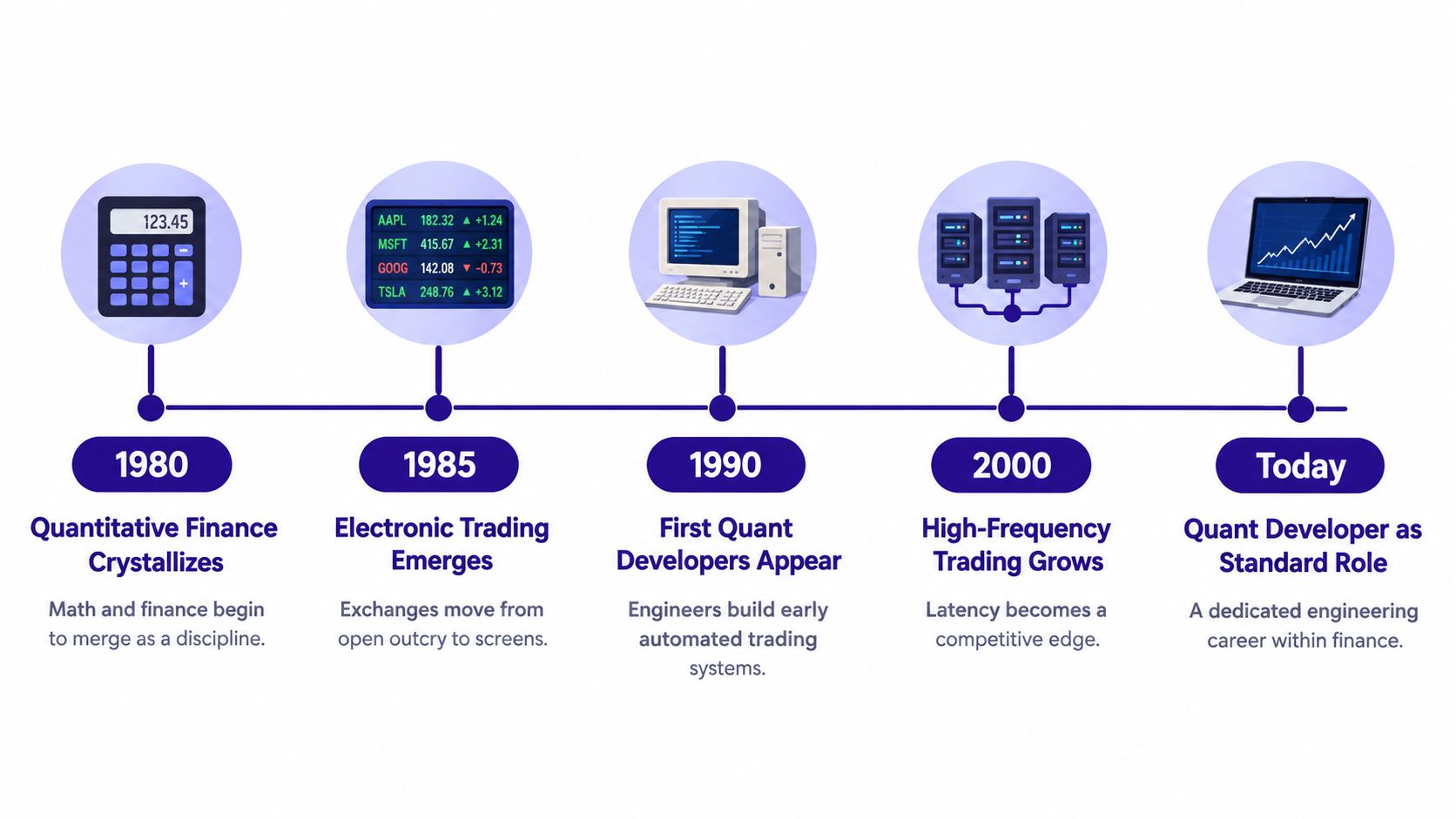
Electronic trading made quantitative finance an engineering discipline as much as an academic one. The field took shape during the 1980s, and Carnegie Mellon University launched the first professional Master of Science in Computational Finance in 1994, milestones recorded in this history of quantitative finance and its career foundations. Its foundation joined mathematics, statistics, computer science, and financial markets. Once models entered computerized markets, teams also needed software that could process data, act on decisions, connect to other systems, and behave predictably when conditions changed.
A market model does not become production-ready because its research results look sound. Electronic trading brought operational demands to the foreground: execution paths, system integration, and dependable behavior under changing conditions. The specific demands vary by production track, which is why a research-infrastructure hire should not be screened as though they were building execution systems.
The SEC reported that approximately 27% of U.S. National Market System stock-share volume was executed by broker-dealer internalizers in 2019, in its report on algorithmic trading and market structure. This measures internalizer activity, not the total share of algorithmic trading. It does show why market structure and automated execution matter when defining engineering responsibilities.
Hire for the market mechanism
The SEC report examines algorithmic systems in relation to liquidity, market quality, operational risk, and resilience. Hiring managers should start with the mechanism the developer will support, then define the production work around it. A broad requirement for “math plus programming” will blur distinct roles and produce weak screening criteria.
Compare quantitative trading firms by their engineering responsibilities, not by job titles alone. Research tooling calls for reproducible experiments; pricing and risk work demands numerical validation and clear model-change ownership; execution teams need defined connectivity, response-time, and recovery requirements. Those distinctions should shape both the job description and the interview.
The recruiting lesson is direct: financial models establish the problem, while the operating environment establishes the engineering bar. Strong mathematics does not prove systems competence, and systems experience does not prove understanding of financial assumptions. Candidates should show evidence relevant to the track they want; hiring managers should specify that track before advertising the role.
The Five Production Tracks Inside One Job Title
Employers shouldn’t write one job description for several incompatible production responsibilities. A useful recruiting framework separates quantitative development into five production tracks. This is a scoping framework, not a universal industry taxonomy.
The underlying responsibilities are concrete. A principal quantitative developer role at Fidelity includes production-oriented work involving APIs, data pipelines, cloud systems, automated testing, deployment practices, troubleshooting, and data integrity. Those duties warrant more precise hiring profiles than a broad demand for programming and mathematical ability.
Five Production Tracks of a Quantitative Developer
The language choices below are recommended starting points for role design, not mandatory stacks.
| Track | Primary Deliverable | Dominant Languages | Reliability Bar |
|---|---|---|---|
| Research infrastructure | Backtesting environments and reusable research tools | Python, with C++ where profiling justifies it | Reproducible experiments and explicit information boundaries |
| Pricing and risk | Valuation libraries, numerical routines, and risk engines | C++, Python, or Java according to the surrounding system | Validated numerical behavior and controlled model changes |
| Execution | Market-data handlers, order management, and trading applications | C++ for latency-sensitive paths; Python for supporting tools | Predictable response times, correct order state, and safe recovery |
| Platform and data engineering | Shared APIs, datasets, deployment systems, and operational tooling | Python or Java; C++ where required | Data integrity, stable interfaces, and recoverable services |
| ML-integrated signal work | Feature pipelines and deployed model inference | Python for experimentation; production language chosen by constraints | Leakage controls, versioned inputs, and monitored model behavior |
Failure consequences should determine interview depth. A weak research-infrastructure hire might permit misleading experiments through inconsistent datasets. A pricing developer might introduce unstable numerical behavior. An execution developer might mishandle an order-state transition, while a platform developer might distribute corrupted inputs across otherwise correct services.
For ML-integrated work, the central risk can be a mismatch between training assumptions and live inputs. Treating that as merely a Python coding problem misses the production responsibility.
The right candidate isn’t the strongest applicant across every track. It’s the applicant who can own the team’s actual failure modes.
Separate overlap from conflicting priorities
Tracks overlap naturally. A research-infrastructure developer may also maintain datasets, and a pricing developer may package libraries for shared platforms. Overlap is reasonable when the employer identifies the primary responsibility and the supporting work.
Conflict appears when an employer expects rapid experimental iteration and tightly controlled execution-path changes from the same undifferentiated role. Those activities need different release practices, review criteria, and performance evidence. Neither culture is superior.
Hiring managers should specify a primary track, secondary responsibilities, and excluded responsibilities. Candidates should ask which deliverable defines success and which team owns adjacent systems. If neither side can answer, the opening isn’t ready for a technical interview.
Python for Research, C++ for Execution
The strongest quant teams choose languages by production responsibility. A quant-developer opening combining research and live trading describes a Python-based research backtest system alongside a low-latency C++ suite of trading applications. Python supports post-trade analysis and simulation; C++ runs on back-end trading servers. The split reflects different work, not résumé fashion.
Python suits rapid investigation: researchers can revise calculations, compare datasets, and inspect intermediate results with less friction. C++ gives developers tighter control over memory use and concurrency, which matters when execution overhead becomes an operational constraint.
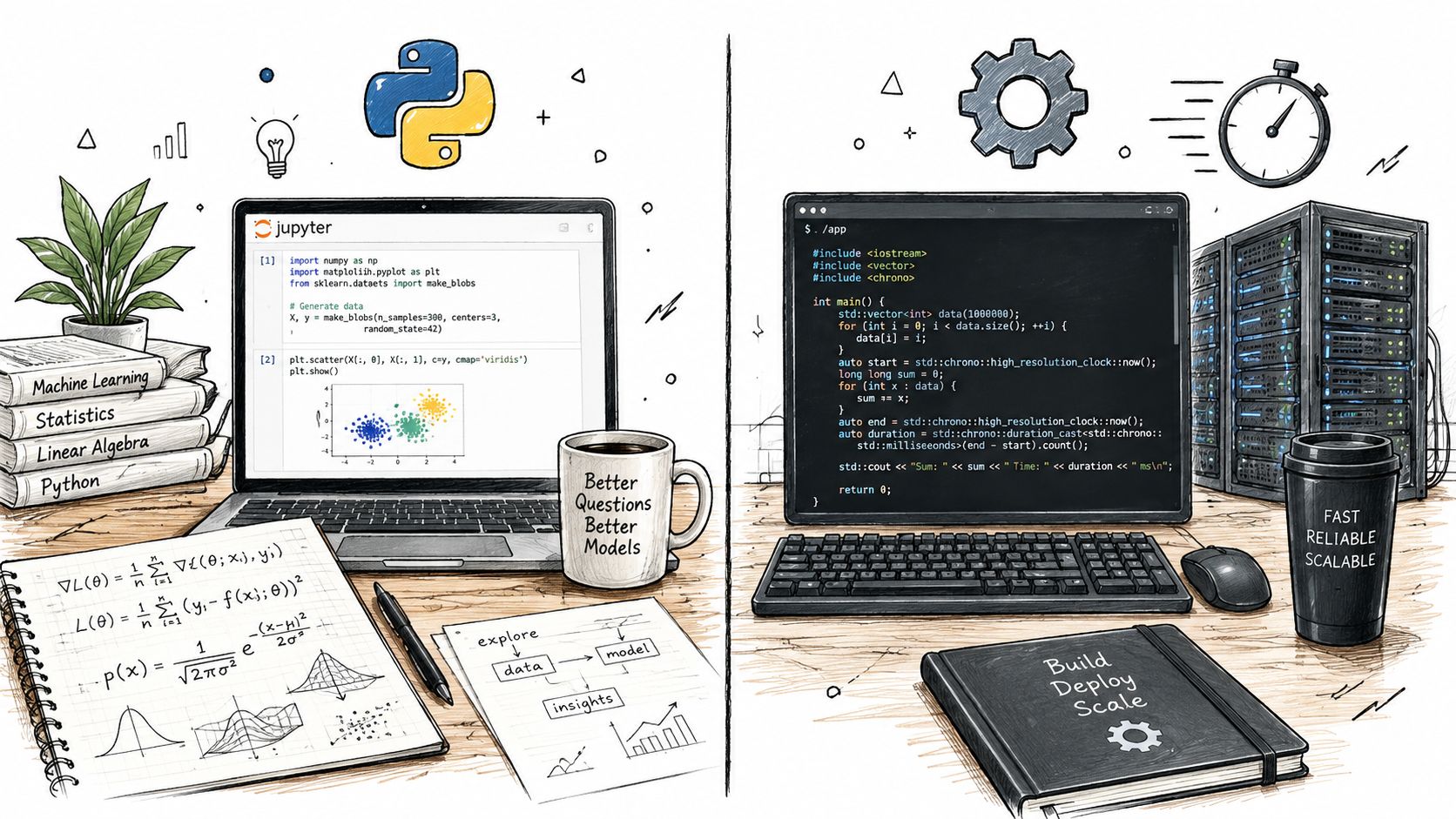
Take a rolling statistic explored in Python. Keep the research implementation clear and repeatable while the team is testing ideas. If that calculation later enters a performance-sensitive service, measure whether Python meets the service’s requirements before porting it. Compiling everything by reflex adds maintenance work without proving a production benefit. Let measured requirements, not language loyalty, decide.
The University of Chicago’s quantitative-finance career guidance covers programming, numerical methods, statistics, database engineering, and financial knowledge. Those skills support distinct workflows: Python often serves research, while C++ can meet requirements for deterministic performance, memory control, concurrency, or low latency.
Before translating a calculation into production, review four things:
- Behavioral equivalence. Confirm the production version handles edge cases and numerical tolerances as intended.
- Memory discipline. Check for avoidable allocation or copying on sensitive paths.
- Interface stability. Make input requirements clear, and distinguish invalid results from valid ones.
- Maintenance cost. Ensure the team can debug and change the compiled component without breaking the research contract.
Hiring managers should assess the work the role owns. For Python-heavy research, test data manipulation, testability, and analytical workflow design. For execution roles, probe C++ resource ownership, concurrency reasoning, and systems behavior.
Candidates should make their evidence match the track. A clearly defended Python research platform can demonstrate research engineering better than an unfinished C++ trading demo. Execution candidates still need to show they understand memory and concurrency constraints in a live system.
Engineering Under Microsecond Pressure
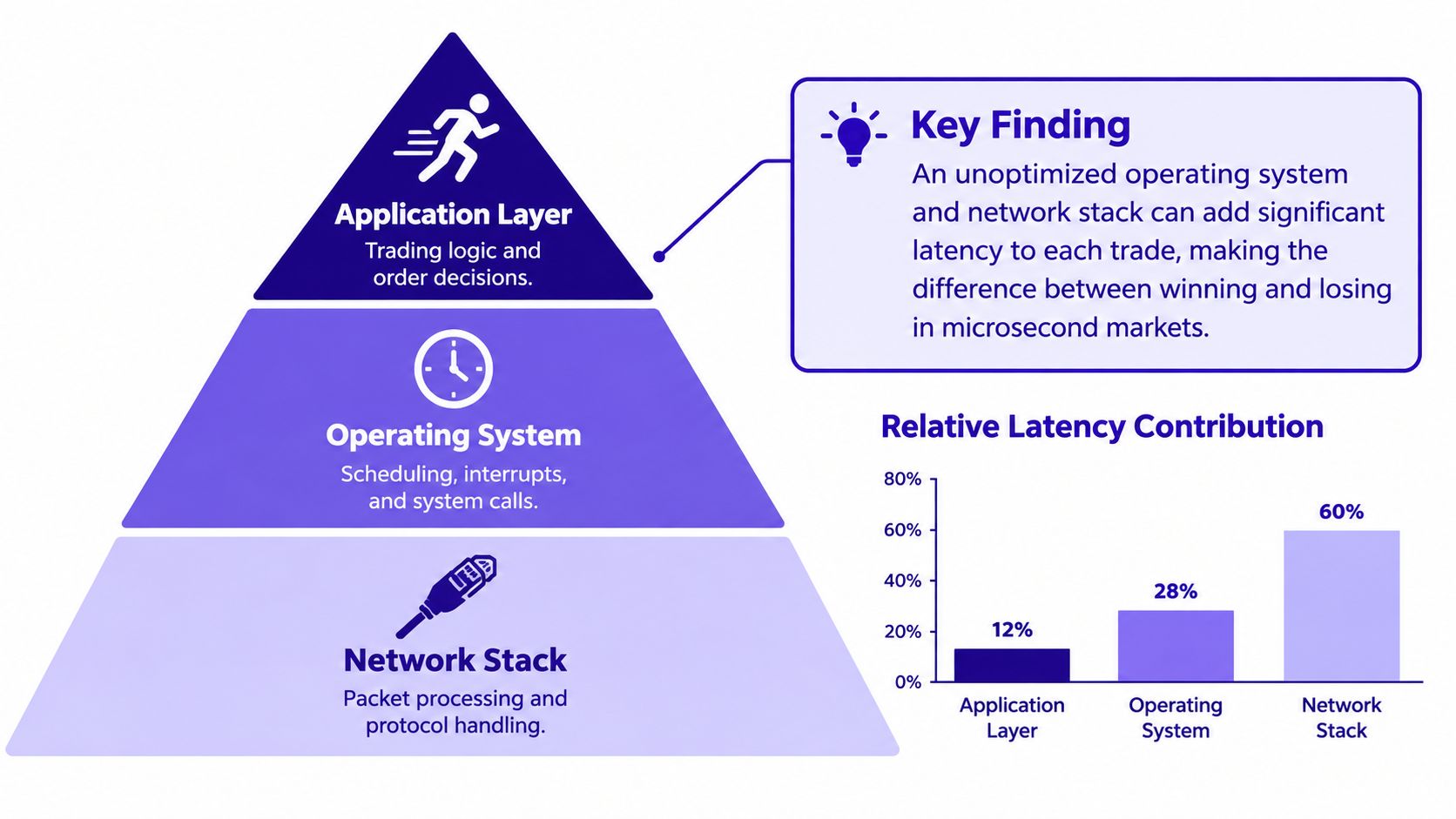
A low-latency system is only as fast as its slowest step. Research on automated-trading architectures reports approximately 15–20 microseconds of half-round-trip latency for an unoptimized operating-system and network stack, compared with about 4 microseconds using specialized network interfaces that bypass parts of the kernel and protocol stack. These measurements describe specific architectures, not a guaranteed trading-system result.
The practical lesson: measure the full path before tuning the model. Packet handling, scheduling, serialization, and memory access can outweigh the calculation itself.
Start with the production track. Execution developers need to trace events from ingestion through order handling and recovery. Platform developers must account for the services and data flows supporting that path. A useful review checks how the system identifies packet loss or stale observations, rejects invalid inputs, and recovers after a failure. Testing should include representative load and failure conditions, while monitoring must help diagnose abnormal behavior without adding unnecessary work to the sensitive path.
Then profile the bottleneck. Separate application costs from operating-system and network overhead. Examine allocations, copies, cache locality, data structures, and serialization only where measurements point. Lock-free code needs a clear account of ordering and safety, not just an attractive benchmark. Check tail behavior under stress, since averages alone cannot show whether a system remains predictable.
Hiring standard: An optimization is incomplete until its author can explain its failure behavior and maintenance cost.
Employers can use a low-latency developer job-description framework to define systems responsibilities instead of bundling them into a generic quant developer opening. Ask candidates what happens after a rejected order, disconnect, or restart. Match those questions to the track: execution hires should explain live-system failure modes; platform hires should address service recovery and operational visibility.
Teams evaluating real-time model services can consult the Streamkap resource on AI streaming for related streaming and benchmarking questions. AI-service measurements and trading-network measurements are not interchangeable.
Faster response can increase defect and maintenance risk. Hire for measured improvement and sound reasoning, not specialized components without a demonstrated need.
Where AI Changes the Role and Where It Does Not
AI doesn’t justify collapsing every quantitative opening into an ML-engineer search. Hedgeweek’s reporting on a quantitative-finance industry survey states that 59% of respondents say AI has already expanded their responsibilities, 74% expect major or complete role transformation within five years, and 75% say their current role requires capabilities not taught at university. The transformation figure describes respondents’ expectations, not a guaranteed outcome.
Those findings support a changing capability mix. They don’t establish that quantitative developers will disappear or that AI-tool familiarity proves model competence. Employers should map adoption to the production track and retain accountability for generated code and deployed models.
Automate by track, not by job title
| Track | Recommended first automation target | Responsibility that should remain explicit |
|---|---|---|
| Research infrastructure | Drafting test scaffolds and research utilities | Experiment validity and reproducibility |
| Pricing and risk | Proposing regression tests and documentation | Numerical validation and model-change approval |
| Execution | Assisting with offline code review and diagnostics | Concurrency correctness and performance verification |
| Platform and data engineering | Drafting integration code and operational documentation | Data contracts, access boundaries, and recovery |
| ML-integrated signal work | Supporting feature exploration and evaluation tooling | Leakage prevention, deployment judgment, and monitoring |
These are recommended starting points, not claims about measured productivity. Teams should begin with work that has clear acceptance criteria and an independently checkable result.
The research track can benefit from faster iteration without granting generated experiments automatic credibility. Pricing and execution teams should be especially skeptical of plausible-looking code whose numerical or concurrency behavior hasn’t been established. Platform teams need integration discipline, while ML-integrated teams need a defensible connection between evaluation and live behavior.
For software leaders considering delivery-process changes, Rite NRG on AI-native delivery offers a relevant additional perspective. The hiring assessment should still distinguish tool usage from the ability to evaluate the resulting system.
A candidate who can generate code but can’t defend its assumptions isn’t production-ready. Employers should hire an ML engineer when experimentation is the bottleneck, a quantitative researcher when model design is the bottleneck, and a quant developer when implementation and operation are the bottleneck.
Hiring, Compensation, and Interview Prep That Actually Works
Pick the track first, then set the assessment and compensation band. A representative C++ quant-developer opening combines quantitative education with C++, Python, algorithms, systems programming, parallel computing, and high-performance experience. A degree alone isn’t an adequate hiring decision.
Calibrate pay against ownership
A defensible salary or total-compensation range requires current, location-specific market evidence. Employers should benchmark each track and distinguish supported implementation work from independent subsystem ownership and senior architectural responsibility. Base salary and variable compensation should be stated separately, with the latter’s conditions made explicit.
Match preparation to assessment
The following 30/60/90-day plan is a recommended preparation schedule, not a placement forecast.
| Preparation stage | Candidate work | Hiring-manager counterpart |
|---|---|---|
| Days 1–30 | Review probability, linear algebra, numerical methods, and Python data tooling | Assess a numerically stable calculation and input handling |
| Days 31–60 | Build a time-series pipeline; study C++ memory and concurrency where relevant | Test information boundaries, complexity, and memory trade-offs |
| Days 61–90 | Defend a backtest and rehearse abnormal-condition tests | Review reproducibility, failure handling, and architecture |
A useful interview loop combines implementation, quantitative validation, and production design. Quant interview questions can support technical preparation, while the StoryCV interview question guide offers candidates an additional resource for preparing questions about the employer.
Red flags include unexplained assumptions, benchmarks without context, and no credible failure tests. Candidates should ask who approves model changes and owns incidents. Hiring managers should reward evidence of sound production judgment rather than polished answers about language syntax.
Alongside direct sourcing and internal recruiting, nexus IT group offers specialized quant recruitment, direct placement, and contract staffing. Hiring managers can bring a track-specific role outline, while candidates can seek role alignment and interview preparation for the production responsibilities their next position will require.
