Hiring for critical IT roles is expensive, slow, and hard to get right. That pressure sits inside a massive labor channel. In the United States, staffing companies hired 12.7 million temporary and contract employees in 2023, and 73% of staffing employees worked full time, according to the American Staffing Association’s staffing industry statistics. That matters because staffing isn’t a side tactic anymore. For many employers, it’s a core way to secure technical talent quickly without building every recruiting capability in-house.
The better question isn’t who has the biggest database. It’s which firm can act like a real hiring partner when the role is difficult, urgent, or strategically important. The best IT staffing agency for one company may be the wrong fit for another.
Four factors separate strong partners from resume vendors. Niche expertise and technical acumen shows up in how they scope an AI, cloud, or cybersecurity search. Engagement model flexibility determines whether they can support contract, direct hire, or executive search without forcing the wrong model. Candidate vetting and experience affects whether hiring teams see relevant people or keyword matches. Market credibility and track record helps validate whether the firm adds value after the introduction.
The list below uses that framework and gets to the point.
Table of Contents
- 1. Nexus IT Group
- 2. TEKsystems
- 3. Apex Systems
- 4. Randstad Technologies
- 5. Kforce
- 6. Motion Recruitment
- 7. Experis
- Top 7 IT Staffing Agencies Comparison
- Your Next Step How to Engage an IT Staffing Partner
1. Nexus IT Group
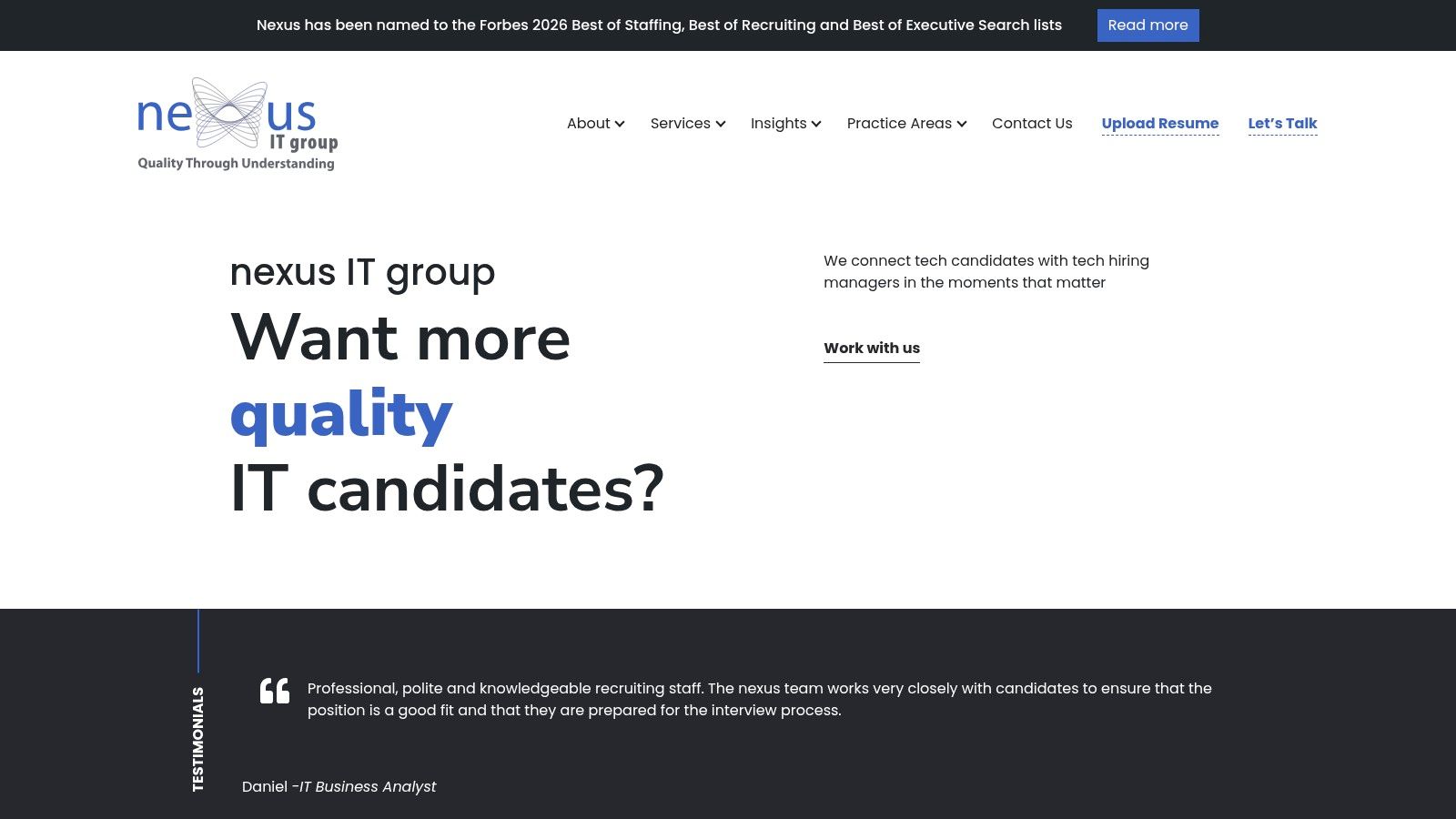
Nexus IT Group is the strongest fit for hiring teams that need a specialist, not a generalist. The firm focuses on hard-to-fill technology roles across AI engineering, cloud, cybersecurity, data science, DevOps and SRE, software development, fintech, UX, quant hiring, healthcare IT, government IT, and leadership search. That breadth matters, but the more important point is that these are role families where weak screening wastes interview capacity fast.
Its model is flexible in the right way. Nexus supports contract staffing, direct placement, IT executive search, Recruitment-as-a-Service, confidential search, and resume review. That gives hiring teams room to match the search model to the business problem instead of bending the role to whatever commercial model the agency happens to prefer.
Why Nexus stands out
Nexus was built by IT recruiters, and that shows in how it positions itself. The emphasis isn’t just speed. It’s fit, communication, and recruiter fluency in technical hiring markets where job titles often hide very different skill sets.
Candidate support is another differentiator. Employers that care about close rates should pay attention to this because candidate experience often predicts whether a finalist stays engaged. Nexus also publishes practical hiring content, including guidance on what to evaluate when picking IT staffing agencies, which is useful for teams building a vendor scorecard before they sign anything.
Practical rule: For AI, cloud, security, and leadership searches, the best IT staffing agency is usually the one that asks sharper intake questions, not the one that promises the fastest first resume.
The firm’s market credibility also helps. Nexus IT Group was named to the Forbes 2026 Best of Staffing, Best of Recruiting and Best of Executive Search lists. For buyers, that doesn’t replace diligence, but it does add a trust signal around service quality and specialization.
Best fit and trade-offs
Nexus is especially well suited to mid-market and enterprise employers, private-equity-backed growth companies, startups scaling technical teams, and firms with niche hiring needs in North American hubs. It also fits well when a company wants one partner that can support both individual contributor hiring and leadership search.
The trade-off is straightforward. Pricing isn’t published publicly, so buyers need a consultation to understand fee structure, delivery model, and timeline. Teams looking for a low-touch, transactional vendor or a purely local non-technical recruiter may find the model more consultative than they need.
What works well
- Niche technical depth: Strong alignment for AI, cloud, cybersecurity, data, DevOps, quant, and IT leadership searches.
- Flexible hiring models: Contract, direct hire, executive search, and RaaS let employers choose the right path for urgency and budget.
- Hands-on process support: Interview prep, resume review, and hiring resources improve the overall search process.
What to watch
- Custom pricing only: Buyers need to clarify fees and terms during intake.
- Best for specialized environments: Very small local businesses with generalist hiring needs may want a broader local staffing firm.
Website: Nexus IT Group
2. TEKsystems
TEKsystems is the call when scale matters as much as specialization. It covers contract, contract-to-hire, direct hire, and project-based work, which makes it useful for enterprise environments that don’t just need one engineer. They need a staffing partner that can support a program.
Its broad coverage across cloud, data and AI, application development, cybersecurity, and IT operations is a practical advantage for companies with multiple open requisitions across adjacent teams. A hiring leader can keep one vendor relationship in place while filling very different technical seats.
Where TEKsystems works best
The strength of TEKsystems is operating discipline. Large employers often need process maturity, reporting, and consistency more than boutique white-glove service. TEKsystems tends to fit best in Fortune 500, public sector, and complex enterprise programs where stakeholder management and delivery coordination matter.
That same scale is the trade-off. Candidate and client experience can vary by office and recruiter. For niche searches, buyers should ask who will personally run the req and what that recruiter has placed recently in the same domain. Teams comparing contract staffing models can also use this short overview of the benefits of using a staffing agency to separate true staffing value from generic vendor promises.
Large firms can absolutely deliver niche talent. But buyers shouldn’t assume the brand guarantees specialist execution. The assigned recruiter matters.
TEKsystems is a strong option when an organization needs coverage, velocity, and the ability to support multiple hiring models under one roof. It’s less compelling when the role is highly specialized and the company wants a boutique-style search process.
Website: TEKsystems
3. Apex Systems
Apex Systems sits in a useful middle ground between staffing firm and broader delivery partner. It offers staff augmentation, consulting support, and deliverable-based services across software, cloud and infrastructure, data, cybersecurity, and PMO work. For companies running multi-site programs, that combination can simplify vendor management.
Apex is often a good fit when the hiring challenge isn’t one role. It’s a transformation initiative with staffing needs attached. In that situation, the agency’s ability to coordinate talent delivery across sites and functions becomes more valuable than a boutique search experience.
Why buyers choose Apex
Apex benefits from its connection to ASGN’s broader services ecosystem. That gives employers optionality if a staffing search turns into a wider consulting or managed delivery need. For CIO and CTO teams under delivery pressure, that flexibility can be useful.
The limitation is familiar. Candidate experience can vary by recruiter, and buyers should verify exactly who is managing outreach and screening. Teams evaluating different vendor approaches can compare Apex’s model against more focused IT recruiting services to decide whether they need specialist search depth or broader program support.
Best reasons to consider Apex
- Enterprise scaling capability: Useful for multi-location and multi-team hiring efforts.
- Staffing plus services: Helpful when one project may require both individuals and structured delivery support.
- Strong coverage in transformation work: Solid fit for operations, development, infrastructure, and modernization programs.
Main caution
- Less boutique by design: If the need is one high-stakes specialist hire, some employers will want a narrower, more niche recruiting team.
Website: Apex Systems
4. Randstad Technologies
Randstad Technologies benefits from the infrastructure of one of the largest staffing organizations in the market. That matters in a category with serious scale. IBISWorld estimates the U.S. Employment & Recruiting Agencies industry will reach $34.0 billion in 2026 and include about 22,370 businesses, while the American Staffing Association reports staffing firms supported about 11 million employees in 2024 and that roughly 57% of staffing companies operate in professional and commercial specialties, as noted in IBISWorld’s industry outlook. For buyers, that means there are many choices, and scale alone doesn’t settle the decision.
Randstad Technologies makes the shortlist because it combines broad delivery capacity with practical vertical experience. It’s often a solid fit for financial services, healthcare, and other regulated environments where hiring managers need technical hiring help plus a vendor that understands process and compliance expectations.
Best use cases
Randstad tends to work well for staff augmentation, direct hire, and technology hiring tied to larger transformation programs. Its bench is useful for cloud migration work, data projects, operations support, and support-heavy environments where reliability matters as much as niche technical brilliance.
The trade-off is that large-agency process can feel standardized. Some teams appreciate that. Others want more search customization, more recruiter access, and a more opinionated point of view on market fit.
Buyers who need consistency across multiple business units often value structure more than flair. Randstad fits that kind of buying environment.
Website: Randstad Technologies
5. Kforce
Kforce has a narrower identity than some broad staffing brands, and that’s a positive. It has long been associated with technology and finance and accounting talent, which makes it useful for organizations hiring at the intersection of systems, reporting, operations, and regulated business processes.
For healthcare IT and other compliance-sensitive environments, that overlap can help. Hiring managers sometimes need a partner that understands both the technical role and the business function around it. Kforce is often stronger in those blended environments than firms that market only pure-play engineering coverage.
Where Kforce earns a spot
Kforce supports contract, contract-to-hire, direct-hire, and consulting engagements. That gives employers enough flexibility to test a contractor path, convert if the fit is right, or run a direct search when continuity matters more than short-term speed.
Its consultant-care reputation is worth noting because retention on longer assignments often comes down to communication, issue resolution, and manager support. The downside is that public pricing is uncommon, and experience can still vary by local team.
Strong fit for
- Healthcare IT and regulated sectors: Helpful where documentation, process, and stakeholder communication matter.
- Mixed business and technical hiring: Useful when the role touches systems and finance or operations.
- Contract-to-hire decisions: A reasonable choice when the employer wants to reduce hiring risk before committing.
Website: Kforce
6. Motion Recruitment
Motion Recruitment earns attention because it stays focused on technology hiring. That narrower scope usually leads to better recruiter conversations for software engineering, data and AI, DevOps and SRE, cybersecurity, and product hiring than buyers get from fully generalist firms.
This is one of the more practical choices for startups, growth-stage companies, and enterprise teams that need specialized technical talent in major U.S. tech hubs. The firm also benefits from having consulting capability through Motion Consulting Group, which gives employers another path if a role becomes a project.
Why specialization matters here
A recurring problem in IT staffing content is that it overemphasizes speed and brand size. A more useful standard is whether the recruiter can improve hiring quality for hard-to-fill roles. That gap is real. Existing market coverage often lists agencies without explaining how to evaluate specialization depth, screening quality, replacement terms, or role-family expertise. The discussion of that buyer gap in Instawork’s staffing agency roundup points in that direction, even though it doesn’t fully solve it.
Motion tends to perform best when the search needs discipline-specific recruiting. If a team is hiring an SRE, a platform engineer, and a security engineer, a specialist model is often more useful than a giant generalist bench.
The trade-off is geographic concentration. Motion is strongest in major tech markets, so companies hiring outside those hubs may want a second firm in the mix.
For hard-to-fill technical roles, deep recruiter specialization usually beats a broad but shallow candidate database.
Website: Motion Recruitment
7. Experis
Experis is a practical choice for employers that need IT staffing tied to broader workforce infrastructure. As part of ManpowerGroup, it can support staffing, consulting, managed services, and workforce development under one umbrella. That makes it useful for enterprise organizations balancing immediate hiring gaps with longer-term capability building.
The brand is especially relevant when the need goes beyond one placement. Some companies need contingent talent, project support, and upskilling pathways at the same time. Experis is built for that type of environment.
When Experis makes sense
A major shift in IT staffing is geographic reach. Insight Global, for example, says it operates 70+ offices across the U.S., Canada, the United Kingdom, India, and the Philippines, and can source talent from 50+ countries, according to Insight Global’s IT industry page. That doesn’t make Insight Global part of this list, but it does show the benchmark many national and global staffing providers now compete against. Experis belongs in the conversation because buyers increasingly expect agencies to support talent acquisition across regions and time zones, not just one local office.
Experis is a strong fit for enterprise programs that need reach, layered service options, and a provider comfortable with both staffing and managed delivery conversations. The compromise is that recruiter and candidate experience can vary across teams, so intake diligence still matters.
Best matched to
- Enterprise hiring programs: Good for organizations with repeat demand across multiple IT functions.
- Blended workforce strategies: Useful when staffing, consulting, and service delivery may overlap.
- Cross-region hiring needs: Relevant when talent sourcing extends beyond one city or one office.
Website: Experis
Top 7 IT Staffing Agencies Comparison
| Provider | Implementation complexity | Resource requirements | Expected outcomes | Ideal use cases | Key advantages |
|---|---|---|---|---|---|
| Nexus IT Group | Low–Medium, flexible, consultative engagements | Moderate, niche candidate networks; consultation to scope fees | High-quality, precise hires with strong candidate experience | Hard-to-fill technical and leadership roles for startups to mid‑market | Deep niche expertise, personalized candidate support, RaaS & executive search |
| TEKsystems | Medium–High, enterprise onboarding and program processes | High, very large talent network and program management capability | Scalable delivery for large, complex initiatives | Fortune 500 programs and large-scale enterprise projects | Broad coverage across IT disciplines, training and process maturity |
| Apex Systems (ASGN) | Medium–High, multi-site program setup and governance | High, enterprise footprint and integration with ASGN services | Scalable staffing and deliverable-based solutions across sites | Multi-site IT transformation and large-scale staffing needs | Enterprise scaling, consulting integration, proven delivery for mid‑market/enterprise |
| Randstad Technologies | Medium, MSA/VMS-based enterprise processes, vertical compliance | High, global staffing resources and industry-specific talent pools | Reliable support for large transformations with compliance support | Regulated industries (finance, healthcare) and large migration programs | Verticalized expertise, enterprise scale, compliance and planning resources |
| Kforce | Low–Medium, standard staffing flows, MSAs common for engagements | Moderate, nationwide recruiters with consultant-care programs | Consistent tech and finance placements with emphasis on retention | Healthcare IT, finance/accounting staffing, mid‑market engagements | Consultant-care focus, sector experience in regulated environments |
| Motion Recruitment | Low, specialist teams enabling fast shortlists; consulting via SOW | Moderate, niche discipline teams concentrated in tech hubs | Fast, well-matched shortlists for specialized technical roles | Startups, growth-stage companies, niche engineering/data/security hires | Discipline-specific recruiting, market intelligence, speed-to-fill |
| Experis (ManpowerGroup) | Medium–High, managed services, upskilling and program management | High, global pipelines, training/academy resources | Capacity plus outcome-based services and upskilling pathways | Large enterprise programs needing talent scale and training | Upskilling pathways, diversified pipelines, managed services expertise |
Your Next Step How to Engage an IT Staffing Partner
A shortlist only matters if the next conversation is structured. Too many hiring teams pick an agency based on brand familiarity, then wonder why candidate quality feels uneven. The agency didn't fail alone. The intake was vague, the evaluation criteria were fuzzy, and nobody aligned on what success looked like.
The first move is to define the hiring need in business terms, not just job-title terms. A strong internal brief should state the role, the tech stack, the project goal, the reporting line, the budget range, and whether the need is contract, contract-to-hire, or permanent. That gives the recruiter enough context to challenge weak assumptions early, especially on hybrid expectations, title inflation, and missing must-haves.
Then narrow the list to two or three firms. For most companies, that's enough to compare recruiter quality without turning the search into vendor chaos. If the role is highly specialized, the best IT staffing agency often won't be the largest provider. It will be the partner that can explain the market clearly, screen for the right technical depth, and maintain candidate engagement from first call to final offer.
The consultation call should work like a two-way interview. Hiring teams should ask how the firm screens for the specific role family, what the submittal process looks like, who runs the search, how candidate communication is handled, and what happens if a placement doesn't work out. Agencies worth hiring usually answer directly and with specifics. Agencies worth avoiding tend to fall back on generic talk about networks and speed.
Three next steps keep the process disciplined:
- Define the need clearly: Write the role brief before contacting agencies.
- Shortlist the right firms: Match the search to specialization, geography, and hiring model.
- Run pointed consultations: Compare recruiter depth, screening rigor, and delivery fit.
The goal isn't just to fill a seat. It's to build a hiring partnership that lowers risk, improves candidate quality, and gives the business a repeatable way to handle critical technical hiring.
Teams hiring for cloud, data, cybersecurity, software engineering, DevOps, or IT leadership can start with Nexus IT Group if the priority is specialist recruiting support with flexible engagement models. It's a strong option for employers that need a partner capable of handling hard-to-fill technical searches with more precision than a general staffing vendor.