
Data scientists aren’t just hard to hire. They’re being pulled into a labor market the U.S. Bureau of Labor Statistics projects will grow 34% from 2024 to 2034, with about 23,400 openings per year on average over the decade (BLS data scientist outlook). That number changes the conversation.
A CTO deciding whether to use data science recruiting firms shouldn’t frame it as a staffing choice. It’s a throughput decision. Every month a critical data role stays open, product roadmaps slip, analytics backlogs grow, and leadership starts making decisions with incomplete technical capacity. Generic recruiting usually fails because “data science” isn’t one job family anymore. It’s a cluster of specialized functions with different hiring risks, compensation expectations, and evaluation criteria.
The firms worth engaging aren’t résumé brokers. They’re filters. The right one narrows the market, screens technical depth before the hiring team gets involved, and aligns the search model with business urgency. The wrong one floods the pipeline with candidates who can talk about Python and machine learning but can’t operate in production, build pipelines, or partner with the business.
Table of Contents
- Why Finding the Right Data Talent Is Harder Than Ever
- The Modern Data Science Recruiting Process
- Comparing Data Science Recruiting Firm Models
- Your Framework for Vetting Potential Partners
- Matching the Right Firm to Your Business Needs
- How Nexus IT Group Delivers Specialized Talent
- Conclusion and Your Hiring Next Steps
Why Finding the Right Data Talent Is Harder Than Ever
The hiring problem isn’t just scarcity. It’s fragmentation.
A company may open one req labeled “senior data scientist” and need a mix of model experimentation, stakeholder communication, feature engineering, and production collaboration. Another may use the same title but need a pipeline-heavy builder who looks more like a data engineer with modeling fluency. When the role definition is blurry, data science recruiting firms can’t save the search. They can only accelerate the confusion.
That’s why the strongest firms have moved away from broad tech staffing language and toward niche positioning in AI/ML, analytics, and quantitative hiring. The market pushed them there. Sustained growth in data talent demand made generalist recruiting less useful and specialization more valuable. Some firms now differentiate by sub-function, such as analysts, ML engineers, NLP specialists, and data leaders, rather than by general headcount.
Hiring friction now comes from specialization gaps
A hiring manager usually sees the pain in three places:
- Role ambiguity: teams say “data scientist” when they need an experimentation lead, forecasting specialist, or MLOps-capable builder.
- Evaluation weakness: internal recruiters can screen for years of experience, but not for model tradeoffs, pipeline design, or tool fluency.
- Candidate loss: strong candidates disappear when interview loops drag or when the company can’t explain the role clearly.
Practical rule: If the business can’t explain what the hire must deliver in production, no recruiter will consistently find the right person.
The right partner matters because a specialized firm can translate business needs into a real market search. It can separate data engineering from modeling, leadership from individual contributor work, and analytics from production ML. That reduces wasted interviews, protects hiring team time, and improves the chance that the final candidate can do the job the business needs done.
The Modern Data Science Recruiting Process
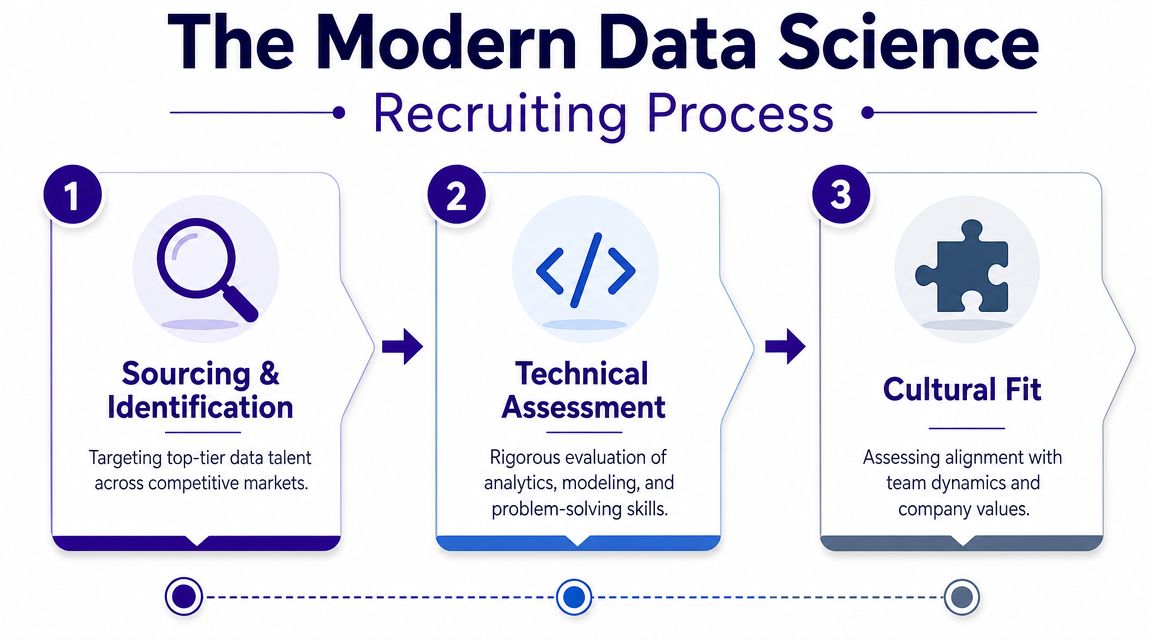
Good recruiting in this market is operational, not cosmetic. The best data science recruiting firms run a disciplined process that starts before the first outreach and continues through close.
Role design comes before sourcing
A specialized firm should challenge the intake. If a hiring manager asks for “a senior data scientist,” a serious recruiter drills into environment, toolset, business owner, expected outputs, and where the role sits in the data lifecycle. Firms that do this well often maintain dedicated pipelines for analysts, data engineers, ML engineers, and NLP specialists, with screening calibrated to each profile’s actual technical demands (role specialization in data hiring).
That distinction matters. A data scientist may need statistical modeling and experimentation strength. A data engineer needs fluency in cloud platforms, ETL, and tools like Spark or Hadoop. A recruiter who can’t separate those profiles will hand over noise.
For teams handling broader hiring operations, some of the same process discipline shows up in adjacent markets. The discussion around streamlining mid-market hiring in the UK is useful because it reinforces the same point. precision in intake and process design beats brute-force applicant flow.
Technical screening is the real separator
The gap between a weak recruiter and a strong one shows up in screening. A commodity firm searches keywords. A specialist validates capability.
That means checking whether a candidate has real depth in Python or R for the role at hand, whether they’ve designed durable data pipelines, and whether they understand tradeoffs between machine learning approaches. It also means checking whether the candidate can communicate with product, engineering, or business stakeholders instead of operating in a technical silo.
A modern process usually looks like this:
- Intake calibration: define the business problem, team shape, and must-have technical signals.
- Targeted mapping: source active and passive candidates from the right segment of the market.
- Technical pre-screen: test depth before the company spends interview time.
- Narrative management: position the role clearly, handle objections, and keep candidates engaged.
- Close and acceptance: manage compensation, timing, and counteroffer risk.
One useful benchmark for teams refining their own internal playbook is this guide to recruiting data scientists effectively. It’s relevant because it treats hiring as a structured process, not a posting exercise.
A recruiter should be able to explain why a candidate fits your stack, your stage, and your decision environment. If they can’t, they’re forwarding résumés, not running a search.
Comparing Data Science Recruiting Firm Models
Not all data science recruiting firms operate the same way. Choosing the wrong model creates friction before the search even starts.
The two biggest decisions are commercial model and firm shape. First: contingency or retained. Second: boutique specialist, national staffing brand, or quant-focused niche player.
Contingency and retained solve different problems
Specialized firms often charge 20% to 30% of a candidate’s first-year salary, and reported time-to-hire windows run roughly 3 to 10 weeks depending on role, region, and model (data science recruiter fee and hiring window overview). Those numbers matter, but the bigger issue is fit.
A contingency search works when speed matters, the role is important but not search-defining, and the company wants optionality across multiple firms. A retained search works when the hire is sensitive, senior, narrow, or strategically expensive to get wrong.
| Attribute | Contingency Search | Retained Search |
|---|---|---|
| Payment structure | Success-based fee after placement | Upfront commitment with staged fees |
| Best use case | Mid-level to senior hires where speed and flexibility matter | Executive, confidential, or highly specialized searches |
| Recruiter behavior | Higher volume, broader outreach, competitive delivery | Deeper market mapping, tighter process control, exclusive focus |
| Candidate pipeline | Can be solid, but quality varies by firm discipline | Usually narrower, more curated, more passive-talent oriented |
| Client commitment | Lower | Higher |
| Search control | Shared across firms if desired | Typically exclusive |
| Risk if role is unclear | High, because firms may chase mismatched profiles fast | Still high, but a good retained partner will push harder on role definition |
Decision lens: Use contingency when the business needs flexibility. Use retained when failure is expensive.
Boutique, national, and quant focused firms
Commercial model isn’t enough. Firm type matters because specialization depth varies sharply.
A boutique specialist usually wins when the role is hard to define, technically nuanced, or senior enough that candidate quality matters more than volume. Firms often cited in market guides include Burtch Works, Harnham, Robert Half, Smith Hanley Associates, Analytic Recruiting, and Averity. That list is useful as a starting map, not a verdict. The critical question is whether the firm handles the exact sub-function the business needs.
A national firm can help when scale, geographic reach, or process coverage matters. That’s useful for larger organizations with multiple openings across analytics and data. The tradeoff is obvious. Broader coverage can dilute technical depth if the team isn’t specialized by practice.
A quant-focused recruiter is a different category. Quant research, HFT, and model-heavy trading environments require a tighter screen, different candidate motivations, and more confidential search handling than general data hiring. A general tech staffing firm usually misses that.
Hiring teams that are comparing agencies side by side may find this roundup of top analytics recruiters useful for building an initial shortlist. But the shortlist should only start the process. It shouldn’t end it.
Your Framework for Vetting Potential Partners
Most firms sound competent on a discovery call. The weak ones fall apart when the questions get specific.

Top-tier firms add value by screening beyond keywords. They assess whether a candidate can work across the data stack, distinguish Python versus R in context, understand data pipeline design, and reason through machine learning tradeoffs. That kind of validation reduces false positives and saves hiring managers time (technical screening depth in data recruitment).
What to inspect before signing anything
A practical evaluation framework should focus on five areas.
- Technical screen ownership: Ask who performs the screen. If it’s a junior recruiter reading a script, expect weak signal.
- Sub-function coverage: Confirm whether the firm recruits for data engineering, ML engineering, analytics leadership, or MLOps separately.
- Candidate market access: Find out whether they rely mostly on inbound applicants or can reach passive talent.
- Search calibration: Check whether they will push back on a vague brief or take the req and run.
- Closing discipline: Ask how they handle candidate objections, process drop-off, and offer-stage friction.
A good partner should also describe how they present candidates. Strong firms submit fewer profiles with better context. They explain technical fit, motivation, compensation alignment, and likely risks.
Questions that expose weak recruiters fast
Use direct questions. Soft questions get polished answers.
- How would the firm separate a strong data engineer from a data scientist with light pipeline exposure?
- How does the recruiter test whether a candidate has worked on production systems rather than notebooks and prototypes?
- What signals would make the firm reject a résumé that looks strong on paper?
- How does the team evaluate tradeoffs in ML model selection without turning the screen into trivia?
- What would the firm change in the job brief before going to market?
Ask for specifics, not reassurance. A credible recruiter names the tools, the workflows, the edge cases, and the reasons candidates fail.
A hiring team should also listen for how the firm talks about business context. Technical depth alone isn’t enough. The recruiter should understand whether the hire is tied to a product launch, platform rebuild, revenue initiative, compliance requirement, or leadership gap. If the conversation stays at the level of title matching, the search will stay shallow too.
Matching the Right Firm to Your Business Needs
The right choice depends less on brand recognition and more on business shape. Startup speed, enterprise scale, and quant precision each require a different recruiting model.
One of the most common hiring mistakes is using a generalist firm for a role that has already split into a narrower specialty. Employers increasingly need distinct profiles such as MLOps specialists or data engineers, and a firm’s value depends on whether it can screen for those sub-functions well (specialization pitfalls in data recruiting).
Startup speed
A startup usually doesn’t need the most elaborate search. It needs a firm that can move fast, tolerate evolving role definitions, and support a practical engagement model.
The best fit is often a specialist contingency firm or a flexible boutique that can work on direct-hire or contract-to-hire terms. The key question isn’t “How big is the agency?” It’s “Can they distinguish a builder from a strategist, and can they keep pace with product deadlines?”
Priority criteria for startups:
- Speed of calibrated candidate flow
- Comfort with changing briefs
- Ability to recruit across adjacent roles
- Recruiters who can sell upside, not just compensation
Enterprise scale
Large companies usually need process reliability, stakeholder management, and the ability to hire across multiple data layers. One search may be for a director of data science. The next may be for a data engineer embedded in a cloud modernization effort.
The right model is often a national specialist or structured boutique retained partner, depending on role seniority. Enterprises should care less about flashy candidate volume and more about consistency, reporting discipline, and role-by-role specialization.
A useful enterprise checkpoint is whether the firm can support parallel searches without collapsing everything into a generic “data” bucket.
Quant precision
Quant environments should avoid broad tech agencies. The candidate market behaves differently, the evaluation standard is tighter, and confidentiality matters more.
The right partner is usually a quant-focused boutique, often on a retained or highly controlled exclusive basis. These searches need recruiters who understand the difference between applied ML, quantitative research, low-latency engineering, and trading-adjacent data work.
The narrower the role, the more dangerous generic recruiting becomes.
A simple matching framework helps:
| Business need | Best firm model | Best engagement style | Main risk to avoid |
|---|---|---|---|
| Startup needing immediate execution | Boutique specialist | Contingency or flexible direct-hire model | Overpaying for an executive-style search |
| Mid-market company making a foundational hire | Specialist boutique | Calibrated contingency or selective retained | Hiring a generalist recruiter with no technical screen |
| Enterprise scaling across functions | National specialist or disciplined boutique | Mix of contingent and retained by role | Treating every data role as interchangeable |
| Quant shop or fund | Quant-focused recruiter | Retained or exclusive search | Using a broad IT staffing vendor |
How Nexus IT Group Delivers Specialized Talent
For companies that need a recruiting partner aligned to hard-to-fill technical work, Nexus IT Group’s data science recruiters and staffing specialists sit in the category that matters most here: specialized IT recruiting rather than general staffing.
That matters because the business problem usually isn’t “find more applicants.” It’s “find the right technical profile, under the right engagement model, without wasting engineering time.” A firm built around direct placement, contract staffing, executive search, and quant recruitment is better positioned for that problem than a generalist recruiter trying to stretch into data hiring.
For a startup, that can mean using a flexible model to secure a production-oriented ML or data engineering hire without building an internal recruiting machine first. For a larger employer, it can mean running a more controlled search for a data leader or specialized individual contributor while protecting confidentiality and interview bandwidth. For quant or fintech environments, it can mean working with a recruiter that already operates in adjacent hard-to-fill markets instead of treating quantitative hiring as a generic analytics search.
The practical takeaway is simple. A firm should match the business need, the technical niche, and the hiring model. If it can’t explain how it handles those three variables, it isn’t the right partner.
Conclusion and Your Hiring Next Steps
The firms that perform well in this market do three things well. They define the role precisely, screen technical depth before candidates hit the interview loop, and use a search model that matches business urgency.
Most hiring failures happen earlier than companies think. They start with vague briefs, the wrong recruiter model, or a partner that can’t distinguish among data science sub-functions. By the time the interview panel realizes the pipeline is weak, weeks are gone and the business is already behind.
A cleaner decision process looks like this:
- Define the precise need: separate analytics, data engineering, ML, MLOps, and leadership work before opening the search.
- Pick the right model: contingency for flexibility, retained for strategic or narrow searches.
- Vet the firm hard: inspect technical screening, sub-function depth, and search calibration.
- Match the partner to the mission: startup speed, enterprise coordination, and quant precision require different recruiter profiles.
A specialized recruiter should reduce decision load, not add to it.
Companies don’t need more introductions to data science recruiting firms. They need a framework for choosing one that can deliver under pressure. That means treating recruiting as an operating decision tied to product timelines, platform delivery, and leadership capacity.
A hiring team that needs help with data science, AI, analytics, or quant recruiting can start a focused conversation with nexus IT group to evaluate role scope, engagement model, and search fit before launch.