
Healthcare cybersecurity jobs sit at the intersection of two pressures that don’t ease up. Healthcare organizations face the highest breach costs in any industry, and companies with high skills shortages see average breach costs of $5.74 million, a $1.76 million gap versus organizations with less severe shortages, according to the ISC2 workforce findings summarized here.
That single fact changes how these roles should be viewed. This isn’t just another branch of IT security. In healthcare, security teams protect patient records, clinical systems, connected devices, and the continuity of care itself. For candidates, that means healthcare cybersecurity jobs offer unusual career durability and mission-driven work. For employers, it means weak hiring processes create operational risk fast.
Table of Contents
- Why Healthcare Cybersecurity Jobs Are Critical in 2026
- The Key Players in Healthcare Cybersecurity
- Skills and Certifications Employers Demand
- Healthcare Cybersecurity Salary and Job Outlook
- Your Path into a Healthcare Cybersecurity Career
- Crafting Your Resume and Acing the Interview
- How to Hire and Retain Top Cybersecurity Talent
Why Healthcare Cybersecurity Jobs Are Critical in 2026
Healthcare security failures do more than expose data. They interrupt scheduling, delay billing, lock clinicians out of core systems, and create patient safety risk in the middle of care delivery. That reality shapes this job market on both sides of the hiring desk. Candidates need to show they understand operational impact, and employers need to hire for it.
This is why healthcare cybersecurity hiring stays difficult even when budgets tighten. Hospitals, payers, digital health companies, and healthcare vendors still need people who can reduce risk without disrupting care. In recruiting, I see the same gap repeatedly. Employers ask for strong technical depth, but the hires who perform best are the ones who can also work inside clinical constraints, compliance requirements, and uptime expectations.
Why the stakes are different in healthcare
In many industries, a security incident is expensive and reputationally damaging. In healthcare, it can also delay treatment, interrupt medication workflows, or force downtime procedures that staff have to execute under pressure.
That changes the hiring equation.
A hospital security team cannot operate like a detached corporate IT function. Leaders need analysts, engineers, and responders who understand that taking a system offline may reduce one risk while creating another. A candidate who can explain that trade-off clearly will usually stand out more than someone who only lists tools, certifications, and generic incident response experience.
Practical rule: The strongest healthcare security hires connect technical decisions to patient care, compliance exposure, and business continuity.
Risk management also reaches well beyond the security team. Operations, HR, legal, compliance, and procurement all affect workforce risk, vendor controls, and policy enforcement. For employers looking at that broader operating model, PEO healthcare risk management is a useful reference point for how staffing and governance decisions influence risk.
Organizations that need help hiring in this niche often turn to healthcare IT recruiters and staffing teams because the role requirements sit across cybersecurity, compliance, infrastructure, and clinical technology.
What this means for both sides of the market
For candidates, healthcare rewards relevance faster than breadth. Experience with HIPAA, EHR access controls, identity management, telehealth platforms, third-party risk, or medical device exposure can carry more weight than a general security background with no healthcare context. The candidates who break in fastest usually translate prior work into healthcare terms. They talk about uptime, audit readiness, least-privilege access, incident containment, and user behavior in regulated environments.
For hiring managers, the common failure points are predictable. Job descriptions are often too broad, interview loops are too slow, and screening criteria overvalue generic checkboxes while missing healthcare judgment. If the role supports clinical systems, say that. If after-hours incident work is part of the job, say that too. Clear scope gets better applicants and saves time on both ends.
The market is competitive, but the problem is usually not a total lack of talent. It is a mismatch between what candidates think the job is and what employers need the person to handle on day one.
The Key Players in Healthcare Cybersecurity
Healthcare security teams work like a hospital defense unit. Some people monitor. Some respond. Some engineer protections into infrastructure and devices. Some set policy and make budget decisions. The roles are connected because the attack surface is connected.
Healthcare cybersecurity jobs must protect an expanded attack surface that includes electronic health records, telehealth platforms, and connected medical devices, where compromise can affect both confidentiality and patient safety, according to this healthcare cybersecurity skills overview.
How the team fits together
A security analyst is usually the front line. This person reviews alerts, investigates suspicious behavior, validates whether activity is benign or malicious, and escalates when something looks real. In healthcare, that might involve identity anomalies in an EHR environment, unusual access to patient data, or suspicious traffic tied to a clinical system.
An incident responder takes over when the issue is no longer theoretical. This role coordinates containment, investigates scope, preserves evidence, works with infrastructure teams, and helps restore normal operations. In a hospital environment, incident response can’t be detached from operational reality. If an EHR or telehealth platform is affected, response decisions have immediate business and care implications.
A medical device security engineer is one of the most misunderstood hires in the market. This role focuses on the security of connected care equipment and the supporting network architecture around it. The job often blends vulnerability management, segmentation, asset visibility, vendor coordination, and policy enforcement. Employers that treat this as a standard endpoint security role usually struggle to hire well.
A healthcare CISO sets direction. This leader translates threat exposure, audit obligations, and business priorities into a security program the organization can run. The role combines governance, incident readiness, vendor oversight, executive communication, and hiring strategy. For teams building or refining this function, a chief information security officer job description helps clarify scope and expectations.
Common healthcare cybersecurity roles at a glance
| Role | Primary Focus | Average Salary Range (USD) |
|---|---|---|
| Security Analyst | Monitoring, triage, alert investigation, access review | Varies by market, experience, and healthcare setting |
| Incident Responder | Containment, forensic coordination, recovery support | Varies by market, experience, and on-call expectations |
| Medical Device Security Engineer | Device risk, segmentation, vendor coordination, hardening | Varies by market and depth of device expertise |
| Healthcare CISO | Strategy, governance, compliance, executive alignment | Varies widely by organization size and program maturity |
What hiring managers often miss
Hospitals, insurers, digital health vendors, and care networks don’t all need the same profile. A payer may need stronger IAM and data governance depth. A hospital system may need practical incident handling and device security. A telehealth company may prioritize cloud controls and application security.
Teams get into trouble when they post one job and expect it to cover SOC monitoring, HIPAA audits, architecture, vendor review, and executive reporting.
The better approach is narrower. Define the environment, the systems under protection, and the specific decisions the person will own in the first months on the job.
Skills and Certifications Employers Demand
Most resumes for healthcare cybersecurity jobs look too similar. They list SIEM exposure, firewalls, endpoint tools, and maybe a certification or two. That’s not enough. Employers usually need proof that a candidate can work inside a regulated environment where technical choices affect privacy, operations, and clinical workflows.
Core skills that translate directly to healthcare
The baseline is still technical. Candidates need working knowledge of network security controls, firewalls, intrusion detection and prevention systems, encryption, secure coding, and vulnerability management. In healthcare, those skills matter because systems are interconnected in ways that create practical downstream risk. Weak segmentation, poor access control, and unpatched assets can spill into broader care operations.
The strongest candidates also understand how healthcare environments run:
- EHR awareness: They don’t need to be EHR administrators, but they should understand what makes these systems sensitive and operationally critical.
- Telehealth exposure: They should know how remote access, video platforms, cloud integrations, and identity controls change the risk picture.
- Medical device context: They should be able to discuss compensating controls when direct patching or configuration changes aren’t simple.
- Compliance fluency: They don’t need to sound like attorneys, but they should speak comfortably about HIPAA, documentation, access controls, and audit readiness.
This visual captures the split between baseline security capability and healthcare-specific specialization.
What separates a credible candidate from a generic one
A generic candidate says, “Managed vulnerabilities across enterprise systems.”
A credible healthcare candidate says they handled patching exceptions, coordinated with application owners, documented risk decisions, and balanced remediation timing against operational sensitivity. That answer sounds different because it shows judgment, not just task execution.
Certifications help when they’re used as supporting evidence instead of the whole pitch. Employers still screen for familiar credentials, and candidates who want a structured roadmap can review cybersecurity certifications that map to different career stages. But certifications don’t replace context. A hiring manager will usually choose the person who can explain a realistic healthcare scenario over the person who only lists more acronyms.
The emerging AI security gap
One hiring problem is getting less attention than it should. Current job postings still lean heavily on traditional security and compliance language, yet an emerging gap exists for professionals who understand AI security vulnerabilities in healthcare. At the same time, the U.S. Department of Health and Human Services was investigating 814 active data breaches as of July 2025, according to this healthcare cybersecurity and privacy analysis.
That matters because healthcare organizations are already using AI-adjacent tools in diagnostics, billing, remote monitoring, and workflow support. Candidates who can discuss prompt injection risk, model governance, adversarial ML concerns, and data handling controls in a HIPAA-sensitive context stand out fast.
The market doesn’t need more people who only say “AI is important.” It needs people who can explain where AI changes the threat model inside a healthcare environment.
Healthcare Cybersecurity Salary and Job Outlook
The U.S. Bureau of Labor Statistics projects 33% employment growth for information security analysts from 2024 to 2034, with about 17,300 openings each year. In healthcare hiring, that demand shows up in a specific way. Employers are not just filling generic security seats. They are trying to hire people who can protect regulated systems, support clinical operations, and make sound risk decisions under compliance pressure.

That distinction matters for both sides of the hiring desk. Candidates often assume a cybersecurity title alone will carry salary growth. Hiring managers often assume they can benchmark these roles against broader security pay bands. Both assumptions create friction. A SOC analyst who has worked through HIPAA-sensitive incidents, EHR access reviews, or third-party risk in a hospital setting usually brings more immediate value than someone with the same title from a less regulated environment.
Why demand stays durable
Healthcare organizations can postpone some projects. They rarely postpone identity governance fixes, incident response staffing, audit preparation, medical device risk work, or cloud security support tied to patient care and revenue operations.
That keeps hiring active even in tighter budget cycles.
The salary side is less straightforward than job seekers expect. In practice, compensation usually moves on four levers:
- Role scope: Alert triage, engineering, architecture, GRC, and security leadership sit in different pay bands.
- Healthcare context: Experience with PHI, EHR platforms, payer systems, clinical workflows, or connected devices usually raises a candidate’s value.
- Ownership: Employers pay more for people who can make risk decisions, influence stakeholders, and handle incidents without constant direction.
- Employer type and location: Health systems, insurers, digital health companies, consulting firms, and medical device manufacturers often pay differently for similar titles.
How compensation actually gets set
Many healthcare employers still miss the mark on salary calibration because they compare specialized roles to general cybersecurity titles. I see this often with IAM, cloud security, and medical device security searches. On paper, the titles look close to broader market roles. In the job itself, the risk profile, stakeholder mix, documentation burden, and after-hours expectations are different.
Candidates should read beyond the title before negotiating. Ask about on-call rotation, audit exposure, vendor management, patient-facing system support, and whether the role touches biomedical or clinical environments. Those details affect compensation more than a title bump with vague responsibilities.
Hiring managers should do the same in reverse. If the role requires healthcare-specific judgment, the pay range needs to reflect that requirement. Otherwise, the strongest candidates drop out early or accept offers from organizations that understand the premium attached to regulated experience.
Broader market references such as the Synopsix 2026 salary survey report can help frame expectations. The useful step is to adjust those benchmarks to the actual job. Scope, compliance exposure, and operational accountability usually matter more than title inflation.
The practical pattern is consistent. Specialized healthcare experience tends to improve negotiating position faster than a more impressive title does.
Your Path into a Healthcare Cybersecurity Career
Breaking into healthcare cybersecurity jobs doesn’t require a perfect background. It requires a credible story, relevant proof, and enough domain awareness that a hiring manager can picture the candidate operating in a regulated environment.
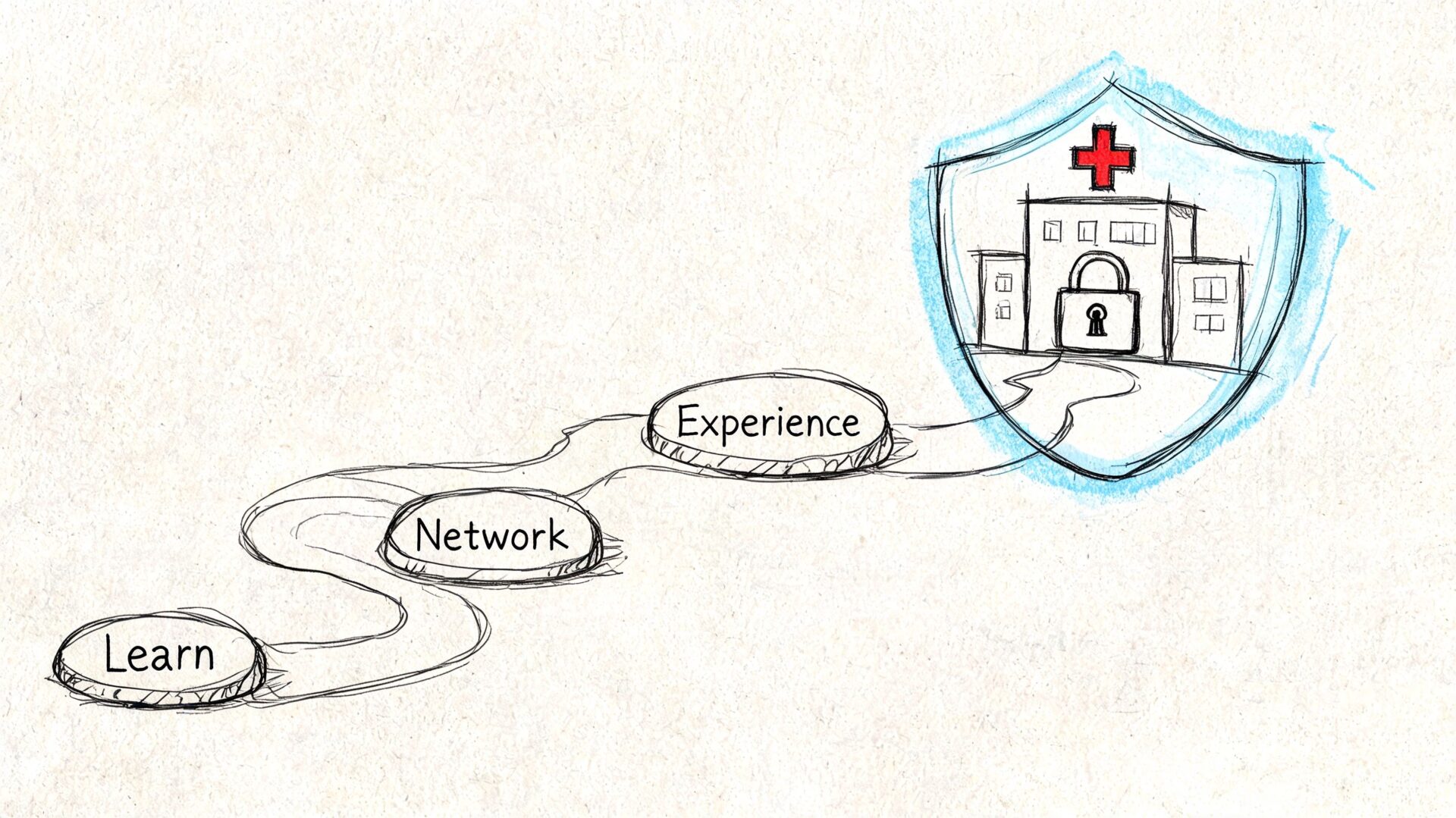
Three workable entry paths
From general IT or infrastructure
This is often the cleanest transition. System administrators, network engineers, cloud support professionals, and help desk staff already understand environments, permissions, uptime, and troubleshooting. The move works best when they add security fundamentals plus healthcare language. A candidate who has handled access controls, patch coordination, logging, and escalation can reposition that work toward analyst, IAM, or security operations roles.
From cybersecurity in another industry
These candidates already know security tooling and workflows, but many undersell the transition. The gap usually isn’t technical ability. It’s healthcare context. The fix is to learn how PHI, HIPAA, EHR sensitivity, vendor risk, and medical device realities shape decisions. A candidate doesn’t need years in a hospital to show readiness, but they do need to stop speaking in generic enterprise terms.
From clinical or healthcare operations backgrounds
This path is narrower, but it can be powerful. Nurses, healthcare IT analysts, clinical application specialists, and compliance staff often understand workflows that pure security candidates don’t. If they build enough technical depth around identity, risk, logging, vulnerability management, or privacy controls, they can become highly credible in governance, compliance, privacy, or application security-adjacent roles.
A portfolio that actually helps
Hiring managers don’t need a portfolio full of generic labs. They need evidence that the candidate understands healthcare problems. Useful project examples include:
- Policy work: A mock HIPAA-oriented incident response playbook for a telehealth provider.
- Technical analysis: A network segmentation proposal for connected medical devices and supporting systems.
- Risk documentation: A sample risk register covering EHR access controls, vendor dependencies, and remediation ownership.
- AI governance thinking: A short framework for reviewing AI tools that may touch sensitive healthcare data.
A small, thoughtful project tied to a healthcare scenario usually beats a stack of unrelated capture-the-flag screenshots.
Candidates should also tighten their target list. Hospitals, health systems, insurers, medtech vendors, digital health firms, and managed services providers all hire differently. The best applications show awareness of the employer’s environment instead of sending the same resume everywhere.
Crafting Your Resume and Acing the Interview
A generic cybersecurity resume rarely works for healthcare. Hiring managers don’t need another document that says “improved security posture” or “supported compliance efforts.” They need enough detail to trust that the candidate understands regulated environments, sensitive data, and operational trade-offs.
Resume changes that matter
The strongest resumes use healthcare-relevant language naturally. Terms like PHI, HIPAA, access control, incident response, audit support, vulnerability management, and NIST should appear where they reflect actual work, not where they were stuffed in for keyword scanning.
A stronger bullet point usually does three things at once:
- Names the environment: hospital, payer, health tech vendor, regulated SaaS platform, or clinical application domain
- States the action: investigated alerts, reviewed privileged access, supported audit evidence, coordinated remediation
- Shows the business effect: reduced exposure, improved response readiness, supported compliance documentation, protected uptime
For example, “Monitored SIEM alerts and escalated threats” is forgettable. “Reviewed security alerts affecting systems that handled regulated data, coordinated with infrastructure owners, and documented escalation paths for incident response and audit follow-up” lands better because it sounds real.
Interview answers that land better in healthcare
Interview performance often comes down to whether the candidate can reason through trade-offs. A healthcare employer may ask how the candidate would handle suspected ransomware affecting an EHR environment, investigate abnormal access to patient records, or prioritize remediation when a medical device can’t be patched immediately.
Good answers don’t try to sound dramatic. They show structure. Confirm scope. Protect critical operations. Escalate appropriately. Preserve evidence. Coordinate with the right stakeholders. Document decisions.
Candidates should also ask smarter questions. Useful examples include:
- About environment: Which systems create the most security stress today?
- About governance: How are security decisions shared between IT, compliance, and clinical leadership?
- About execution: What separates someone who succeeds in this role from someone who’s only technically capable?
Employers remember candidates who show judgment under constraints, especially when those constraints involve regulated data and clinical operations.
How to Hire and Retain Top Cybersecurity Talent
Open healthcare cybersecurity roles stay open longer when employers ask for everything, define little, and drag out the process. I see this constantly on the hiring side. Strong candidates do not wait around while a hospital debates whether the role is really GRC, SOC, cloud security, or third-party risk.
What attracts specialists
The best job descriptions reduce ambiguity. They name the environment, the team structure, and the first problems this person is expected to solve. If the role touches EHR platforms, identity, medical devices, audit response, or vendor security, say so plainly. Candidates read that detail as a sign that the hiring manager understands the work.
Scope matters as much as compensation. A posting that mixes architecture, IR, compliance, IAM, and leadership duties into one seat usually repels the people you want. Serious practitioners know what overloaded jobs look like, and they assume the day-to-day will be worse than the posting suggests.
Interview design also affects close rates. Good healthcare security interviews test judgment under operational constraints, not trivia. Ask how a candidate would handle an unpatchable clinical system, a risky vendor integration, or a conflict between security controls and care delivery. Their answer should show prioritization, stakeholder awareness, and documentation habits. For teams that want a better sense of how candidates present experience on paper, these examples of effective resumes for cybersecurity job seekers are useful calibration points.
What improves retention after the offer
Retention starts with role design, then lives or dies in the operating model.
Security people stay longer when authority is clear, escalation paths work, and leaders back reasonable risk decisions. They leave when every issue becomes an emergency, ownership shifts weekly, or clinical and infrastructure teams bring security in after decisions are already made.
The trade-off is real. Healthcare employers need people who can protect regulated systems without disrupting care, but that pressure cannot become a permanent state of chaos. Teams retain stronger talent when they set priorities, separate urgent work from routine backlog, and give staff enough access and support to do the job well.
Three practices help most:
- Tighten the role before opening it: Hire for the highest-need problem, not five future problems.
- Shorten the interview loop: Good candidates often exit after unnecessary delays or repetitive panels.
- Build a workable first 90 days: Define priorities, key stakeholders, and decision rights before day one.
The employers that hire well usually think about both sides of the desk. Candidates want clarity, support, and credible leadership. Hiring managers want people who can make sound decisions in messy environments. The organizations that connect those two realities fill roles faster and keep talent longer.