
Critical tech roles now take an average of 44 days to fill in 2025, and 46% of employers say finding qualified candidates is their top recruitment challenge, according to hiring and recruiting trend data. That changes how skilled tech professionals should think about recruiters.
A recruiter isn’t just a gatekeeper to open jobs. In high-skill markets like AI, cybersecurity, cloud, and quant, a recruiter is often the person translating a candidate’s background into a story a hiring manager can act on quickly. Done well, that relationship creates an advantage. Done poorly, it creates noise, misalignment, and wasted interview cycles.
The practical question isn’t whether to work with a recruiter. It’s how to work with a recruiter without giving up control of the process, especially when the search is confidential or the role is so specialized that small framing mistakes can derail it.
Table of Contents
- Why a Great Recruiter Is Your Career Co-Pilot
- Preparing for the First Contact
- Translating Your Tech Skills into a Compelling Story
- Managing the Recruitment Process Like a Pro
- Navigating Red Flags and Advanced Scenarios
- Securing the Offer and Building a Long-Term Ally
Why a Great Recruiter Is Your Career Co-Pilot

Specialized tech searches stay open for weeks, and the hardest roles stay open longer because the candidate pool is small, the bar is high, and many searches run under confidentiality. That creates an advantage for strong candidates, but only when someone positions their background with precision.
In senior hiring, a recruiter is not just a messenger between you and a hiring manager. The right recruiter acts as a filter, market translator, and risk screen. That matters in AI, quant, and cyber roles where the public job description often hides the actual constraints. A posted “ML Engineer” role may be an infra-heavy platform hire with on-call ownership. A “Quant Developer” opening may be a low-latency C++ build role where research exposure matters less than exchange connectivity and production reliability. If the recruiter does not know the difference, your profile gets framed the wrong way from the start.
The best recruiter relationships protect your time and your reputation.
That protective function gets overlooked. Senior candidates in confidential searches face two recurring risks. First, weak submissions create recruiter-induced bias before you ever meet the team. Second, vague outreach pulls you into processes that look prestigious but do not match your level, compensation band, or technical scope. A strong recruiter reduces both problems by testing fit early, controlling how your story is presented, and flagging where a search has political or organizational risk.
Why this relationship matters more in specialized tech hiring
Specialist recruiters earn their keep by cutting noise. They know which “Head of AI” role is a real mandate with budget and board support, and which one is a title wrapped around an underfunded data science team. They can tell whether a cyber search is driven by audit pressure, incident response maturity, or a pending leadership change. Those details shape your odds of success and the quality of the role after you join.
I have seen excellent engineers lose momentum because a generalist recruiter pitched them as broad technologists instead of showing the specific value they brought. A staff security engineer with deep identity experience gets treated differently when the recruiter explains zero-trust architecture ownership, regulatory exposure, and incident decision-making authority. A distributed systems candidate from a top trading firm gets a different reception when the recruiter explains throughput constraints, failure tolerance, and what “performance-critical” meant in production.
Practical rule: Give time to recruiters who can explain the business problem, the reporting line, and the reason your background fits before they ask for submission.
Candidates who want a cleaner process often pair recruiter conversations with their own tracking discipline. Resources like Eztrackr job hunting strategies can help structure follow-up, outreach history, and pipeline visibility so separate processes do not blur together.
What separates a recruiter from a resume forwarder
The difference shows up fast, often in the first call or email exchange.
| Recruiter behavior | What it signals |
|---|---|
| Asks about scope, decision-making authority, team context, and motivation | They are assessing fit beyond keywords |
| Explains why the hiring manager cares about your background | They have real intake detail from the client |
| Presses for immediate submission with limited context | They are working for speed and volume |
| Uses vague title language and cannot describe the interview process | They may not control the search or understand it well |
| Advises you on what to emphasize and what to leave out | They know how candidate framing affects outcomes |
Clear communication matters on both sides. Candidate expectations tend to align with responsiveness, transparency, and honest feedback, which is reflected in what job seekers expect from recruiters.
A great recruiter helps you get access. A great one also helps you avoid preventable mistakes. For senior tech professionals, especially in confidential or highly competitive searches, that is the difference between being in process and being positioned well.
Preparing for the First Contact
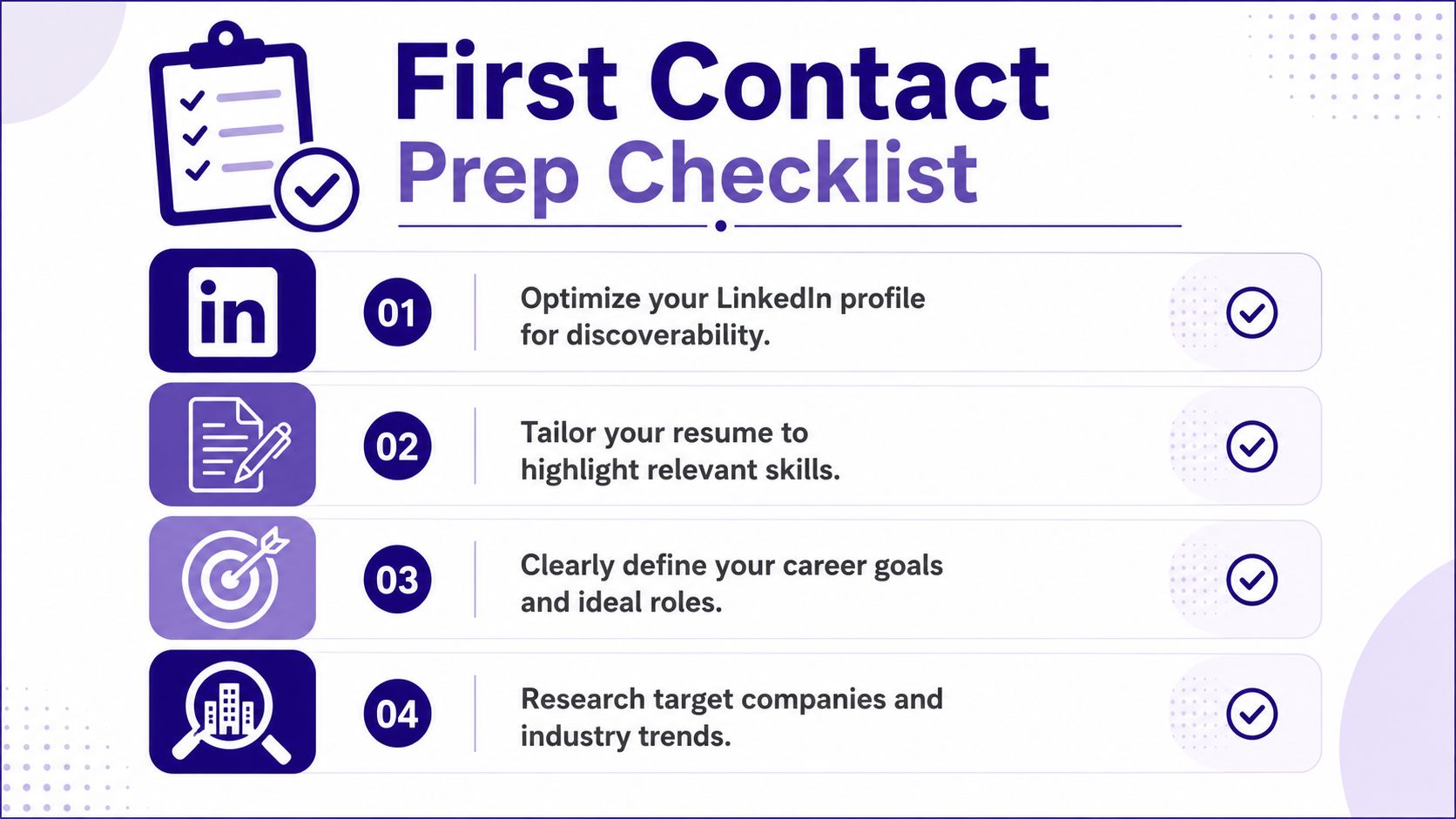
Most recruiter conversations go wrong before the first message is answered. The candidate hasn't defined the target role, the online profile reads like a tool dump, and the recruiter has to guess at what would be compelling.
That guesswork creates bad submissions. It also attracts the wrong recruiters.
Build a profile a specialist recruiter can actually use
A strong LinkedIn profile and resume don't need to read like marketing copy. They need to make technical scope obvious. For a senior cloud engineer, that means surfacing platform ownership, migration depth, reliability work, and security exposure. For a quant developer, it means showing system constraints, latency sensitivity, model-adjacent work, and the stack used in production.
A recruiter should be able to answer these questions in under a minute after reading the profile:
- What does this person build or own
- What environments do they operate in
- What level are they functioning at
- What kinds of roles should they not be pitched for
GitHub, publications, patents, open-source contributions, and technical writing all help when they reinforce the core story. They don't help when they're random artifacts with no relationship to the target search.
Decide your boundaries before anyone calls
Candidates who work with recruiters effectively already know their constraints. They don't improvise them on a screening call.
A short private brief is enough:
- Non-negotiables: compensation floor, location rules, clearance constraints, visa limitations, or confidentiality needs.
- Role priorities: staff-plus IC path, research depth, management scope, production ownership, domain focus.
- Deal-breakers: on-call expectations, title downgrades, commodity analytics roles, agency-heavy environments, weak equity structure.
- Narrative anchors: two or three projects that best represent current value.
This matters in high-stakes hiring because vague flexibility often gets interpreted as broad availability. That's how an applied AI candidate ends up in generic BI loops, or a cloud security engineer gets pitched for a support-heavy infra role.
Candidates don't need a polished speech. They need clear boundaries and repeatable language.
Run a quick credibility check
A recruiter doesn't need a perfect personal brand. They do need signs of role familiarity and process discipline.
A quick screen can be done in minutes:
- Check whether the recruiter specializes. Look for repeated work in AI, cyber, cloud, DevOps, quant, or leadership hiring rather than a scattershot role history.
- Read the message for specificity. Was the outreach tied to actual background, or was it generic keyword matching?
- Ask what they know already. A credible recruiter can usually explain reporting line, team context, interview stages, and why the hiring team is opening the role.
- Watch how they handle confidentiality. If they ask for sensitive information too early, that's a warning sign.
Preparation also includes sharpening the document they'll carry into the market. Candidates who need to tune their positioning can use examples like technical resume skills guidance with examples to tighten language before that first call happens.
Translating Your Tech Skills into a Compelling Story
Senior technical candidates lose interview momentum for a simple reason. Their recruiter hears tools, but the hiring manager needs evidence of scope, constraints, and judgment.
A recruiter can only advocate with the raw material provided. If the story is thin, the candidate gets flattened into keywords. In AI, that often means a strong applied scientist gets routed into generic analytics searches. In cyber, a staff-level security engineer can be presented as a broad infrastructure generalist. In quant, the difference between research tooling and execution systems often disappears unless the candidate states it clearly.
From tool list to hiring narrative
A weak summary sounds like this:
Built Python pipelines, worked with AWS, supported ML workflows, collaborated with data scientists.
It is accurate. It does not help much.
A stronger version sounds like this:
Owned the production path that moved model outputs from research into a monitored AWS environment. Built Python services around validation, deployment, and failure handling. Worked with research teams to reduce the gap between notebook experiments and production release.
That version gives a recruiter something usable. It defines ownership, operating environment, technical depth, and business relevance without overselling.
The standard I use is simple. If a hiring manager hears the summary, they should understand what would break if you left.
Translate specialized work the way hiring managers evaluate it
For senior candidates, the useful framing is not a software inventory. It is a decision record. What problem sat on your desk, what constraints shaped the work, who depended on the result, and what changed because you handled it well?
| Element | Weak framing | Strong framing |
|---|---|---|
| Scope | “Worked on security” | “Owned identity and access controls for a multi-team platform” |
| Constraint | “Improved performance” | “Worked in a latency-sensitive environment with strict production constraints” |
| Stakeholders | “Collaborated with teams” | “Partnered with research, platform, and compliance stakeholders” |
| Outcome | “Built dashboards and scripts” | “Created operational visibility that informed production decisions” |
This matters even more in confidential searches. When a recruiter is protecting client identity, they may share limited context on the company, team, or roadmap. That creates room for recruiter-induced bias. If your background is described loosely, the recruiter may over-index on one familiar label and underrepresent the harder-to-explain parts of your work. A defensive candidate corrects that early by giving precise language that survives retelling.
Use a four-part structure recruiters can repeat accurately
A good recruiter summary usually has four parts:
- Mission: What business or technical problem did you own?
- Constraint: What made the work hard? Scale, regulation, latency, ambiguity, security, model risk, or uptime.
- Decision authority: What did you decide yourself versus support for someone else?
- Result: What improved, shipped, stabilized, or got approved?
That structure reduces distortion.
For example, an AI platform engineer should not stop at “supported model deployment.” A stronger version is: owned the internal platform used to move models from experimentation to governed production, with attention to reproducibility, rollback, and auditability. That tells me whether to position the candidate for platform, MLOps, or applied infrastructure roles.
The same rule applies in quant hiring. “Built trading systems” is too broad to be useful. A recruiter needs to know whether the work sat in research infrastructure, signal generation, market data, execution, or post-trade controls. In low-latency environments, those distinctions change compensation bands and interview loops.
In cybersecurity, tool lists create the most confusion. “Worked with Okta, CrowdStrike, Splunk, and Terraform” tells me very little. “Owned IAM policy design across cloud and workforce systems, partnered with audit on control evidence, and drove implementation with platform engineering” tells me where the candidate sits on the strategy-to-execution spectrum.
Metrics help when they survive scrutiny
Numbers work when they clarify impact and can be defended in a real interview. StoryCV's advice on resume metrics is a good reference on when metrics strengthen a resume and when they read like filler. In technical hiring, inflated precision is easy to spot. A clean statement of system scale, latency requirement, cost reduction, incident reduction, or deployment frequency usually carries more weight than a padded percentage.
Candidates who need help tightening skill language can review examples of skills to include on a technical resume, then rewrite those skills inside project outcomes rather than leaving them as a static list.
What recruiters actually need from you
Give the recruiter a version of your experience they can repeat in thirty seconds without damaging the truth.
That means separating what you touched from what you owned, where you were hands-on from where you set direction, and which parts of your background are current versus historical. Senior candidates who do this well get better calibration, fewer irrelevant submissions, and stronger advocacy when the shortlist gets tight.
Managing the Recruitment Process Like a Pro
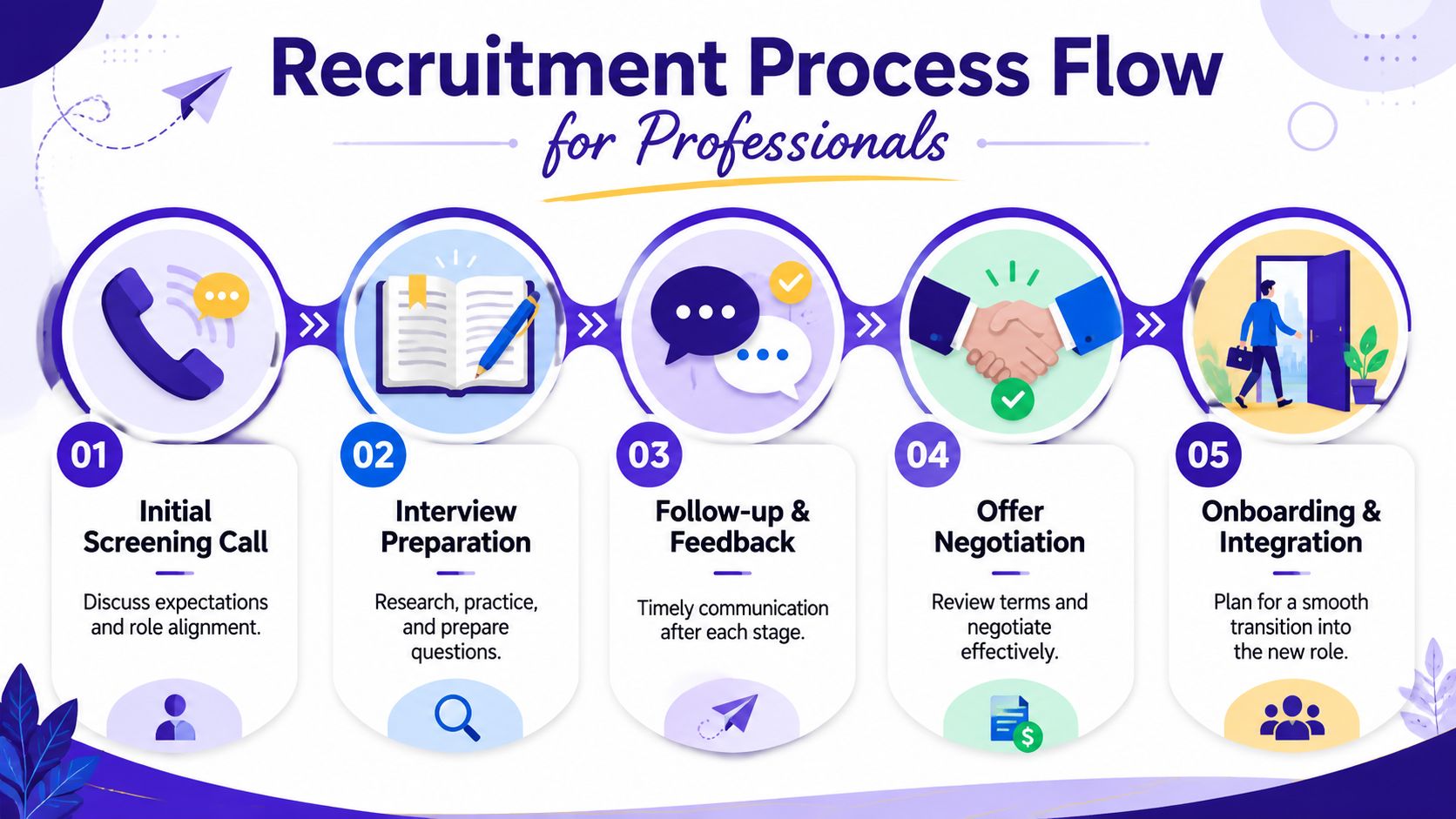
Senior candidates rarely lose strong opportunities because they lack skill. They lose them because the process gets noisy. A delayed reply gets read as weak interest. A vague debrief gives the recruiter nothing to sell back to the client. In confidential searches, that noise is even more expensive because candidates often have less visibility into the company, the team, and the political reason the role exists.
Process control matters.
Use cadence, not chaos
Set a communication rhythm early. Agree on when you will hear back after submission, how quickly you will debrief after each round, and how timing changes will be handled if another process starts moving faster. That protects both sides from guesswork.
A practical pattern looks like this:
- After submission: confirm where your profile went, whether the company name is disclosed, and what the next decision point is.
- Before each round: ask what that interviewer is screening for and what concern the team is trying to clear.
- After each round: send a concise debrief while details are fresh.
- When timing changes: say so fast, especially if you are in late-stage talks elsewhere.
Senior candidates differentiate themselves in this area. In AI, quant, and cyber searches, interview loops are often built to remove one specific risk. A quant researcher may need to prove production judgment, not raw math ability. A cyber leader may need to show board-facing communication, not another war story about detection engineering. If the recruiter knows the actual concern, prep gets sharper and your answers stay targeted.
If you need a reset on preparing for job interviews, do it before the loop starts, not after the first weak round.
Know whether the process is well run
A serious technical process has structure. Karat describes a staged approach with defined evaluation criteria and recruiting KPIs in its technical recruiter guidance. Candidates will not see the scorecard, but they can still judge whether one exists.
Signs of a mature process:
| Signal | Why it matters |
|---|---|
| Consistent interview focus across rounds | The team is likely using a rubric instead of improvising |
| Clear explanation of what each stage evaluates | You can prepare accurately and spot mismatches early |
| Specific prep guidance from the recruiter | The recruiter has real calibration with the client |
| Fast, coherent feedback | The recruiter has access to people who can make decisions |
Loose process creates avoidable risk. I see this often in confidential replacements and newly funded AI teams. The company wants discretion, the recruiter wants speed, and the interview panel has not aligned on what “senior” means. Then one interviewer fixates on an irrelevant gap, and bias can outweigh the evidence.
Ask a direct question before the loop starts: “What does success look like in each round?” A strong recruiter can answer in plain English.
Give feedback your recruiter can use
“Seems good” is not useful. “Not sure” is only slightly better.
Useful feedback is specific enough that the recruiter can act on it:
- State the themes discussed. System design, model deployment, latency trade-offs, incident leadership, stakeholder management.
- Note where the match was strongest. Production ML, exchange connectivity, cloud identity, offensive security, whatever fits.
- Call out friction directly. Scope mismatch, title inflation, weak manager communication, unrealistic ownership, compensation gap.
- Flag what changed. The role may have turned out to be more platform engineering than applied research, or more GRC-heavy than hands-on security.
That debrief helps the recruiter do three things. Reframe your candidacy with the hiring team, sharpen prep for the next round, and decide whether the search still deserves your time.
Use the recruiter, but keep your own record. Save the version of your resume that was submitted, note how the role was described, and write down any claims about team scope or reporting line. In specialized hiring, recruiter-induced bias often starts as a small translation error. Left unchecked, it turns into a story about your background that is easier to sell but worse for your career.
Navigating Red Flags and Advanced Scenarios
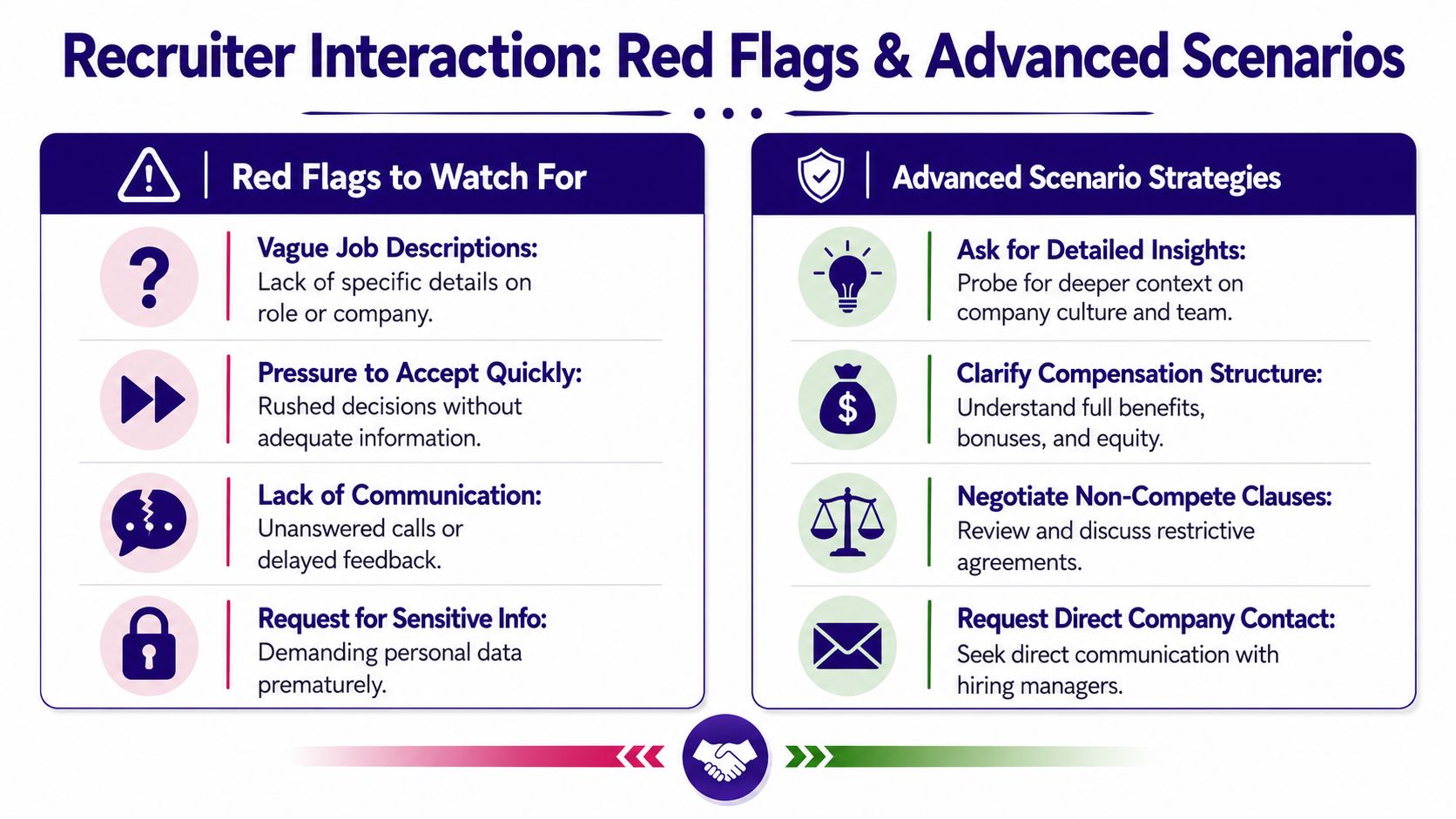
Most advice about recruiters assumes the process is clean. It often isn’t. Senior technical candidates run into confidential searches, role distortion, pressure tactics, and submissions that blur the edges of their real background.
The fix isn’t cynicism. It’s defensive clarity.
How to spot recruiter-induced bias early
A 2025 SHRM report found that 35% of IT candidates were initially pitched for roles with a significant skill mismatch due to recruiter pressure to close the deal. That makes recruiter-induced bias a real career risk, especially for specialized professionals whose profiles can be flattened into broader categories.
The early signs are usually obvious once a candidate watches for them:
- The title sounds right but the work sounds wrong. An AI research profile gets framed into reporting and dashboard work.
- The recruiter keeps translating downward. A platform security engineer is repositioned as general infrastructure support.
- The submission summary doesn’t match the conversation. The recruiter highlights adjacent experience instead of core expertise.
- There is urgency without clarity. The candidate is pushed toward speed before role alignment is established.
The response should be direct and documented. A candidate doesn’t need confrontation. They need a counter-narrative.
A short correction might sound like this in practice: the strongest fit is production ML infrastructure, not generic analytics; recent work has centered on deployment pathways, evaluation workflow, and systems ownership; if the hiring team needs dashboarding or business reporting, this isn’t the right process.
A defensive script for confidential searches
Confidential searches are common in sensitive hiring. They show up in pre-IPO leadership work, quant firms, cyber teams replacing incumbents, and government-adjacent environments where exposure has consequences.
The candidate’s obligation isn’t total disclosure on first contact. It’s enough to validate fit while protecting current employment and identity until the process is real.
A privacy-first approach usually includes:
| Stage | What to share | What to hold back |
|---|---|---|
| Early outreach | Core specialty, seniority, target scope | Current employer name, identifying project details |
| Initial recruiter call | Skill fit, broad career goals, constraints | Full resume chronology if confidentiality is critical |
| Later-stage validation | Deeper technical detail and context | Sensitive internal information unrelated to fit |
This is especially important in quant and cyber hiring, where a single revealing detail can identify the candidate to a small market.
Protecting confidentiality isn’t evasive if the candidate is still giving enough information to establish legitimate fit.
Candidates entering serious loops should also sharpen their preparation because advanced scenarios often come with compressed interviews and less public information. A practical companion resource is preparing for job interviews, especially when the recruiter can provide only partial context.
Working with multiple recruiters without creating problems
Senior candidates often talk to more than one recruiter. That’s normal. The risk isn’t having multiple channels. The risk is losing track of who submitted what.
A few operating rules keep things clean:
- Never authorize blind submissions. Company name, role scope, and compensation range should be clear enough before approval.
- Track every submission. This avoids duplicate representation, which creates instant friction with employers.
- Tell recruiters when there is overlap. A professional recruiter would rather know early than discover it after submission.
- Separate exploratory calls from formal representation. Interest isn’t consent to be marketed.
The same defensive mindset applies here. Precision protects reputation.
Securing the Offer and Building a Long-Term Ally
Offer stage is where a recruiter either proves their value or exposes their limits. By this point, the company has spent time, attention, and internal coordination to get a candidate to the finish line. That matters because the average cost per hire is about $4,700 per candidate in 2025, according to recruitment statistics on hiring cost.
That investment doesn’t guarantee an advantage in every negotiation. It does mean the employer has reasons to keep a vetted candidate engaged, and a recruiter can use that reality to manage the final conversation more effectively.
Use the recruiter as a negotiation channel
Candidates often make one of two mistakes at offer stage. They become passive and hope the recruiter fights for them, or they become so rigid that the recruiter can’t negotiate productively.
A better approach is to give the recruiter a clean brief:
- State the target package clearly. Base, bonus, equity, title, start timing, remote expectations.
- Rank what matters most. For one candidate it may be title scope. For another, signing structure or hybrid flexibility.
- Explain the rationale without oversharing. The recruiter needs enough context to advocate, not a full personal budget.
- Define walk-away conditions. If the title is a downgrade or the scope shifted, say it plainly.
This helps the recruiter go back to the employer with a coherent position instead of a vague request for “more.” It also prevents a common failure mode where the candidate and recruiter are each guessing at the other’s negotiation strategy.
A recruiter can negotiate best when the candidate gives priorities in order, not as a bundle of equal demands.
Candidates who want a stronger framework for those conversations can review salary negotiation tips for job seekers before offer terms start moving.
Close one process without ending the relationship
Whether the candidate accepts the offer or declines it, the closing message matters.
Strong candidates do a few things well at the end:
| Situation | Smart move |
|---|---|
| Accepting | Thank the recruiter, confirm next steps, and stay responsive through onboarding |
| Declining for fit | Give concise reasons the recruiter can reuse constructively |
| Declining for timing | Leave the door open and explain what would make future roles relevant |
| Offer lost or withdrawn | Stay professional and ask what the team concluded |
The long-term upside is real. Recruiters remember candidates who communicate clearly, protect their reputation, and understand how technical hiring works. Those candidates get called for narrower, better-fit opportunities later.
A recruiter should be more than a one-off transaction. In specialized markets, a trusted recruiter becomes a repeat interpreter, a quiet source of market intelligence, and sometimes the fastest path into a role that never becomes public.
If the goal is to work with a recruiter in a more strategic way, especially for specialized roles in AI, cybersecurity, cloud, DevOps, data, leadership, or quant, nexus IT group offers IT staffing, direct placement, executive search, quant recruitment, and confidential search support built around hard-to-fill technical hiring.