Three open requisitions are competing for attention, two candidates have rejected offers, and a quarter-end launch is approaching. The internal talent team has posted the roles, but qualified engineers aren’t responding quickly enough, and the hiring manager can’t afford another week of interviews that lead nowhere.
An IT staffing agency can relieve that pressure, but only when the engagement model matches the hiring problem. The wrong agency just adds another inbox, another layer of communication, and another fee. The right partner compresses sourcing, validates technical ability, manages employment mechanics, and gives the hiring team a realistic path to a start date.
The decision should begin with the work, risk, and employment structure. Vendor selection comes second.
Table of Contents
- What an IT Staffing Agency Actually Does
- Service Models Compared and When to Use Each
- Benefits, Costs, and Honest Trade-Offs
- How to Evaluate an IT Staffing Agency Like a Buyer
- Role-Specific Examples in AI, Cloud, Security, and Quant
- Compliance, Skills Verification, and Risk
- Checklists, Sample JD, and Case Study Snapshots
What an IT Staffing Agency Actually Does
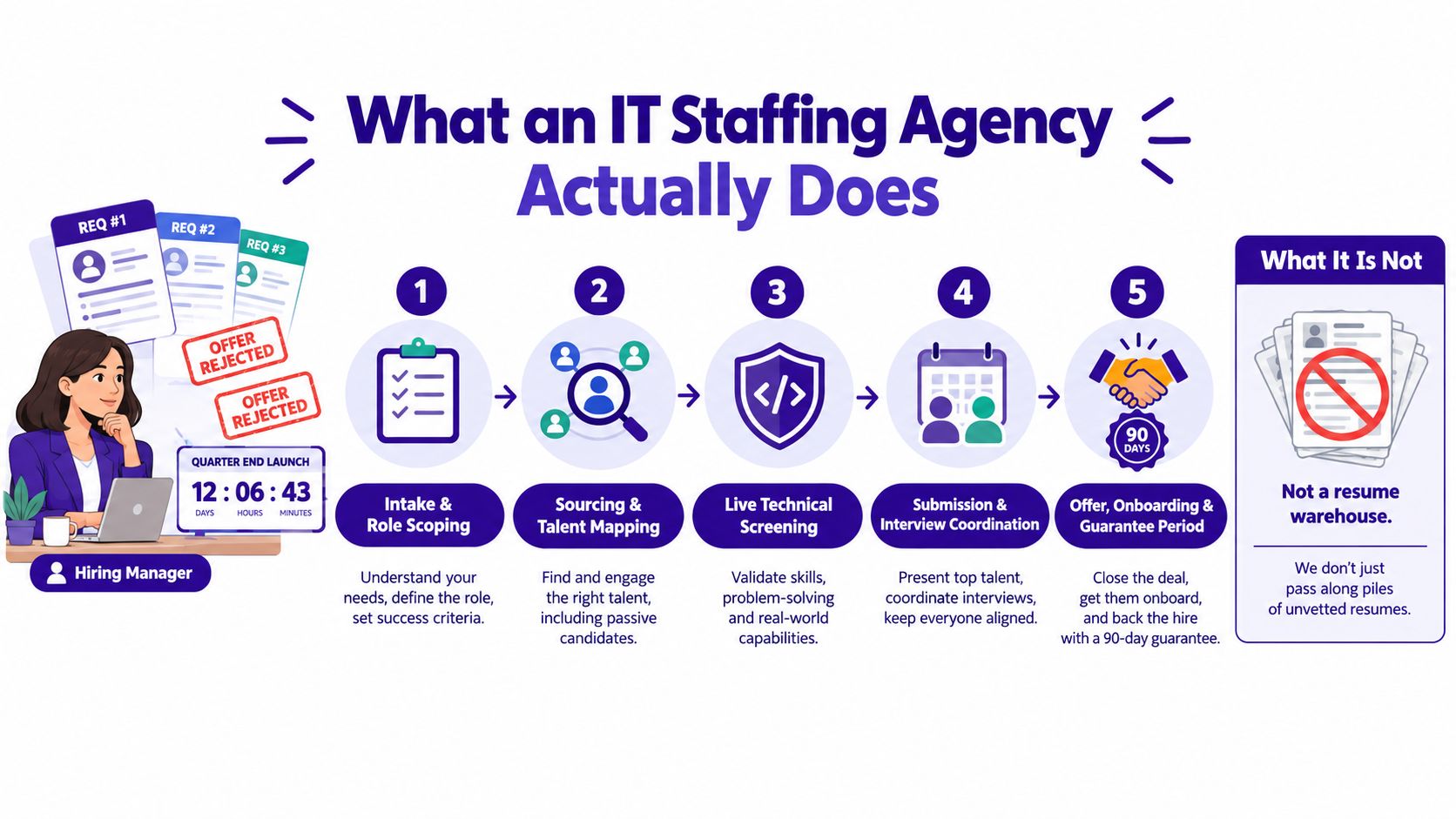
An IT staffing agency is a third-party firm that sources, screens, and presents technology candidates for an employer. The hiring company defines the need, controls the budget, and usually makes the final selection. The agency manages some or all of the work required to turn an open requisition into a qualified, available candidate.
The process normally follows five steps:
- Intake and role scoping: The recruiter clarifies the technical environment, deliverables, seniority, location, employment model, compensation structure, and interview process. A strong intake distinguishes a true Kubernetes operator from someone who has merely listed Kubernetes on a resume.
- Sourcing and talent mapping: The agency searches its network, direct-sources passive candidates, identifies adjacent skills, and tests whether the brief is realistic in the available market.
- Technical screening: Recruiters or technical assessors examine work history, tools, architecture decisions, coding ability, and communication. The depth varies dramatically by agency.
- Submission and coordination: The agency presents a shortlist, explains the match, schedules interviews, manages feedback, and keeps candidates engaged.
- Offer and onboarding: Depending on the model, the agency handles employment paperwork, payroll, background checks, onboarding, and any replacement or guarantee period.
The employment structure changes everything
Four delivery modes dominate technology staffing:
- Contract staffing: The agency usually employs the worker and pays wages, while the client pays an hourly bill rate. The worker performs the assignment under the client’s direction.
- Contract-to-hire: The worker begins under an agency employment arrangement, often as a W-2 employee, with a later option for the client to hire directly under agreed conversion terms.
- Direct placement: The client employs the candidate from the start and pays the agency a recruiting fee, commonly tied to the candidate’s compensation.
- Executive search: The agency conducts a confidential, targeted search for senior leadership or unusually consequential roles. The commercial structure may include a retained fee or another staged payment arrangement.
That structure separates an agency from a freelance marketplace. A marketplace generally facilitates transactions between clients and independent professionals, while an agency takes responsibility for recruiting, screening, and, in contract models, employment administration. An in-house talent acquisition team remains part of the employer and works inside its systems. An RPO provider may operate as an embedded extension of the recruiting function, taking responsibility for broader process capacity rather than filling only selected roles.
The buyer should also separate candidate-side research from employer-side staffing decisions. Practical virtual assistant job hunting tips can help candidates organize searches and evaluate opportunities, but an employer choosing a staffing partner needs evidence about technical screening, employment compliance, delivery speed, and accountability. A provider’s IT recruiting services should be judged against those operating requirements, not against the number of resumes it can forward.
The model is the first decision. If the business needs a defined delivery team for a temporary initiative, direct placement may be the wrong instrument. If it needs a permanent engineering leader, hourly contract staffing may create unnecessary complexity. Only after that distinction is clear should a hiring manager compare agencies.
Service Models Compared and When to Use Each
The four models solve different hiring problems. A hiring manager should select the model before inviting agencies to compete, otherwise each vendor will frame its preferred service as the answer.
| Model | Payment & Fees | Cycle Time | Employer of Record | Best Fit |
|---|---|---|---|---|
| Contract staffing | Hourly bill rate, including worker pay and agency margin | Fast for defined, available skills | Usually the agency | Temporary delivery, scarce skills, project-based capacity |
| Direct placement | One-time recruiting fee tied to compensation | Moderate, depending on search complexity | Client | Mid-level permanent roles with an approved headcount |
| Executive search | Retained or staged search fees, usually negotiated | Longer and more deliberate | Client | Confidential leadership and high-consequence appointments |
| Quantitative recruiting | Specialized recruiting fee or contract structure, negotiated around the search | Depends on technical validation and candidate scarcity | Client or agency, depending on model | Research, trading, quantitative engineering, and data-heavy roles |
Contract staffing is the practical choice when the assignment has a defined duration, such as a migration, platform rebuild, or remediation program. A scarce skill can justify the hourly premium because the client buys flexibility and avoids committing permanent headcount before the workload is proven. The IT staff augmentation model is particularly useful when the internal team owns delivery but needs additional capacity quickly.
Direct placement fits a permanent mid-level role when the budget supports a recruiting fee and the employer has a clear long-term need. It gives the client direct ownership of the employment relationship, but the company also carries the full responsibility for onboarding, retention, performance management, and replacement if the hire fails.
Executive search is different. A confidential chief information security officer search, technology leadership replacement, or senior product engineering appointment needs market mapping, discretion, references, and careful calibration. It shouldn’t be used for a six-month contract just because the role is technically difficult.
Quantitative recruiting deserves its own category because resumes rarely prove the required capability. A candidate may need to demonstrate probability, statistics, financial reasoning, programming, market microstructure, or research judgment in a live setting. A hiring manager should expect a specialist process rather than a standard recruiter screen.
Practical rule: Choose contract staffing for temporary scarcity, direct placement for durable headcount, executive search for confidential leadership, and quantitative recruiting when technical proof matters more than polished credentials.
The most common commercial mistake is forcing one model across unrelated needs. A seasonal project shouldn’t carry a permanent-placement structure, and a leadership search shouldn’t be reduced to rapid resume delivery.
Benefits, Costs, and Honest Trade-Offs
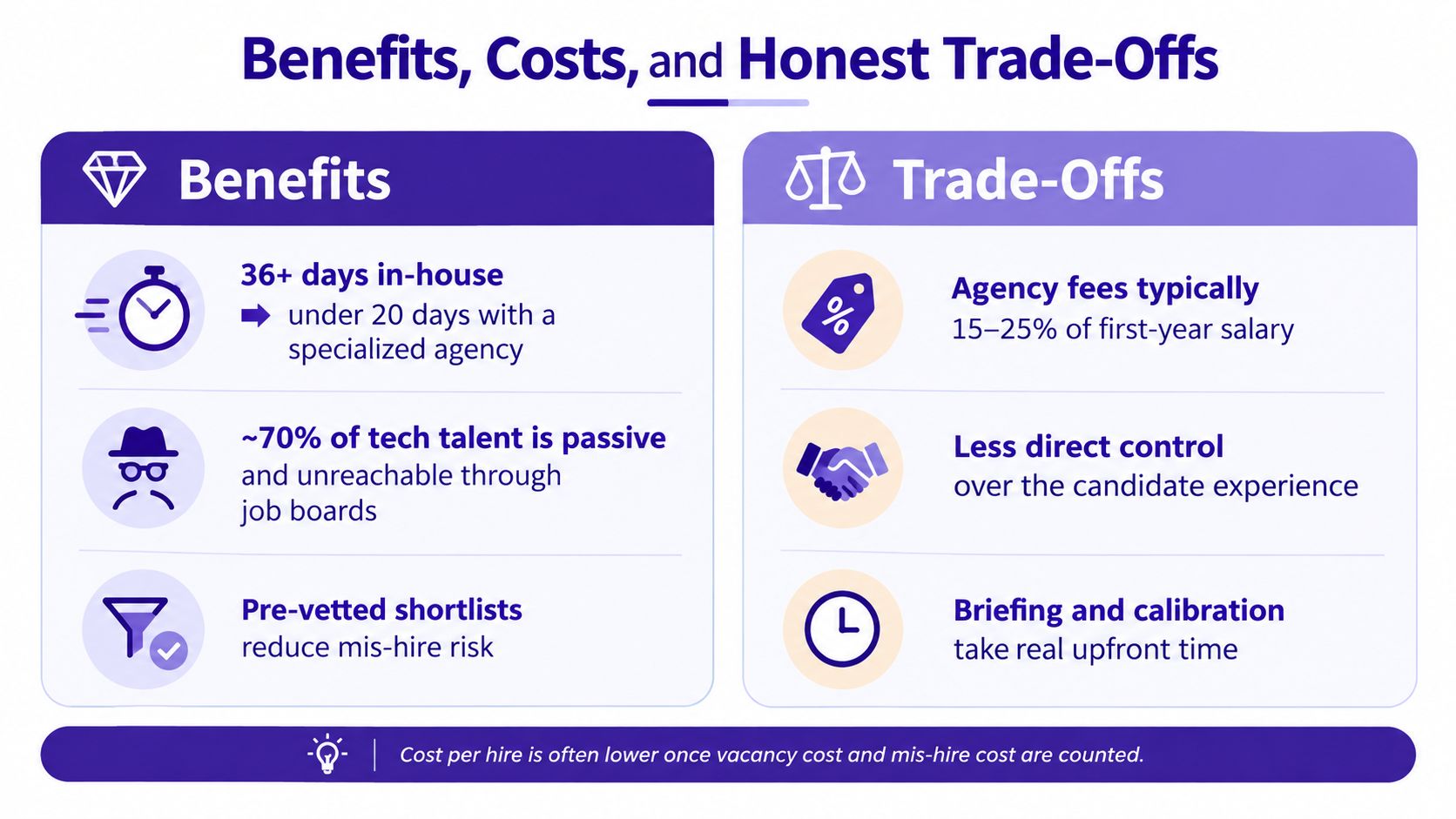
Speed is the clearest reason to use a specialized agency. One industry benchmark reports that general IT positions take an average of 41 days to fill, while staffing agencies fill comparable roles in 22 to 24 days, implying roughly a 45% reduction in cycle time when specialized sourcing and matching are applied. The benchmark is available in the 2025 Staffing Speed Report.
That difference matters when a missing engineer blocks a release, leaves production support understaffed, or forces senior employees into overtime. The value doesn’t come from receiving more resumes. It comes from reducing wasted interviews, reaching passive candidates, and presenting people who already meet the essential technical conditions.
The market is large and durable. The IT staffing market estimate places worldwide IT staffing at about USD 123.3 billion in 2025, projected at USD 127.75 billion in 2026 and USD 152.47 billion by 2031, with a 3.61% CAGR from 2026 to 2031. The same source identifies North America as the largest demand region and describes offshore and nearshore supply markets including India, Mexico, Brazil, Poland, Vietnam, and the Philippines.
The bill is not the whole cost
An agency introduces real trade-offs:
- Fees: Contract pricing includes agency margin, while permanent placement adds a recruiting charge. The buyer must compare those costs with vacancy cost, delayed delivery, and internal recruiting time.
- Calibration time: The recruiter needs enough detail to understand architecture, team norms, decision rights, and critical skills. A shallow briefing produces shallow matches.
- Candidate experience risk: The agency represents the employer before the candidate ever meets the hiring team. Poor communication can damage acceptance rates and employer reputation.
- Overstatement risk: Some agencies claim access to rare AI, cloud, or security talent without proving that their recruiters can distinguish genuine hands-on depth from keyword-heavy resumes.
The 2026 enterprise technology jobs survey reports that 80% of respondents said talent shortages were affecting operations. It also identifies AI engineers as the hardest-to-fill role for 39% of respondents, followed by cybersecurity engineers at 38%, cloud engineers at 25%, and data analytics professionals at 24%. Those conditions make speed valuable, but they also make weak screening more expensive.
The right question isn’t whether an agency charges a fee. It is whether the agency removes enough delay and risk to justify the fee. A bad-fit vendor charges in lost weeks, repeated interviews, and a project team waiting for someone who was never properly qualified.
How to Evaluate an IT Staffing Agency Like a Buyer
Agency selection should look like procurement, not a chemistry call. Before the first meeting, the hiring manager should create a scorecard and require every supplier to answer the same questions.
Start with delivery evidence. Ask for average time-to-fill by role family, retention through the replacement or guarantee period, offer-to-acceptance ratio, submission-to-interview ratio, and the share of candidates who pass the client’s technical screen. A blended company average is nearly useless if the open role is an AI platform engineer or security architect.
| Dimension | What to Ask | Pass Threshold | Weight |
|---|---|---|---|
| Technical screening | Who conducts the assessment, and what does the candidate complete? | Practitioner-led evidence tied to the role | High |
| Delivery speed | What is the average time from intake to qualified shortlist for this role family? | Sub-day evidence, not a broad company average | High |
| Retention | How does the agency track early attrition and replacements? | Written guarantee and transparent retention reporting | High |
| Service levels | How quickly does the agency respond to feedback and new requirements? | Response terms documented in the agreement | Medium |
| Pricing | Can the supplier show pay rate, bill rate, margin layers, conversion fees, and termination terms? | Complete commercial disclosure in writing | High |
| Continuity | Who owns the account if the recruiter leaves? | Named-account continuity clause | Medium |
| References | Can the buyer speak with clients hiring comparable technical roles? | Relevant, verifiable references | High |
Put consequences into the agreement
An SLA without a consequence is a preference, not a service level. The buyer should negotiate a replacement guarantee under 10 business days, response windows under 48 hours, and a named-account continuity clause where those terms fit the role and market. These thresholds are procurement targets, not universal market facts, so the contract should define exactly when the clock starts and what counts as a qualified replacement.
Pricing deserves the same precision. The written agreement should identify hourly bill rates, worker pay rates, margin layers, conversion fees, termination provisions, expenses, and any change-order mechanism. If a salesperson explains the economics verbally but refuses to document them, the buyer should treat that as a warning.
Certifications can support due diligence, but they shouldn’t substitute for operating evidence. A WBENC certification or disability-owned supplier program may matter for procurement goals, yet it says little about technical screening. Ariba readiness, SOC 2 evidence, security procedures, and actual client references are more useful when the engagement involves sensitive systems or data.
Scale is also overrated. Ten generalist recruiters won’t necessarily outperform one recruiter who understands distributed systems, model evaluation, threat detection, or quantitative research. Reference calls should involve clients who hire the same role families, not only the agency’s most polished success stories.
Role-Specific Examples in AI, Cloud, Security, and Quant
A credible technical shortlist looks different by discipline. An agency that uses the same screening script for a machine learning engineer, a cloud migration specialist, a security engineer, and a quantitative researcher isn’t screening thoroughly enough.
AI and machine learning
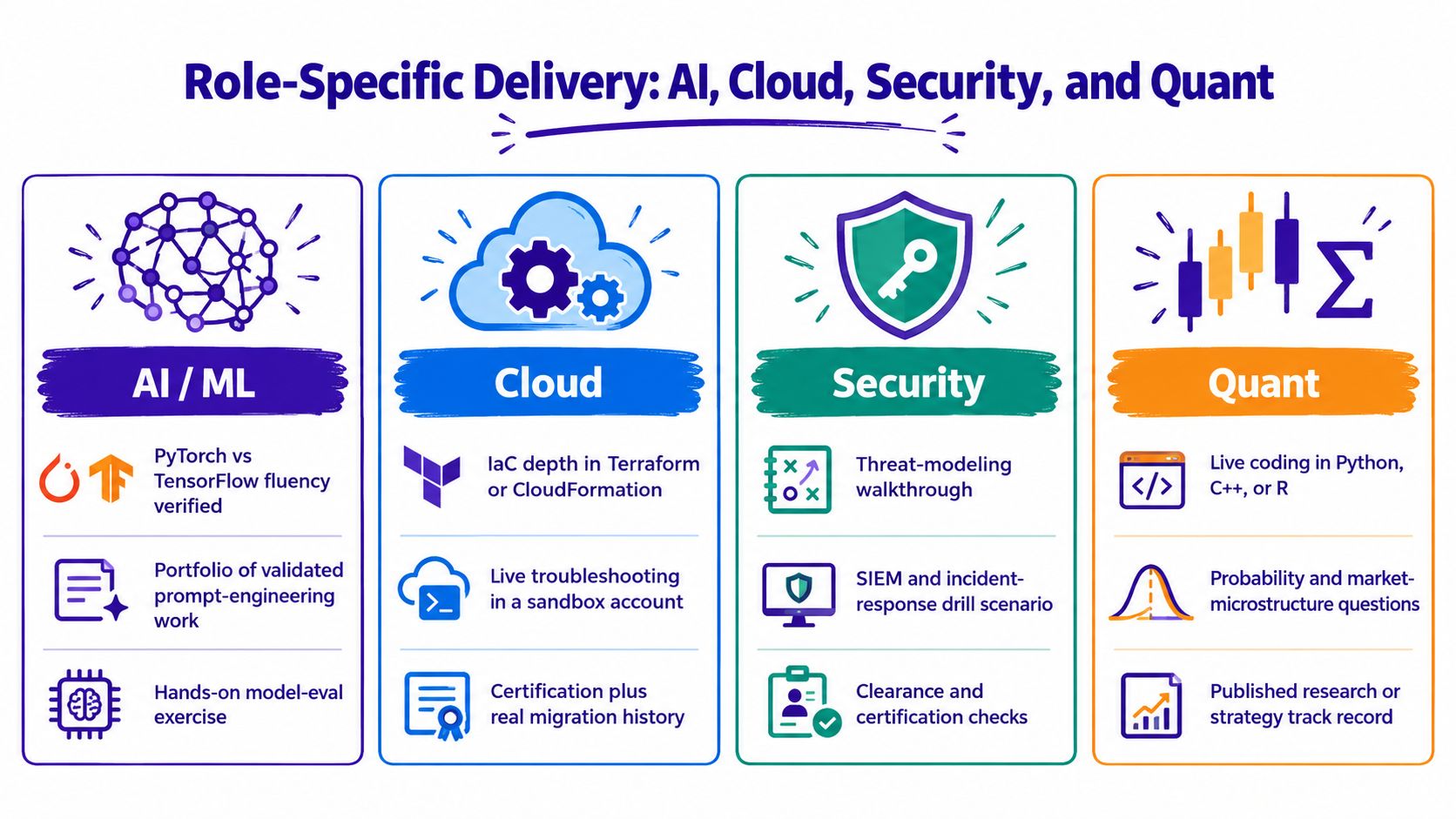
For an AI role, the recruiter should establish whether the candidate has built with PyTorch, TensorFlow, or both, and what decisions the candidate made around data pipelines, model evaluation, deployment, and monitoring. Prompt-engineering claims need work samples or a structured exercise, not a keyword match.
The hiring team should request a concise assessment record. It should state what the candidate built, which tools were used, how evaluation was performed, and where the candidate’s contribution ended. A recruiter who can’t explain those points hasn’t validated the profile.
Cloud and infrastructure
Cloud screening should connect certification to production behavior. A candidate may need hands-on evidence in AWS, Azure, or GCP, along with infrastructure as code, observability, cost control, migration planning, and FinOps literacy.
A practical agency deliverable might include a recorded troubleshooting discussion or a sandbox exercise. The candidate should be able to reason through an outage, explain Terraform or CloudFormation choices, and identify the trade-offs between reliability, security, and spend.
Cybersecurity
Security hiring requires more than a CISSP listing. A serious screen should test threat modeling, incident response, identity controls, logging, containment, and communication under pressure.
The agency should provide the scenario used, the candidate’s reasoning, and the assessor’s notes. For regulated or public-sector work, the supplier also needs a reliable process for clearance and background requirements. Government IT vacancies can average 6 to 12 months, and hiring can take more than a year because of checks, approvals, civil-service rules, and requirements such as CJIS and NIST, as described in government IT staffing trends for 2026.
Quantitative recruiting
Quant recruiting is the clearest test of technical rigor. The agency should ask for live coding in Python, C++, or R, probability and statistics questions, market-microstructure reasoning, and evidence of research or strategy work. Back-tested code, competition rankings, published research, or relevant trading PnL context can be more informative than academic labels alone.
A quantitative resume is an invitation to test the work, not proof that the work exists.
Before signing, the hiring manager should define the assessment artifacts the agency must deliver for each specialty. That requirement prevents a generalist supplier from presenting a uniform resume packet for roles that demand entirely different evidence.
Compliance, Skills Verification, and Risk
Three risks meet in agency hiring. The first is skills risk, where a candidate’s resume overstates technical ability. The second is classification risk, where the contract structure conflicts with the worker’s actual relationship to the client. The third is data and intellectual-property risk, where sourcing exposes confidential information or candidate records remain uncontrolled.
Skills verification should start with observed evidence. The buyer should request live technical assessment transcripts, recorded or observed coding sessions, practitioner-reviewed work samples, and references from former engineering leaders. Self-reported scores and recruiter summaries aren’t enough for high-consequence roles.
Worker classification needs legal and operational review before the first invoice. Contract engagements should address the IRS and Department of Labor independent-contractor tests, document W-2 or 1099 status for each placement, check applicable state rules, and record a written classification opinion. The buyer should also review co-employment exposure, EEO procedures, background-check handling, and responsibility for workplace policies.

Protect information before sourcing begins
The agency shouldn’t receive client code, unreleased product details, or a full roadmap merely to write a job description. Candidate data should be handled under the relevant privacy requirements, including GDPR and CCPA where applicable, with clear retention and deletion terms.
The agreement should cover:
- Assessment records: Who owns interview notes, coding exercises, recordings, and evaluation outputs?
- Candidate data: How long does the agency retain resumes, contact details, and background information?
- Intellectual property: When are confidentiality and IP-assignment documents signed?
- Subcontracting: Can the agency transfer sourcing, screening, payroll, or background checks to another party?
- Access controls: How does the agency revoke access when an engagement ends?
A current legal dispute illustrates why contract language matters. In a California Court of Appeal staffing-agency decision, the court declined to let a client enforce an arbitration agreement signed with the staffing agency because the client wasn’t a signatory and the agreement didn’t cover claims arising after the worker moved into direct employment. The operational lesson is straightforward: employment documents, client agreements, and conversion terms must align. Compliance is a vendor filter, not a post-signature cleanup exercise.
Checklists, Sample JD, and Case Study Snapshots
A hiring manager can make the agency decision more reliable by turning expectations into documents. The following checklists are designed for immediate use.
Hiring manager checklist
Before selecting an agency, the employer should confirm:
- Role definition: The job description names the production environment, deliverables, required skills, preferred adjacent skills, work arrangement, employment model, and interview stages.
- Screening proof: The agency supplies an assessment rubric and sample anonymized notes from comparable technical searches.
- Commercial clarity: Rates, fees, conversion terms, guarantees, expenses, and termination provisions appear in the agreement.
- Compliance ownership: The contract assigns responsibility for classification, background checks, work authorization, privacy, and subcontracting.
- Delivery cadence: The recruiter commits to a feedback rhythm, shortlist format, escalation path, and replacement process.
- Onboarding readiness: Access, equipment, security training, timekeeping, and manager responsibilities are defined before the start date.
Candidates should apply their own checklist when evaluating an agency:
- Recruiter credibility: Can the recruiter explain the client’s stack, work, reporting line, and interview process?
- Contract clarity: Does the agreement identify the employer, pay structure, benefits, assignment terms, and conversion conditions?
- Privacy controls: Does the candidate know where personal data goes and who can access it?
- Communication standard: Does the recruiter provide clear feedback and realistic timelines rather than promising an offer?
Sample technical job description
A concise JD can follow this structure:
Role: [AI Engineer, Cloud Engineer, Security Engineer, or Quantitative Researcher]
Business outcome: [State the system, product, risk, or research result the hire will own.]
Required evidence: [Name the practical work sample, live exercise, production environment, or research output.]
Core skills: [List the essential tools, languages, frameworks, platforms, and methods.]
Adjacent skills accepted: [Identify credible alternatives to narrow keywords.]
Assessment process: [Describe the technical screen, panel, coding task, and decision criteria.]
Engagement model: [Contract, contract-to-hire, direct placement, executive search, or quantitative recruiting.]
Success measures: [Define what effective performance looks like after onboarding.]
Teams that need a stronger starting point can use these IT job description templates and adapt them to the actual technical environment rather than copying generic requirements.
Two decision snapshots
A quant team scaling for a defined research initiative should use quantitative recruiting or contract staffing, depending on whether the need is temporary. The differentiator is live technical validation, including coding, probability, and research reasoning. A polished resume alone should not determine the shortlist.
A public-sector security program facing a long clearance process may need contract staffing and a pre-cleared talent network to cover immediate delivery gaps. The differentiator is not the largest resume database. It is the agency’s ability to verify clearance status, manage compliance requirements, and keep qualified candidates engaged through a slow approval process.
The hiring manager should request both snapshots from prospective agencies in a comparable format: scope, model, assessment method, delivery timeline, employment structure, and the factor that determined success. If a supplier can’t explain those mechanics, it probably can’t reproduce them.
nexus IT group provides contract staffing, contract-to-hire, direct placement, executive search, and quant recruitment for specialized technology roles, including AI, cloud, cybersecurity, data, DevOps, and IT leadership. Visit nexus IT group to discuss a role-specific staffing model and define the screening, compliance, and delivery standards before engaging candidates.
