
Entry-level quant researchers in New York commonly see $125K to $150K in base salary, with bonuses of 50% to 100%, putting first-year total compensation in the $200K to $300K range according to Mergers & Inquisitions on quant funds. That pay level changes the hiring dynamic immediately. Firms aren’t filling generic seats. They’re trying to secure scarce people who can improve research quality, harden production systems, and operate in markets where mistakes are expensive.
That is why a quant trading recruiter matters. In this market, recruitment isn’t a clerical function. It’s a filtering system for signal, a source of market intelligence, and often the only efficient bridge between highly selective firms and highly selective candidates.
A strong quant trading recruiter doesn’t just move resumes around. The recruiter translates between hiring managers who know exactly what they need but struggle to describe it cleanly, and candidates who may have elite technical ability but present themselves too broadly. For firms, that means better calibration. For candidates, it means better positioning.
Table of Contents
- Introduction The High-Stakes World of Quant Trading
- What a Quant Trading Recruiter Really Does
- The Recruiter’s Value to Firms and Candidates
- Inside the Quant Hiring Lifecycle
- Decoding Quant Job Descriptions with Examples
- How to Select the Right Quant Recruiting Partner
- Finding Your Edge in the Quant Market
Introduction The High-Stakes World of Quant Trading
Quant hiring sits near the top of the compensation curve in finance and technology, which is why small hiring errors carry outsized cost. A missed hire can delay research output, weaken execution, or add production risk. A rushed hire can do the same, just more expensively.
That pressure hits both sides of the market. Firms need people who can produce signal under real constraints, not candidates who test well. Candidates need more than strong degrees, Olympiad medals, or a recognizable employer. They need evidence that their work transfers to a specific desk, strategy, codebase, and risk framework.
A good quant trading recruiter solves a filtering problem. The market has plenty of noise. Resumes look stronger than they are. Interview loops drift. Compensation data travels fast, but role context usually does not. The recruiter who adds real value reduces that noise for hiring managers and for candidates at the same time.
I have seen the pattern repeatedly. The firms that hire well treat recruiting as part of team construction, not as a handoff to HR after headcount is approved. The candidates who move well treat recruiter relationships the same way. They want honest market feedback, clear role mapping, and process control, not just introductions.
Practical rule: Quant recruiting is usually a signal-detection exercise, not an applicant-volume problem.
That is also why the relationship works best as a partnership. Firms need market mapping, calibration, and disciplined assessment. Candidates need context on where their profile will carry weight and where it will not. Even outreach systems matter here. Teams that Generate leads for recruitment still need a recruiter who can separate surface-level interest from genuine fit in a market where timing and precision decide outcomes.
What a Quant Trading Recruiter Really Does
A real quant trading recruiter works less like a job broker and more like a mix of sports agent, market mapper, and technical translator. The recruiter has to know where demand is building, which teams are expanding, and what skills are critical for a given seat.
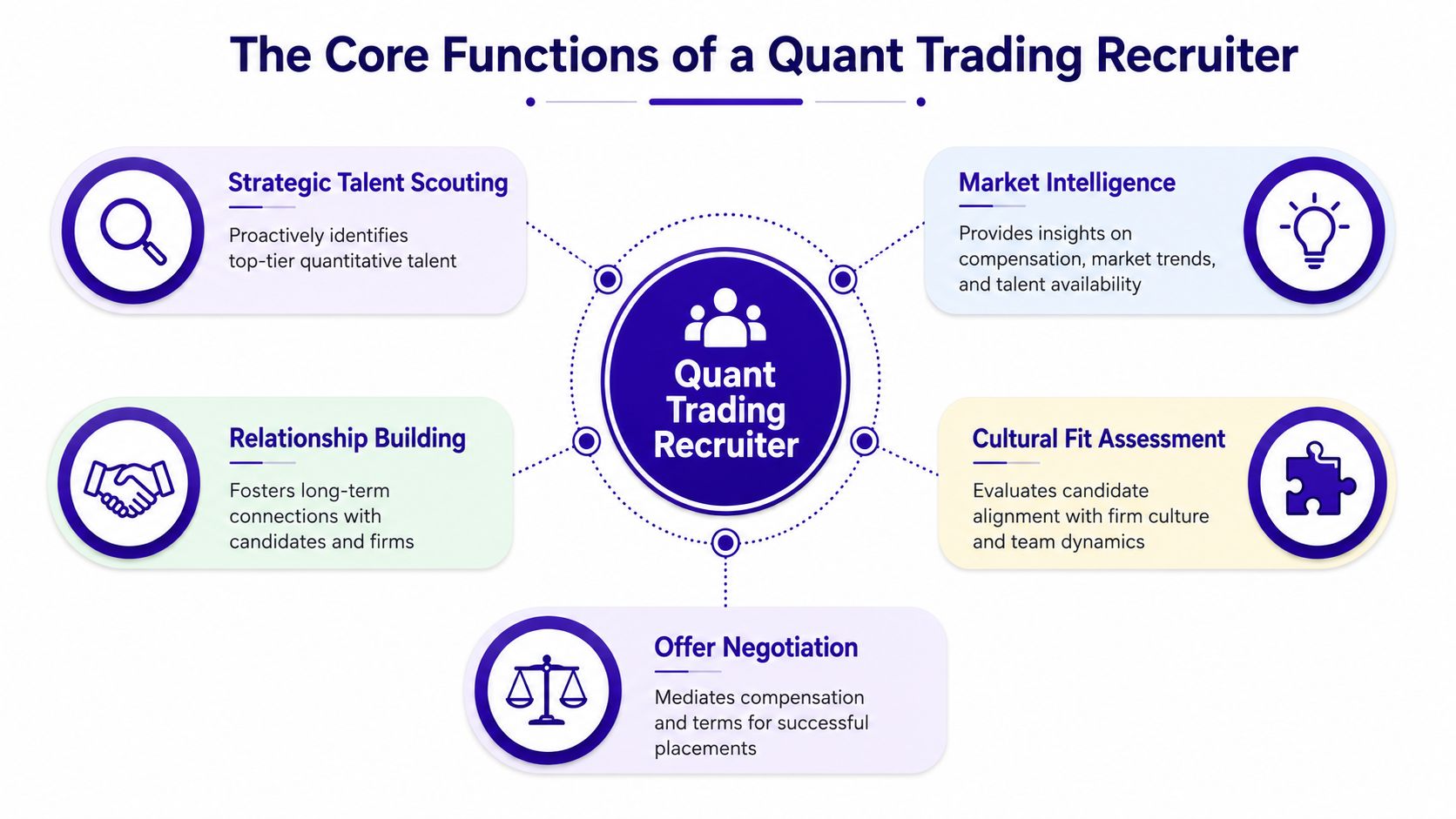
In early 2022, open quant roles rose from 2,750 at the beginning of January to 3,193 by the end of June, a net increase of 443 roles, or about 16% in six months, according to Grainstone Lee’s Quant Recruitment Report. The same report noted that Millennium Management led hiring in that period and that Hudson River Trading devoted nearly 40% of its postings to infrastructure. That matters because it shows a basic truth many hiring teams and candidates miss. Quant hiring is not only about traders and researchers. A large share of hiring pressure sits in software engineering and infrastructure.
Scouting is more targeted than most people think
A capable recruiter doesn’t search for “smart people in finance.” The search starts with role topology.
- For research seats, the recruiter looks for evidence of model design, validation discipline, and the ability to explain why a signal should persist.
- For quant development roles, the recruiter screens for production habits, code quality, and system constraints.
- For execution or HFT-adjacent seats, the recruiter pays close attention to latency sensitivity, infrastructure exposure, and technical depth in lower-level languages.
That targeting also changes outreach. Generic candidate funnels break quickly in quant because the best profiles are often passive, skeptical, and selective.
Market intelligence is part of the product
A firm doesn’t hire well if it has no view on what competing firms are asking for, how narrowly its own role is scoped, or where adjacent talent can be found. A quant trading recruiter provides that context. That can include advice on whether a “quant researcher” brief is effectively a machine learning engineering role, or whether a team needs an infra-heavy quant developer instead of another signal researcher.
Teams that want better outbound often pair recruiter judgment with systems that help Generate leads for recruitment, especially when hiring across adjacent technical profiles and passive candidate pools. The tooling can help at the top of funnel. It doesn’t replace specialization.
The strongest recruiters don’t widen the funnel blindly. They narrow it with better definitions.
Negotiation starts long before the offer
In quant, negotiation isn’t just compensation mechanics. It includes scope, reporting line, production ownership, desk alignment, and what the candidate will work on directly in the first stretch of the job. Deals fall apart when those pieces are vague. Good recruiters surface them early, before the interview loop creates false momentum.
The Recruiter’s Value to Firms and Candidates
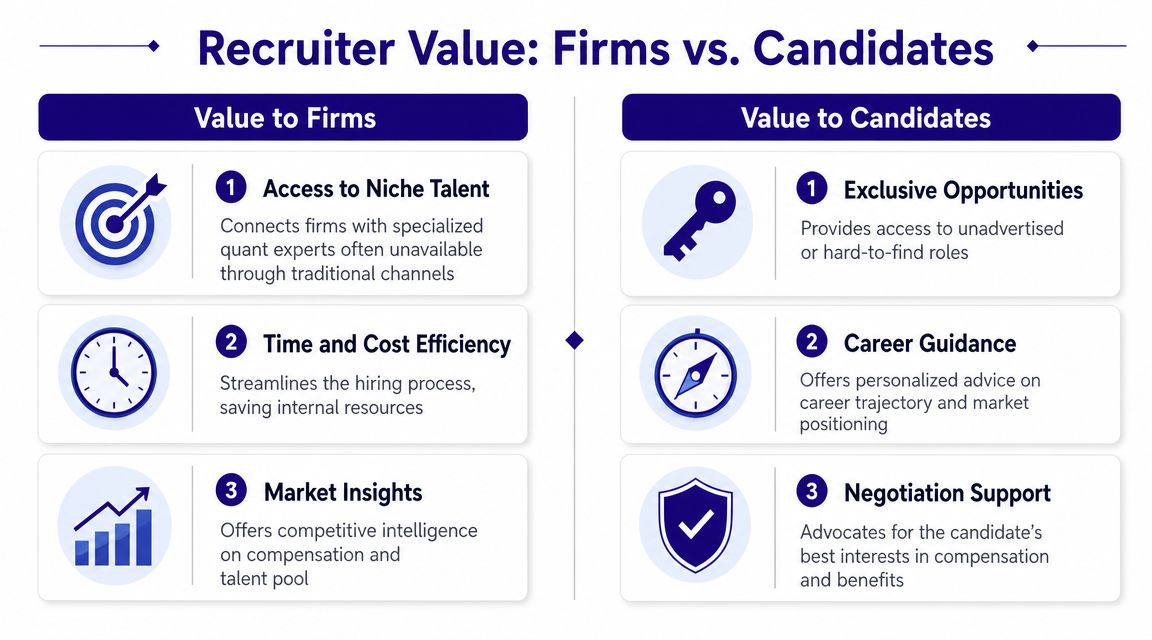
A quant trading recruiter creates value only if both sides trust the signal. That means the recruiter has to reduce noise for the firm while increasing clarity for the candidate.
Globally, 41% of candidates in one survey said they would use AI to tailor resumes and applications, as noted by Street of Walls in its quant recruiting discussion. For quant hiring teams, that adds volume but not necessarily clarity. The recruiter’s job is to identify what is real: research output, technical range, market fluency, and role fit.
Value to Firms
Firms achieve an advantage when the recruiter understands the difference between surface credentials and deployable ability.
A strong academic profile can still be the wrong hire if the candidate has never worked with production constraints, noisy market data, or the pace of a live trading environment. Good recruiters screen beyond pedigree. They ask whether the person can contribute in the actual operating model of the team.
Three areas matter most:
- Hidden talent access. Many of the best quant candidates aren’t mass-applying. They move through trusted conversations, not open portals.
- Role calibration. Recruiters often spot when a hiring manager has bundled incompatible expectations into one job.
- Funnel efficiency. Firms waste less interview time when candidate presentation includes real technical and motivational context.
For employers, the advantage isn’t merely speed. It’s lower error rate in a market where interview cycles are expensive and top candidates disappear quickly.
Value to Candidates
For candidates, a recruiter can act like a career agent if the relationship is handled correctly. The recruiter should know how a given firm interviews, what the desk needs, and which parts of a profile deserve emphasis.
Candidates often undersell themselves in one of two ways. Some stay too abstract and talk about “machine learning” without tying it to market data, model validation, or production usage. Others get too narrow and fail to frame their work in business terms.
A useful recruiter helps correct both problems.
- Opportunity access. Some roles are highly targeted and never become broad public searches.
- Positioning help. The right recruiter can sharpen a resume around fit, not just credentials.
- Interview coaching. That includes preparing for technical depth, pacing, and the firm-specific style of questioning.
- Offer advocacy. Compensation matters, but so do seat quality, team mandate, and long-term trajectory.
A recruiter adds the most value when the candidate hears the hard truth early, not the easy answer late.
That is the simultaneous value of the relationship. The firm gets a cleaner signal. The candidate gets a more informed path.
Inside the Quant Hiring Lifecycle
Quant hiring feels opaque from the outside because the process often changes by strategy, team maturity, and technical stack. From a recruiter’s side, though, the lifecycle is fairly consistent. The difference is how sharply each stage is run.
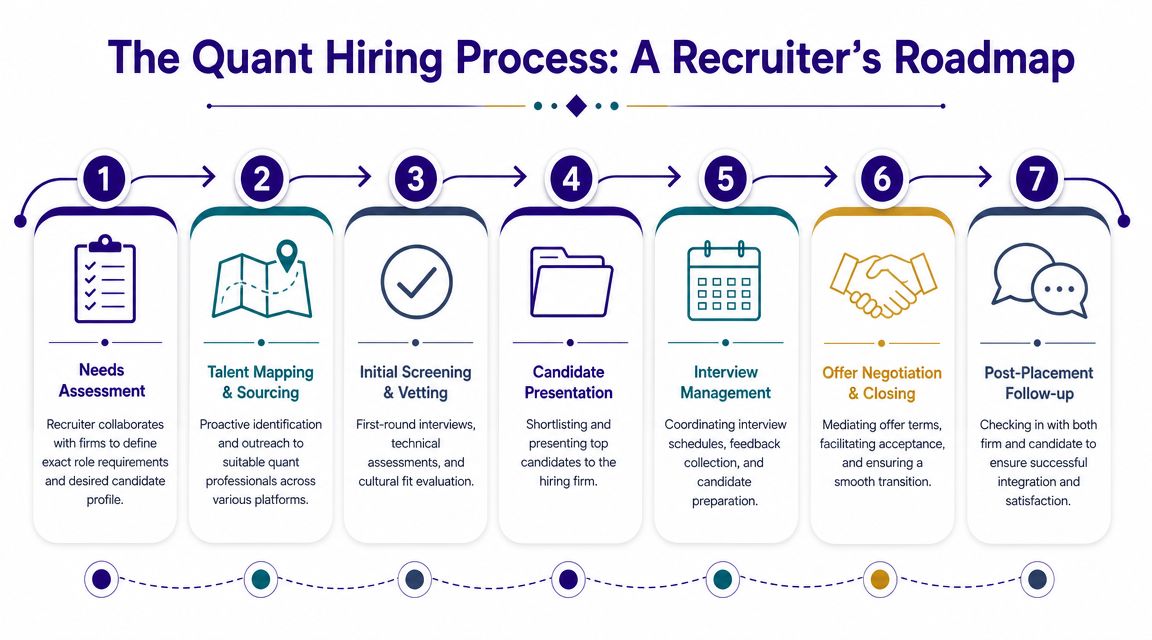
Stage One Market Mapping
The process starts before any outreach. The recruiter has to define the role in operating terms.
Is this person expected to discover alpha, productionize models, support low-latency systems, or bridge all three? Is the team optimizing for research originality, implementation speed, or execution reliability? Without those answers, sourcing turns into keyword collection.
That is why strong recruiters push hiring teams on specifics such as data environment, language expectations, strategy exposure, and who owns deployment.
Stage Two Screening for Transferability
The first serious screen isn’t about whether a candidate sounds smart. It’s whether the candidate can move from research into real use with limited friction.
According to QuantInsti’s guidance on quantitative analyst and researcher skills, recruiters should screen for Python for research and backtesting, SQL for large datasets, and often C++ when the role touches lower-latency execution. The same guidance highlights time-series analysis, machine learning, backtesting, data cleansing, and market microstructure as core areas. Candidates who can discuss noisy, high-frequency data and justify validation choices clearly usually stand out.
A screening conversation should answer practical questions:
- Can the candidate explain a model clearly?
- Can the candidate defend data handling decisions?
- Can the candidate describe what changed when the work moved closer to production?
- Can the candidate separate notebook performance from live-trading reality?
Stage Three Interview Execution
Once the candidate enters the formal loop, preparation becomes specific. The recruiter should know whether the first round will emphasize probability, algorithms, coding, market intuition, or direct discussion of prior research.
The strongest candidates adapt their communication to the interviewer. They don’t answer every question like an academic seminar, and they don’t oversimplify technical work into buzzwords.
Firms should judge consistency across rounds, not isolated brilliance in one interview.
For employers, process discipline matters. Interview panels should know what each round is testing. If every interviewer asks a slightly different version of the same question, the process feels busy but gathers little useful information.
Stage Four Closing Without Drift
The final stage is where many quant hires become unstable. The interviews may have gone well, but the candidate still doesn’t understand team design, production ownership, or what success looks like after joining.
A recruiter earns trust here by removing ambiguity. That means pressure-testing title, scope, compensation structure, reporting line, and what the role really is. Clean closing comes from early alignment, not last-minute persuasion.
Decoding Quant Job Descriptions with Examples
Most quant job descriptions hide more than they reveal. The wording is often compressed, and the important signal sits in small phrases. A candidate who can decode that language applies more selectively. A firm that writes more clearly attracts better-fit applicants.
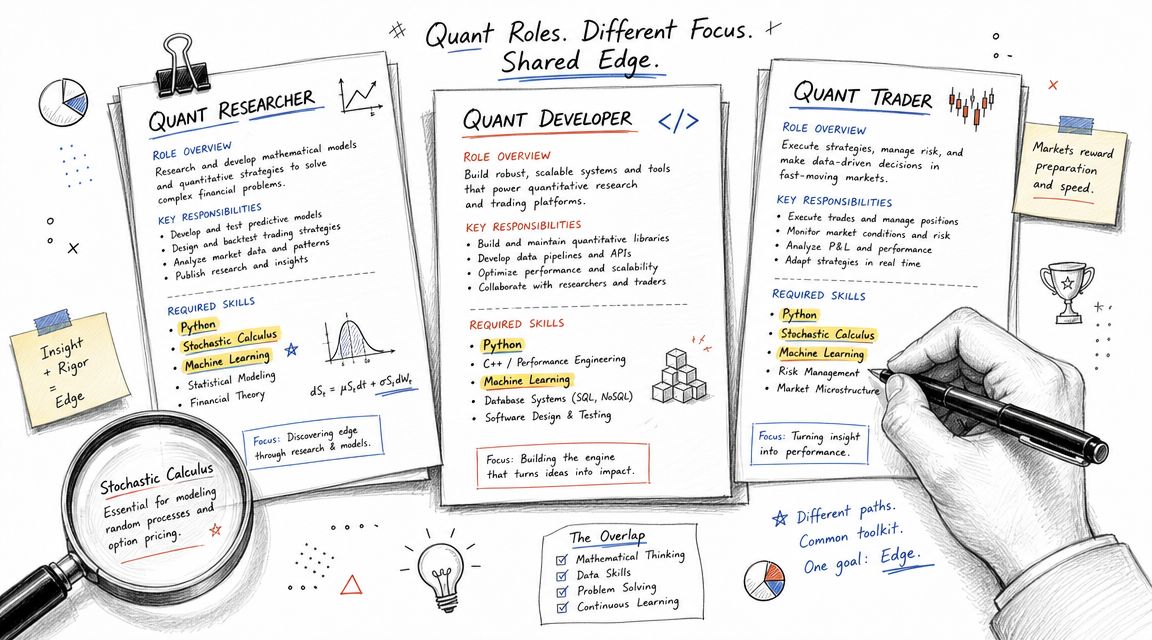
Example One Quant Researcher
A typical description might ask for strong statistics, experience with time-series modeling, Python, and a background in mathematics, statistics, physics, or computer science.
The subtext is usually clear. The team wants someone who can generate and test ideas, not just maintain an existing framework. If the listing emphasizes alternative data, feature generation, or signal validation, the firm probably expects research independence. If it mentions market microstructure or tick-level analysis, the seat may be much closer to execution-sensitive work than the title suggests.
Useful questions for candidates include:
- What data frequency does the role touch?
- Who productionizes the models?
- How is research quality evaluated internally?
Those questions often reveal whether the role is exploratory or mostly incremental.
Example Two Machine Learning Engineer
A machine learning engineer listing in a quant environment usually isn’t a generic AI role. If the description mentions pipelines, model deployment, feature stores, or collaboration with researchers, the team probably needs someone who can operationalize research rather than invent pure alpha.
That distinction matters. Some candidates hear “ML engineer” and assume broad model experimentation. In many trading firms, the practical need is different. The team may want a person who can turn fragile research code into something stable, testable, and reproducible.
When candidates review adjacent roles such as algorithmic trader job descriptions, they should compare the verbs in the listing. “Build” and “deploy” imply different accountability than “research” or “discover.” That language usually signals where the seat sits in the investment process.
Example Three Quant Developer
A quant developer posting often looks straightforward, but it can cover very different jobs. One version is tooling and researcher enablement. Another is trading systems and execution support. A third is infrastructure-heavy engineering close to latency-sensitive environments.
The clues sit in the stack and in the nouns around the stack.
| Phrase in the listing | What it often signals |
|---|---|
| Python and data tooling | Research support, analytics, internal platform work |
| C++ and low-latency systems | Execution path, performance-sensitive components |
| Exchange connectivity and market data handling | Trading infrastructure or systems close to live flow |
| Backtesting platform ownership | Bridge role between researchers and production engineering |
If a posting asks for everything, the recruiter should test whether the firm actually knows which pain point it is trying to solve.
For firms, the lesson is simple. Write the description around outcomes, not prestige language. “PhD preferred” means little without explaining whether the role requires original modeling, heavy implementation, or desk-facing decision support.
For candidates, the best move is equally simple. Read past the title. The title gets attention. The verbs, tools, and data references reveal the actual job.
How to Select the Right Quant Recruiting Partner
Choosing a quant recruiting partner is a filtering decision. The recruiter will affect role definition, candidate quality, interview flow, and close rate. A weak partner creates noise. A strong one reduces it.
What Good Specialization Looks Like
Most firms say they understand quant hiring. Fewer can explain the differences between a quant researcher, quant developer, machine learning engineer in a trading environment, and infrastructure-heavy systematic engineering.
A useful recruiter should also understand that demand isn’t evenly distributed. As noted in Selby Jennings’ quantitative analytics and trading market overview, quant demand is concentrated in specific markets and role types, and the same source notes that 77% of employers plan to reskill workers around AI. That means the recruiter should be able to discuss skill adjacencies and hybrid profiles that bridge research, code, and infrastructure.
For firms evaluating options, one practical reference point is reviewing how specialized providers frame the space. Pages such as quant recruiters and staffing support can help benchmark whether a partner speaks in real role categories or only in generic finance language.
Questions Worth Asking Early
The fastest way to evaluate a recruiter is to ask questions that expose process quality and market understanding.
| Area of Inquiry | Key Question to Ask |
|---|---|
| Role definition | How would you distinguish this seat from adjacent quant roles in the market? |
| Candidate calibration | What evidence do you look for beyond pedigree or firm brand names? |
| Market mapping | Which markets and team types are most relevant for this search? |
| Technical understanding | How do you screen for production readiness versus pure research strength? |
| Process management | What feedback cadence should both sides expect during the search? |
| Search model | Is this contingent or retained, and what behavior should that model create? |
Red Flags That Usually Predict Friction
Some warning signs are easy to miss because they sound polished on the surface.
- Generic language. If a recruiter uses the same pitch for every quantitative role, specialization is probably shallow.
- Poor technical translation. If the recruiter can't discuss why a team wants certain languages, data exposure, or market experience, screening quality will suffer.
- Pressure without context. Pushing candidates toward fast decisions before role clarity is established usually creates drop-off later.
- No challenge to the brief. Good recruiters don't accept every hiring spec as correct. They refine it.
There is also a business-model point many firms overlook. Contingent search can work well for narrower or highly visible mandates where speed matters and the market is well understood. Retained search tends to fit more confidential, complex, or leadership-oriented quant hiring where definition and access are part of the assignment. Neither model is automatically better. The right one depends on how hard the role is to scope and how much partnership the search requires.
A good recruiter should make the hiring brief sharper within the first conversations. If the brief stays vague, the search usually stays vague too.
Finding Your Edge in the Quant Market
Quant hiring is a signal problem disguised as a staffing problem. Firms need people who can contribute in a specific technical and market context. Candidates need a way to present real evidence of fit in a crowded field. A quant trading recruiter matters because the recruiter can align those two needs when the process is disciplined.
For firms, the edge comes from tighter role definition, smarter screening, and fewer wasted interviews. For candidates, the edge comes from sharper positioning, better interview preparation, and access to roles that fit the actual profile rather than the broad resume headline.
Candidates who are still refining that positioning should invest in how they present public signal, especially on LinkedIn and other professional channels. A thoughtful personal branding tool can help shape clearer market-facing narratives, especially for technical professionals whose work is often stronger than their profile copy suggests. Those exploring the field more broadly can also review a practical guide on how to become a quant to understand how skills, education, and role selection fit together.
The market will keep rewarding specificity. Firms that hire with precision and candidates who present with precision will keep outperforming the rest.
Nexus IT Group helps employers and candidates with specialized technical hiring across quantitative finance, software, data, AI, and infrastructure. Firms that need support on hard-to-fill quant roles, and candidates who want informed guidance on role fit and process expectations, can learn more at nexus IT group.