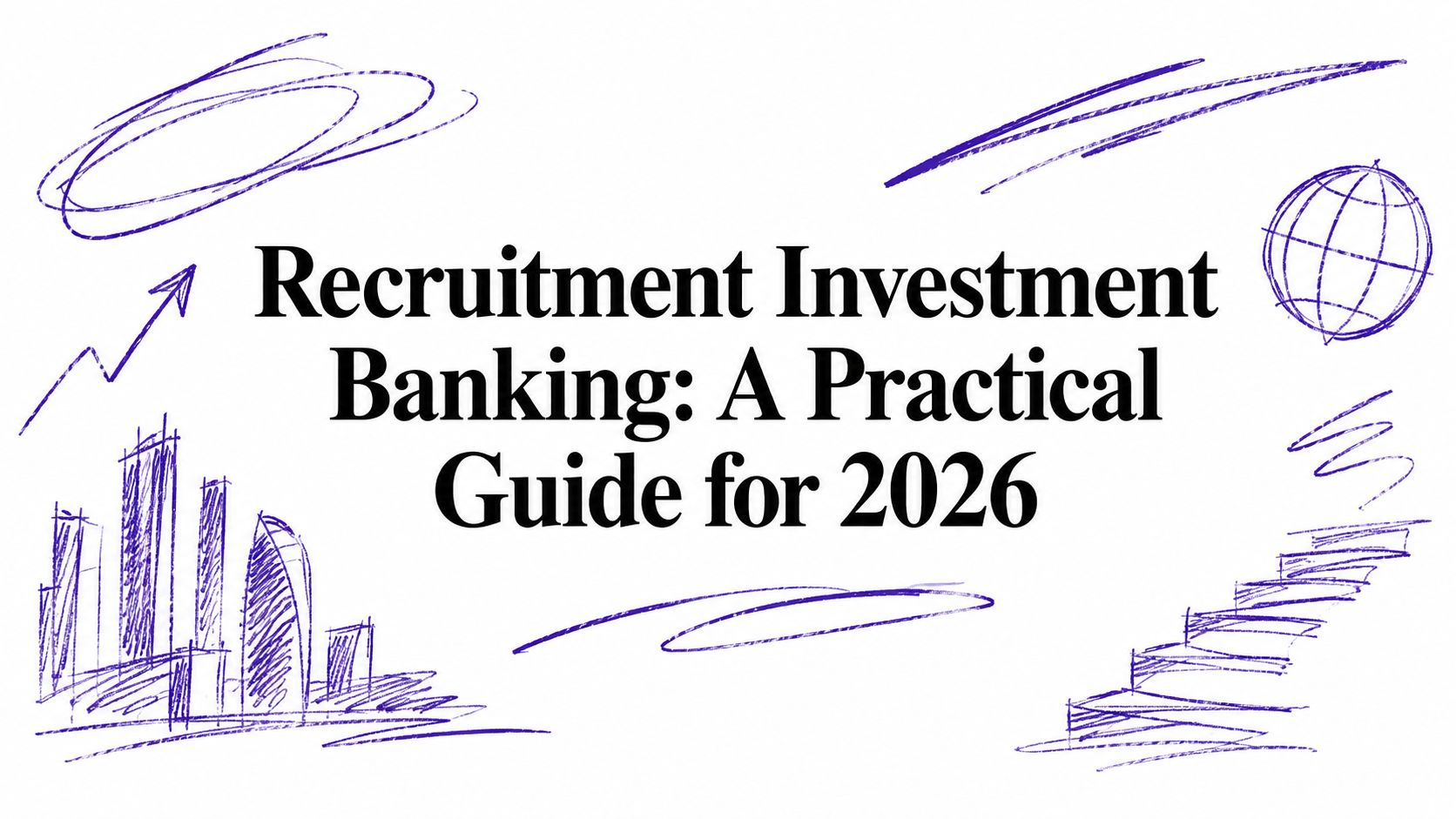
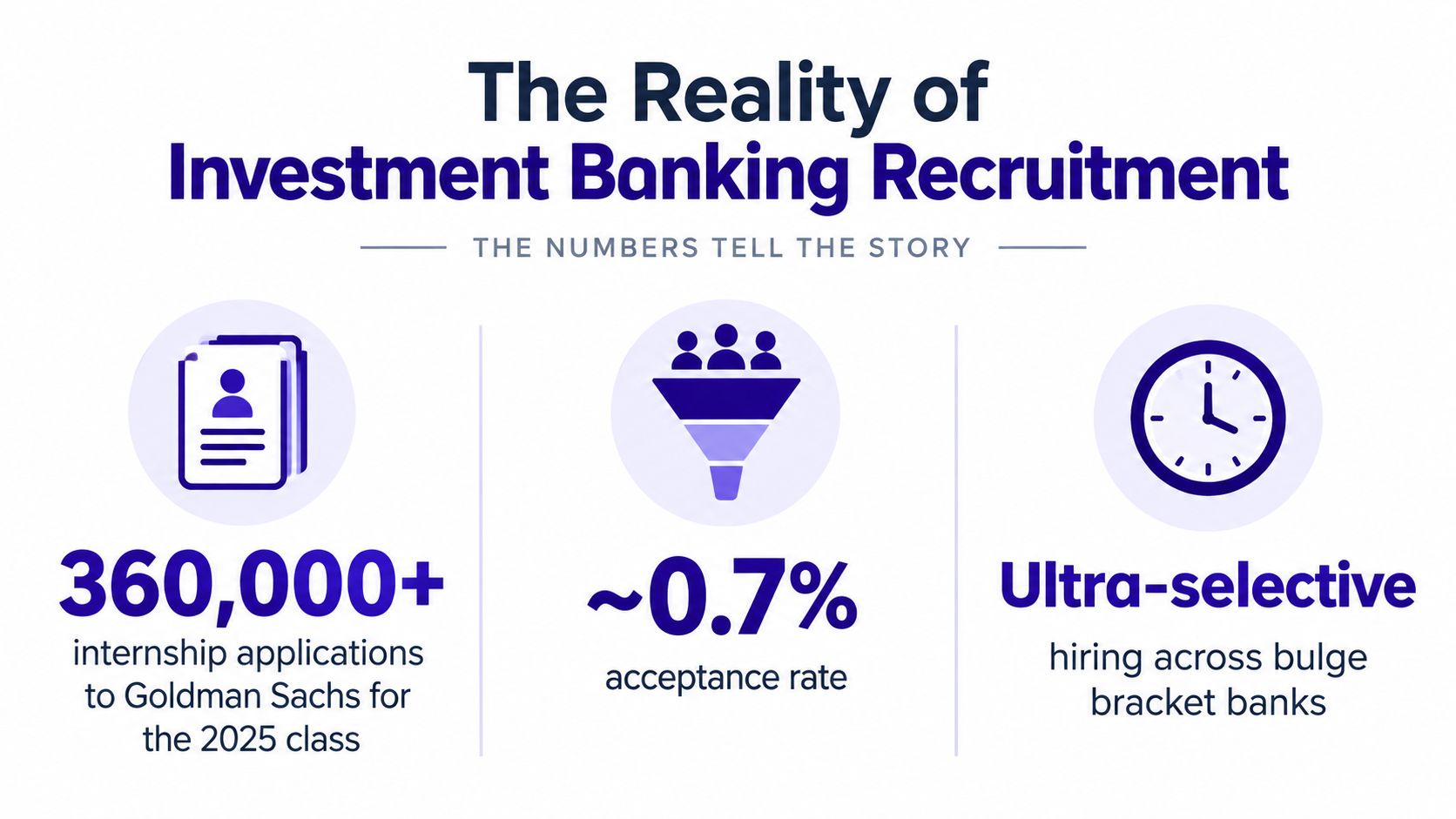
Goldman Sachs received more than 360,000 internship applications for its 2025 class and accepted only about 0.7% of applicants. Recruitment investment banking therefore demands targeted sourcing, specialized assessment, and earlier decisions, not a generalist hiring funnel.
That selectivity changes the recruiter’s job. A broad search for candidates who “want investment banking” produces noise, while a focused search for people who understand a sector, a transaction type, a market, or the technology supporting financial workflows produces a smaller but more useful slate. The strongest teams now connect practice-group needs, geographic reach, and evidence-based evaluation before a role reaches the interview stage.
The practical question is no longer how to recruit for Wall Street in general. It’s how to identify the right analyst, associate, banker, quant, data specialist, or finance technology professional for a specific revenue-sensitive team.
Table of Contents
- The Reality of Investment Banking Recruitment
- Key Roles and Where to Find Them
- On-Cycle Versus Off-Cycle Recruiting
- Navigating Interviews and Assessments
- The Geography of Opportunity
- Compliance and Confidentiality Best Practices
- Building Your Recruitment Strategy
The Reality of Investment Banking Recruitment
The headline figure is difficult to ignore. Goldman Sachs reportedly received more than 360,000 internship applications for its 2025 class and accepted about 0.7% of applicants, while its 2026 class remained below 1% acceptance for a third straight year, according to Extern’s investment banking acceptance-rate analysis. Fewer than one in one hundred applicants securing a flagship seat illustrates the scale of the funnel, not a normal hiring process.
The employment backdrop makes that funnel more significant. Employment in the global investment banking and brokerage industry declined by an average of 2.5% over the five years from 2021 to 2026, as reported by IBISWorld’s global employment data. Staffing pressure doesn’t mean every team is shrinking at the same pace. It does mean recruiters should distinguish replacement hiring and targeted capacity building from broad expansion.
Why generalist sourcing underperforms
A generalist profile can still work for some entry-level programs, but it becomes less persuasive when a group needs a professional who can contribute to a defined book of business. Financing, restructuring, debt advisory, technology coverage, healthcare coverage, and cross-border execution each call for different signals.
The market has been shifting toward financing teams and credit-experienced professionals as refinancing and recapitalization activity creates demand in debt advisory, financing, and restructuring. A review of European financial-services hiring also describes improving momentum in London, the Nordics, and Germany, especially in TMT and healthcare, with language skills becoming more valuable for cross-border execution. Those observations appear in Selby Jennings’ 2026 investment banking market update.
Recruiters should translate that reality into sharper intake meetings. A hiring manager who asks for “strong finance candidates” hasn’t defined a search. A manager who specifies credit documentation, refinancing exposure, healthcare transactions, Python-based analytics, or a particular office has given the recruiting team something testable.
For additional context on legal and financial-sector work, Kons Law investment banking offers a useful resource for understanding the broader professional environment around these roles.
Practical rule: The narrower the team’s revenue mandate, the more dangerous a broad keyword search becomes.
Key Roles and Where to Find Them
Investment banking roles share a demanding environment, but they don’t share the same talent market. The first recruiting decision should be role classification, followed by a sourcing plan and an assessment that tests actual work rather than résumé polish.
Traditional analyst and associate tracks
Analysts and associates usually need a combination of transaction judgment, financial analysis, communication, and stamina. For analysts, recruiters can examine internships, financial modeling exercises, accounting fluency, and the ability to explain an investment thesis clearly. For associates, the evidence should move toward transaction ownership, client communication, review responsibility, and the ability to turn incomplete information into a usable recommendation.
Campus recruiting remains relevant, but it shouldn’t be the only channel. Alumni networks, specialized finance communities, boutique-bank referrals, and lateral searches can uncover candidates who have already demonstrated deal exposure. A résumé that lists “valuation” isn’t enough. The recruiter should ask what the candidate built, which assumptions mattered, and how the analysis affected a decision.
Quant and proprietary trading roles
Quantitative researchers, traders, and quantitative developers require a different search strategy. Useful signals include mathematical problem solving, statistics, probability, market microstructure, programming fluency, and the ability to validate a model rather than merely produce code.
Recruiters should search technical communities, research groups, computational finance programs, open-source projects, and competitive programming networks. The evaluation should include a structured reasoning exercise and a coding or data task relevant to the role. A candidate with a computer science background may outperform a traditional finance candidate in a research-heavy seat, while the reverse may be true for a client-facing advisory role.
Technology professionals inside finance
AI engineers, data scientists, platform engineers, cybersecurity specialists, and software developers often support trading, risk, research, operations, and deal teams. Their hiring criteria should include system design, production reliability, data governance, model risk awareness, and the ability to work with stakeholders who may not share a technical vocabulary.
A recruiter searching only for “fintech” experience will miss strong candidates from enterprise software, regulated industries, cloud infrastructure, and data-intensive startups. The better approach maps the business problem to the technical capability. A pricing platform needs different evidence from a secure research environment, and a transaction-data pipeline needs different evidence from a client reporting system.
Hiring managers can use capital markets jobs as one reference point when defining finance and technology talent requirements. The key is to align the source with the role rather than treating every finance vacancy as interchangeable.
On-Cycle Versus Off-Cycle Recruiting
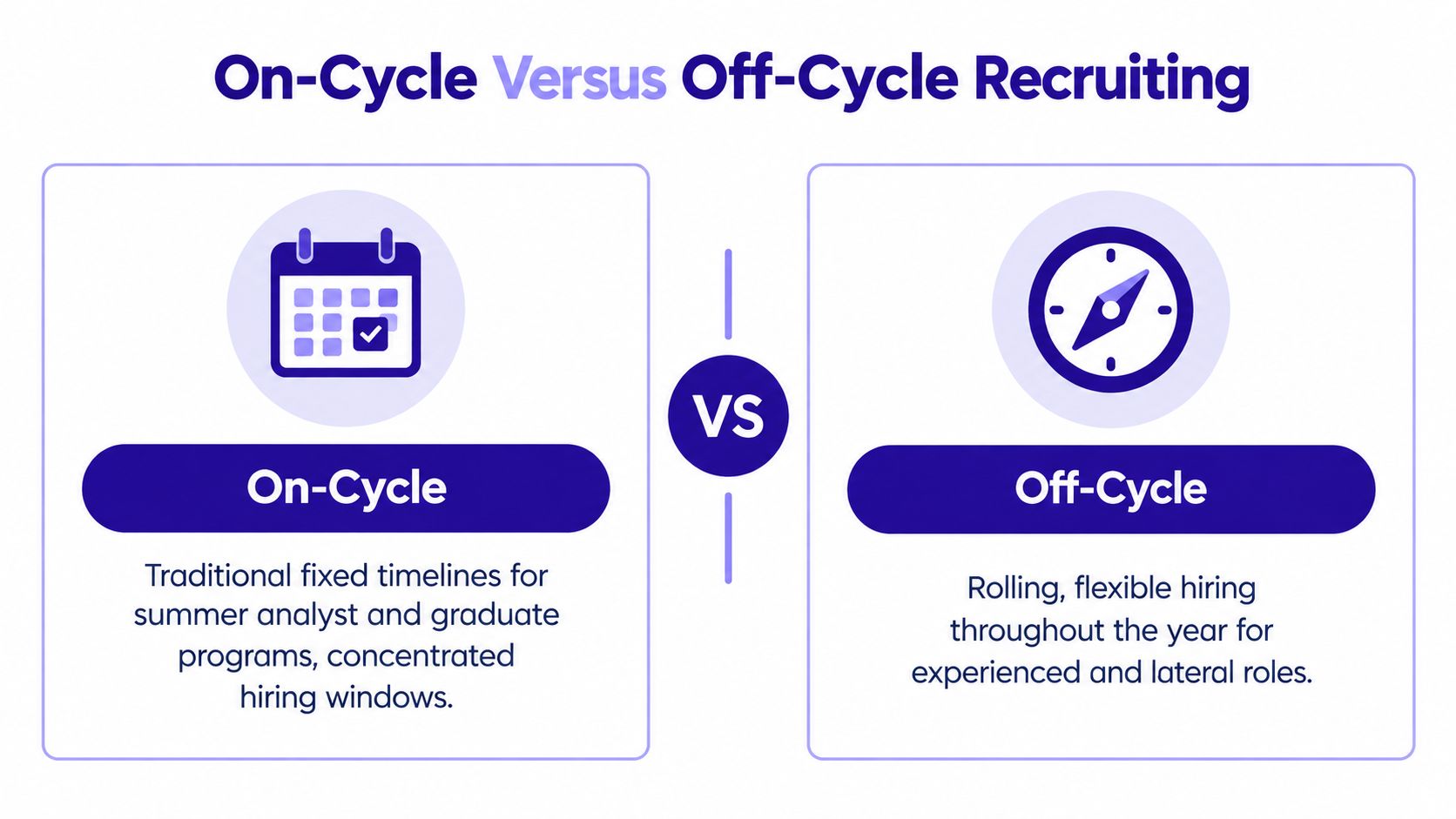
On-cycle recruiting offers structure. Firms can coordinate campus outreach, assessment stages, interviewer availability, and start dates around established programs. That consistency helps large institutions process large candidate populations, but it also compresses decision-making and encourages comparison by brand, school, and conventional credentials.
Off-cycle recruiting solves a different problem. It responds to a team opening, a departure, a new mandate, or an immediate deal requirement. Leland’s comparison of on-cycle and off-cycle recruiting describes off-cycle investment banking recruitment as a rolling, year-round process commonly used by middle-market firms, growth equity funds, and European funds to fill analyst and associate seats.
The trade-off between speed and depth
| Recruiting route | Strength | Limitation | Best use |
|---|---|---|---|
| On-cycle | Predictable coordination and broad candidate access | Compressed timelines and heavy competition | Structured analyst, associate, and graduate programs |
| Off-cycle | Flexibility and stronger alignment with an immediate need | Slower, relationship-driven process | Lateral, experienced, and specialist hiring |
On-cycle hiring works when the firm has a repeatable program and enough internal capacity to evaluate candidates quickly. It works less well when a team needs a rare combination of sector knowledge and technical capability, because the calendar can force the firm to choose from a convenient pool instead of the right pool.
Off-cycle recruiting tends to involve interviews spread over several weeks, with greater attention to fit and behavioral assessment. That slower pace can be an advantage for a candidate who needs to demonstrate judgment through detailed examples, but it can frustrate a team facing a live staffing gap. Recruiters should set expectations early, especially around decision ownership, interview sequence, and communication frequency.
A practical timing decision
Use on-cycle hiring when the firm is filling a known cohort and can define evaluation standards before applications arrive. Use off-cycle hiring when the business need is specific, time-sensitive, or dependent on a candidate’s transaction history.
Rolling applications also make submission timing important. Bank of America’s Paris and Frankfurt analyst recruiting pages state that applications are reviewed on a rolling basis once they open, and assessments may begin before the deadline. That makes Bank of America’s off-cycle analyst posting a useful reminder that a posted deadline isn’t necessarily the first evaluation point.
Navigating Interviews and Assessments
A strong recruitment process tests the work the hire will perform. It shouldn’t reward candidates merely for memorizing technical answers or rehearsing polished stories.
The initial screen should establish motivation, communication quality, work authorization where relevant, location preferences, and role alignment. The technical stage should then match the seat. An analyst may complete a modeling or valuation exercise. A restructuring candidate may need to reason through a stressed capital structure. A data scientist may work through feature selection, validation, and model-risk questions. A software engineer may explain a reliable data pipeline under demanding access and security constraints.

What candidates should demonstrate
Candidates should prepare evidence, not scripts. A useful answer connects a situation to an action, a judgment call, and a result without disclosing confidential client information. Technical preparation should cover accounting relationships, valuation logic, transaction mechanics, and the specific market or practice group named in the job description.
Technology candidates need the same discipline. They should explain architecture choices, testing methods, data limitations, security controls, and stakeholder trade-offs in language a banker can use. A technically impressive project becomes more relevant when the candidate can show how it reduced operational risk, improved decision quality, or supported a repeatable workflow.
A real-time speech feedback tool can help candidates identify pacing, clarity, and verbal habits during practice. It can’t replace role-specific preparation, but it can expose delivery problems that a résumé review won’t reveal.
What employers should measure
Employers should use a consistent scorecard with separate dimensions for technical competence, judgment, communication, integrity, and learning agility. Interviewers should record evidence against those dimensions rather than writing vague impressions such as “good culture fit.”
A Superday interview format can support a multi-interviewer process, but coordination matters. Interviewers should receive distinct questions and clear ownership so candidates aren’t asked the same question repeatedly or assessed against shifting standards.
Assessment principle: A difficult test is valuable only when it resembles the decisions the successful hire will face.
Confidentiality also matters during interviews. Candidates should never be pressured to reveal nonpublic deal information, and interviewers should stop probing when a response could expose a former employer’s protected data.
The Geography of Opportunity
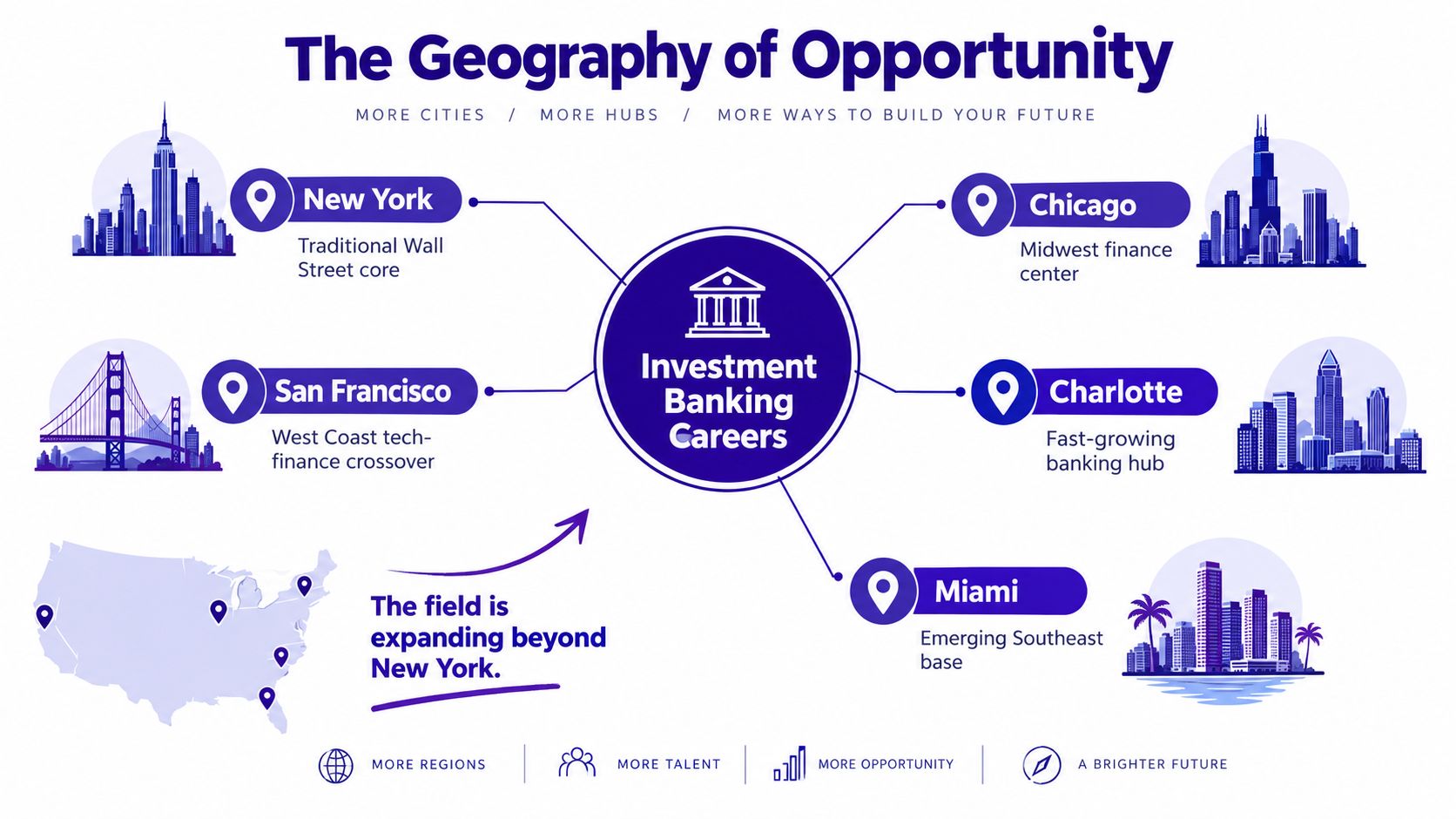
New York remains an important financial center, but treating it as the only meaningful investment banking market narrows the search unnecessarily. Yale’s 2026 guidance points to growing offices outside New York in Charlotte, Chicago, San Francisco, and Miami, alongside a shift from generalist hiring toward direct recruiting in coverage groups such as technology and healthcare. The details are outlined in Yale School of Management’s investment banking recruiting guidance.
Why location and practice fit now matter together
A city can shape access to clients, sector expertise, and adjacent technology talent. Charlotte may offer a strong banking ecosystem, Chicago can connect recruiters with Midwest finance and industrial networks, San Francisco can support technology and finance crossover, and Miami can widen access to an emerging Southeast base. These aren’t interchangeable pools, and a recruiter who treats them as such may miss candidates who are connected to a local market.
The same logic applies to practice groups. A technology coverage candidate should be assessed on technology-sector fluency and transaction relevance, not on whether the candidate has pursued a general finance career. A healthcare candidate may need to demonstrate regulatory and business-model awareness that a generalist interview doesn’t test.
A better geographic search design
Employers should define location as part of the role architecture, not add it as a filter after sourcing begins. A practical intake document should identify:
- Primary market: Which office has the client relationships, senior leadership, or deal activity that the hire will support?
- Practice group: Which sector or product team owns the work?
- Talent adjacency: Which technology, finance, academic, or professional communities overlap with that group?
- Mobility requirement: Which activities require local presence, and which can be performed across offices?
Candidates face a parallel decision. Brand, geography, and practice fit can pull in different directions. The right choice depends on the work the candidate wants to learn, the market where the candidate can build relationships, and the type of transaction exposure the team actually provides. A famous platform with weak practice fit may be less useful than a well-matched group in a growing office.
Compliance and Confidentiality Best Practices
Recruitment investment banking requires the same care with information that the work itself demands. Recruiters handle résumés, compensation details, references, immigration information, interview notes, and sometimes sensitive explanations of departures. Employers also need to prevent interview conversations from becoming channels for nonpublic transaction information.
Protect candidate and client information
Use approved systems for storing applications and interview notes. Limit access to people who need the information for the hiring decision, and establish retention rules before the search begins. Recruiters should avoid sending résumés or interview notes through personal accounts, unmanaged messaging applications, or shared folders with unclear permissions.
A confidentiality agreement can clarify expectations, but it shouldn’t become a substitute for professional judgment. Candidates need to know what they may discuss, while interviewers should frame questions around skills and experience rather than asking for identifiable details about a former client or transaction.
Keep the process consistent
A structured process reduces both compliance exposure and unfair treatment. Every candidate should receive the same core information about responsibilities, location, interview stages, and required documentation. Interviewers can explore individual experience, but they should score candidates against the same role-related criteria.
Practical safeguards include:
- Separate facts from impressions: Record the candidate’s stated experience and assessment evidence, not personal speculation.
- Use secure references: Obtain permission before contacting references and explain what information the employer seeks.
- Avoid protected information: Don’t ask questions about health, family status, religion, or other matters unrelated to the role.
- Control deal references: Permit candidates to describe their contribution without requesting confidential names, figures, or documents.
- Document decisions: Keep a clear explanation of why candidates advanced or exited the process.
Compliance is also a candidate responsibility. A candidate should decline to share confidential materials, remove protected client details from work samples, and ask whether a requested exercise can be completed with anonymized information. Ethical restraint is a hiring signal, particularly in roles where trust is part of the job.
Building Your Recruitment Strategy
The practical model for 2026 is a specialist funnel. It begins with a precise business need, reaches beyond traditional Wall Street pipelines, and measures candidates against the work rather than the prestige of their previous employer or school.
For employers
Start with a role brief that names the practice group, transaction type, office, seniority, technical stack where relevant, and decision rights. A financing team may need credit experience. A technology coverage group may need sector fluency. A data team supporting research may need production engineering and model governance. Those requirements should determine the search language, outreach channels, and assessment design.
Then divide the sourcing work. Campus recruiting can support structured analyst hiring, while specialist communities and referrals may produce stronger results for niche technical or lateral roles. For executive or confidential searches, the distinction between retained and contingency models matters, and PathSource Consulting’s guide to finding the right recruitment approach provides a useful framework for comparing those options.
Hiring managers should also define a communication cadence. Candidates with scarce skills often disengage when the process becomes opaque, especially when several interviewers provide inconsistent information. A clear timetable, named process owner, and prompt feedback protect the candidate experience without lowering standards.
For candidates
Candidates should choose a target lane before polishing a generic application. That lane might be technology coverage in Chicago, restructuring in London, quantitative research, or data engineering for a capital-markets platform. The résumé, networking list, technical preparation, and interview examples should all support that choice.
A candidate should track target firms, offices, practice groups, application openings, referrals, and follow-ups in one working document. Early submission matters for rolling processes, while off-cycle opportunities reward sustained relationship building rather than a single application burst. Candidates should also prepare a concise explanation of why the selected group fits their skills and why the location makes sense.
For employers evaluating specialist finance and technology hiring partners, how to choose finance executive search firms offers a relevant decision framework. A firm such as nexus IT group can support searches where investment banking, private equity, hedge fund, quant, and technology requirements overlap, including roles across software, data, AI, cloud, and cybersecurity.
The strongest recruitment strategy connects four decisions: what the team needs, where that talent sits, how the work will be tested, and how confidential information will be protected. Generalist volume may still have a place in large programs, but specialized hiring requires sharper briefs, broader geography, and evidence that maps directly to revenue, risk, and execution.
Nexus IT Group connects employers with specialized technology and finance-adjacent professionals across areas such as AI engineering, data science, software development, quant recruitment, cloud, and cybersecurity. Visit nexus IT group to discuss a confidential search, direct placement, contract staffing, or executive hiring need tied to investment banking and capital-markets teams.
