A critical requisition sits open, the roadmap slips, and every new shortlist looks like the last one. Specialized IT recruitment services earn their fee at that exact point, not by sending more resumes, but by proving a candidate can do the work in production. CIOs should judge a firm on verified capability matching and quality of hire, not database size or speed claims. Anything less is generalist sourcing with a new label.
Table of Contents
- The Hiring Moment Most Teams Underestimate
- What Specialized IT Recruitment Actually Means
- The Hiring Models You Can Buy
- The Technical Domains a Specialist Should Cover
- Skills-Based Screening That Actually Works
- When to Buy Versus When to Build the Capability
- A Practical Checklist for Choosing the Right Partner
The Hiring Moment Most Teams Underestimate
A hiring manager opens a priority role for a cloud security engineer. Ninety days later, talent acquisition has run three sourcing cycles, hiring panels have met promising talkers, and nobody has passed a serious architecture review. The resumes contain the right words. The candidates can’t explain containment decisions, identity controls at scale, or what broke in their last migration.
That loop isn’t bad luck. Broad postings attract broad applicants, keyword filters reward polished resumes, and generalist screeners can’t tell Terraform proficiency from a candidate who once edited a module. Each weak shortlist forces hiring managers to do the technical vetting themselves, which slows calibration and burns panel time.
Why the Loop Persists
Demand keeps tightening the screw. Bureau of Labor Statistics projections for computer and mathematical occupations show 10.1% growth from 2024 to 2034, more than three times the 3.1% projected for all occupations, with data scientist roles up 33.5% and information security analyst roles up 28.5%. Scarce specialists don’t queue up on job boards, and the best ones ignore vague outreach.
Internal teams also inherit a flawed brief. Job descriptions copy titles, tool lists, and years of experience from the last hire. Nobody separates mandatory production skills from trainable preferences, so screeners reject strong adjacent profiles and advance exact-title candidates who lack depth.
- Symptoms of a broken search: Repeated shortlists, panels redefining the role mid-process, and finalists who fail on production reality.
- Hidden cost: Senior engineers spend their week interviewing instead of shipping, while the vacancy blocks a migration, audit, or product launch.
- Real decision: The choice isn’t agency versus in-house. It’s generalist sourcing versus a partner that verifies capability before a resume reaches the panel.
A specialist that can’t explain why a candidate fits, skill by skill, is just forwarding paper faster.
A proper specialist changes the input, not the volume. Intake becomes a technical calibration session, sourcing targets defined competitor teams and niche communities, and screening tests evidence. That shift shortens time to a credible shortlist and protects retention, because the hire was matched to the actual work, not to a title.
What Specialized IT Recruitment Actually Means
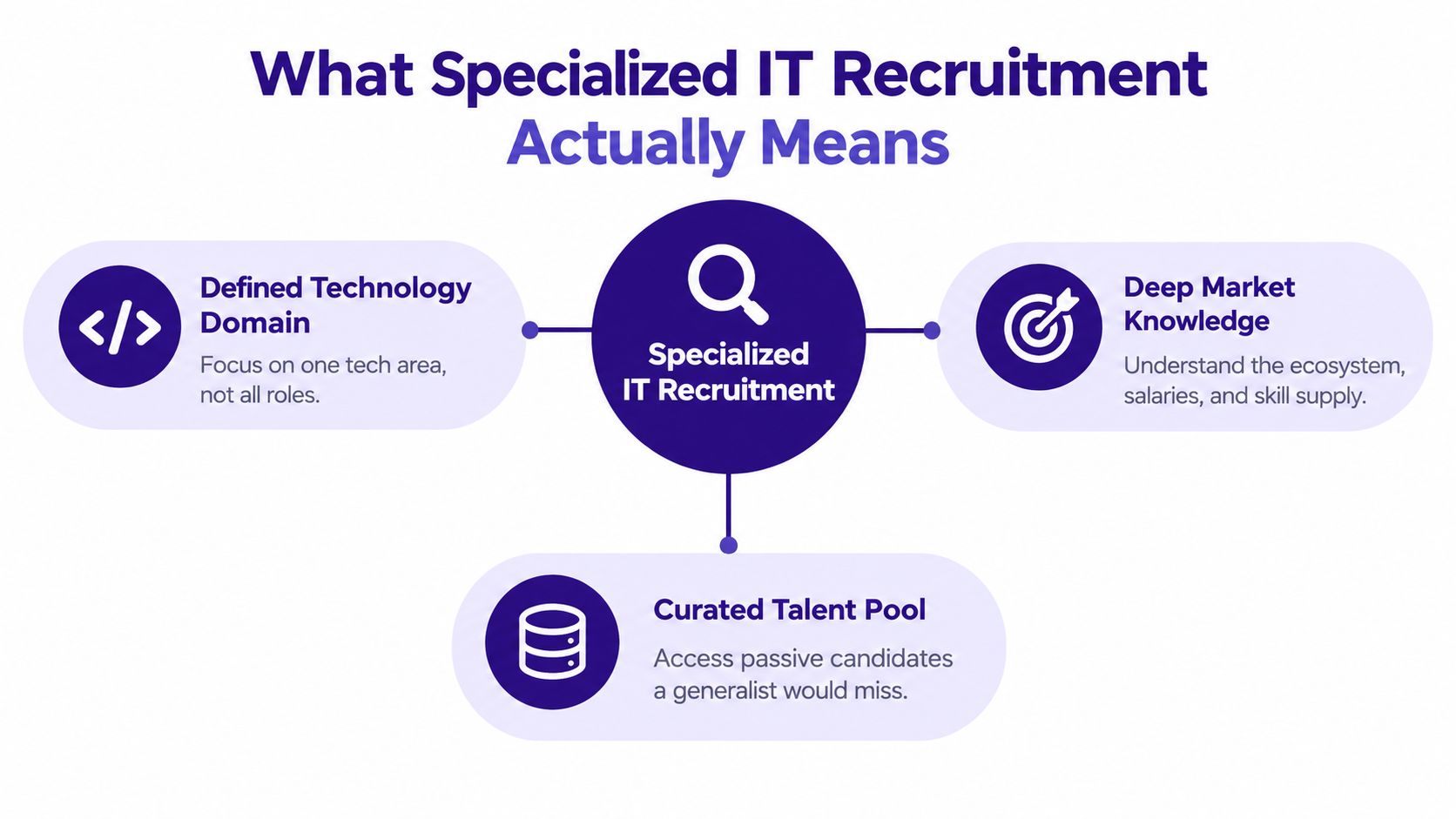
Specialized IT recruitment services start with a narrow domain. A recruiter covers cloud platform engineering, or cybersecurity, or AI engineering, and knows the employers, compensation bands, tool stacks, and failure patterns inside that market. Narrow focus sounds limiting. In practice, it’s the reason the shortlist improves.
The Same Search, Handled Two Ways
Consider an AI engineering hire. A generalist searches for the title, filters for Python and LLM keywords, and sends candidates who built demos and prompt wrappers. Panels discover late that nobody has deployed a model, owned evaluation, handled data leakage controls, or run inference under cost constraints.
A specialist asks different intake questions. Does the team need an AI user, an AI integrator, or an AI systems builder? What’s the data pipeline maturity, the MLOps stack, the latency target? Screening then maps evidence to each requirement, and candidates with adjacent strength in data engineering or platform work become visible instead of filtered out.
That distinction matters because skill definitions keep moving. The World Economic Forum Future of Jobs Report 2025 places big data specialists, fintech engineers, AI and machine learning specialists, and software and application developers among the fastest-growing jobs globally and estimates 39% of workers’ existing skill sets will be transformed or become outdated by 2030. A recruiter tracking one domain notices those shifts early. A generalist covering every function notices them at intake, too late.
What a Real Specialist Does Differently
- Maps the market: Names target employers, adjacent teams, and passive communities before sourcing starts.
- Translates the role: Converts vague requirements into verifiable capabilities with proficiency levels.
- Screens for production evidence: Probes scale, ownership, incident outcomes, and tool versions, not buzzword fluency.
- Advises on trade-offs: Tells the CIO when compensation, location, or a must-have list makes the search unfillable as written.
Mature specialists typically cover cloud, cybersecurity, data and AI, DevOps and SRE, software development, quant, and IT leadership through separate domain practices, not one recruiter handling everything. Ask who personally screens candidates and what that person covered before. If the answer is every IT role in every industry, the firm isn’t specialized. It’s staffed for volume, and volume is exactly what created the ninety-day loop.
The Hiring Models You Can Buy
Model selection is a risk decision, not an administrative preference. The wrong model overpays for short-term capacity or leaves a permanent leadership gap filled by a contractor who’ll leave. CIOs should match the model to duration, scarcity, confidentiality, and how much hiring risk the business can absorb.
Specialized IT hiring models at a glance
| Model | Best fit scenario | Engagement signal |
|---|---|---|
| Contract staffing | Defined project, migration, or sudden capacity gap | Speed matters more than long-term retention |
| Contract-to-hire | Uncertain headcount approval or fit risk on both sides | Trial period before permanent commitment |
| Direct placement | Permanent role with clear long-term ownership | Business case supports a full-time hire |
| IT executive search | CIO, CTO, VP Engineering, or CISO appointment | Judgment, references, and succession risk dominate |
| Confidential search | Incumbent replacement or sensitive reorganization | Discretion outweighs public employer branding |
| Quant recruitment | Trading, research, and low-latency engineering roles | Compensation structures and non-competes shape the search |
Where Each Model Wins
Contract staffing buys capacity fast. It’s right for a cloud migration, an audit remediation push, or a platform rebuild with a fixed end. It fails when managers use contractors as permanent headcount by another name, because knowledge walks out and rates keep renewing. Demand a documented handover plan from day one.
Contract-to-hire de-risks fit when a team can’t judge production ability from interviews alone, or when finance hasn’t released permanent headcount. Set conversion criteria in writing at the start, including timeline and salary range. Without that agreement, strong contractors accept permanent offers elsewhere while the client deliberates. A clear-eyed comparison of direct hire and contract staffing trade-offs helps teams avoid choosing a trial model by default.
Direct placement suits roles with lasting ownership, on-call responsibility, and institutional knowledge value. Security engineers, SREs, and data platform leads usually belong here. The fee only makes sense if the firm delivers calibrated, evidence-backed shortlists. Paying a placement fee for unscreened applicants is indefensible.
Models That Require Real Specialization
Executive search is not senior direct placement. Retained work should include market mapping, structured references, and assessment against transformation mandates, not a shortlist of available leaders. Confidential search adds controlled outreach and staged disclosure, which matters when an incumbent still holds the role.
Quant recruitment operates under different rules entirely. Recruiters must understand research versus trading system roles, compensation tied to performance, garden leave, and why a strong software engineer may still fail in a low-latency environment such as C++ systems for HFT firms. A firm that treats quant as generic software hiring shouldn’t touch the search.
Decision rule: Buy contract for defined outcomes, contract-to-hire for unresolved fit or headcount risk, and direct placement for enduring ownership. Never let a firm’s preferred fee model make that call.
The Technical Domains a Specialist Should Cover
Coverage claims are cheap. Every firm lists cloud, AI, and cybersecurity on its website. CIOs should test fluency domain by domain and listen for the questions a recruiter asks, because question quality reveals whether screening will rest on evidence or keywords.
Signals of Genuine Domain Depth
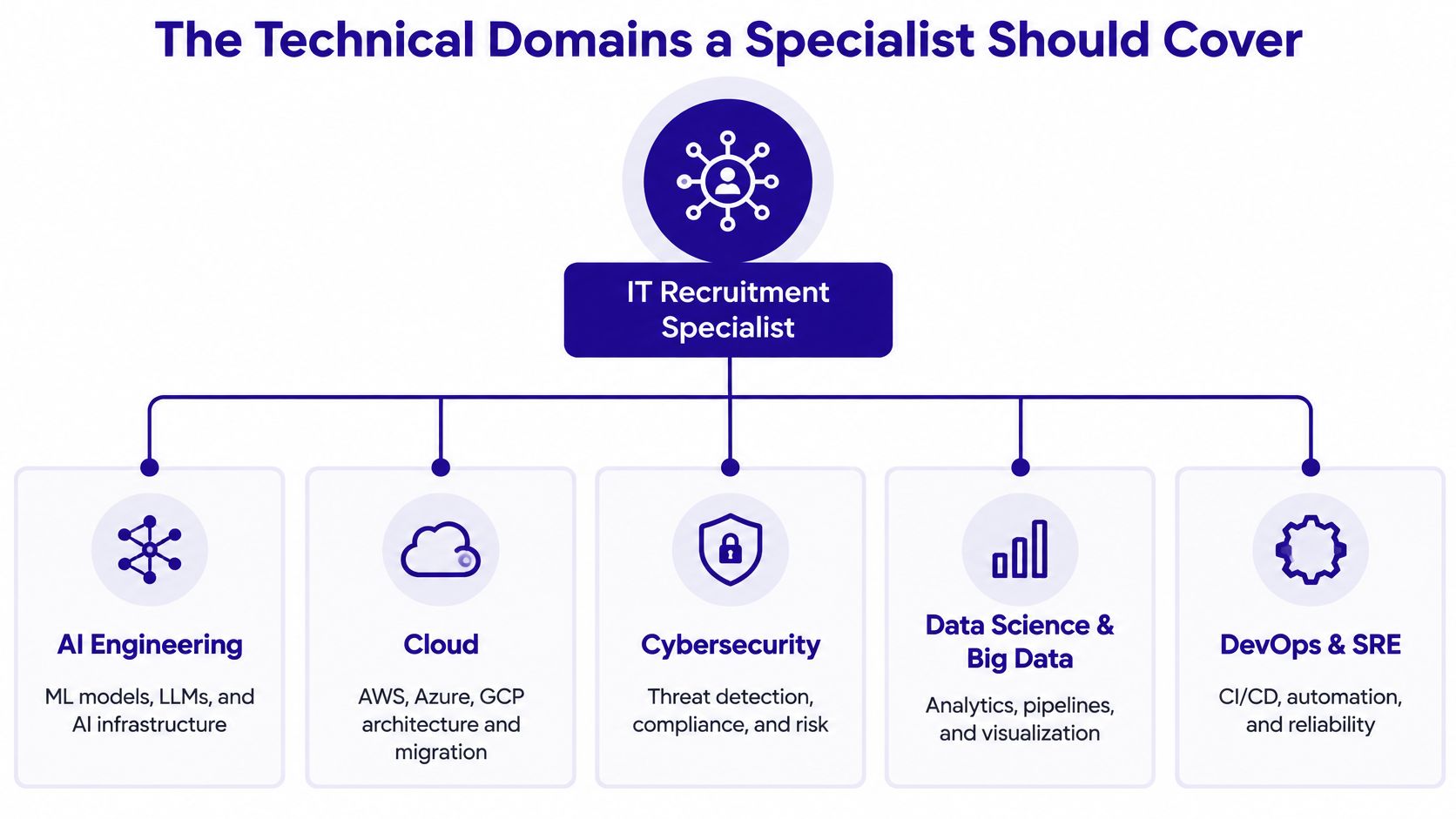
In cloud, a credible recruiter distinguishes AWS, Azure, and GCP architecture work, asks about landing zones and migration patterns, and probes infrastructure as code with tools like Terraform rather than accepting a certification as proof. Certifications signal study. Production ownership signals capability.
In cybersecurity, the test is sharper. NIST’s summary of CyberSeek workforce data estimated a shortfall of nearly 265,000 cybersecurity workers in the United States in 2024, so recruiters must translate the NICE Framework into specific work roles instead of treating cybersecurity as one skill. Incident response, vulnerability analysis, cloud security engineering, security architecture, and governance require different searches, different assessments, and different compensation logic.
AI engineering demands separation of model research, ML engineering, data engineering, and AI product integration. Data science and big data hiring should probe pipeline ownership, data quality work, and tools such as Spark, dbt, or Snowflake in context, not as a checklist. DevOps and SRE screening should cover CI/CD design, Kubernetes operations, observability, error budgets, and incident command experience.
Software, Leadership, and Regulated Contexts
Software development remains the largest lane, and it’s where keyword screening does the most damage. Strong recruiters ask what candidates shipped, at what scale, and how they handled reliability and testing. Practical strategies for recruiting software engineers on demonstrated outcomes show why outcome-based briefs outperform title-based ones.
- IT leadership: Assessment should cover operating model design, vendor decisions, and transformation delivery.
- Fintech and quant: Low-latency, risk, and regulatory constraints change both sourcing pools and screening depth.
- Government IT: Clearance eligibility, procurement rules, and compliance frameworks narrow the funnel early.
- Healthcare IT: HIPAA exposure, EHR ecosystems, and patient data controls are screening criteria, not onboarding topics.
- UX and digital marketing technology: Portfolio evidence and platform fluency, such as analytics and marketing automation stacks, matter more than titles.
One diagnostic question cuts through coverage claims. Ask the recruiter which adjacent profile could succeed in the role and what evidence would prove it. A specialist answers immediately. A generalist promises to search the database, and that answer predicts the shortlist.
Skills-Based Screening That Actually Works
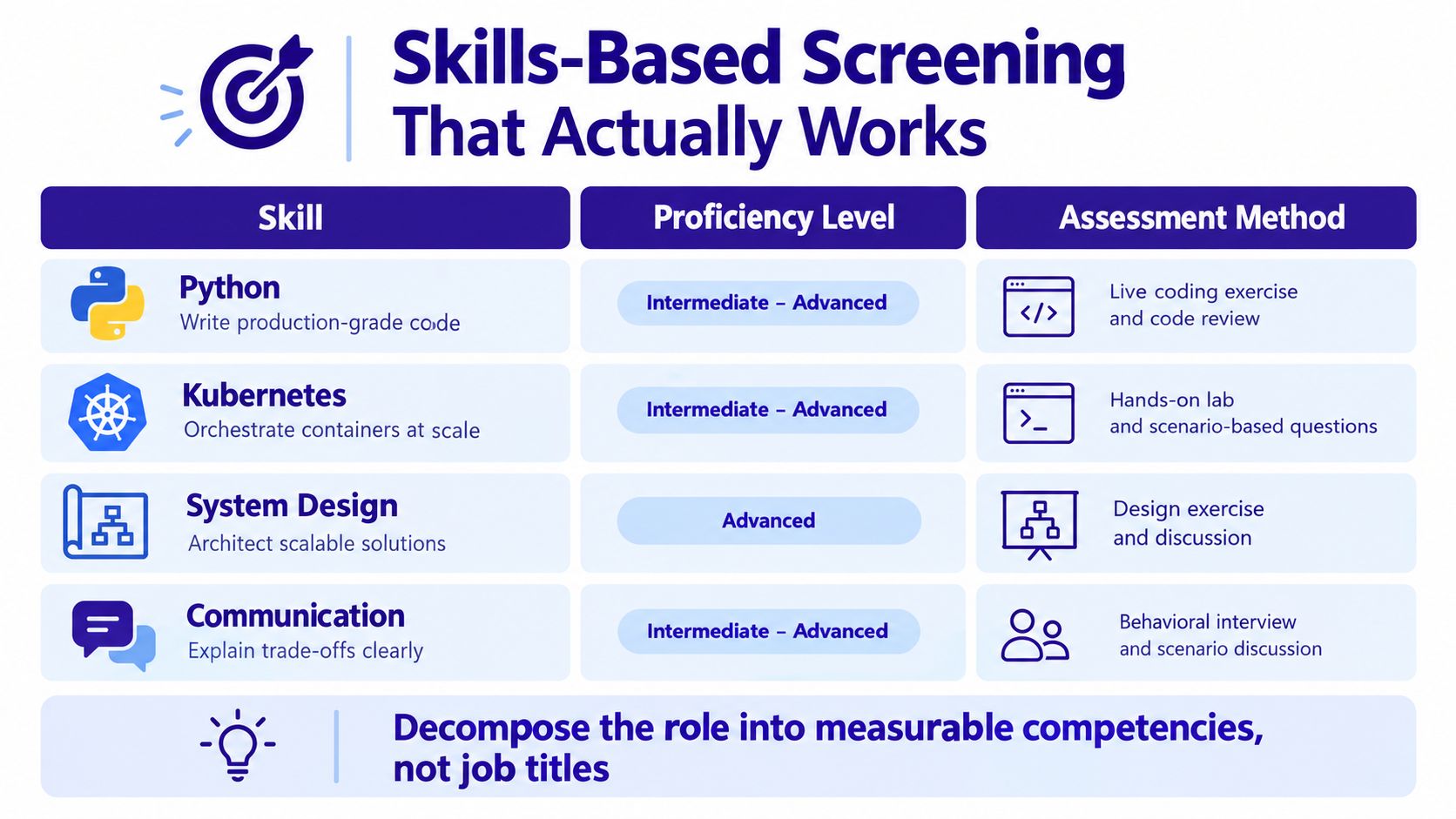
Titles lie politely. Evidence doesn’t. Skills-based screening decomposes a role into verifiable capabilities, defines observable proof for each one, and separates production essentials from preferences a strong hire can learn on the job. Teams that skip this step don’t have a sourcing problem. They have an assessment problem.
The business case is documented. LinkedIn’s Future of Recruiting research reports 73% of recruiting professionals consider skills-based hiring a priority, skills-based methods can expand the talent pool by up to 10 times, and more than nine in ten talent acquisition professionals believe accurate skills assessment is key to quality of hire. Expansion only helps if screening can judge the wider pool, which is where a competency matrix earns its place.
Build the Matrix at Intake
- List capabilities, not duties: Kubernetes operations, distributed systems design, threat modeling, model deployment.
- Set proficiency levels: Define what supervised, independent, and architecture-owning performance look like for each skill.
- Attach proof: Production scale, incident outcomes, work samples, portfolio artifacts, structured references.
- Split the list: Mark each capability as mandatory on day one or trainable within a defined ramp.
- Align the panel: Every interviewer tests assigned rows and scores against the same rubric.
Public sector hiring offers a useful parallel on structured criteria. The Australian government ICT hiring guide from erecruit shows how skills-based methods apply in ICT contexts where capability definitions must be explicit and defensible, a discipline private sector teams should borrow.
Two Searches Where Adjacent Talent Wins
For an SRE role, a platform engineer with demonstrated Terraform depth, observability ownership, and incident response experience may outperform a candidate holding the SRE title at a smaller scale. The matrix surfaces that candidate. A title filter deletes the resume.
For a cloud security engineer, an infrastructure engineer with security automation, identity policy work in AWS IAM or Azure Entra ID, and compliance tooling experience can be a credible hire with a defined development plan. Validation should use applied tasks. Ask candidates to prioritize alerts, explain containment, or design identity controls for a realistic scenario. Guidance on testing IT candidates in the era of AI matters here, because screening must also check how candidates validate AI-generated code, protect confidential data, and document decisions.
Reject any shortlist that can’t show, per candidate, which matrix rows are proven, which are trainable, and what evidence supports the call.
When to Buy Versus When to Build the Capability
Not every scarce capability should be bought at full market price. That’s the conversation most recruitment firms avoid, because it can shrink a search. CIOs should force it anyway. The right answer depends on risk, time to productivity, manager capacity, regulatory exposure, and whether the business needs the skill forever or once.
Market behavior already reflects that nuance. PwC’s Digital Trust Insights findings on upskilling priorities sit alongside Robert Half reporting that 57% of technology hiring managers prioritize high-potential candidates and invest in development when required skills are unavailable, while PwC reported 47% of organizations were prioritizing upskilling or reskilling to close AI and cybersecurity gaps.
Buy the Specialist Outright When
- Risk is immediate: An audit finding, active threat exposure, or a stalled migration can’t wait for a ramp period.
- Regulatory exposure is high: Healthcare, government, and financial services roles often require proven judgment under compliance pressure.
- Nobody internal can mentor: A first security hire or first ML engineer must set standards others will follow.
- The capability is durable: Platform engineering, security architecture, and data governance compound over years.
Build or Blend When
Hire for potential when a strong adjacent candidate shows learning velocity, a manager has real coaching capacity, and the work allows a supervised ramp. This path fails when teams hire potential and then assign expert-level accountability in month one. That’s not development. It’s mislabeling.
Blend the team when one perfect candidate doesn’t exist at an acceptable price or timeline. Pair an adjacent-profile hire with a senior specialist, a fractional CISO, or a contract architect who transfers knowledge while delivering critical milestones. Startups and private equity backed companies use this well. One senior hire stands up the system, then internal talent grows underneath it.
Judge each option with measurable outcomes. Track time to independent delivery, retention, internal promotion, and reduction in critical skill gaps. Compare those against the salary premium and vacancy cost of holding out for a perfect title match.
A firm such as nexus IT group, which offers contract staffing, direct placement, executive search, and quant recruitment across these domains, should be willing to model all three paths at intake. If a partner’s only answer is a full fee search for a perfect candidate, the firm is selling its inventory, not advising on capability.
A Practical Checklist for Choosing the Right Partner
Evaluate a firm the way a firm should evaluate candidates. Demand evidence, score it consistently, and check references. Polish in a pitch meeting predicts nothing about shortlist quality in week three.
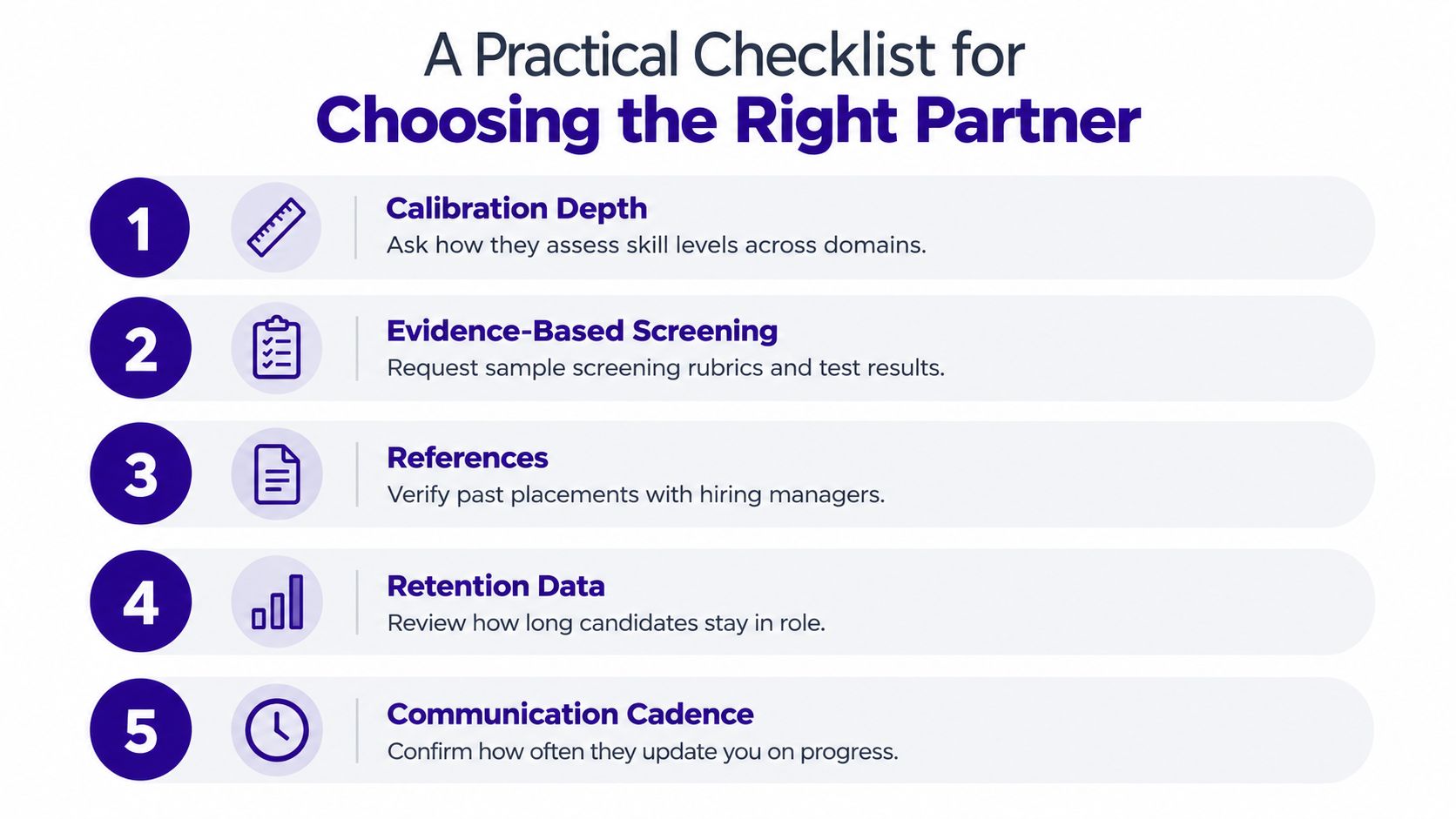
Five Checks Before Signing
- Calibration depth: Ask the firm to walk through a recent intake. Strong partners describe capabilities, proficiency levels, and trade-offs they pushed back on.
- Evidence-based screening: Request a redacted competency matrix and candidate write-up. Vague summaries mean vague screening.
- References from hiring managers: Speak to technical leaders, not only procurement contacts. Ask about first shortlist quality.
- Retention and replacement terms: Ask how long placements stay and what happens operationally when a hire fails early, including backfill capacity.
- Communication cadence: Agree on market feedback, pipeline reporting, and honest escalation when the brief proves unfillable.
Outcome reporting separates partners from vendors. LinkedIn platform data on skills-based searches and quality hires indicates companies conducting the greatest number of skills-based searches are 12% more likely to make a quality hire. That gives employers a measurable standard to demand. Placement counts alone don’t.
Measure Quality of Hire at Set Intervals
- At 30 days: Ramp progress against the matrix rows marked trainable, manager confidence, and early delivery signals.
- At 90 days: Independent contribution, incident or project outcomes, and collaboration across dependent teams.
- At 180 days: Retention risk, scope growth, and whether the hire closed the capability gap the search targeted.
Scale changes the emphasis, not the standard. Startups need speed with honest trade-off advice. Mid-market companies need repeatable screening across managers. Enterprises need domain depth that survives procurement cycles and panel complexity across North American hiring hubs. In every case, the winning firm is the one that verifies adjacent and transferable capability, reports outcomes past acceptance, and tells the CIO when not to run the search as written.
When a hard-to-fill AI, cloud, cybersecurity, data, or leadership role is blocking delivery, specialized IT recruitment services should bring a calibrated shortlist backed by production evidence, not another stack of keyword matches. Explore how nexus IT group supports contract staffing, direct placement, executive search, confidential search, and quant recruitment across North America. Start with an intake conversation built around a competency matrix, and hold every candidate presented to that standard.
