
A CTO usually starts looking up what is staff augmentation at a specific moment. A release is slipping. A cloud migration needs one specialist the current team doesn’t have. An AI initiative got executive approval before the hiring plan caught up. Internal recruiting is moving, but the project can’t wait.
That’s where staff augmentation becomes useful. Not as a buzzword, and not as a shortcut around management, but as a controlled way to add specific talent to an existing team without rebuilding the org chart. The difference between a strong engagement and an expensive distraction comes down to one thing most articles skip: integration friction. Finding a capable engineer matters. Getting that engineer productive inside the team’s actual workflow matters more.
Table of Contents
- Defining Staff Augmentation Beyond the Buzzwords
- Staff Augmentation vs Other Talent Models
- Strategic Business Cases for Augmenting Your Team
- The Implementation Process from Need to Onboarding
- Understanding Contracts and Pricing Models
- Measuring Success with KPIs and Governance
- Common Pitfalls and How to Avoid Them
Defining Staff Augmentation Beyond the Buzzwords
A working definition that holds up in practice
Staff augmentation is adding external talent to an internal team for a defined need and a defined period, while the company keeps direct control of the work. The augmented engineer, architect, analyst, or security specialist works inside the client’s environment, follows the client’s processes, and reports to the client’s managers for day-to-day execution.
A simple way to think about it is this. It’s like renting a specific tool for a specific job instead of hiring a full construction crew to run the whole site. If a team needs a Kubernetes specialist, a machine learning engineer, or a senior QA lead, staff augmentation adds that specialist to the existing system. It doesn’t replace the system.
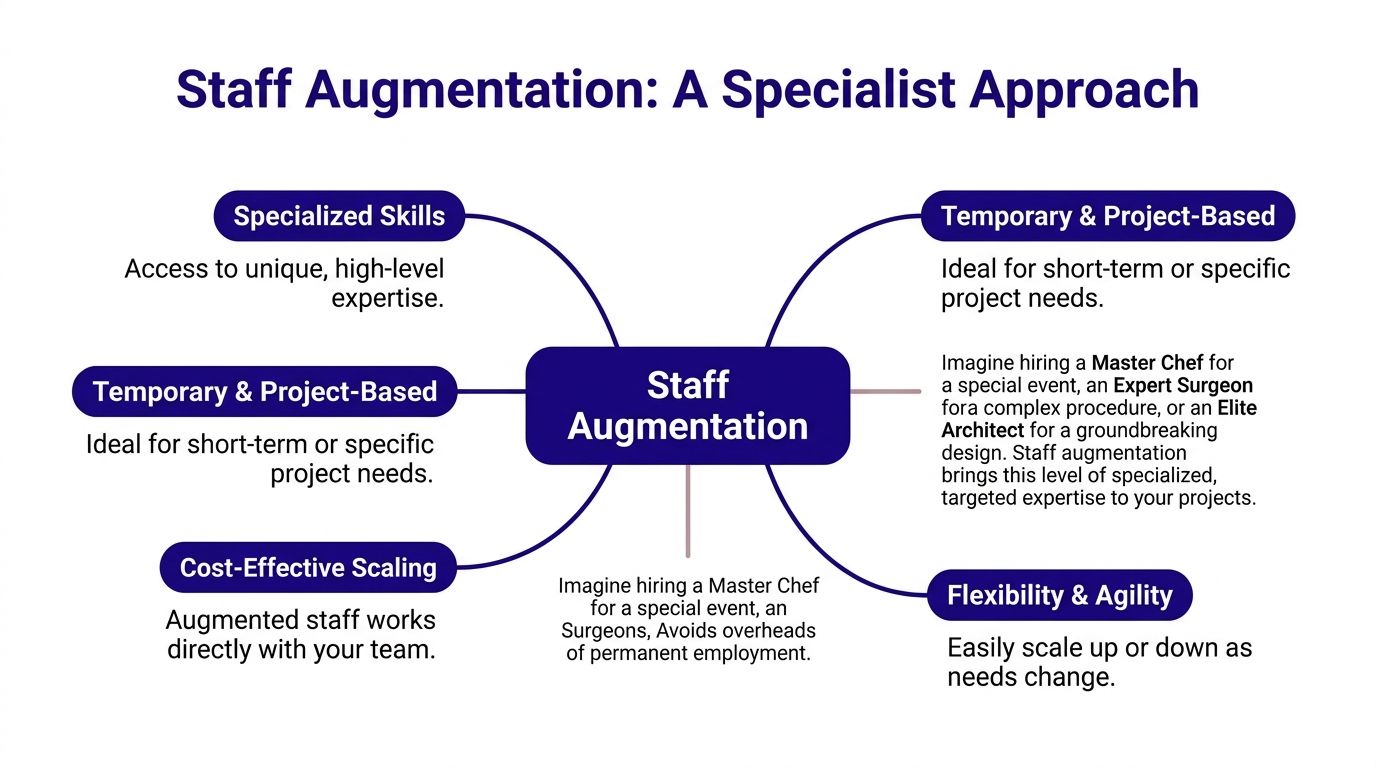
That distinction matters because many hiring leaders use the term loosely. In a true augmentation model, the company still owns the roadmap, sprint priorities, technical decisions, code review standards, and release cadence. The provider supplies talent. The client supplies direction.
The market has moved well beyond a niche staffing tactic. The global IT staff augmentation market was valued at $299.3 billion in 2024 and is projected to reach $857.2 billion by 2032, growing at a CAGR of 13.2% according to Verified Market Research on the IT staff augmentation service market. That kind of growth reflects how often technology teams use augmentation to keep delivery moving when internal hiring can’t solve the problem fast enough.
Practical rule: If leadership wants outside talent but doesn’t want to give up delivery control, they’re usually talking about staff augmentation whether they realize it or not.
For buyers evaluating providers, financing, and market maturity, it also helps to understand who backs and scales firms in this space. A useful reference point is this list of top staffing agency investors, which gives context on how established the broader staffing ecosystem has become.
What staff augmentation is not
It isn’t full outsourcing. In outsourcing, the vendor owns delivery of an outcome. It also isn’t classic consulting, where an outside firm comes in to advise, assess, and often leave behind recommendations instead of embedded execution.
It’s also not the right answer for every situation. If a company lacks internal technical leadership, can’t manage external contributors, or needs a vendor to own the whole deliverable, another model is usually a better fit.
Staff Augmentation vs Other Talent Models
The decision comes down to control and accountability
The fastest way to choose the wrong model is to compare them only on speed or hourly cost. The better lens is operational. Who owns the work? Who manages the people? Who absorbs delivery risk? And how tightly do external contributors need to mesh with the internal team?
Staff augmentation works best when the client has a manager, tech lead, or product owner ready to direct the work. Managed services fit better when the client wants a partner to own an outcome. Project-based consulting fits when the need is expertise plus guidance, often around a transformation, audit, or specialized initiative. RPO fits when the goal is building permanent headcount through an external recruiting engine.
One related model worth separating from augmentation is direct hire. For companies deciding whether a role should become permanent rather than contract-based, this guide to direct placement services and how direct hire works is a useful comparison point.
The right model doesn’t just fill a seat. It puts the right kind of responsibility in the right place.
Staffing Model Comparison
| Criteria | Staff Augmentation | Managed Services | Project-Based Consulting | RPO |
|---|---|---|---|---|
| Primary goal | Add specific talent to an existing team | Hand off delivery of a function or outcome | Solve a defined business or technical problem | Build permanent hiring capacity |
| Project control | Client retains direct day-to-day control | Vendor controls service delivery | Shared, but consultant usually guides the approach | Client controls hires after recruiting support |
| Who manages the work | Client manager or tech lead | Vendor manager | Consultant lead with client stakeholders | Internal hiring managers |
| Integration level | High. Talent works inside internal workflows | Moderate. Service is often run as a separate lane | Variable | Low during execution, high after hire |
| Best use case | Skill gaps, short-term delivery pressure, niche expertise | Ongoing operational support with defined service levels | Assessments, transformations, specialized advisory work | Building full-time teams at scale |
| Cost structure | Usually time-based billing for talent capacity | Service fee tied to scope and service commitment | Fee tied to advisory or delivery engagement | Recruiting fee or ongoing recruiting support fee |
| Speed to impact | Fast when scope is clear | Fast once service model is defined | Slower upfront because discovery matters | Slower than augmentation because permanent hiring is the end goal |
| Vendor responsibility | Talent supply and employment administration | Delivery, staffing, and service management | Expertise, recommendations, and sometimes implementation | Candidate pipeline and process support |
| When it fails | Client lacks bandwidth to manage external staff | Scope is vague or expectations are shifting constantly | Team expects extra hands, but buys advice instead | Business needs work done now, not months from now |
A common mistake is using staff augmentation when the actual need is outcome ownership. If the internal team can’t break down work, run standups, review deliverables, and remove blockers, external talent won’t fix that gap. It may expose it faster.
The reverse mistake also happens. Some firms buy managed services because they want less hassle, then realize too late that they’ve given up visibility into delivery details they still care about. CTOs who want architecture control, coding standards enforced internally, and direct communication with contributors usually lean back toward augmentation.
Strategic Business Cases for Augmenting Your Team
The clearest moments to use augmentation
The strongest use cases are usually obvious once the business strips away hiring jargon.
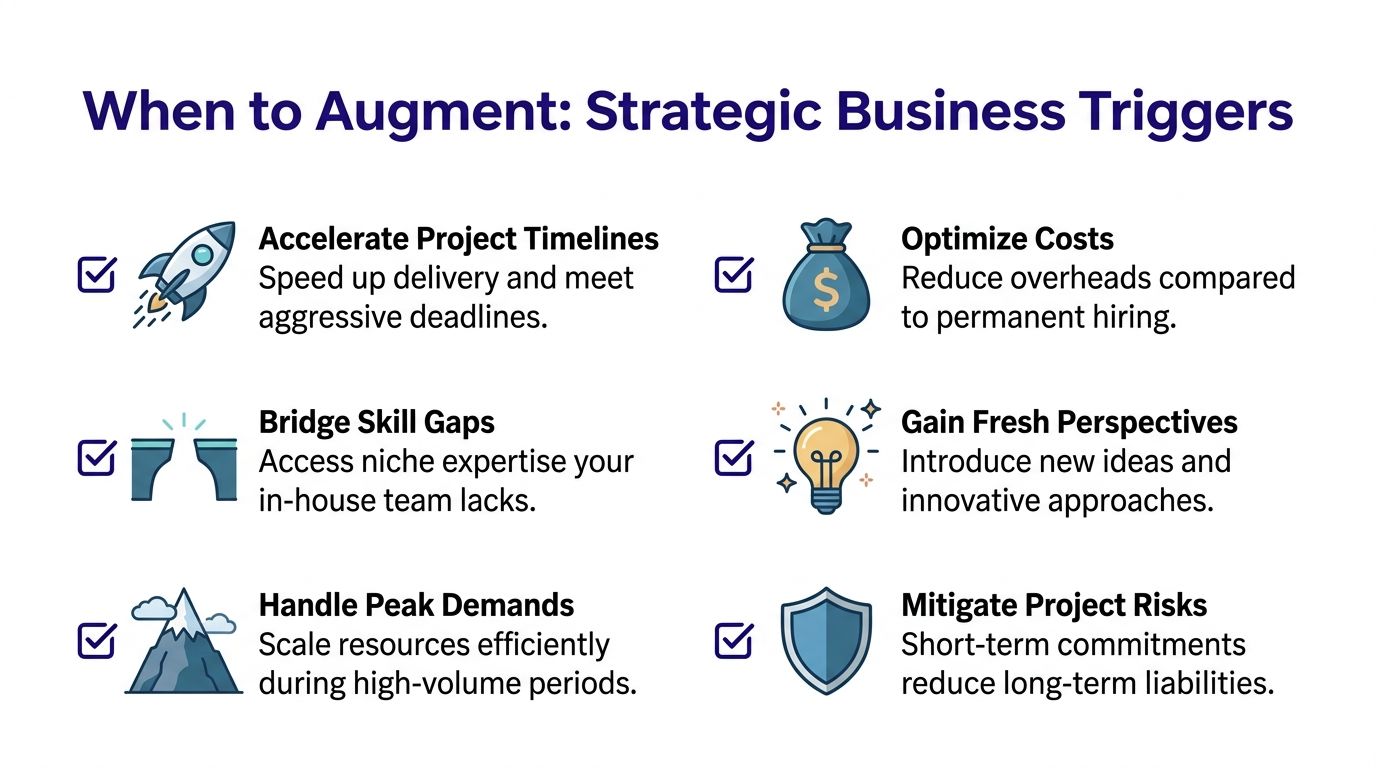
A team should consider augmentation when a roadmap is healthy but capacity isn’t. That includes product launches, cloud migrations, ERP integrations, security remediation, platform rebuilds, and post-acquisition systems work. The internal team knows what needs to happen. It just can’t absorb the work inside the current headcount.
Another strong trigger is specialization. The model’s modern use has shifted sharply toward scarce technical talent. By 2025, staff augmentation is described by Software Mind’s analysis of how staff augmentation works as the dominant strategy for rapidly acquiring scarce AI engineers to train models and cloud architects to build scalable infrastructure. That’s a different use case from adding another generalist developer.
Roles that fit this model well
Some roles consistently fit augmentation better than others:
- Senior DevOps engineers for a cloud migration, observability rollout, or CI/CD overhaul.
- AI and ML engineers for model training workflows, inference pipelines, or data preparation.
- Cloud architects when infrastructure design needs to move faster than permanent hiring.
- QA specialists during release hardening, regression cycles, or major product launches.
- Cybersecurity experts for incident response support, IAM cleanup, or compliance remediation.
- Data engineers when a company needs pipeline work done before analytics or AI initiatives can deliver value.
A useful screen is duration and specificity. If the work has a clear mission, a known owner, and a finite window, augmentation often fits cleanly. If the company expects a long, undefined need with no real endpoint, permanent hiring or another delivery model may be more stable.
Teams usually get the most value when they augment for a business event, not for a vague feeling that they’re understaffed.
The Implementation Process from Need to Onboarding
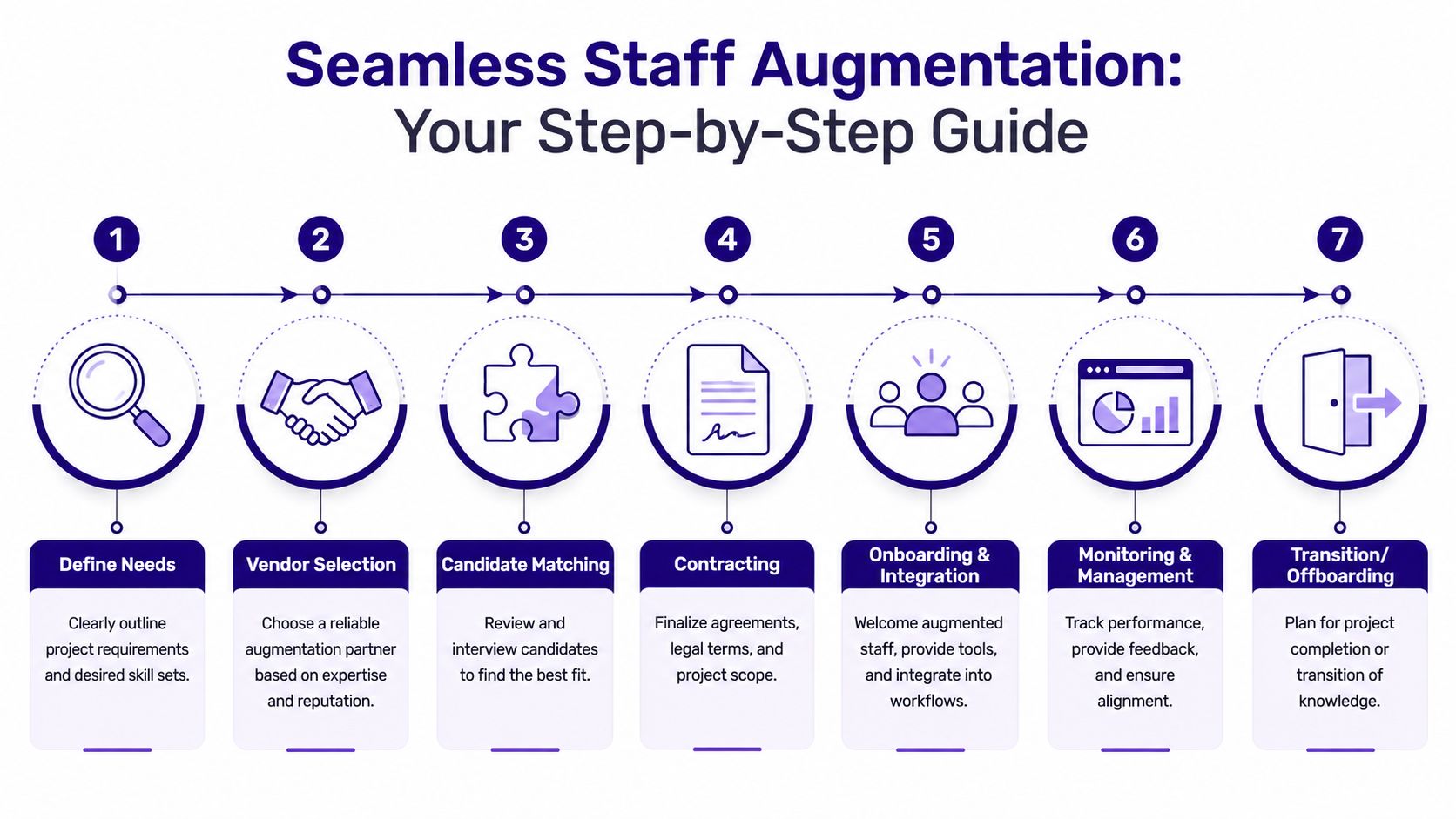
Start with a precise scope
Most failed engagements start too loosely. The business says it needs “a senior engineer” when it needs a backend developer with API design strength, AWS experience, and enough maturity to work inside an ambiguous legacy environment. Precision up front saves rework later.
A critical preliminary step is to define both the specific skills needed and an estimated duration for the assignment, because failing to set that timeline makes it harder to identify the right candidates and can create unnecessary staffing cost, as noted by Hill International’s staff augmentation best practices.
A practical intake usually answers five questions:
-
What problem must this person solve
Not title first. Problem first. “Stabilize Kubernetes clusters” is more useful than “hire a DevOps contractor.”
-
What environment will they enter
Spell out the stack, tooling, team size, reporting line, and whether they’ll work in Jira, GitHub, Azure DevOps, ServiceNow, or another system.
-
What does success look like
Define deliverables or contribution markers. That could be cleared backlog, reduced defect load, completed migration workstream, or an internal handoff.
-
How long is the need
Temporary work with no estimated duration creates confusion in sourcing and in budget planning.
-
Who owns the person once they start
If no manager is available, the engagement will drag.
Reduce integration friction before day one
Sourcing and interviews matter, but they don’t solve ramp-up on their own. The team also needs pre-placement diagnostics. That means checking technical scope, communication style, team dynamics, and workflow fit before a candidate is selected.
A staffing partner can help structure that process. For companies evaluating contract talent channels, Nexus IT Group contract services is one example of a provider offering contract-based technology staffing across roles such as AI, cloud, cybersecurity, data, and software engineering.
Once the candidate is chosen, onboarding shouldn’t be treated like admin. It should include:
- Tool access on day one so the person isn’t blocked waiting for credentials.
- A workflow briefing covering sprint rituals, review standards, escalation paths, and communication norms.
- A team map showing who owns product, architecture, QA, infrastructure, and approvals.
- A first-week plan with real tasks, not observation-only time.
- A check-in cadence so managers catch confusion early.
Good onboarding is less about orientation slides and more about removing the first five blockers before they happen.
Understanding Contracts and Pricing Models
How buyers usually structure the spend
Most staff augmentation engagements are purchased as time and materials, usually through hourly or monthly billing tied to the person’s time allocation. That structure fits work that changes as sprints evolve, priorities shift, or scope becomes clearer during execution.
Fixed-price structures are less common for pure augmentation because they blur the line between adding capacity and outsourcing an outcome. If a buyer wants a fixed fee tied to a defined deliverable, that usually points toward a project-based services model instead of embedded staffing.
For many teams, the budget conversation comes down to a trade-off between flexibility and predictability. Time and materials gives the client room to adjust workload or duration. Fixed pricing gives finance cleaner forecasting, but it only works when the scope is stable.
Regional pricing trade-offs
Geography changes the rate card and the operating model.
According to Zartis on IT staff augmentation costs and benefits for U.S. companies, U.S. onshore staffing for technical roles typically ranges from $80 to $150+ per hour, nearshore in Latin America ranges from $30 to $90 per hour, and offshore in Eastern Europe and South Asia ranges from $20 to $70 per hour.
That doesn’t make the cheapest option the smartest one. Buyers still need to weigh:
- Time zone overlap for standups, pair programming, and incident response
- Communication fit for stakeholder-facing roles
- Security and compliance expectations tied to the work
- Role criticality if the person will own production-impacting systems
A strong budget plan doesn’t ask only, “What’s the hourly rate?” It asks whether the selected region supports the collaboration speed the project requires.
Measuring Success with KPIs and Governance
What to measure
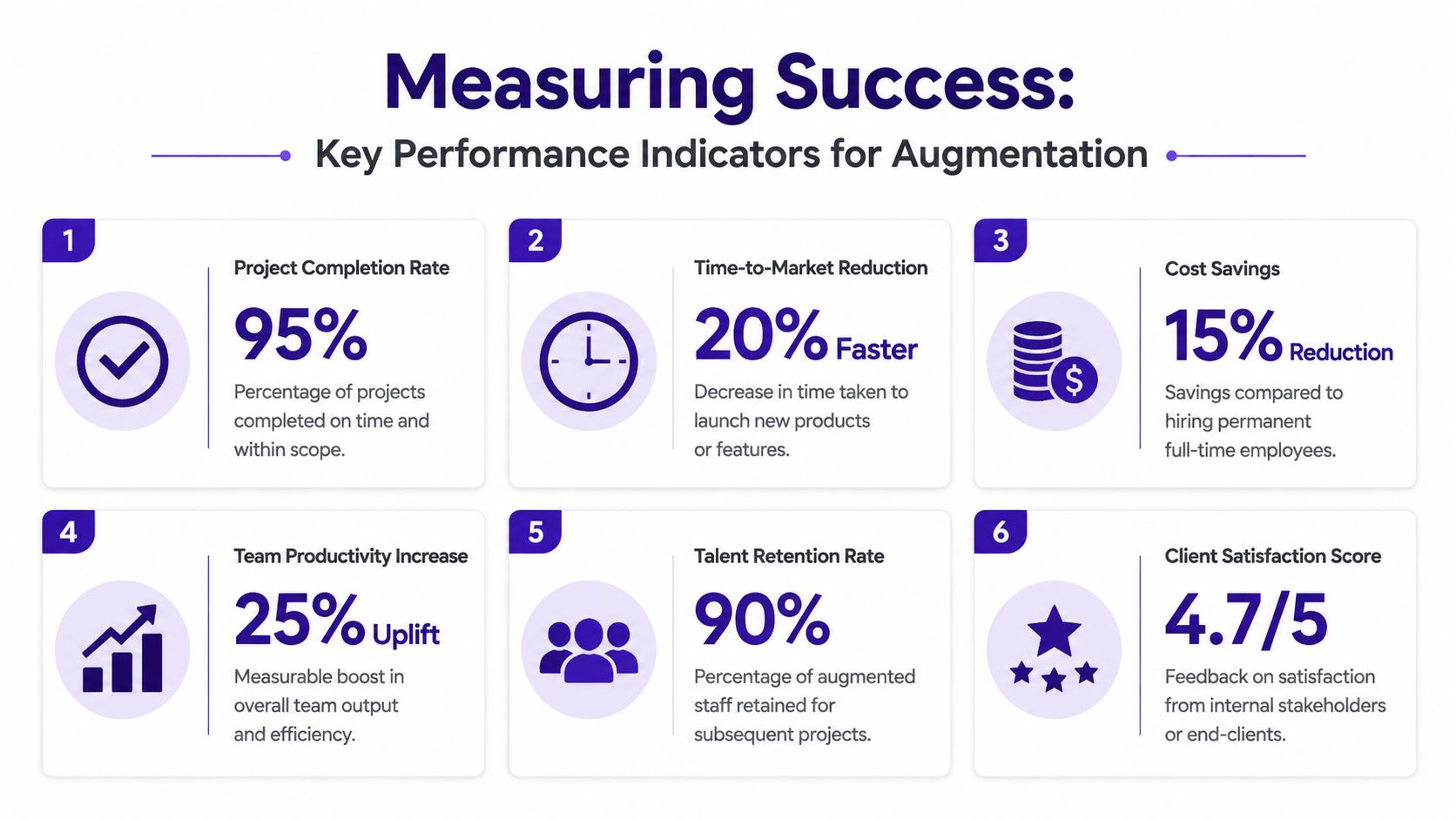
Many teams judge augmentation too loosely. If the person seems busy and the sprint board keeps moving, leadership assumes the model is working. That’s not enough. A blended team needs visible indicators that show whether external talent is improving delivery.
Distillery’s guidance on staff augmentation execution points to quantifiable KPIs including the productivity index and project completion rate, and also warns that poor communication and management can wipe out expected savings.
That creates a practical measurement set:
-
Time to productivity
How quickly the person moves from access and orientation into useful contribution. -
Productivity index
Whether assigned work meets expected quality and output standards. -
Project completion rate
Whether assigned work lands on time and within the expected delivery window. -
Manager intervention load
Whether the team lead is spending normal oversight time or constant rescue time. -
Knowledge transfer quality
Whether important context is being documented and shared, not trapped in one contributor’s head.
Governance that keeps the model working
Good governance isn’t bureaucracy. It’s the operating rhythm that keeps augmented staff aligned with internal priorities.
A lightweight structure usually includes daily standups, a weekly manager check-in, clear ownership of backlog items, and a visible escalation path when blockers appear. The company should also review fit early. If someone is technically strong but misaligned on pace, communication, or ambiguity tolerance, that issue should surface quickly.
The fastest way to lose value in augmentation is to assume that once the contract is signed, management effort can drop.
Common Pitfalls and How to Avoid Them
Where engagements go sideways
The most common failure isn’t lack of technical skill. It’s integration friction. A company brings in someone capable, gives partial context, excludes them from key decisions, and then wonders why output stays uneven.
That gap shows up before onboarding. Black Diamond Networks on staff augmentation meaning and process notes that the benefits of augmentation aren’t automatic and that a pre-placement diagnostic of project scope and team dynamics can reduce ramp-up time by 30% to 50% compared with unmanaged new hires.
A few mini-scenarios make the risk clear:
-
The isolated specialist
A cloud engineer gets access to tickets but isn’t invited to architecture discussions. The person completes tasks but makes decisions without enough system context. -
The title mismatch
The client asks for a “senior data engineer,” but the underlying need is a hands-on platform builder who can also work with product stakeholders. The candidate isn’t weak. The requirement was. -
The shadow workforce problem
Augmented staff are kept outside retrospectives, Slack channels, and planning meetings. Communication slows, ownership gets fuzzy, and the internal team starts treating them like temporary labor instead of contributors.
The operating habits that prevent failure
These problems are fixable when the client treats integration as part of delivery, not HR admin.
A stronger operating pattern looks like this:
- Run a pre-placement diagnostic that tests both skill fit and team-fit conditions such as communication style, manager availability, workflow maturity, and project ambiguity.
- Assign a real internal owner who can answer questions, unblock decisions, and review output.
- Include augmented staff in the team’s normal cadence so they hear priorities firsthand.
- Use a buddy system for the first stretch of the engagement, especially in complex environments.
- Review fit early and directly rather than waiting for a quarterly milestone to admit the match isn’t working.
Another hidden risk is vendor sprawl. When multiple staffing firms submit loosely screened profiles into the same process, candidate quality often drops and employer messaging gets messy. For teams trying to tighten process discipline, this perspective on whether using multiple staffing vendors can hurt employer brand is worth reviewing.
The practical takeaway is simple. Staff augmentation works when the company buys capacity and manages integration with equal seriousness. It fails when leaders assume placement alone creates productivity.
Nexus IT Group helps employers hire contract, direct placement, executive, and specialized technology talent across areas such as AI engineering, cloud, cybersecurity, data, DevOps, and software development. Teams that need help defining a hard-to-fill role, tightening candidate fit, or scaling delivery capacity can explore nexus IT group as one option for structuring that search.