
You’re staring at a federal job board and half the listings look like compliance homework. Clearance terms, agency acronyms, SAM.gov, FedRAMP, CMMC, and a dozen roles that sound technical but read like procurement forms. That’s normal. Government Contractor IT Jobs sit in a different labor market, and the people who win them understand that compliance readiness is part of the job, not a side note.
If the search has already started to feel opaque, the fix is not to spray résumés everywhere. The fix is to pick the right role family, understand how contracting works, and position yourself where hiring managers can see technical depth plus federal fit fast.
Table of Contents
- Why Government Contractor IT Jobs Look Different From Commercial IT Roles
- The Two Decisions That Shape Every Government Contractor IT Career
- The Five Role Families Driving Federal IT Demand
- Security Clearance Basics Every Federal IT Candidate Should Know
- Where Government Contractor IT Jobs Actually Get Posted
- Resumes and Interviews That Win Cleared IT Roles
- Pay, Benefits, and Remote Work Realities for Federal IT Contractors
- Your 30/60/90-Day Plan to Land a Government Contractor IT Role
Why Government Contractor IT Jobs Look Different From Commercial IT Roles
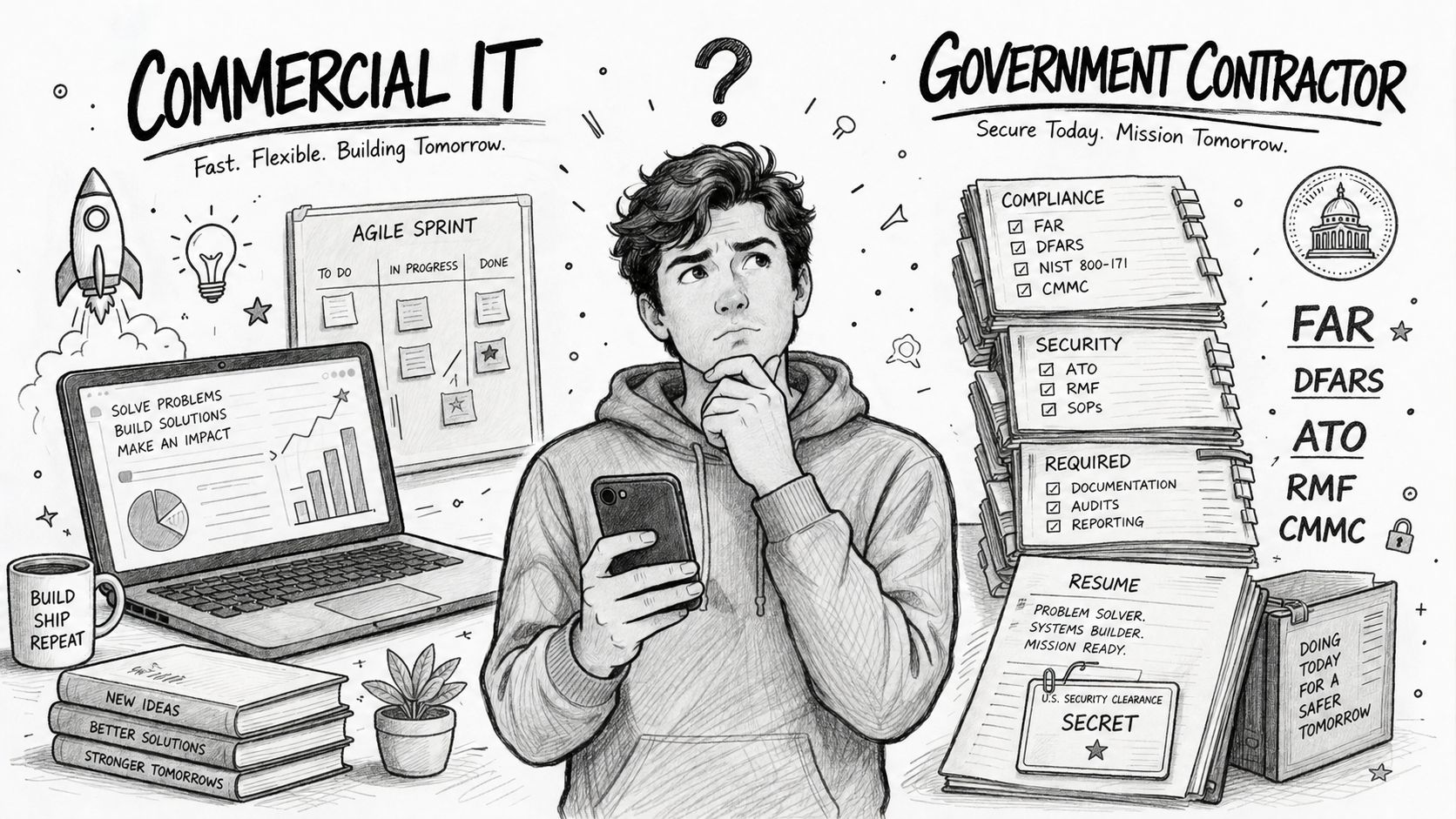
You open a posting, and it feels like the recruiter copied half the language from a security manual. The role wants cloud skills, but it also wants citizenship, compliance familiarity, and possibly an active clearance. That isn’t clutter. It’s the operating model.
Why the market behaves like a separate lane
Federal agencies have long relied on outside firms for technology work, and the pay structure explains a lot of what candidates see. The Project on Government Oversight found that the U.S. government paid contractors an average of $268,653 per year for computer engineering services, versus $136,456 for its own computer engineers, and $198,411 for IT management services, versus $124,663 for federal IT managers, with CIO reporting those contractor rates were roughly nearly twice the government’s direct-pay rates for engineering and about 1.59 times the government’s IT-management pay (CIO). That’s not an accident. It’s why contract roles keep absorbing specialized skills when agencies need them quickly.
What candidates should do first
Stop reading these roles like standard enterprise IT postings. Start reading them like procurement-backed staffing requests. If the posting asks for niche compliance knowledge, clearance status, or federal framework experience, that’s usually the primary filter, not the job title.
Practical rule: if the posting leads with compliance language, the hiring manager is buying reduced risk as much as technical output.
The scale matters too. One industry analysis citing Bureau of Labor Statistics data says government contracting clusters employed more than 4.1 million workers, or nearly 3% of the total U.S. workforce, and that the sector has grown at around 2.3% per year (LinkedIn Pulse analysis). For IT candidates, that means government contractor work is a real labor market, not a niche backwater. The right move is to learn the rules of that market instead of trying to force a commercial résumé into it.
The Two Decisions That Shape Every Government Contractor IT Career
Two choices determine almost everything about a federal contracting career. The first is whether the worker is on a prime or a subcontractor team, or comes in through a small business set-aside specialist. The second is whether the work is W-2 employment or Corp-to-Corp, often called C2C.
W-2 versus C2C changes the entire risk profile
A W-2 contractor is an employee of the staffing firm or prime contractor. That usually means benefits, payroll withholding, and a cleaner compliance trail. A C2C arrangement puts the worker in business for themselves, which can look attractive on paper but shifts tax handling, liability, and benefit responsibility onto the person doing the work.
That difference matters in government work because procurement teams and hiring managers are often buying continuity as much as skill. A W-2 structure is simpler for many candidates who need stability, especially early-career professionals, families managing predictable income, or anyone trying to get into a clearance pipeline. C2C can make sense for experienced specialists who already know how to run their own business operations and accept the extra burden.
Prime, subcontractor, and small business teams are not interchangeable
Prime contractors usually own the direct relationship with the agency and often control the strongest internal mobility. Subcontractors can still offer excellent entry points, but the promotion path is often narrower and depends on the prime’s contract structure. Small business set-aside shops can be especially useful for people who need faster access to a federal program, because they are often built to move quickly and fill very specific gaps.
A simple decision heuristic works better than overthinking it:
- Early career: favor W-2 roles, especially where the employer will sponsor you into the pipeline.
- Family-stage or income-sensitive: avoid C2C unless the rate premium clearly justifies the loss of benefits and payroll stability.
- Visa-sensitive: focus on employers with explicit sponsorship practices, and don’t assume a remote ad removes citizenship rules.
- Clearance-required: prioritize firms that already live inside federal programs, because they know how to manage the paperwork and timing.
Clear takeaway: the right structure is the one that fits your risk tolerance and your access needs, not the one that looks flashiest in the job ad.
The Five Role Families Driving Federal IT Demand
Federal IT demand clusters around five role families, and candidates waste time when they treat them as one blob. Cloud, cybersecurity, software, DevOps, and data all sit under the same contracting umbrella, but the day-to-day work and clearance posture are different enough that the wrong positioning can stall a search.
Cloud and cybersecurity usually live closest to compliance gates
Cloud engineering and architecture often touch FedRAMP authorization work, platform hardening, and migration planning. These roles are attractive because agencies need people who can connect infrastructure decisions to security controls, not just stand up instances. Cybersecurity and information assurance goes even deeper into NIST 800-53, RMF, SIEM tuning, access controls, and incident response. If a posting mentions ATO support or security documentation, that’s a clue the team needs someone who can operate inside the control framework, not just patch servers.
These two families also tend to be the most sensitive to clearance posture. A cleared cybersecurity professional is easier to place on sensitive programs, but many compliance-heavy roles still accept applicants who can be sponsored rather than already cleared. That’s where a strong federal-ready résumé matters.
Software, DevOps, and data roles are broader than people think
Software development and modernization often means legacy-to-modern transitions, including COBOL-to-cloud migrations and agency application rewrites. DevOps and platform engineering is where automation meets evidence, with teams building pipelines that support ATO documentation and repeatable releases. Data engineering and analytics usually involve federal data lakes, reporting environments, and governance controls that keep data usable without turning it into a security liability.
These roles can be entered with less clearance friction than sensitive cyber work, especially when the employer only needs a candidate who can obtain clearance later. They’re often the fastest path for candidates who have strong technical skills but no prior federal exposure.
A useful way to think about the five families:
- Cloud engineering: best for infrastructure-minded candidates who can talk controls and architecture.
- Cybersecurity and IA: strongest fit for people who already think in risk, evidence, and policy.
- Software modernization: ideal for developers who can work with legacy systems without ego.
- DevOps and platform engineering: best for automation-focused builders who document their work.
- Data engineering and analytics: strongest for people who can handle governance, pipelines, and access discipline.
The right move is to pick the family where the candidate can prove relevance fast, then learn the federal vocabulary around it. That vocabulary often decides who gets called back.
Security Clearance Basics Every Federal IT Candidate Should Know
Clearance is not a single gate. It’s a layered filter, and candidates who treat it like a binary checkbox end up applying to the wrong jobs. Federal hiring also has a formal qualification standard for IT roles, and OPM’s 2210 standard requires either a relevant accredited degree or at least 24 semester hours in qualifying fields, plus for GS-7 and above one year of specialized experience at the next lower grade (OPM 2210 standard).
The practical order of operations
Most candidates encounter Public Trust first. It’s common for non-sensitive federal IT work and starts with background vetting rather than the more intensive clearance ladder. Above that sits Secret, which usually demands U.S. citizenship and a more complete investigation. At the top is Top Secret / SCI, which is tied to highly sensitive programs and can involve extra screening, including polygraph requirements in some environments.
The biggest mistake is assuming the clearance itself is the bottleneck. For most applicants, the bottleneck is sponsorship plus paperwork readiness. That means the employer has to be willing to put the candidate forward, and the candidate has to be able to move cleanly through the forms and investigation.
What early-career candidates should do
A candidate who does not already hold a clearance should stop chasing roles that clearly require active access unless the employer explicitly sponsors. Target help desk, network support, system administration, or junior cloud roles where the posting says the applicant can obtain clearance or where the employer routinely brings people into the process. That’s the cleaner entry lane.
Do not oversell clearance language. If a résumé says “clearance-ready” but the candidate has never been sponsored, hiring managers notice immediately.
For role-specific process guidance, the clearance workflow is laid out well in this security clearance process guide. The point is not to memorize every acronym, it’s to understand that the timeline is usually measured in months, and the employer’s willingness to sponsor matters more than wishful thinking.
Where Government Contractor IT Jobs Actually Get Posted
The search gets easier when the candidate stops treating every job source as equal. Federal openings, prime contractor pipelines, clearance boards, and staffing agencies all surface different parts of the market, and each one has a different level of noise.
Channel choice matters more than volume
USAJOBS and SAM.gov are useful for awareness, especially if the role is directly tied to federal hiring or procurement. Prime contractor career pages, including firms like Booz Allen, Leidos, SAIC, GDIT, and Peraton, often surface the broadest range of program-specific opportunities. Clearance-focused job boards usually catch roles that are already filtered for citizenship or active access. Specialized staffing agencies are the most useful when the role is hard to fill, clearance-sensitive, or tied to a hiring manager who wants a pre-vetted shortlist.
A recruiter relationship changes the search because it compresses the distance between the résumé and the hiring manager. Good recruiters already know what the program can accept, what wording will get a submission rejected, and which requirements are flexible. That’s especially valuable when the posting language is vague or overloaded with agency shorthand.
The table below is the practical version of the sourcing map.
| Channel | Best For | Typical Lead Time | Clearance Expectation |
|---|---|---|---|
| USAJOBS | Direct federal awareness and reference checks | Slower, more formal | Varies by role |
| SAM.gov | Procurement context and contract visibility | Indirect, not always immediate hiring | Often not job-facing |
| Prime contractor career pages | Broad program roles and active requisitions | Moderate | Often role-dependent |
| Clearance-focused boards | Active or soon-to-be-cleared candidates | Faster filtering | Usually higher |
| Specialized staffing agencies | Hard-to-fill, senior, or cleared roles | Fastest path to a real conversation | Often pre-qualified |
The phrase 90%+ of federal IT contracts do not require security clearances appears in market guidance, which means a large share of demand is for engineers, support specialists, and administrators who can prove compliance capability without already holding a clearance (GovBidPortals guide). That is why broad sourcing still matters, even for candidates who think cleared work is the only lane.
The practical search edge also comes from using tools that can track federal opportunities more intelligently. A resource like AI for Government Contracts can help surface opportunities faster than manual searching, especially when the target role is buried inside a large procurement ecosystem.
For a broader search framework, the best IT job search websites guide is useful as a comparison point, but federal work still rewards direct recruiter relationships more than blind volume.
Resumes and Interviews That Win Cleared IT Roles
Commercial tech résumés sell velocity and product impact. Federal contractor résumés sell controlled execution. That difference is why so many good engineers get ignored. The hiring manager is not looking for startup sparkle, they’re looking for a candidate who can work inside government constraints without creating extra risk.
What to put on the page
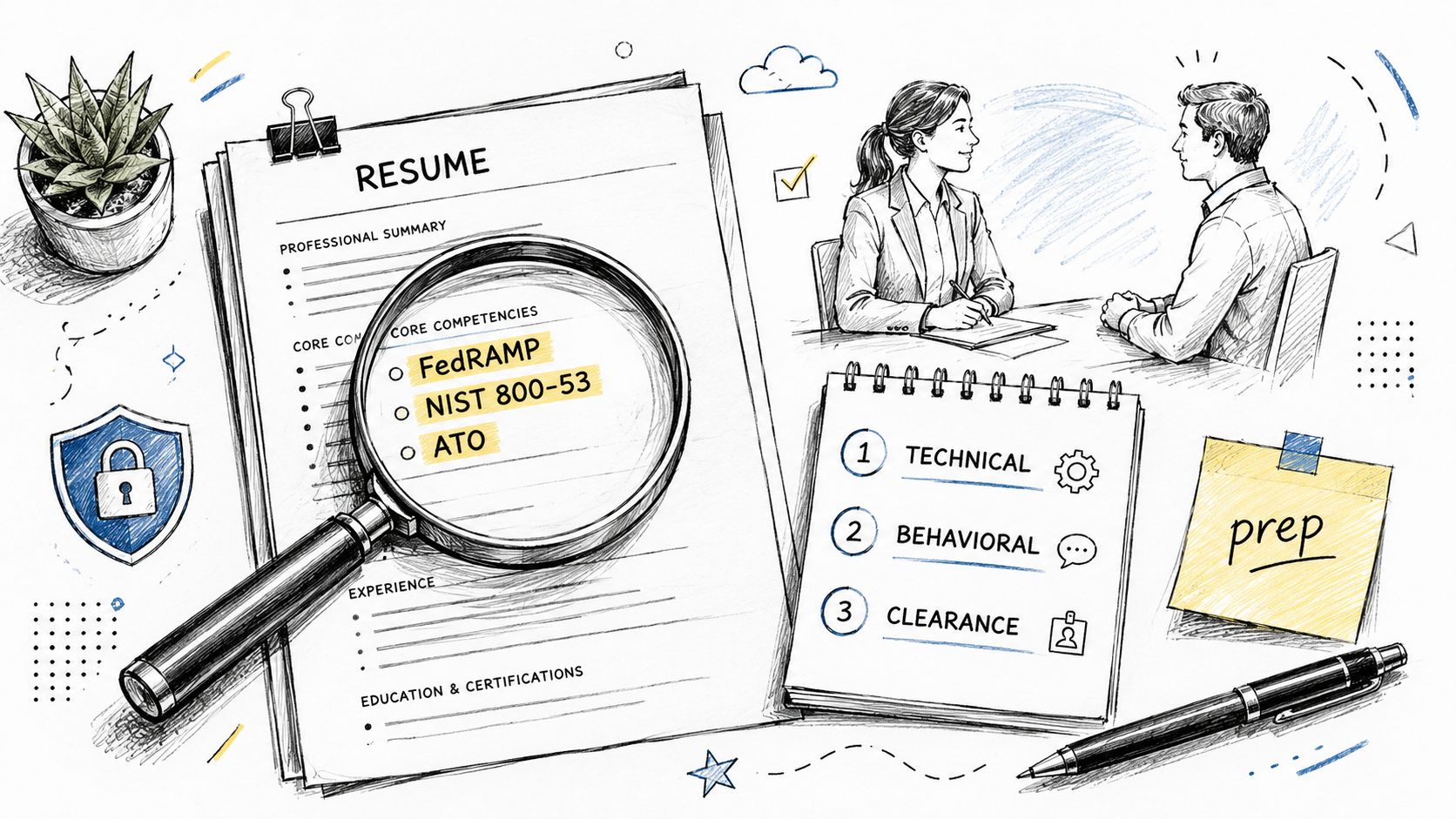
The résumé should surface FedRAMP, NIST 800-53, ATO, RMF, or agency-specific frameworks only when the candidate has direct, hands-on experience with them. Padding the document with acronym soup backfires fast. The best résumés make it obvious what environments the candidate supported, what controls they touched, and where they operated with direct accountability.
Three signals hiring managers scan for first:
- Relevant environment exposure: government, defense, regulated cloud, or compliance-heavy systems.
- Concrete tooling and framework fluency: only the frameworks the candidate used.
- Stable delivery record: enough detail to show the person can support programs without hand-holding.
The interview side is similar. Candidates should expect a technical screen, a behavioral check, and sometimes a direct read on clearance posture. Two questions kill weak candidates. One is whether they can start with the required work authorization and citizenship status. The other is whether they can explain their previous compliance work without inflating it.
Useful rule: if the candidate can’t explain exactly how they helped satisfy a control, they probably shouldn’t name it on the résumé.
A practical prep workflow helps. The candidate should rewrite one résumé version for cloud, one for cyber, and one for support or systems work. Then they should rehearse short, federal-style answers that describe tools, environments, and outcomes without marketing language. For interview practice and positioning, this interview preparation guide is a solid reference point.
The people who get hired fastest do one thing well. They make it easy for the recruiter to see federal fit in under a minute.
Pay, Benefits, and Remote Work Realities for Federal IT Contractors
Compensation in federal contracting is not a simple translation of commercial market rates. The procurement model, the employer structure, and compliance costs all affect what lands in the candidate’s pocket. The rate spread between contractor engineering work and federal direct pay is real, and it explains why some candidates move into contracting even when the job title looks similar.
Benefits depend on the structure, not the title
A W-2 role through a prime or staffing partner usually includes health coverage, retirement options, and PTO. A C2C setup pushes those decisions onto the contractor, which means the headline rate has to cover taxes, insurance, downtime, and admin overhead. That’s why a higher posted number is not automatically the better deal.
Compliance can also affect the economics in a less obvious way. The U.S. Department of Labor states that the minimum wage for work covered by Executive Order 13658 was $12.15 per hour in calendar year 2023, and the required minimum cash wage for tipped employees on covered contracts was $8.50 per hour (DOL federal contractor requirements). Those floors are not the target for skilled IT talent, but they show how contract labor is shaped by rules that commercial tech hiring rarely has to think about.
Remote is real, but not always portable
A lot of listings are labeled remote and still come with hard constraints. Some require U.S. citizenship, some require an active clearance, and some explicitly say remote work is not an option. That’s why candidates overestimate portability. A posting may look flexible on the surface and still lock the worker to a location, a facility, or a program with restricted access.
The smart checklist is simple:
- Read the citizenship rule first: if that fails, the role is already off the table.
- Check for clearance language: active clearance usually narrows the path fast.
- Look for facility or on-site clauses: those override the “remote” label.
- Watch for hybrid language buried near the bottom: that’s where the requirement often sits.
Candidates also need to think about negotiation differently. Contract renewals are often the cleanest time to discuss rate changes, and the next role should be positioned before the current one ends. Waiting until the final week is how good contractors get forced into weak options.
Your 30/60/90-Day Plan to Land a Government Contractor IT Role
The first 30 days should be about focus, not volume. Pick one or two role families, audit clearance posture, and rebuild the résumé so it reads like a federal-ready operator document. The 60-day mark is where sourcing widens, including primes, clearance boards, and a specialized staffing partner that already knows which programs are hiring. By 90 days, the candidate should be converting interviews into offers with a clean story about citizenship, sponsorship, and relevant technical depth.
Quick answers candidates keep asking
Can a candidate enter without a clearance? Yes, if the employer will sponsor or if the posting allows work to begin while the clearance process runs.
How long does vetting take? Plan around months, not a quick turnaround.
Are these jobs remote? Some are, but many are only partly remote or not remote at all.
Does an IT staffing agency matter? Yes, because it can align the résumé to the contract and get the candidate in front of the right hiring manager faster.
The edge comes from treating this as a hybrid career path. Technical skill gets attention, but compliance readiness decides whether the resume survives the first pass.
If the search feels stuck, the fastest move is to work with a recruiter who already understands federal contracting language, cleared hiring patterns, and how to position technical experience for the right program. Nexus IT Group connects technology professionals with hiring managers, supports contract staffing and direct placement, and gives candidates resume review and interview preparation that fit government contractor IT jobs. Visit nexus IT group to start the conversation and get your federal search pointed in the right direction.