
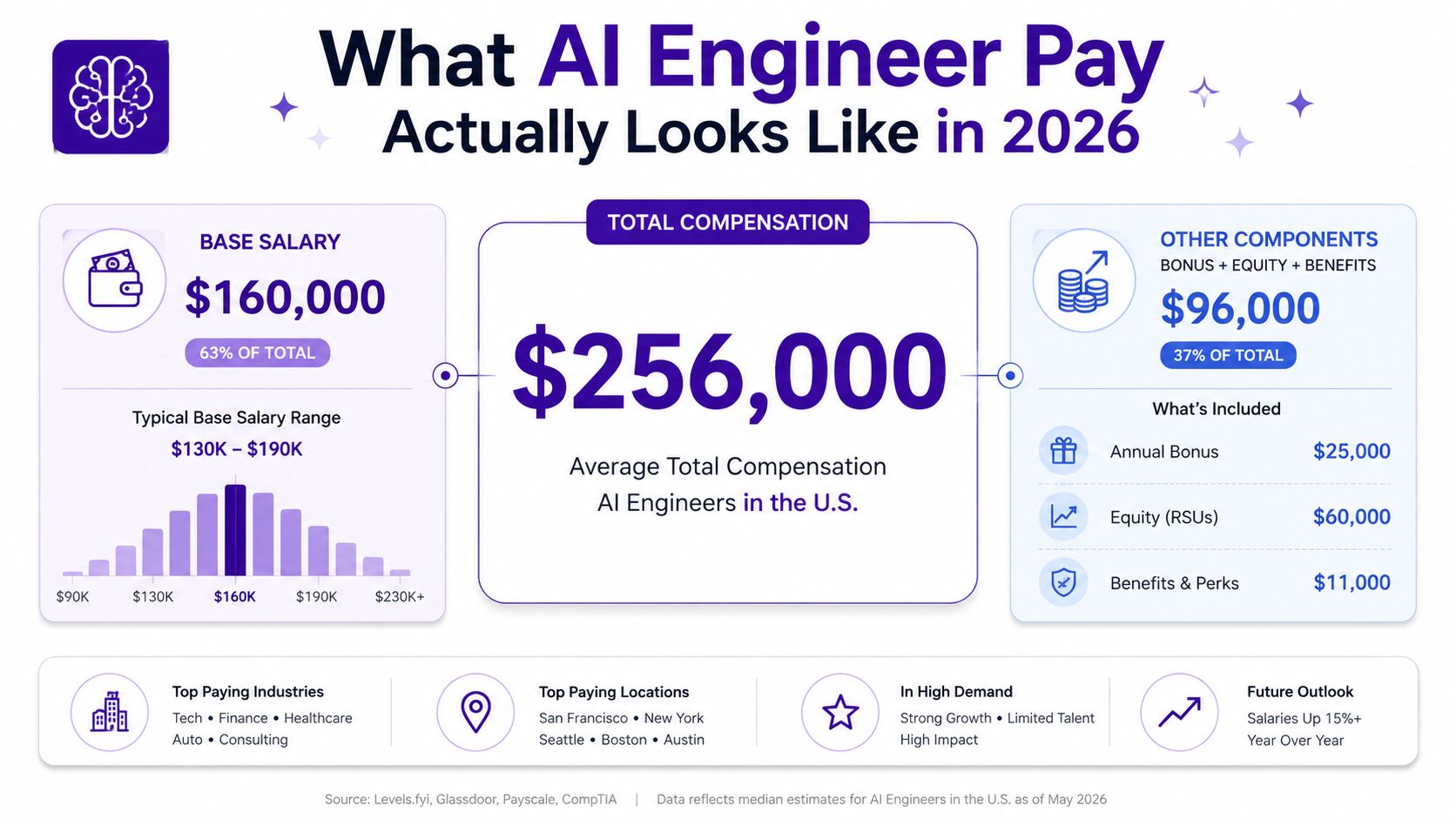
AI engineer total compensation in the U.S. commonly sits between $185K and $300K at mid-level, and senior or staff packages can reach $500K to $800K+ once equity is included. The reason is simple, ai engineer salary is not one number, it’s a stack of base pay, bonus, and equity, and the mix changes fast by employer, specialization, and seniority.
The market also sends mixed signals on purpose. Levels.fyi reported $245,000 average total compensation for a U.S. ML/AI Software Engineer in 2025, while Coursera cited Bureau of Labor Statistics data showing a $145,080 median annual salary and Glassdoor median base pay of $134,023 for AI engineers in the U.S. (Levels.fyi compensation trends)
Table of Contents
- What AI Engineer Pay Actually Looks Like in 2026
- How Base, Bonus, and Equity Add Up
- Salary Ranges by Experience Level
- Why Specialization Drives the Real Pay Premium
- Geography, Remote Work, and Employer Type
- Negotiation Playbook for Candidates
- Salary-Setting and Retention Strategy for Employers
- Where AI Engineer Pay Is Headed Next
What AI Engineer Pay Actually Looks Like in 2026
The first mistake candidates make is treating salary as a single clean number. It isn’t. The better question is whether the offer includes only base salary, or whether it also includes bonus, equity, sign-on cash, and retention value that push the overall package far higher.
A working definition matters too. An AI engineer here means someone who ships production models, owns MLOps pipelines, and is accountable for inference reliability. That is a different job from a data scientist who mainly models and reports, and it’s why compensation leans closer to software engineering than analytics.
Practical rule: Never compare a base-salary number from one company with a total-comp number from another. That’s how candidates underprice themselves and employers lose people in the final round.
The spread between $145,080 median salary, $134,023 median base pay, and $245,000 average total comp exists because companies count compensation differently and hire from different labor pools. Top-paying AI roles cluster in large tech firms, late-stage startups, and specialized employers competing for scarce production talent. If the job owns deployment, monitoring, and reliability, the compensation usually rises with the operational risk.
For readers comparing market options, a practical benchmark is the role description, not the title. The salary page at top AI engineer skills and salary is a useful cross-check because skills and pay move together, but the title alone doesn’t tell the full story.
Candidate pipelines matter too. Open roles for production AI work are often posted alongside adjacent machine learning and platform jobs, so a search like AI engineering jobs is more useful than narrowing to one exact title. That’s the right lens, because employers rarely hire the title, they hire the outcome.
How Base, Bonus, and Equity Add Up
A strong offer starts with base salary, but base salary is only the floor. The money in AI engineering usually comes from the way companies layer annual bonus, equity, and, sometimes, sign-on or relocation cash on top of that floor.
Base pay is the anchor, not the full answer
Built In reports an average AI engineer base salary of $184,757, plus $26,486 in additional cash compensation, for $211,243 total compensation (Built In AI engineer salary). That gap is the point. It shows why a role can look average on paper and still be attractive once bonuses and equity are counted.
Equity is where the offer often gets serious. In major tech markets, equity and bonuses can add roughly 15% to 30%+ above base pay, especially when the role includes shipping models into production and owning the full lifecycle. That is why two people with the same title can land in very different bands, one is being paid as an engineer, the other as a scarce production owner.
A candidate should read equity as a risk-adjusted instrument, not free money. Public-company RSUs are easier to value, startup options are harder, and both require a clean view of vesting, dilution, and liquidity.
What each component usually does
| Component | Big Tech / Late-stage | Mid-stage Startup | Early-stage Startup |
|---|---|---|---|
| Base salary | Higher cash floor, tighter leveling | Competitive cash, more room to negotiate | Lower cash, often used to conserve runway |
| Annual bonus | More formal and predictable | Sometimes discretionary | Often limited or absent |
| Equity | Meaningful and easier to model | Can be sizable, but riskier | Can be meaningful on paper, harder to value |
| Sign-on or relocation | Used to win fast-moving candidates | Common when urgency is high | Used selectively, usually for critical hires |
The negotiation mistake is focusing only on salary. In the offers that close, candidates look at cash certainty, equity upside, and how likely the grant is to vest before a change in strategy. Employers that understand this usually close faster because they stop pretending every AI engineer wants the same trade-off.
For teams calibrating adjacent roles, machine learning engineer salary is the better internal comparison than generic software benchmarks. AI and ML offers live in the same talent market, but production ownership pushes the package higher.
Salary Ranges by Experience Level
Experience matters, but only up to a point. The bigger jump often isn’t from mid-level to senior base pay, it’s from base pay to total comp, especially when equity starts to carry real weight.
Level bands tell a cleaner story than job titles
AI engineers have seen pay rise sharply. AgileFever’s 2025 to 2026 U.S. salary report said AI engineers earned an average of $206,000 in 2025, up $50,000 from the prior year, and Acceler8 Talent repeated the same $206,000 average while noting that 76% of employers still could not fill AI roles in 2025 (AgileFever salary report). That level of pressure is why offers moved up quickly and then started to normalize.
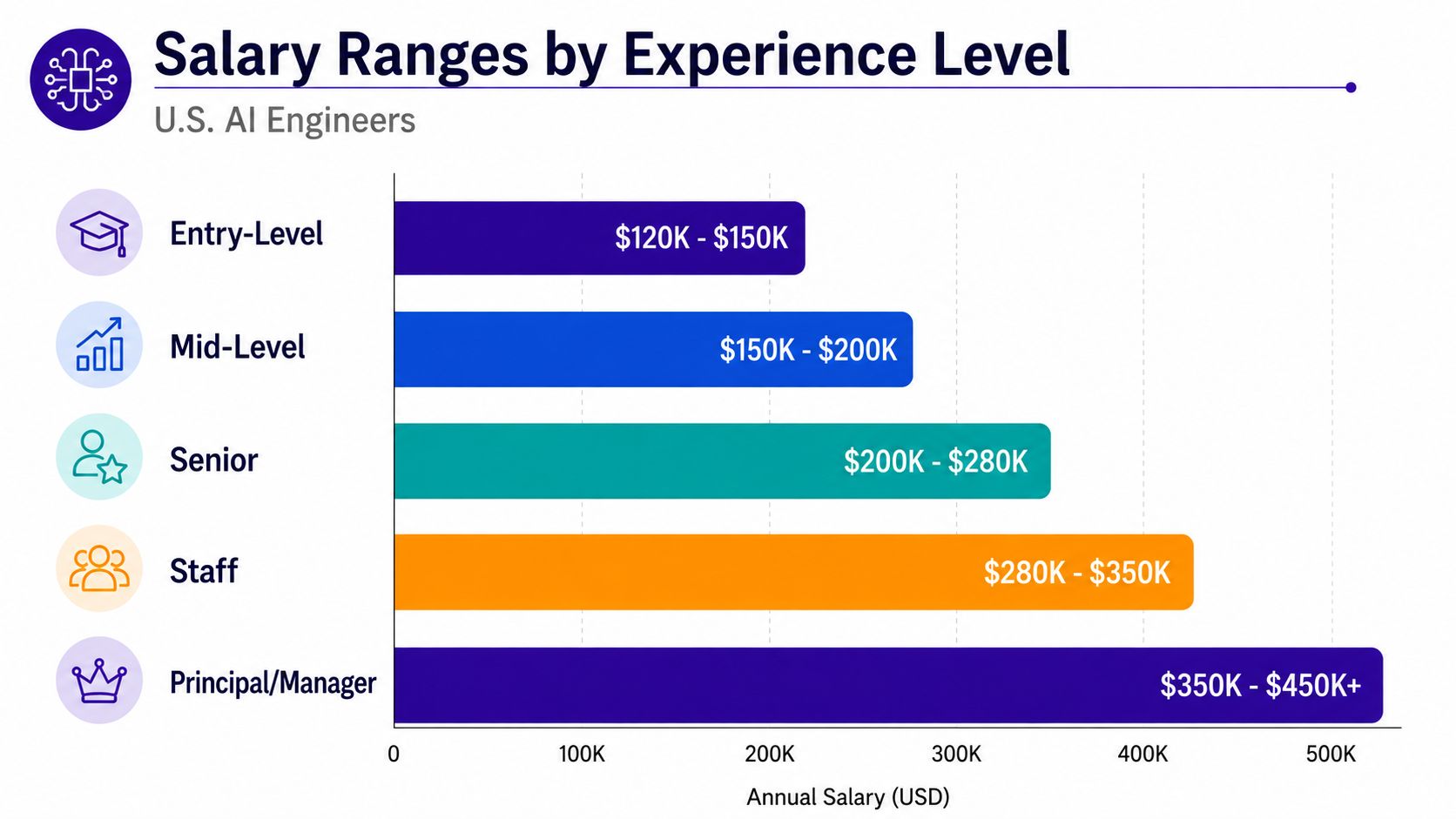
A useful way to read the market is by seniority band, not title inflation. Entry-level AI roles still pay well, but the premium is softening, while senior and staff roles remain the key prize because they’re tied to ownership, not just output.
Hiring reality: Employers don’t pay extra for the word “AI” in the title. They pay for people who can deploy, maintain, and debug production systems under pressure.
How the bands usually behave
- Entry-level: strong pay for hands-on builders, but the premium is no longer as stretched as it was in the prior cycle.
- Mid-level: the most common landing zone for production AI work, especially where model deployment and application integration matter.
- Senior: where base pay rises, but total comp starts widening faster than base alone.
- Staff: where scope, not just coding speed, drives package size.
- Principal or manager: where compensation depends on whether the role still carries deep technical ownership or shifts toward org leadership.
The practical takeaway is blunt. Candidates should judge where they sit by what they can ship in production, not by years alone. Employers should set bands by impact on model lifecycle and platform reliability, because those are the skills that drive the offer. Once the work stops being experimental, compensation stops behaving like a research stipend and starts behaving like a scarce engineering seat.
Why Specialization Drives the Real Pay Premium
Two engineers with the same title can be far apart on pay because their actual work is not the same. The market pays for specialization, and the premium shows up fastest in narrow, production-critical niches.
LLM and RAG work pull the market hardest
The clearest premium is in LLM fine-tuning and RAG architecture. Acceler8 Talent reported a 135.8% surge in demand for LLM fine-tuning and RAG-related roles, which is exactly why these candidates negotiate from a stronger position (Acceler8 Talent market rates). When a team needs retrieval quality, context handling, and production reliability, generalist AI experience doesn’t close the gap.
The premium is real, but it isn’t uniform
AI safety and alignment work carries a different kind of pricing power. The same market data says the premium has grown 45% since 2023, which makes sense in regulated or frontier settings where risk tolerance is low. Computer vision and domain-specific deep learning also command materially higher pay, because those roles are usually tied to sector knowledge, not generic model training.
| Specialization | Market signal | Why employers pay more |
|---|---|---|
| LLM fine-tuning and RAG architecture | Fastest-growing demand | Directly affects answer quality and product usefulness |
| AI safety and alignment | Premium has grown since 2023 | Lowers risk in sensitive systems |
| Computer vision and domain-specific deep learning | Strong premiums in niche sectors | Requires deep domain and deployment knowledge |
| Production MLOps ownership | Persistent shortage | Keeps models reliable after launch |
The lesson for candidates is straightforward. The fastest route to a higher band is depth, not tenure. An engineer who can own a production RAG stack or stabilize inference at scale is worth more than a generalist with a broader but shallower résumé.
For employers, the mistake is writing a vague AI engineer requisition and hoping the market will self-sort. It won’t. A generic title attracts generic applicants, then the team overspends late in the process to rescue the search. Specificity costs less than confusion.
Geography, Remote Work, and Employer Type
Location still matters, but it doesn’t matter equally. A remote offer from a product company, a Bay Area role at a frontier lab, and a traditional enterprise seat in a secondary metro can all carry very different economics.
The same engineer, different price tags
In the U.S., compensation can vary by up to 40% depending on geography according to the MRJ Recruitment zone model included in the research notes. San Francisco and New York sit at the top of the stack, Seattle and Washington DC or Los Angeles trail slightly, and Austin, Boston, and Denver typically land in a more competitive middle band. That spread exists because companies are paying for access to talent, not just for cost of living.
Employer type matters just as much. Major AI labs and big tech platforms can push total comp into the $350,000 to $943,000+ range at mid to senior levels, while AI startups, enterprise tech, financial services, healthcare, consulting, and government-adjacent employers all sit on different pay curves. The work can be equally hard, but the package reflects different business models, liquidity, and risk tolerance.
Trade-off rule: When a company says it can’t match Big Tech cash, the real question is whether it can compensate with scope, velocity, equity upside, or rare technical ownership. If it can’t, the offer will usually lose.
What candidates should trade for, and what they should avoid
- Remote flexibility is worth real value for some candidates, but it should not be confused with equivalent cash.
- Frontier-lab prestige can sharpen a résumé quickly, yet the work can be narrower and more volatile.
- Enterprise stability often brings defined scope and better predictability, but the top end is usually lower.
- Late-stage startup equity can be attractive when the company has a real path to liquidity, but it is still a risk-bearing instrument.
For employers, the implication is obvious. A standard comp band copied from a Bay Area peer won’t work in every geography, and a fully remote role still has to compete with national talent. The right benchmark is the role’s production difficulty and the employer’s ability to make the package legible, not a blind comparison to the loudest names in the market.
Negotiation Playbook for Candidates
The strongest candidates do not bluff first. They build a clean case, then let the company react to that case.
Prepare your case before the recruiter call
Start with evidence, not hope. A candidate should know whether the role is closer to production engineering, platform work, or research-adjacent AI, then anchor the conversation on total compensation instead of base pay alone. That matters because recruiters usually open with the tidiest number and leave the rest for later.
Do not throw out a comp target too early. Once you name a number before the company has seen your value, you shrink the room to negotiate. A better move is to let the recruiter define scope first, then respond with a package view that includes base, equity, bonus, and sign-on.
Negotiate the pieces that actually change the offer
Bring up another offer only when it helps your position. Use it to confirm market demand, not to sound threatening. The same rule applies to equity. A larger grant matters most when the role carries real ownership and the company already wants you.
Non-cash terms change the quality of the job more than many candidates admit. Model ownership, publication time, conference budget, and remote flexibility can all improve the offer without forcing a brittle salary standoff.
| Negotiation move | Why it works |
|---|---|
| Anchor on total compensation | Keeps the conversation honest |
| Use competing offers carefully | Creates competitive tension without sounding combative |
| Ask for written clarity | Prevents misunderstandings on equity and bonus terms |
For a compact set of tactics, how to negotiate salary is worth keeping handy because salary talks in AI move fast and rarely reset cleanly.
Recruiters remember candidates who are direct, organized, and realistic. They also remember the ones who negotiate every detail after saying yes.
Close the process by asking for the offer in writing, then review vesting, bonus eligibility, and any performance conditions before signing. If the company will not document the package clearly, the offer is weaker than it looks.
Salary-Setting and Retention Strategy for Employers
Employers that hire AI talent badly usually make the same mistake. They benchmark against the wrong peer set, then act surprised when candidates walk.
Benchmark the job, not the logo
A good salary band starts with the work itself. If the role owns deployment, reliability, and MLOps, it should not be priced like a pure analytics seat. If it requires niche specialization like RAG, model serving, or safety-sensitive deployment, the band should reflect that reality from day one.
Counter-offers are expensive when the original range is too tight. The cleanest defense is a band that already leaves room for the candidate’s actual market value, plus enough equity structure to support retention. Refresh grants matter because AI people who are good at production work get recruited constantly.
Retention beats reactive matching
Matching a counter-offer at the last minute is lazy management. The better move is to make the role harder to leave by giving the engineer scope, a clear technical ladder, and enough room to own a meaningful part of the AI stack. That is especially important when the person is the only one who understands model deployment or inference stability end to end.
A transparent comp philosophy helps too. Internal equity breaks when managers improvise numbers, and that creates resentment long before the next opening gets filled. If finance wants discipline, the answer is not underpaying everyone. It’s building a framework that can survive market pressure without rewriting the rules each quarter.
Where AI Engineer Pay Is Headed Next
The market is still hot, but it’s maturing. Entry-level premiums have already started to normalize, while the highest comp packages remain sticky at the staff level and above.
The near-term watchlist is straightforward. Employers will keep paying up for AI safety, MLOps, and production engineers who can keep systems stable. Remote-first compensation will also keep settling into clearer patterns as more companies decide whether they’re buying talent, location flexibility, or both.
The broader signal is simple. Total compensation is still the honest way to read ai engineer salary, because base alone hides too much of the story. The next year will reward candidates who can prove production ownership, and it will punish employers who pretend the market still looks like pre-2024 recruiting.
Nexus IT Group helps employers hire AI engineers, machine learning specialists, and other hard-to-fill technology talent through direct hire, contract staffing, executive search, and recruitment support that’s built around real market pressure. Teams that need help calibrating pay, tightening role scope, or moving faster on critical openings can visit nexus IT group to start a conversation and compare the market against a live hiring plan.