
Machine learning engineer salary in the United States now spans roughly $107,972 for junior talent to over $600K at frontier labs, with mid-level total comp often landing between $190K and $260K depending on market and equity. That spread is the whole story: the title looks simple, the offer letter is not.
Table of Contents
- What Every Machine Learning Engineer Should Know About Pay in 2026
- The Headline Numbers and Why They Disagree
- How Total Compensation Breaks Down
- Regional Salary Bands Across Major U.S. Markets
- Salary by Experience Level From Junior to Staff Engineer
- Skills, Credentials, and Industries That Drive the Premium
- Common Misconceptions That Cost Candidates and Employers Money
- Negotiation Tips for Candidates and Budgeting Guidance for Employers
What Every Machine Learning Engineer Should Know About Pay in 2026
A machine learning engineer offer is never just a salary. It’s a mix of base pay, bonus, equity, and the skills premium attached to production ownership, and salary guides that collapse those levers into one neat average are usually hiding the key details. A candidate comparing offers only on headline pay is already making a bad decision.
The right way to read the market is to separate the four numbers that move the deal. Base salary tells you what is guaranteed, bonus tells you how much cash is at risk or variable, equity tells you how much upside the employer believes the role deserves, and the skills premium tells you whether the company is paying for generic ML work or for hard-to-replace AI capability. That last point matters more in 2026 than it did even a year ago, because AI-specialized roles are pulling the top of the market up while generic ML roles are moving more unevenly.
Practical rule: if an offer letter doesn’t clearly separate base, bonus, and equity, it’s not a clean offer. It’s a number designed to impress someone who won’t read the fine print.
A useful comparison point for broader AI leadership pay is enterprise AI leader salary benchmarks, which helps frame how quickly compensation rises once a role touches strategy, deployment, and business ownership. That’s the same logic buyers use for ML engineers, just at a different scope.
The most dangerous habit in this market is treating a single average like a budget. A better habit is to ask, “What level, what region, what comp mix, and what kind of ML work is this?” That question cuts through most confusion immediately.
The Headline Numbers and Why They Disagree
The market does not have one machine learning engineer salary. It has several, and the spread is the first clue that methodology matters more than the headline. Some sources pull from broad job-posting data, some from self-reported compensation, and some from tech-heavy employer samples, so the same role can look underpaid in one guide and expensive in another.
Indeed reports an average salary of $189,380 in 2026. Indeed’s salary page gives you one view of the market, while Nexus IT Group’s AI engineer salary coverage points to a different slice shaped by AI-specific hiring. That gap is not a contradiction. It is exactly what happens when one source captures a broad national market and another focuses on higher-value AI work.
Built In reported $202,817 in average total compensation in 2025, built from $158,798 base pay plus $44,019 in additional cash compensation. Built In’s 2025 machine learning engineer salary data is the clearest reminder that base salary alone does not describe the offer. A candidate who compares only base pay is missing a large part of what the company is putting on the table.
RecruitLab goes much higher on seniority, with $260K to $430K base for senior engineers and $340K to $520K base for staff-level engineers in 2026. RecruitLab’s 2026 salary guide is speaking to a very different market than entry-level hiring. These are roles that carry system ownership, reliability, and deployment across teams, so the numbers should be read as senior engineering budgets, not as a general market average.
2026 U.S. Machine Learning Engineer Salary Sources Compared
| Source | Metric | Reported Figure | Skew |
|---|---|---|---|
| Indeed | Average salary | $189,380 | Broad national average, likely pulled upward by stronger markets |
| Built In | Average total compensation | $202,817 | Total comp, not base, and weighted toward tech employers |
| RecruitLab | Senior base salary | $260K to $430K | Senior and staff-level market, not general population |
The right conclusion is direct. A single average is a weak budgeting tool. If a hiring manager wants a defensible number, the key question is which source matches the level, location, and compensation mix for this exact role. That is the only way to keep an offer from being underbudgeted on one end or padded with meaningless noise on the other.
How Total Compensation Breaks Down
The offer letter has four moving parts, and each one behaves differently. Base salary is the cleanest number because it is guaranteed. Annual bonus is variable and easy to overrate. Equity can be the biggest line item on paper and the least cash-like in practice. Perks and signing packages matter a lot at junior and mid-level, then matter less as total comp rises.
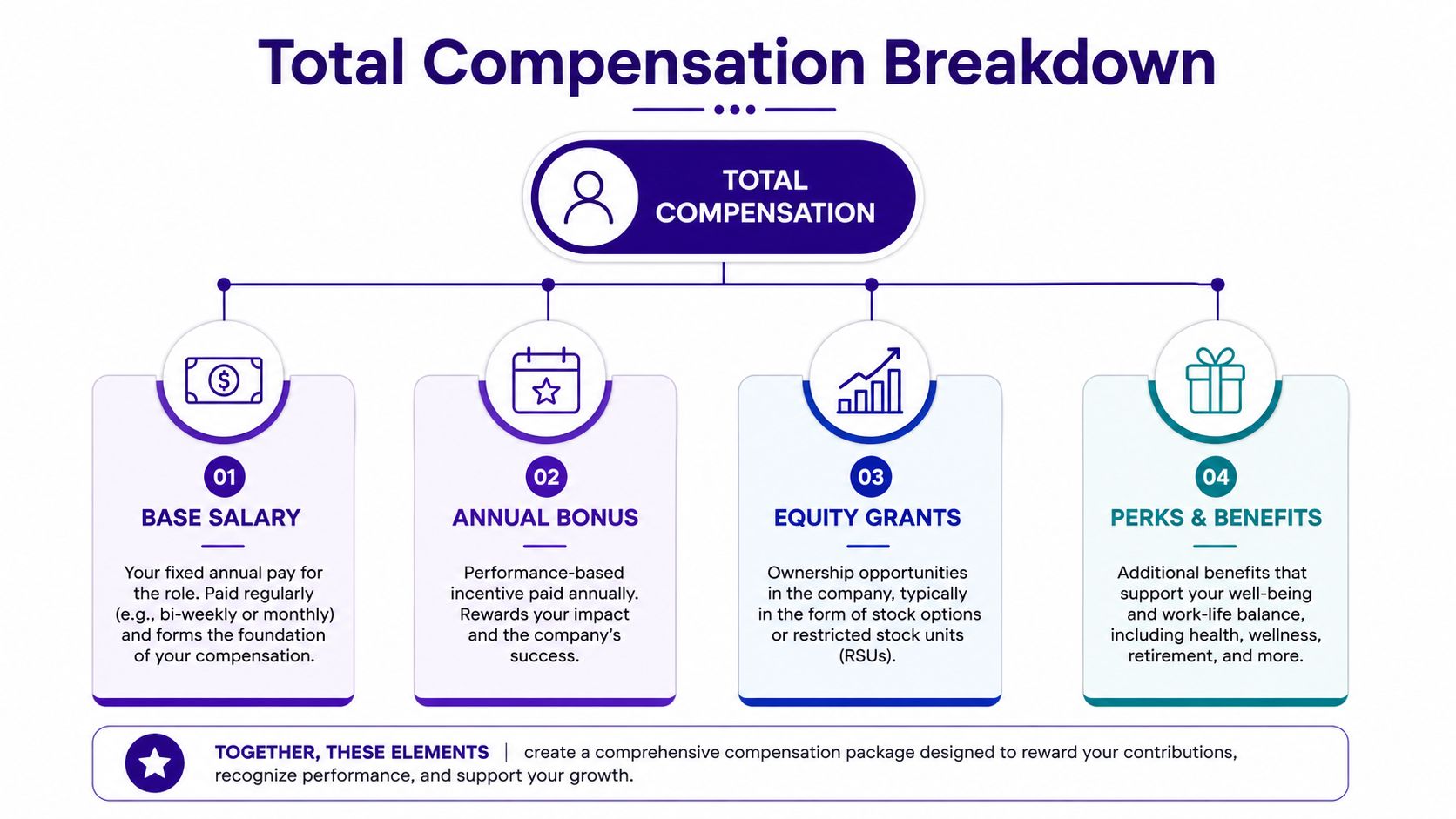
A mid-market package is usually a mix of guaranteed cash and variable pay, and the split matters more than the headline number. That source shows a total compensation figure with a base component and additional cash compensation, which is the right way to read an ML engineer offer. If a candidate only negotiates base, they are ignoring a sizable part of the deal. If an employer only budgets off base, they are undercounting the total cost of hiring.
Read Equity Like a Recruiter
Equity is where many candidates fool themselves. A large grant at a high-growth company can look like a home run, but it is only worth its headline value if the company exits well and the vesting schedule works in the employee’s favor. In frontier-lab and AI-native startup settings, equity can add a large amount to total comp, but that upside is not the same thing as cash in hand.
The practical move is to value equity conservatively. Treat it as upside, not salary replacement. If two offers differ mainly on equity, the one with the bigger grant is not automatically better unless the candidate understands dilution, vesting, and the employer’s track record.
Put Perks on a Dollar Scale
Perks are often treated like fluff, and that is a mistake. Relocation help, signing bonuses, and benefits can change the value of a package, especially when the base band is fixed. For earlier-career candidates, those extras can be the difference between a good offer and a workable one.
A smart comparison starts with guaranteed cash, then checks upside, then asks how clean the risk really is. If you want a useful cross-role comparison, you can compare PM salaries by experience and see the same pattern, base matters first, then the rest of the package fills in the picture.
A good comparison model does not ask which offer sounds bigger. It asks which offer creates the better guaranteed cash, the better upside, and the cleaner risk profile.
That is the standard recruiters use. Any employer that will not discuss the full package transparently is inviting a bad comparison.
Regional Salary Bands Across Major U.S. Markets
Location still changes the machine learning engineer salary in a very real way. Motion Recruitment’s 2026 guide puts U.S. mid-level ML engineers at $149,136 to $192,044, and senior engineers at $168,076 to $220,560, while also noting that some regions push mid-level compensation up to $240,000 annually. Motion Recruitment’s 2026 salary guide makes one point very clear, location and scope can move the band by tens of thousands of dollars even when the title stays the same.
That is why a role in San Francisco does not compare cleanly with one in Austin or Raleigh unless the employer is using a national band. A company with production ML systems, heavier model ownership, and more competitive hiring pressure is likely to pay differently than a company using ML as a support function. Same title, different market.
Geography Changes the Negotiation Frame
A strong budgeting model starts with the local market, then adjusts for the work itself. If the role supports revenue-critical systems, the band should sit higher than a role that mainly maintains internal models. If the employer is remote-first but hiring into a high-cost labor pool, the offer may still track a coastal market even when the employee does not live there.
The international figures from DataCamp help show how wide the gap can be. It reports £57,830 for the U.K., ₹10,88,060 for India, $151,132 for Australia, and $129,929 for Singapore. That spread is useful because it reminds global teams that one leveling framework will not work everywhere.
Remote Doesn’t Mean One Band
Remote-first hiring still clusters around talent hubs, not just cost-of-living logic. A recruiter setting pay for a distributed team should ask where the person sits in the labor market, not just where the company is incorporated. That distinction matters because the strongest candidates often know the coastal benchmarks even when they live elsewhere.
For broader context on role-level pay comparisons in a different market, compare PM salaries by experience shows how quickly compensation can vary by geography and seniority in another discipline. The lesson carries over cleanly to ML hiring.
Salary by Experience Level From Junior to Staff Engineer
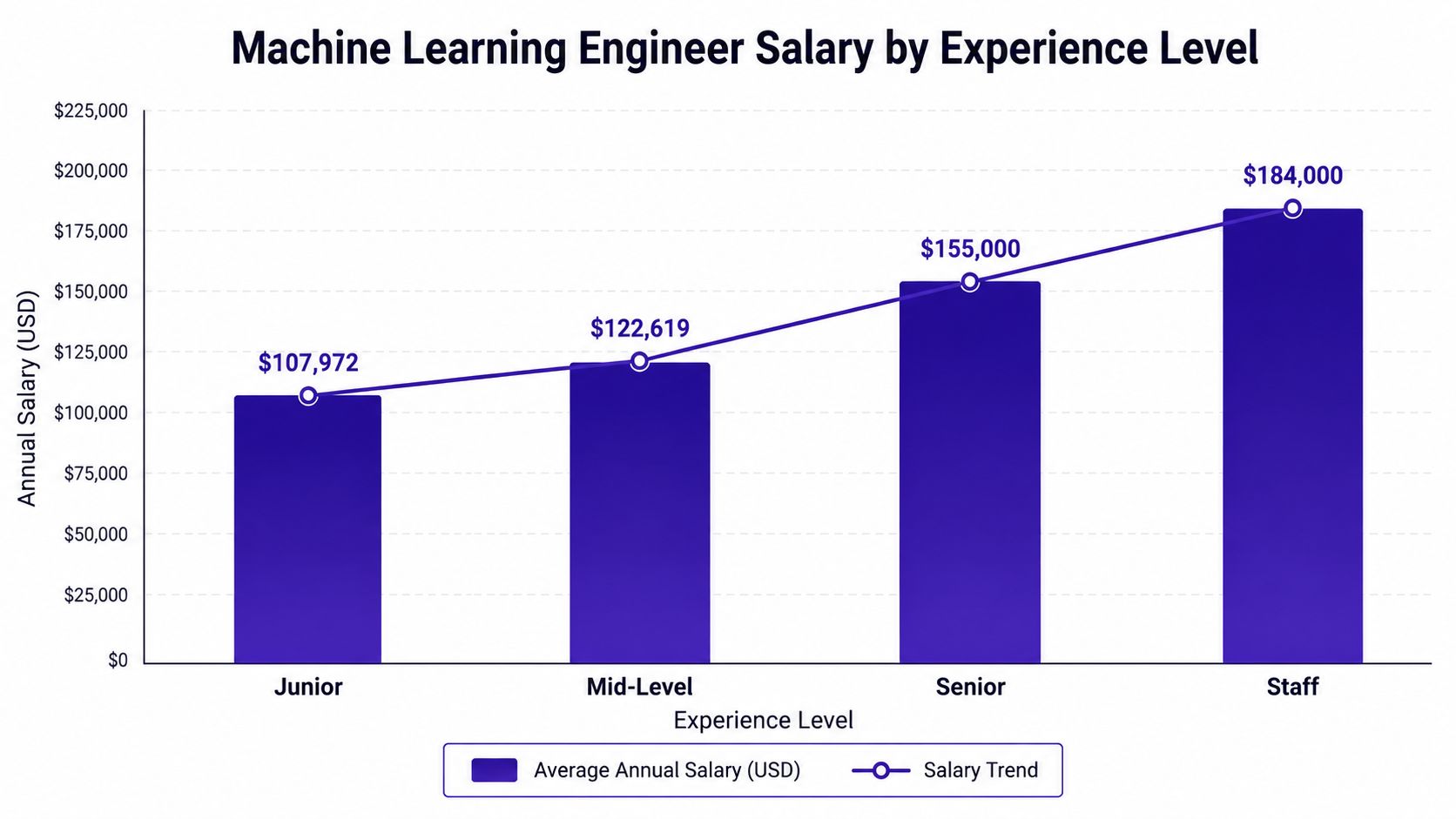
Experience still predicts pay, but the ladder is uneven. A junior machine learning engineer at the lower end of the market is paid for execution and supervision. A mid-level engineer gets more because they own more, but the jump is usually incremental until the role starts carrying real architectural responsibility.
Jumps Happen at Ownership Boundaries
Junior pay sets the floor. One market guide places junior machine learning engineers at $107,972 on average and mid-level engineers at $122,619, which shows the early-career increase is real but still modest.
The bigger move comes when an engineer stops being a ticket closer and starts owning the system. That is the point where pay stops tracking tenure and starts tracking risk, scope, and how much damage the person can prevent or cause.
Use machine learning fundamentals as the baseline for that shift. Once an engineer can reason about data flow, model behavior, deployment constraints, and failure modes without constant supervision, the market prices that person differently.
Payscale’s 2025 data shows a range from $98,000 for less-than-one-year workers to $123,401 for early-career engineers, with a highest reported pay of $184,000. That spread makes the same point clearly. Pay rises fastest when the engineer moves from isolated tasks to broader system ownership.
RecruitLab pushes the senior conversation further. It places senior base pay at $260K to $430K and staff base pay at $340K to $520K, which is what happens when scope, architecture, and cross-team influence matter more than a résumé line that says “years of experience.”
The ladder is simple, but the market reads it with nuance.
- Junior: owns pieces of a model pipeline, ships with heavy review, and needs close direction.
- Mid-level: owns a feature, a model endpoint, or a pipeline segment end to end.
- Senior: makes design calls, drives reliability, and removes blockers across functions.
- Staff: sets technical direction across teams and is paid for influence, not just output.
The sharpest salary jumps come after an engineer is trusted to shape architecture and steer multiple teams. Two people with the same title can still sit in very different bands because the offer reflects scope, not just label. That is why title-only comparisons are weak and often misleading.
Skills, Credentials, and Industries That Drive the Premium
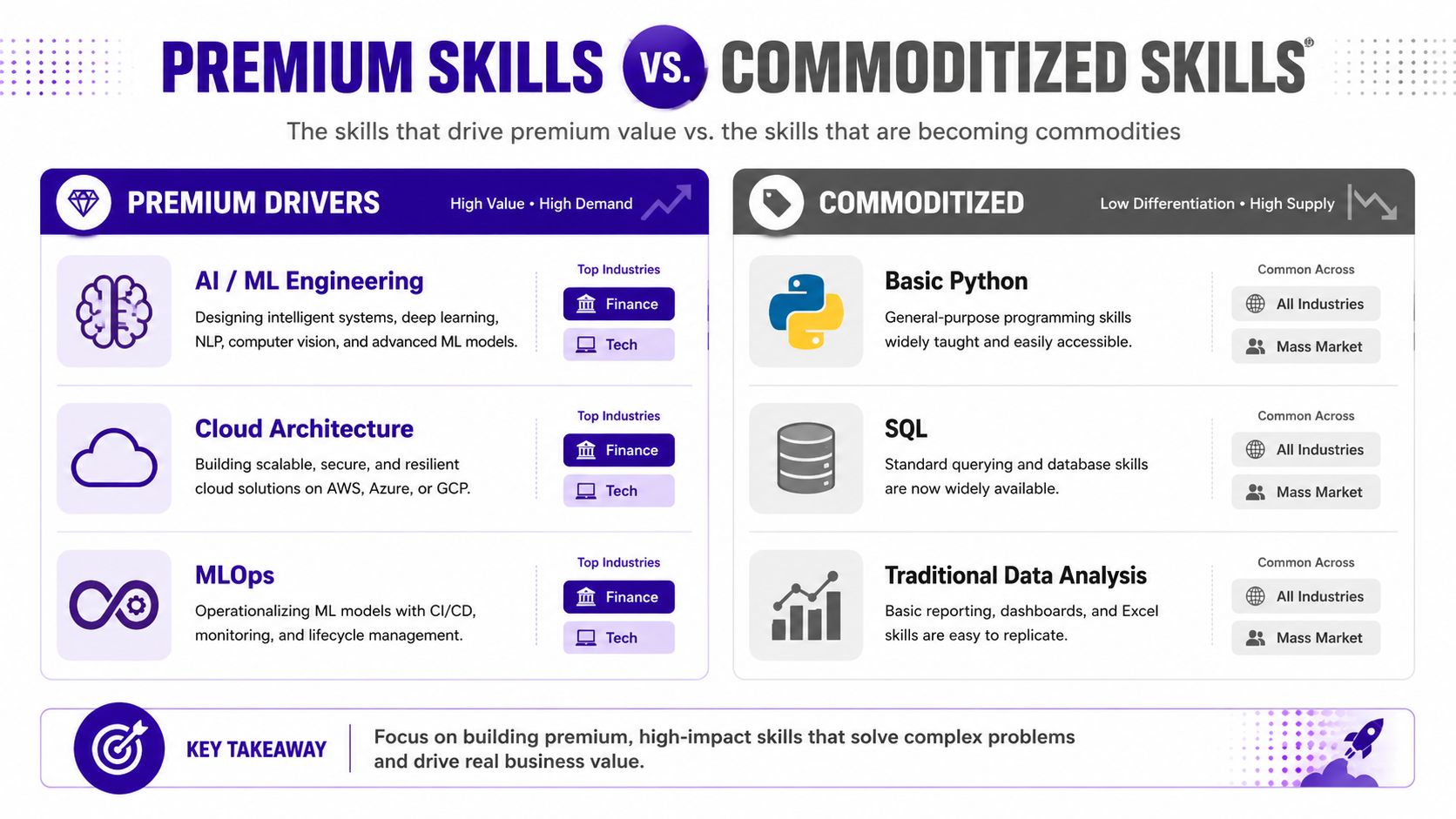
The premium in 2026 is not going to generic ML trivia. It’s going to engineers who can ship models into production, operate MLOps cleanly, and work on generative AI or frontier-model systems where failure is expensive. Signify Technology reports salary inflation of about 38% year over year for AI-specialized roles, average AI engineer compensation of $206,000 in 2025, and senior or frontier packages exceeding $500K total comp. Signify Technology’s 2025-2026 salary benchmarks make the point plainly, the market is paying for scarce implementation depth, not broad buzzwords.
Where the Real Premium Lives
The skills that move offers are the ones tied to revenue and reliability. Cloud-native ML infrastructure matters because it lets teams deploy, monitor, and scale. Generative AI matters because many employers are still paying a premium to move fast in a crowded market. Frontier-model work matters because only a small pool of engineers can handle that level of complexity.
The commoditized layer is different. Basic Python and SQL are expected. They get someone into the conversation, but they don’t justify top-of-band pay by themselves. Hiring managers know the difference immediately, and candidates should too.
Credentials Help, But Only When They Prove Capacity
Advanced degrees can help in research-heavy environments, and cloud certifications can signal current platform knowledge. Neither one automatically creates advantage in an offer unless the candidate can tie it to shipped work. A clean portfolio, production deployment experience, and evidence of systems thinking still beat résumé decoration.
For a broader skills baseline, Nexus IT Group’s machine learning fundamentals guide is a useful companion for employers and candidates who need to separate surface-level fluency from actual engineering depth.
Industry matters too. Defense, quant finance, and AI-native startups tend to pay more aggressively when the work is directly tied to scarce infrastructure or market advantage. That’s where the premium has held up best.
Common Misconceptions That Cost Candidates and Employers Money
The costliest mistake is treating one salary figure as the whole offer. A candidate who sees $189,380 from one source and $128,769 from another can anchor on the wrong number and negotiate from a weak position. As noted earlier, salary sites do not use the same methodology, and pretending they are interchangeable leads to bad decisions on both sides of the table.
Title is another trap. A Machine Learning Engineer at a frontier lab can sit in a completely different compensation tier than the same title at a mid-market retailer because scope, equity, and product risk are not the same. Recruiters see this every day. Candidates who ignore that gap usually chase the wrong offer, then wonder why the numbers never make sense.
Remote Work Didn’t Flatten Pay
Remote work softened geography, but it did not erase pay strategy. Strong employers still hire in expensive markets or price roles to the market they are trying to compete in. That is why the same remote job can fall under a national band, a coastal benchmark, or a location-adjusted range that pulls the offer down.
Python is the other lazy assumption. Python gets a candidate in the room. It does not justify top-of-band pay by itself. The number moves when an engineer can ship, monitor, and own ML systems in production, especially where outages, bad predictions, or slow inference hit revenue or trust.
Bottom line: if the offer looks rich but the role carries little ownership, the number is inflated by title, not by responsibility.
Employers make the reverse mistake just as often. They price senior ML roles too low, ignore equity expectations at AI-native firms, and then act surprised when strong candidates walk. That approach fails because the market is too transparent for vague bands and wishful comparisons.
For candidates who want a cleaner way to push back, Nexus IT Group’s salary negotiation guide is the right starting point.
Negotiation Tips for Candidates and Budgeting Guidance for Employers
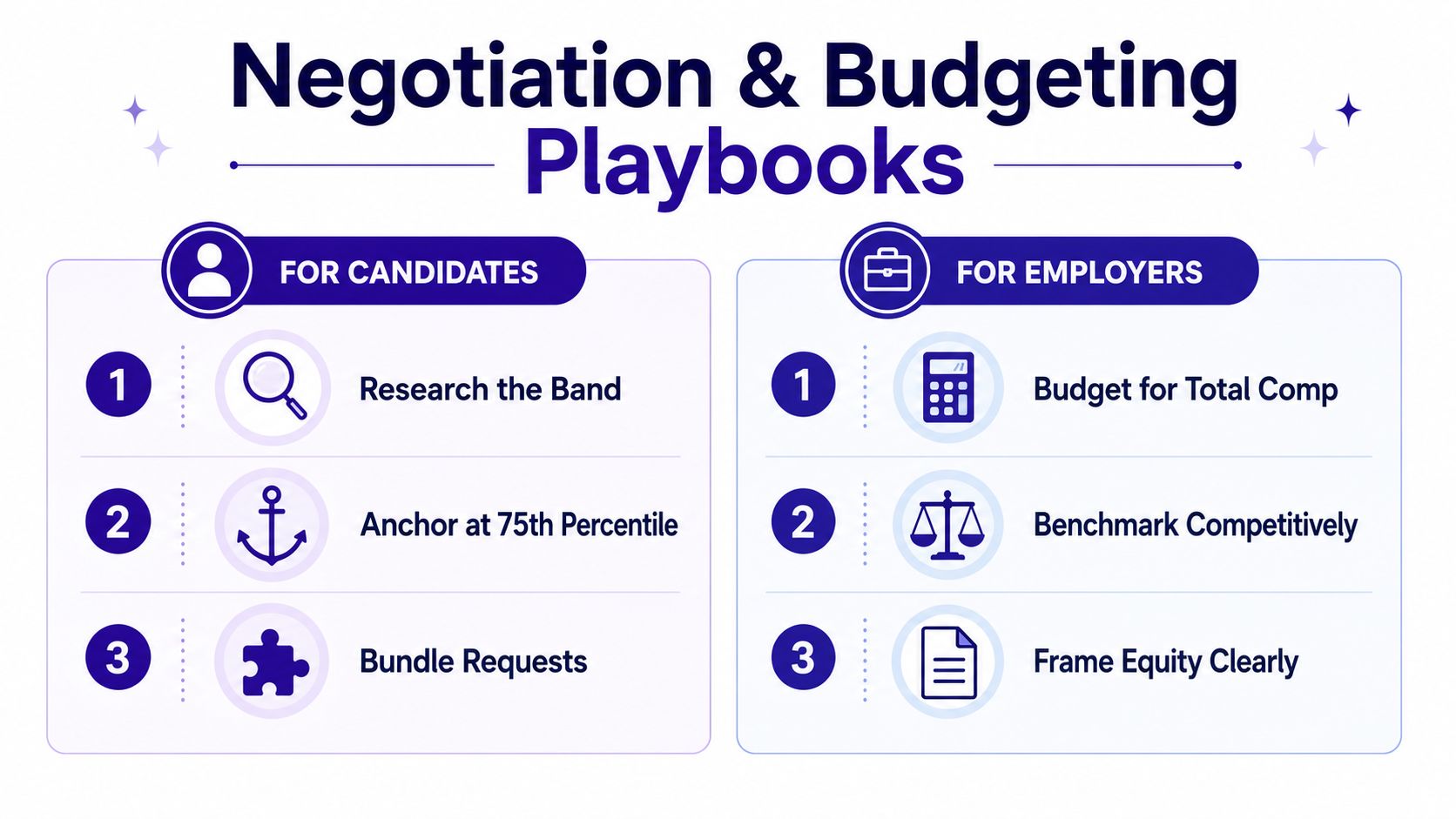
Candidates should negotiate from the band, not from emotion. The right sequence is simple. First, identify the level. Second, compare the offer to the 75th percentile, not the average. Third, model equity conservatively. Fourth, ask for signing bonus or relocation help if base is locked. Nexus IT Group’s salary negotiation guide is useful because the mechanics matter more than the tone.
How Candidates Should Push
A candidate should never counter with a vague request. Use a specific number tied to market data. Say what range is acceptable, explain why the ask fits the level and geography, and separate base from total comp. Recruiters can work with that. They can’t work with “something higher.”
- Research the band: compare the role against multiple sources, then ignore the outlier that flatters the candidate or the employer.
- Anchor at the 75th percentile: the average is what weak negotiations settle on.
- Bundle requests: if base won’t move, push on signing bonus, equity, or relocation together.
How Employers Should Budget
Employers need a band wide enough to hire real talent, not just filter résumés. Senior ML roles cannot be underbanded and then “sold” on mission alone. AI-native firms also need to budget for equity expectations, because candidates in that market know what the top of the market looks like.
A defensible budget starts with level, adjusts for region, then adds comp structure. That means total compensation, not base salary, should be the planning unit. Anything else is a false economy that slows hiring and weakens acceptance rates.
The last question in every offer conversation should be this, “What would it take for you to accept today?” It forces both sides to surface the blocker quickly, and that’s far more useful than a polite back-and-forth that drags for another week.
For employers trying to hire hard-to-fill AI talent and for candidates who want a straight read on the market, nexus IT group is worth a direct conversation. The firm works on specialized tech searches, and that’s exactly the kind of support that helps turn a confusing salary range into a clean offer or a better counter.