
99% of U.S. hiring managers say their company uses AI in some part of the hiring process, and 98% of those AI users say it improved hiring outcomes, according to Insight Global’s 2025 AI in hiring report. That should change the framing for any CTO or VP of Engineering. The question isn’t whether AI belongs in recruiting anymore. The question is whether the organization is using it in a way that improves hiring without creating governance, compliance, or candidate trust problems.
For specialized tech hiring, that distinction matters more than it does in volume recruiting. Filling a support role and filling a lead SRE, principal data engineer, or applied AI engineer are different operating environments. The former rewards speed alone. The latter rewards speed, yes, but only when paired with precise screening, calibrated decision-making, and a process that strong candidates trust.
That’s where talent acquisition functions often get stuck. They buy a tool for résumé screening or outreach automation, then discover the hard part wasn’t software selection. It was data quality, recruiter adoption, hiring-manager discipline, workflow design, and governance. AI for talent acquisition works best when it strengthens judgment instead of pretending to replace it.
Table of Contents
- The New Normal AI in Your Hiring Process
- Understanding How AI Works in Recruiting
- Actionable AI Use Cases Across the Hiring Funnel
- Measuring the Real Impact A KPI Framework
- Your AI Implementation Roadmap for Tech Hiring
- Navigating Risks and Selecting the Right AI Partner
- The Nexus IT Group Advantage Augmented Intelligence
The New Normal AI in Your Hiring Process
In the U.S., 99% of hiring managers say their company uses AI in some part of the hiring process, 98% of those users say it improved hiring outcomes, and 93% say AI is useful but shouldn’t replace human decision-making, according to Insight Global. For CTOs and talent leaders hiring specialized technical talent, the signal is clear. AI is now part of the operating model. A central question is where it belongs, who owns it, and what guardrails keep it from creating new hiring risk.
That matters more in tech hiring than in general recruiting. A poor fit at the senior engineer, security, data, or platform level is expensive, slow to correct, and often damaging to delivery plans. Teams that get value from AI usually apply it to narrow, high-friction tasks with clear rules and visible outcomes. Teams that struggle often hand it too much authority too early, especially in areas where hiring manager judgment, compensation context, or technical nuance should carry more weight.
What this means for tech employers
The practical starting point is not “use AI for repetitive work.” It is deciding which recruiting tasks can be standardized without weakening hiring quality.
For example, AI is well suited to parsing résumés from software engineers whose experience is described in inconsistent ways, then normalizing terms such as Kubernetes, EKS, GKE, and AKS so recruiters can build a cleaner shortlist faster. It is also well suited to re-engaging candidates already in the ATS when a new role opens that matches adjacent skills, such as moving a strong backend Java candidate into consideration for a Kotlin-heavy team.
By contrast, AI should not decide whether a staff engineer from a high-scale SaaS company can succeed in a regulated enterprise environment with slower release cycles, stricter change control, and heavier cross-functional influence. That call depends on architectural depth, communication style, risk tolerance, and team design. Those are judgment questions.
Used well, AI usually fits into workflows like these:
- Résumé intake and skill normalization: Converting inconsistent technical profiles into structured data recruiters can search and compare
- Interview scheduling: Reducing delays across recruiters, hiring managers, and technical panels
- Candidate communication: Handling status updates and routine follow-up so applicants are not left in the dark
- Talent rediscovery: Finding silver-medalist candidates and adjacent-skill profiles already sitting in your system
The governance piece is where many adoption efforts break down. Someone has to define approved use cases, decide which decisions require human review, and document what the tool is allowed to read, rank, summarize, or draft. In high-stakes tech hiring, that usually means recruiting leadership, HR, legal, security, and engineering leaders all have a role. Without that operating discipline, AI becomes one more black box inside a process that already has too many handoffs.
Change management matters just as much. Recruiters need to know when to trust an AI-generated shortlist and when to challenge it. Hiring managers need to understand that a ranked list is a starting point, not a verdict. Security and compliance teams need confidence that candidate data is handled correctly. If those groups are not aligned, adoption stalls or, worse, the tool gets used inconsistently across teams and creates avoidable bias, candidate confusion, and audit problems.
Candidates are adapting too. The same Insight Global report also found that hiring managers can often detect AI use in applications, and many care about it. That raises a practical policy question for employers. Decide now what candidate AI use is acceptable, where disclosure is expected, and how interview teams will evaluate polished but possibly AI-assisted application materials. In technical hiring, that policy needs to be explicit, because the line between helpful drafting and misrepresentation gets blurry fast.
Understanding How AI Works in Recruiting
The most useful way to think about AI in recruiting is this. It acts like a superpowered research assistant embedded inside the hiring process. It doesn’t replace the recruiter, the sourcer, or the hiring manager. It helps those people process more information, faster, and with more consistency than manual review alone.
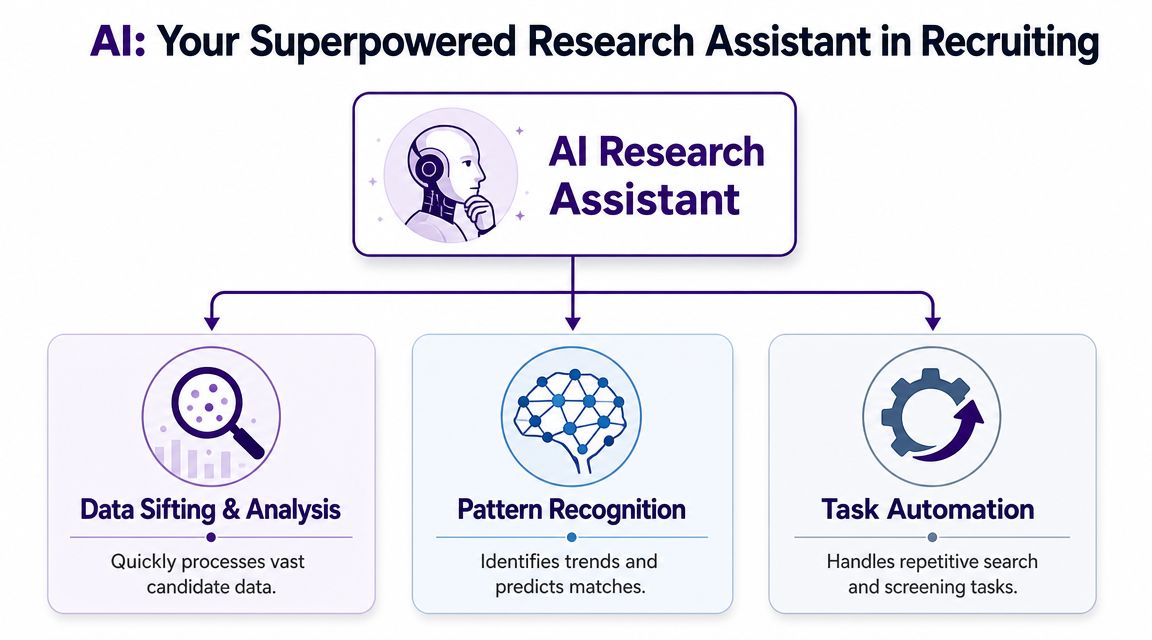
AI sits on top of your recruiting systems
In practice, AI for talent acquisition rarely works as a standalone product. It performs best when layered into the systems the team already uses. Deloitte notes that modern talent acquisition stacks are evolving to configure ATS, CRM, and talent intelligence platforms around AI capabilities that can identify passive candidates and build strong talent pipelines by analyzing large internal and external datasets in its analysis of AI in talent acquisition.
That matters because most hiring pain starts with fragmented systems. Candidate history sits in the ATS. Outreach activity lives in the CRM. Interview notes are buried in email, calendars, or separate tools. AI can connect patterns across those records only if the underlying data is accessible and reasonably clean.
A well-configured stack lets the system do useful work such as matching old applicants to new openings, identifying passive candidates with adjacent technical skills, and ranking prospects based on role requirements rather than raw keyword overlap.
What the models are actually doing
Under the hood, the mechanics are less mysterious than many teams assume. The most common capabilities are straightforward:
- Natural language processing: Reads unstructured text in résumés, job descriptions, GitHub summaries, project histories, and interview notes, then converts that text into comparable signals.
- Matching and ranking: Compares candidate profiles to requirements and surfaces likely fits for recruiter review.
- Workflow automation: Handles repetitive actions such as scheduling, follow-up messaging, interview transcription, and note consolidation.
For specialized hiring, the biggest gain often comes from moving beyond keyword search. A recruiter searching manually for “Kubernetes + Terraform + AWS + SRE” may miss a platform engineer with highly relevant adjacent experience. AI can be trained to surface that profile if the job architecture and skill taxonomy are strong enough.
The quality of AI output in recruiting usually reflects the quality of the hiring data underneath it.
That’s why implementation discipline matters more than tool demos. If job titles are inconsistent, skills are labeled differently across teams, or recruiters document candidate stages unevenly, the AI layer will inherit that mess. Teams don’t need perfect data before they start. They do need shared definitions for roles, skills, stages, and outcomes.
Actionable AI Use Cases Across the Hiring Funnel
Most organizations start in the same place. They use AI where the recruiting funnel creates the most drag, then expand once the process is stable. Mercer reported that 38% of respondents said the most common application was sourcing and engaging talent for pipeline building, followed by 28% using AI-generated analytics and 28% using AI to create job posts in its strategic AI adoption in talent acquisition research. That pattern makes sense. Top-of-funnel work is repetitive, time-sensitive, and easier to standardize than final-stage evaluation.
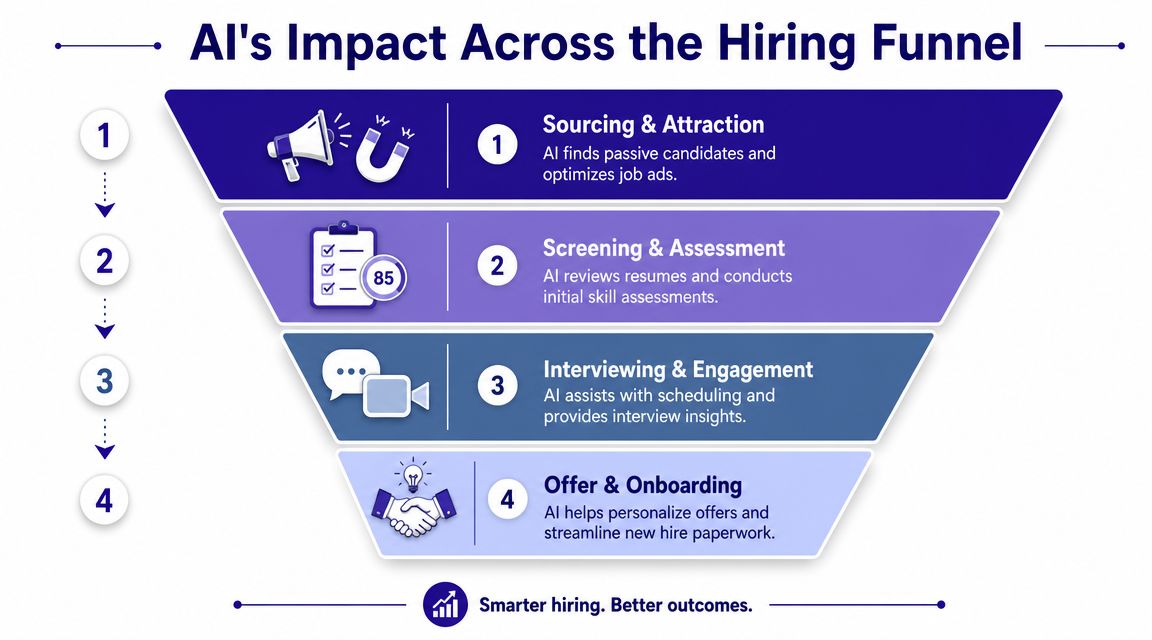
Sourcing and attraction
AI typically gains trust most quickly in this scenario.
For a difficult search, such as a cloud security engineer with both compliance exposure and hands-on automation experience, AI sourcing tools can widen the aperture beyond exact-title matching. They can identify candidates from adjacent environments, surface talent hidden in old CRM records, and generate targeted outreach drafts based on the role’s core requirements.
Teams evaluating category options can explore AI recruiting tools to compare how different products handle sourcing, search, and recruiter workflow support. The key is to test whether the system understands transferable skills, not just title similarity.
A second win sits in job ad creation. AI can help recruiters tighten language, tailor copy for a specific audience, and create variants for different channels. For teams refining this part of the funnel, Nexus IT Group’s guidance on using AI for job ads to boost recruitment efficiency is a practical reference.
Screening and assessment
Screening is where many teams over-automate too quickly.
AI can parse résumés, normalize skills, flag likely matches, and help recruiters prioritize who to review first. That’s valuable when applications spike or when internal talent teams are covering multiple niche openings at once. For technical roles, some platforms also summarize portfolios, open-source contributions, certifications, and project patterns that would otherwise take much longer to review manually.
What doesn’t work is treating an AI score as a hiring verdict. In specialized tech hiring, strong candidates often look unconventional on paper. They may come from a less familiar industry, a nontraditional educational background, or a hybrid role that doesn’t align neatly with the requisition template. Good teams use AI ranking as triage, then calibrate with a human reviewer who understands the actual work.
Interviewing and candidate engagement
Once a candidate enters the interview loop, speed and consistency matter.
AI can schedule interviews, answer recurring process questions, transcribe interviews, and consolidate interviewer feedback into one place. Those tasks sound mundane, but they’re often the source of costly delay. A strong candidate will tolerate a rigorous interview process. They won’t tolerate a disorganized one.
A practical model looks like this:
- Before the interview: AI handles scheduling, reminders, and common logistics.
- During the interview: Note-taking or transcription support reduces admin burden on the panel.
- After the interview: Feedback summaries help recruiters spot disagreement, missing evidence, or incomplete scorecards.
Good AI support should make the interview process feel more human to the candidate, not less.
Offer and onboarding support
The bottom of the funnel gets less attention, but AI still has a role.
It can support offer-letter workflows, document collection, timeline reminders, and personalized onboarding communications. For specialized tech talent, that matters because offer acceptance often depends on momentum and clarity. Candidates want to know what happens next, who they’ll work with, and how fast the company moves once a decision is made.
This is also one place where a recruiting partner can complement internal tools. Nexus IT Group, for example, supports hard-to-fill technology hiring across areas such as AI engineering, cybersecurity, cloud, data science, DevOps, software development, and IT leadership. In that model, AI can assist with sourcing and process efficiency while recruiters handle market calibration, candidate coaching, and final-fit evaluation.
Measuring the Real Impact A KPI Framework
AI only deserves budget if it changes hiring outcomes that technical leaders care about. Time saved is useful, but it’s not enough. CodePath cites that 67% of hiring professionals say AI saves time during the hiring process, while 96% of HR professionals believe AI will significantly affect talent acquisition in its guide to AI in recruiting. Time savings matter. But for a CTO, the sharper question is whether those savings translate into better hiring decisions, faster delivery, and fewer failed searches.
This framework helps keep the evaluation honest.
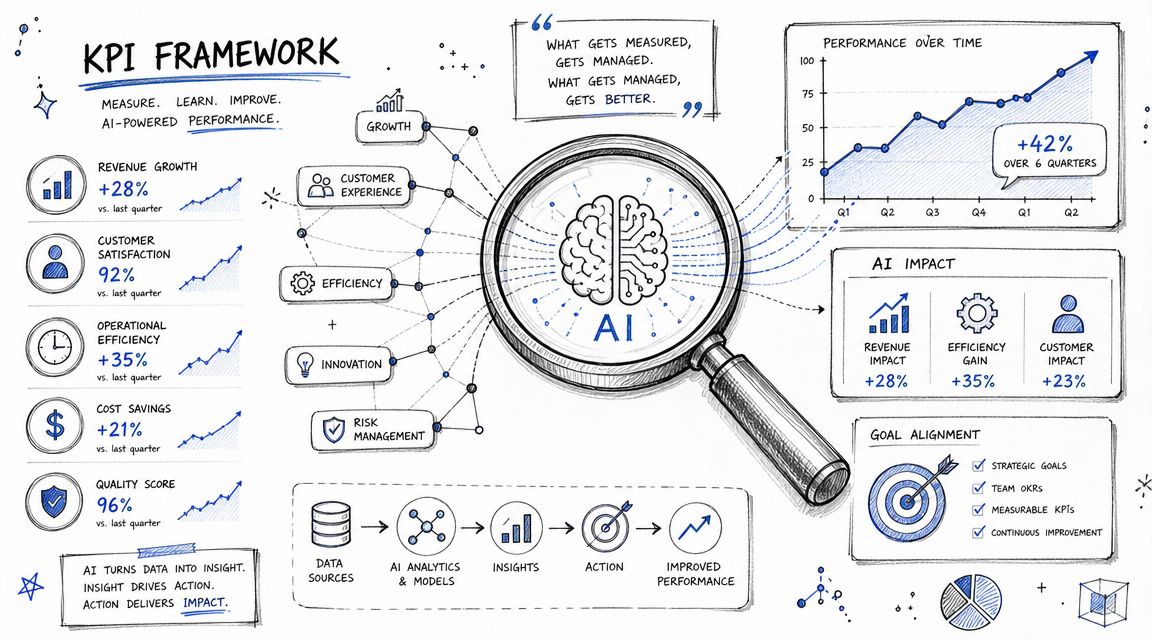
The metrics that matter to technical leadership
A practical KPI set for AI for talent acquisition should include both speed and quality.
| KPI | Why it matters in tech hiring | What AI should influence |
|---|---|---|
| Time to fill for critical roles | Long vacancies slow roadmaps and burn out existing teams | Faster sourcing, quicker screening, less scheduling friction |
| Quality of hire | A fast hire that misses the bar creates rework and team drag | Better shortlist precision and stronger evidence in evaluation |
| Offer acceptance rate | Candidate experience and role alignment show up here | Better communication, cleaner process, stronger fit assessment |
| Pipeline quality | More applicants doesn’t mean more qualified talent | Higher relevance in sourced and screened candidate pools |
| Hiring manager response time | Tooling fails if managers create bottlenecks | Clearer prioritization and better workflow visibility |
For teams trying to tighten the full process, Nexus IT Group’s article on how to improve the hiring process is useful because it frames recruiting performance as an operating system problem, not just a sourcing problem.
How to prove value without gaming the numbers
The mistake many organizations make is measuring only early-funnel throughput. If the AI tool helps the team review more résumés per day, the dashboard looks healthy. But that doesn’t tell a CTO whether the engineering team is meeting stronger candidates or making better hires.
A more grounded review asks questions like these:
- Did shortlist quality improve: Are hiring managers seeing fewer obvious mismatches?
- Did bottlenecks shrink: Is the team losing fewer candidates to delay?
- Did evidence quality improve: Are scorecards and interview notes more consistent?
- Did candidate experience improve: Are communications clearer and faster?
Operating principle: Measure AI as part of the hiring system, not as a standalone widget.
That means comparing outcomes across a real hiring workflow. If sourcing improved but offer acceptance declined, the system didn’t improve overall. If scheduling got faster but final-stage decisions remained inconsistent, the highest-risk problem is still unresolved.
Your AI Implementation Roadmap for Tech Hiring
Most AI recruiting rollouts fail for boring reasons. The data is messy. The ATS isn’t configured well. Recruiters don’t trust the recommendations. Hiring managers ignore the workflow. Security and legal get involved late. None of those problems are solved by buying a more advanced product.
A workable rollout needs operating discipline from the start.
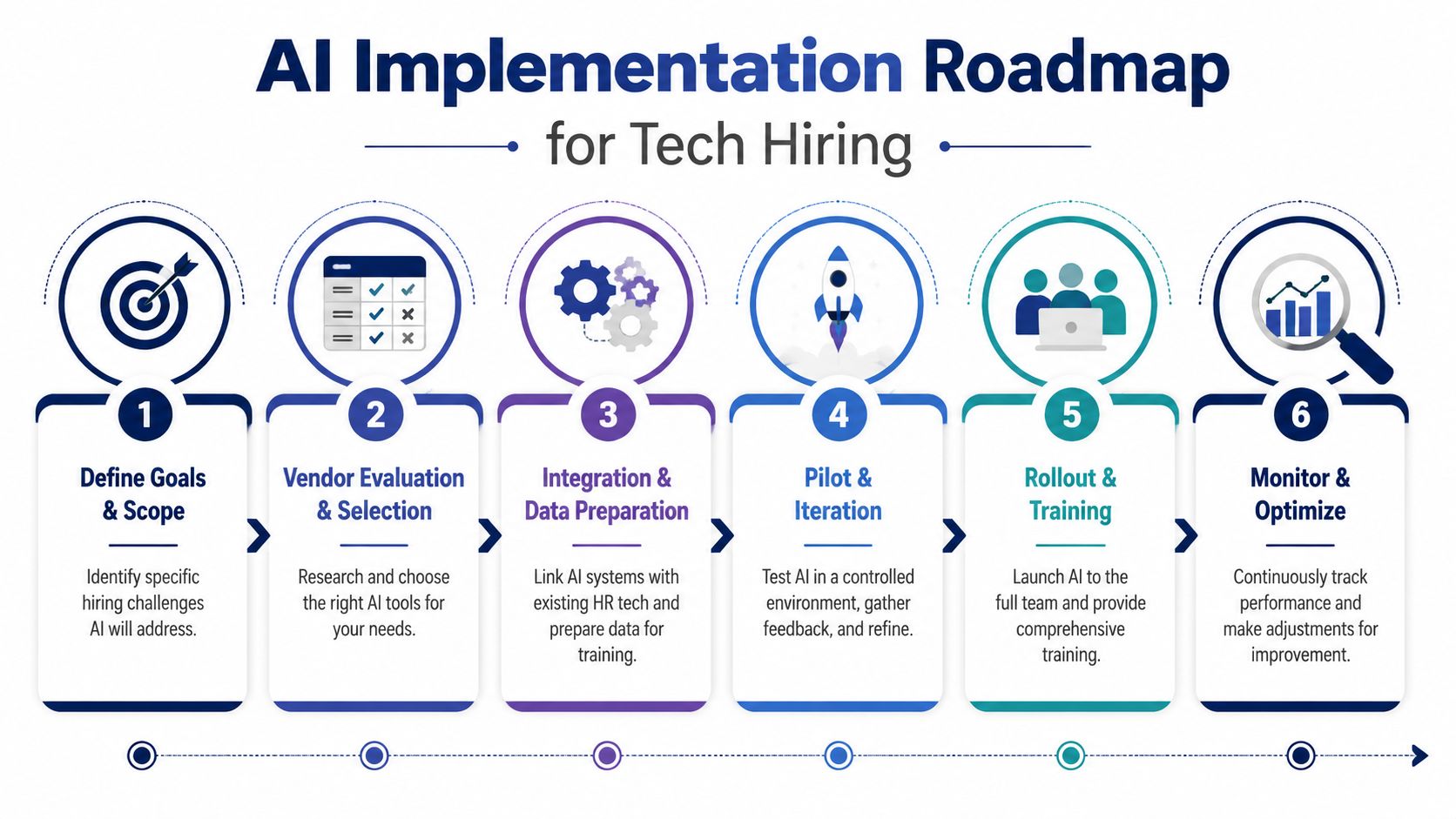
Phase one goals data and scope
Start with one painful, visible problem. For many tech employers, that’s a recurring shortage in cloud, data, security, or software engineering hiring. Define the hiring friction in plain terms. Too many unqualified applicants. Slow scheduling. Weak rediscovery of prior candidates. Inconsistent scorecards. Pick one or two.
Then clean the inputs that matter for that problem:
- Job architecture: Standardize titles, levels, and core skill expectations.
- Candidate records: Remove duplicate profiles and inconsistent stage data.
- Outcome definitions: Decide what “good shortlist” and “successful hire” mean.
Without that prep work, the AI layer will make fast guesses from bad information.
Phase two vendor fit and integration
Teams often chase feature lists instead of operating fit.
The right vendor for specialized hiring should integrate with the current ATS and CRM, support recruiter workflows instead of forcing workarounds, and make it easy to review how recommendations are generated. It also needs to fit the organization’s governance requirements, especially if candidate data crosses regions or if hiring activity touches regulated environments.
A useful evaluation lens includes product questions and process questions. Can the tool handle skill adjacency, not just title matching. Can recruiters override recommendations easily. Can the hiring team inspect and correct output. Does the vendor support auditability and permission controls.
Phase three pilot before scale
Run the first deployment as a pilot, not as a platform migration.
Choose a contained use case with enough volume to produce learning. Screening for software engineers in one business unit. Scheduling support across a single recruiting pod. Candidate rediscovery for data and analytics roles. Keep the scope narrow enough that recruiters can compare old and new workflows without confusion.
Good pilots include a control mindset:
- Document the current workflow before implementation.
- Train the recruiters and coordinators on how to use the tool and when not to rely on it.
- Review outputs weekly with one hiring leader and one recruiting leader.
- Adjust the workflow before expanding usage.
Phase four change management and operating discipline
This is the step most vendors underplay. It’s also the difference between adoption and shelfware.
Recruiters need clear rules for when AI is advisory and when human review is mandatory. Hiring managers need to know what changed in the process and what hasn’t. Interviewers need better scorecard discipline, because AI summaries are only useful if the underlying feedback is specific.
Three habits help:
- Train for judgment, not just buttons: Teams should know how to challenge recommendations, not just accept them.
- Create escalation paths: If the AI ranks a candidate unexpectedly high or low, someone should own the review.
- Review candidate experience regularly: Fast automation that feels opaque will hurt trust.
The strongest rollouts treat AI as a process redesign effort with software attached, not as a software purchase that magically redesigns the process.
Navigating Risks and Selecting the Right AI Partner
The biggest mistake in AI recruiting is assuming speed justifies opacity. It doesn’t. In specialized hiring, opaque processes create risk fast. Candidates ask harder questions, hiring managers care about edge cases, and weak governance can damage both employer brand and defensibility.
SHRM’s coverage of UNLEASH highlights a growing trust gap and argues that employers must explain how AI is used and set clear boundaries for candidate-generated AI content, because transparency is becoming critical as candidates scrutinize fairness and acceptable AI use in the application process in this SHRM resource on the evolving role of AI in recruitment and retention. For CTOs, that issue isn’t abstract. It affects candidate response, legal exposure, and executive confidence in the hiring process.
Where AI hiring programs fail
Weak programs usually break in four places.
- Bias enters through historical data: If the training or matching logic reflects prior hiring patterns too closely, the system can narrow instead of widen the field.
- Privacy controls are vague: Candidate data gets processed through tools that the organization hasn’t fully vetted.
- Recruiters over-trust the output: Rankings become shortcuts instead of prompts for review.
- Candidates don’t understand the process: Opaque automation feels unfair, especially in high-stakes technical hiring.
For technology leaders who need a broader governance lens, this CIO’s guide to AI era compliance is a useful companion read because it frames compliance and risk management as operating design issues, not paperwork.
Organizations hiring data and AI talent should also think carefully about domain expertise in the recruiting process itself. A partner with technical specialization, such as one focused on data science recruiting firms, is more likely to understand where automation helps and where human calibration is essential.
AI Vendor Evaluation Checklist
| Evaluation Criteria | What to Ask / Look For |
|---|---|
| Transparency | How does the system generate recommendations, rankings, or summaries? Can recruiters inspect the reasoning well enough to challenge it? |
| Human oversight | Which decisions require mandatory human review? Can recruiters override output easily and document why? |
| Data governance | Where is candidate data processed, stored, and retained? What controls exist for permissions, deletion, and audit trails? |
| Bias monitoring | How does the vendor test for fairness issues, and how are customers expected to review outcomes over time? |
| Integration quality | Does the platform connect cleanly to the existing ATS, CRM, calendar, and interview workflow? |
| Workflow fit | Does the product support the team’s current operating model, or will recruiters need to work outside the system to get the job done? |
| Candidate experience | Can the organization explain to candidates where AI is used and what role humans still play? |
| Security review readiness | Can the vendor support internal security, privacy, and procurement review without vague answers or missing documentation? |
Trust in AI recruiting is built less by clever automation than by clear boundaries.
The Nexus IT Group Advantage Augmented Intelligence
Ultimately, handling the risks and getting consistent value from AI in specialized tech hiring comes down to one operating model: augmented intelligence. Software can expand searches, cluster profiles, summarize résumés, and reduce manual coordination. Recruiters still need to set the criteria, test the output, challenge weak matches, and make judgment calls where the stakes are high.
That distinction shows up fast on difficult technical searches.
A lead SRE role may look clear on paper and still be hard to fill well. Keyword matching can produce plenty of profiles. The harder work is separating candidates who supported production from candidates who owned reliability strategy, incident response, capacity planning, and cross-functional decisions under pressure. AI can help cast a wider net and organize the market. It cannot independently judge whether a candidate has the technical depth, business judgment, and communication range to succeed in a high-impact environment.
The firms that perform well with AI are usually the ones that treat it as part of a governed hiring system, not a shortcut. They define where automation is allowed, where human review is required, how recruiter overrides are documented, and how hiring managers are trained to interpret AI-assisted output. That matters even more for Nexus IT Group’s clients, where one weak hire in infrastructure, security, data, or engineering leadership can create delivery risk, team friction, and expensive backfill cycles.
Nexus IT Group applies that model in a recruiting process built for hard-to-fill technology roles. The advantage is not tool access alone. It is the combination of market calibration, recruiter judgment, process discipline, and clear operating boundaries around how AI is used, reviewed, and improved over time.
If the hiring team needs help building a practical AI-enabled recruiting process for hard-to-fill technical roles, nexus IT group can support the effort with specialized IT recruiting, market calibration, and hands-on search execution that keeps human judgment at the center.