
Nearly 40% of executive searches fail to place a candidate, often because the company sets compensation below the market, drags out interviews, or ignores market feedback on the role itself, as outlined by Cowen Partners on why first-time retained executive searches fail. That number changes the conversation. A CTO search isn’t a hiring task to squeeze into an already busy quarter. It’s a strategic decision that affects product velocity, platform stability, engineering credibility, security posture, and board confidence.
Most failed CTO searches don’t collapse because there were no talented candidates. They collapse because the company never got aligned on what it was buying, how fast it needed to move, and what trade-offs it was willing to make. A vague mandate produces a vague shortlist. A slow process pushes out the strongest operators. A mispriced offer invites endless resets.
A strong CTO executive search works when the company treats the search like a board-level operating decision. That means defining the business problem before writing the spec, building a real pipeline instead of waiting for inbound interest, assessing leadership with evidence instead of charisma, and keeping the process tight enough to close the right person.
Table of Contents
- Why Most CTO Searches Are Set Up to Fail
- Laying the Foundation Your Ideal CTO Profile
- Building Your Pipeline Modern Sourcing Strategies
- The Assessment Framework How to Identify True Leadership
- Partnering for Success Engaging a CTO Executive Search Firm
- Avoiding Common Pitfalls to Secure Your Top Candidate
Why Most CTO Searches Are Set Up to Fail
The most common mistake in CTO executive search is assuming the market will adapt to the company’s internal confusion. It won’t. Senior technology leaders are evaluating the company as hard as the company is evaluating them.
A board may want transformation. The CEO may want a product partner. The engineering team may want a technical mentor. Finance may want cost control. If those priorities aren’t reconciled before the search starts, candidates receive mixed signals in every interview. Strong operators notice that immediately.
Another failure pattern is treating the role description as strategy. It isn’t. A job description usually lists responsibilities. A serious CTO mandate defines what must change. For one company, that means rebuilding engineering management. For another, it means modernizing data architecture. For another, it means earning trust with enterprise customers who need a credible technical counterpart in diligence calls and renewal cycles.
Practical rule: If three internal stakeholders would describe success in three different ways, the search isn’t ready to launch.
Speed also matters more than many first-time clients expect. Senior candidates often engage in several confidential conversations at once. If a company takes too long to schedule interviews, collect feedback, or decide what concerns matter, the strongest candidates usually disengage. They don’t always announce it. They stop prioritizing the process.
A practical way to pressure-test readiness is to answer four questions before any outreach begins:
- What problem must this CTO solve first: team scale, product direction, architecture, reliability, AI strategy, investor confidence, or all of the above.
- Who has veto power: not who has opinions, but who can stop the hire.
- Where is the compensation likely to break down: cash, equity, title scope, or reporting structure.
- What trade-off is acceptable: elite technical depth with lighter people leadership, or a stronger executive leader with less hands-on architecture range.
| Search assumption | What usually happens |
|---|---|
| “We’ll know the right person when we meet them.” | Interviews become subjective and inconsistent. |
| “We can fix the role after we see candidates.” | Strong candidates lose confidence in the mandate. |
| “If someone is interested, they’ll wait.” | Top talent reallocates attention elsewhere. |
A failed CTO search rarely looks dramatic at first. It usually looks like drift.
Laying the Foundation Your Ideal CTO Profile
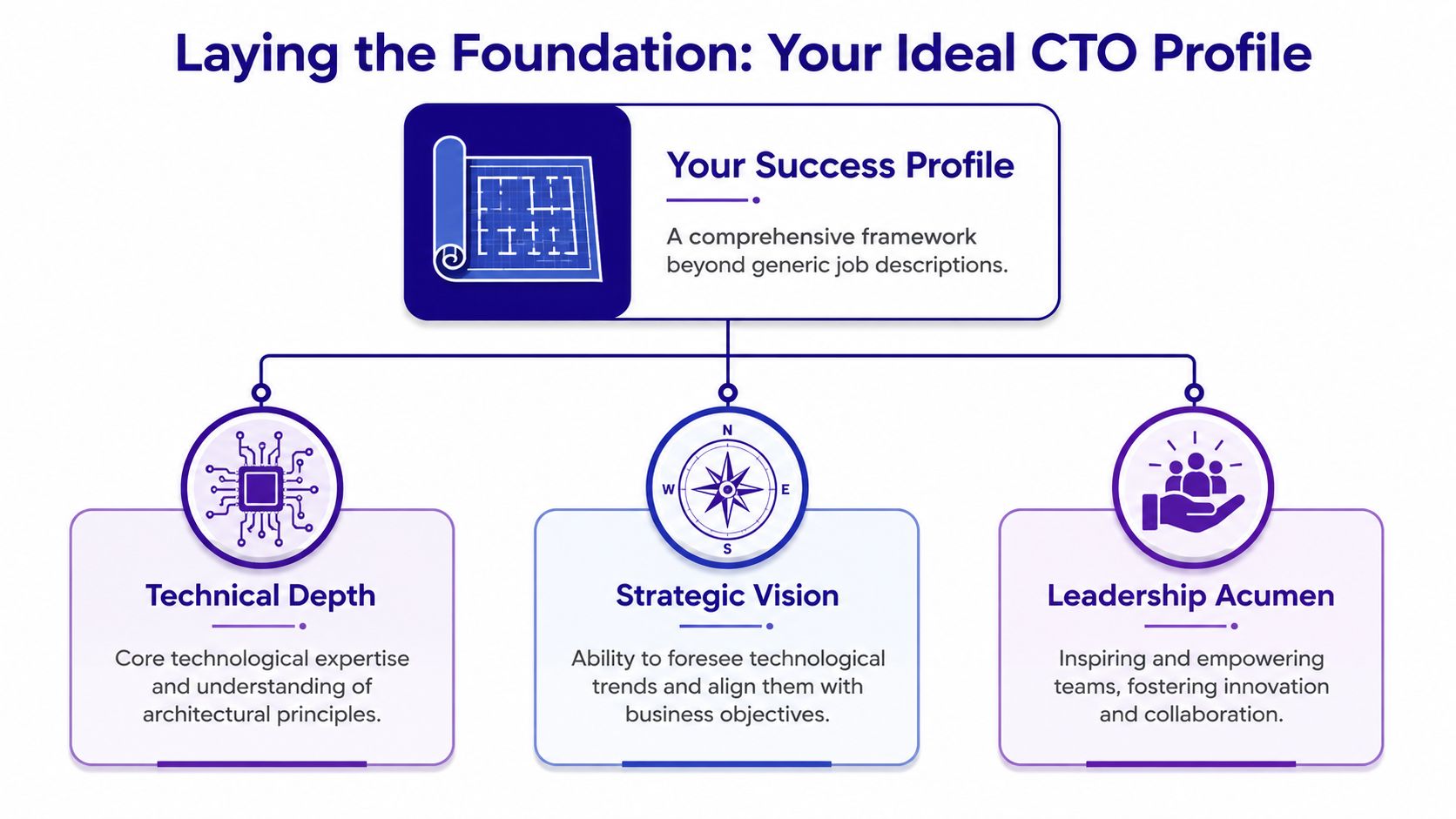
The companies that hire well don’t start with a laundry list of tools. They start with a success profile. That profile defines what the CTO must accomplish, what context they’re entering, and what kind of authority they’ll have.
Start with outcomes, not credentials
A role built around outcomes is easier to search, easier to assess, and easier to sell. Instead of asking for “a proven CTO with startup and enterprise experience,” define the first mission.
Examples of outcome-led mandates include:
- Transformational operator: inherited an engineering organization that needs structure, delivery discipline, and clearer accountability.
- Product-centric builder: partners closely with product and go-to-market leaders, shaping platform choices around customer value and roadmap speed.
- Infrastructure and scale leader: stabilizes architecture, improves reliability, and prepares the company for higher transaction volume, stricter compliance, or broader regional expansion.
Those aren’t titles. They’re operating archetypes. One candidate may be excellent in one archetype and risky in another.
Build a success profile with three dimensions
A useful CTO profile has three parts. Technical depth matters, but it can’t carry the search by itself.
-
Technical depth
This is the floor, not the ceiling. The board and CEO need confidence that the CTO can evaluate architecture decisions, challenge engineering assumptions, and make informed trade-offs in cloud, security, data, and platform design. -
Strategic vision
The CTO has to connect technology decisions to business priorities. That includes product timing, cost structure, customer trust, diligence readiness, and competitive positioning. -
Leadership acumen
A technically brilliant candidate who can’t build followership often becomes an expensive bottleneck. The role usually requires recruiting senior managers, shaping culture, handling conflict, and leading through ambiguity.
One capability now belongs inside the profile by default. In 2026, AI fluency is essential for CTO roles, with 20% of hiring decisions prioritizing a candidate’s track record and tech focus in AI, machine learning, and data science, according to this LinkedIn analysis of CTO executive search trends. That doesn’t mean every company needs an AI-first CTO. It means candidates should be able to evaluate where AI belongs in the stack, in the roadmap, and in the operating model.
A weak brief asks for experience. A strong brief defines decisions, constraints, and expected impact.
A simple alignment exercise works well before the search opens:
- CEO input: what business change must happen because this person joined.
- Board input: what risks must this hire reduce.
- Product input: where technical leadership should accelerate roadmap execution.
- Engineering input: what leadership gaps the current team feels every week.
When those answers are synthesized into one profile, sourcing becomes sharper and interviews become more consistent. Companies that need help turning that profile into a real mandate often start with a specialized Chief Technology Officer search approach so the brief reflects the market they’re hiring in, not the one they wish existed.
Building Your Pipeline Modern Sourcing Strategies
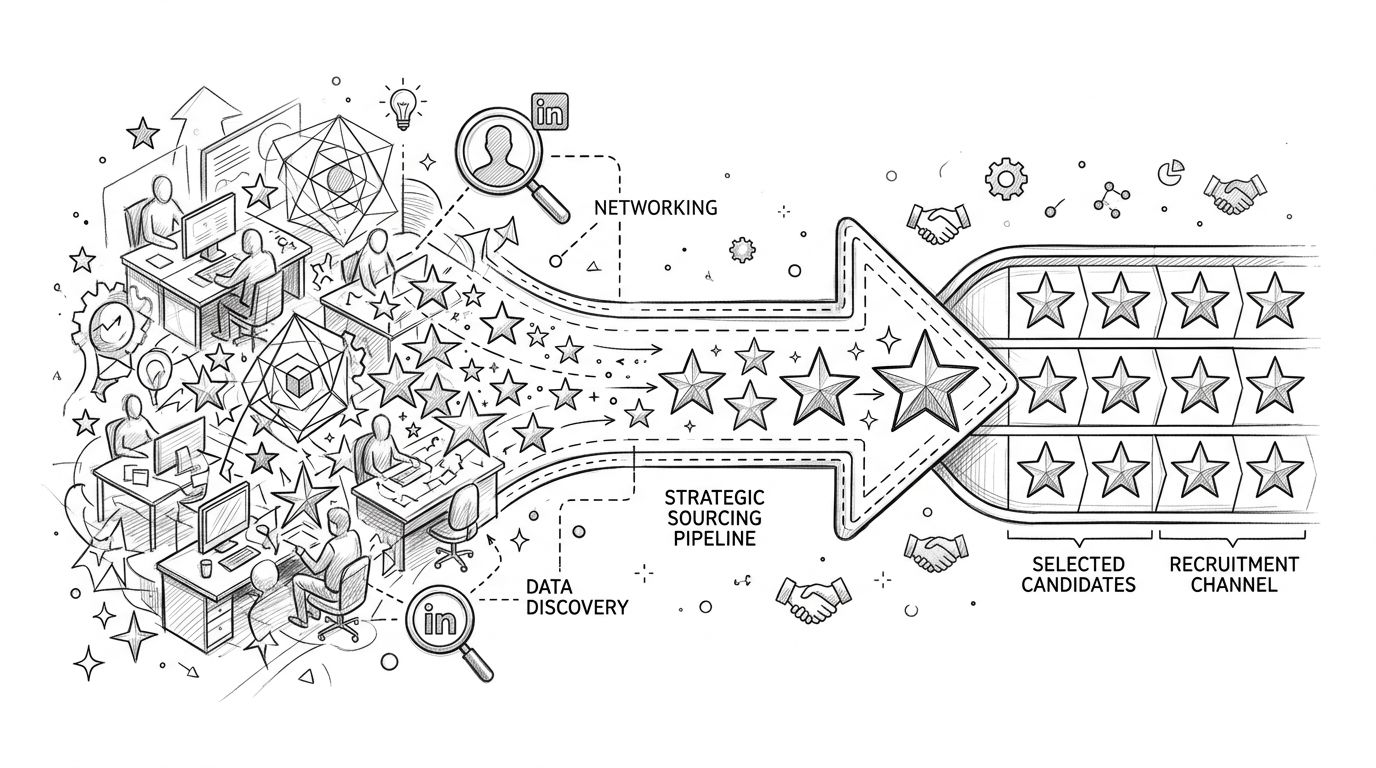
Nearly 70% of professionals are passive candidates, according to LinkedIn’s Global Talent Trends research. CTO searches live inside that reality. The best candidates are already in seat, carrying a board relationship, and solving hard operating problems. A process built around inbound applicants and broad outreach usually misses them.
Why passive outreach alone underperforms
Cold outreach still matters. It just works best as one part of a coordinated search, not the entire sourcing plan.
Senior technology executives respond to relevance and timing. They want to know why this role exists, what business problem they would own, how the CEO thinks about technology, and whether the board wants transformation, stability, or both. Generic messages fail because they ask for attention before they establish context.
The bigger mistake is treating sourcing as a volume problem. It is a signal-quality problem. A thin process produces the wrong shortlist in two ways. It either overweights title match and misses genuine leadership fit, or it overreacts to early candidate interest and assumes the market is stronger than it is.
Strong pipelines are built before the first outreach message goes out. Weak ones are assembled after the first few candidates decline.
Build the market map before you start conversations
A credible CTO pipeline usually comes from three channels working together at the same time.
- Internal rediscovery: revisit prior VP Engineering, CIO, platform, and startup CTO processes. Earlier finalists often failed on timing, compensation, relocation, or company stage, not on capability.
- Target-company mapping: include direct competitors, adjacent sectors, and companies one step ahead in scale or systems complexity.
- Relationship-led introductions: use investors, board members, former founders, and search networks to open conversations that would be ignored through cold outreach.
This mix reduces a common search failure. Teams often define the role one way, then source from a market that reflects a different mandate. For example, a company may say it wants a hands-on scale-up CTO but build its list from public-company infrastructure leaders. The search looks active, but the pipeline is misaligned from week one.
A practical pipeline design looks like this:
| Channel | What it’s good for | Common mistake |
|---|---|---|
| CRM and ATS rediscovery | Warm candidates with known history and prior calibration | Assuming older records no longer matter |
| Market mapping | Finding leaders shaped by the right business and technical conditions | Filtering too hard on title and too little on context |
| Network introductions | Starting confidential conversations with passive executives | Waiting until the search has already stalled |
Message the mandate, not the perks
CTO candidates do not move for slogans. They move for scope, clarity, and conviction.
The outreach message should answer five questions quickly. Why does the role exist now. What change is expected in the first 12 to 24 months. Where are the technical and organizational constraints. How does the CEO work with the technology leader. What would make this opportunity worth the risk of leaving a current post.
That is also where founder quality matters. Candidates assess the company as hard as the company assesses them. Early-stage and growth-stage businesses should be especially clear about leadership maturity, because seasoned CTOs can spot unclear decision rights fast. The perspective in Founder Connects on visionary leadership is useful here. Executive candidates are drawn to founders who can articulate direction without creating confusion around accountability.
For teams tightening this part of the search, a practical sourcing strategy for recruitment can help connect internal records, target lists, and outreach sequencing into one process.
Run sourcing in calibrated waves. Review the first market response after enough conversations to spot patterns, then adjust the brief, compensation range, or target pool if the evidence supports it. That discipline de-risks the search early, before the team commits to a shortlist built on incomplete market feedback.
The Assessment Framework How to Identify True Leadership
Search failure usually shows up late, but the cause is often obvious much earlier. The interview process never tested how a CTO candidate makes decisions under pressure, with imperfect information, and across competing stakeholder demands.
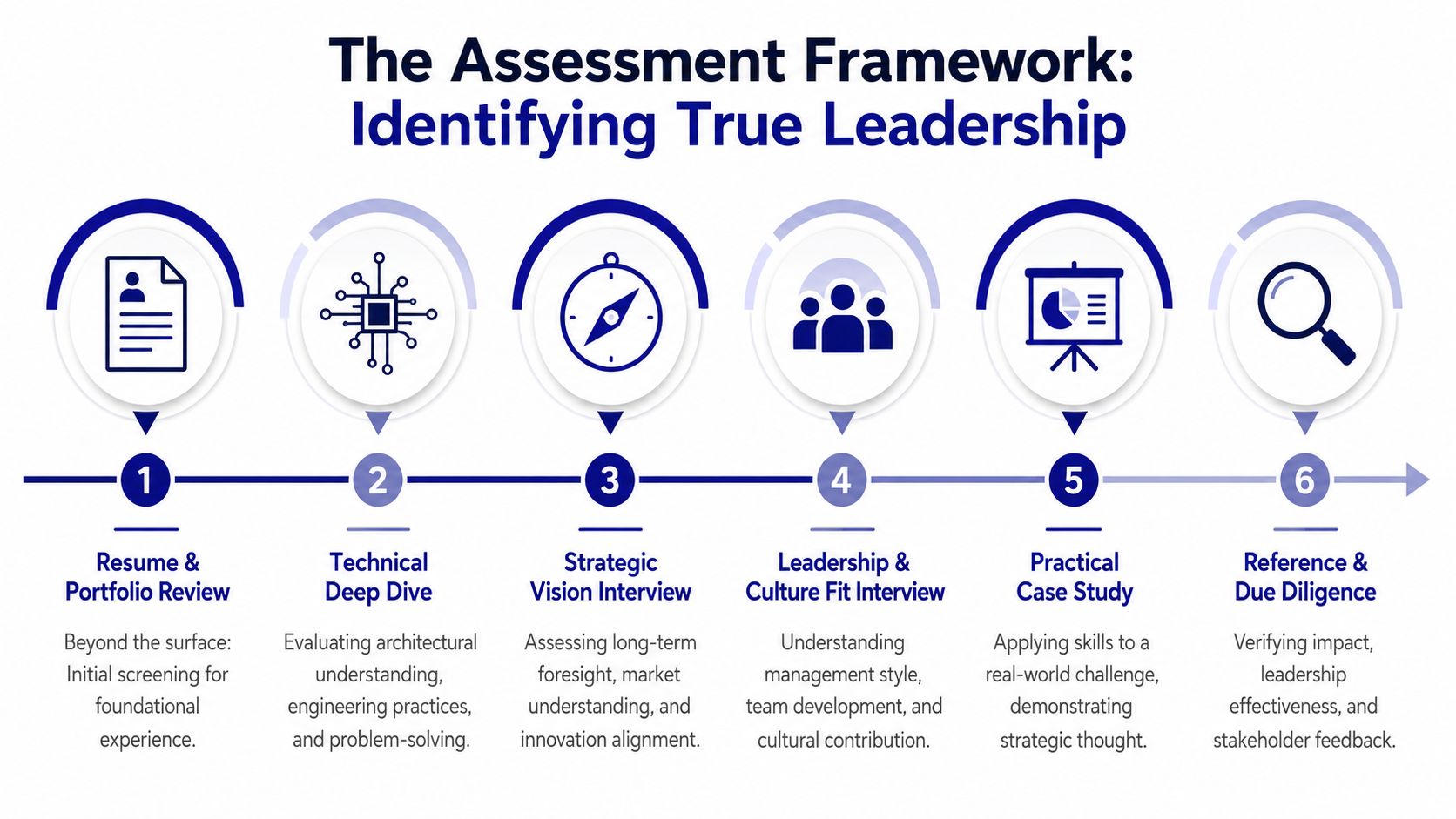
A polished résumé can get someone into contention. It cannot justify the hire. Assessment's primary function is to reduce risk before the company hands over architecture influence, team design, board exposure, and often a large piece of execution accountability to one person.
That starts with process discipline. Teams that run a loose sequence usually overweight charisma, pedigree, or one impressive company name. A stronger approach uses the same evaluation criteria from first screen through final references, with each stage answering a different question. Firms that study executive IT search firm practices generally separate market access from assessment discipline for a reason. Access gets candidates into the funnel. A repeatable framework helps the company choose well.
A practical interview design often includes three stages:
-
Initial screen for pattern recognition
Focus on career arc, reporting scope, scale of decisions, and the business context behind major wins. The goal is to learn whether the candidate has operated in environments that resemble the role. -
Technical examination with internal leaders
Senior engineers or architecture leaders should test judgment, not individual contributor trivia. Good questions surface how the candidate handles technical debt, reliability, security, platform change, build versus buy decisions, and sequencing under resource limits. -
Business and stakeholder interview
The CEO, board members, or investors should assess whether the candidate can connect technology decisions to revenue, margin, customer trust, speed of execution, and organizational design.
The sequence matters because each stage should narrow uncertainty, not repeat the last conversation in different language.
Leadership interviews fail when they stay abstract. “How would you describe your management style?” rarely produces useful evidence. Scenario-based interviews do. Put the candidate inside the company's actual points of tension and ask for a decision path, not a philosophy statement.
Useful scenarios include:
- Team tension: engineering is shipping, but product and engineering no longer trust each other.
- Board pressure: investors want AI on the roadmap, but the underlying data and platform are not ready.
- Customer pressure: enterprise prospects need confidence in security, uptime, and technical credibility before they will sign larger contracts.
Ask what the candidate would do in the first 30, 90, and 180 days. Ask who they would trust first, what they would postpone, which risks they would surface to the board, and what they would keep internal until the facts are clearer. Strong candidates build a decision framework in real time. Weaker candidates stay at the level of general principles.
For founder-led companies, one more factor matters. The CTO has to read the founder correctly and know when to challenge, translate, or align. Founder Connects on visionary leadership is a useful reference point here because it highlights a trait strong executive candidates look for quickly. Clear direction paired with clear accountability.
A strong CTO candidate does not just describe what they built. They explain why they made a trade-off, what it cost, and how they brought others with them.
Keep the scorecard tight. Many companies blend three separate judgments into one vague impression, then wonder why the final decision feels subjective.
- Can this person understand the system
- Can this person lead the people
- Can this person earn trust with the board, peers, and customers
A yes in one category does not imply a yes in the others.
Reference checks should confirm patterns already visible in the process. They should not introduce major surprises. If a final reference reveals serious issues around followership, conflict, or execution under pressure, the interview design probably missed something important.
The best reference calls focus on specifics:
- How this leader handled disagreement
- Whether they built followership or dependency
- How they behaved during delivery pressure
- Whether they improved the leaders beneath them
A concise scorecard keeps the discussion grounded:
| Dimension | What to look for |
|---|---|
| Technical judgment | Clear reasoning tied to business and architecture trade-offs |
| Strategic range | Understands how technical choices affect growth, risk, and execution |
| Leadership credibility | Builds teams, develops lieutenants, handles conflict directly |
| Change capacity | Can reset process, architecture, or org design without creating confusion |
The companies that get this right do not treat assessment as a set of interviews. They treat it as risk reduction. That is the difference between hiring a credible technologist and hiring a CTO who can lead through the company’s next stage.
Partnering for Success Engaging a CTO Executive Search Firm
A critical CTO hire often breaks down in the gaps between sourcing, assessment, process control, and candidate management. That’s where a specialist search partner adds value. Not by replacing internal judgment, but by sharpening it.
The market for that support is growing. The global executive search market is projected to reach $94.7 billion by 2030, and top firms are delivering CTO placements 60% faster than the U.S. average by using pre-vetted tech leader networks, according to Alpha Apex Group’s analysis of CTO executive search firms. For companies facing a narrow candidate market, speed comes from preparation and access, not from rushing.
What a retained partner changes
Contingency recruiting can work for some roles. It usually struggles at the CTO level when confidentiality matters, the stakeholder group is large, and the mandate needs shaping before outreach begins. Retained search is built for that complexity.
A capable retained partner helps in a few concrete ways:
- Mandate design: clarifies whether the company needs a builder, transformer, operator, or external-facing technical executive.
- Market calibration: pressures the brief against compensation realities, title expectations, and candidate availability.
- Confidential outreach: approaches passive leaders who won’t engage through public channels.
- Process management: keeps interview cadence, feedback flow, and candidate communication tight enough to maintain momentum.
- Offer navigation: handles concerns early, before they become stalled negotiations.
This is also the right point to ask whether the firm understands senior technology hiring or merely sells general executive recruiting under a tech label. A practical benchmark is whether they can discuss architecture leadership, product-stage fit, AI readiness, org design, and board dynamics without hiding behind generic search language.
For companies comparing providers, executive IT search firms offer one route to specialized support when the search requires a technology-specific network and confidential market outreach.
How to vet a search firm before signing
A good search brief deserves a good search partner. Before engagement, the hiring team should ask:
- How do you define the role before sourcing begins
- What does your candidate assessment process look like
- How do you handle passive outreach and confidentiality
- How do you surface market feedback if our brief is unrealistic
- What happens if stakeholder opinions diverge mid-search
The right search partner doesn’t just bring names. They bring discipline when the client is tempted to improvise.
The product isn’t a stack of resumes. It’s decision quality.
Avoiding Common Pitfalls to Secure Your Top Candidate
Most CTO searches don’t fall apart at the start. They break late, when the company has invested time, identified a preferred candidate, and then stumbles on execution.
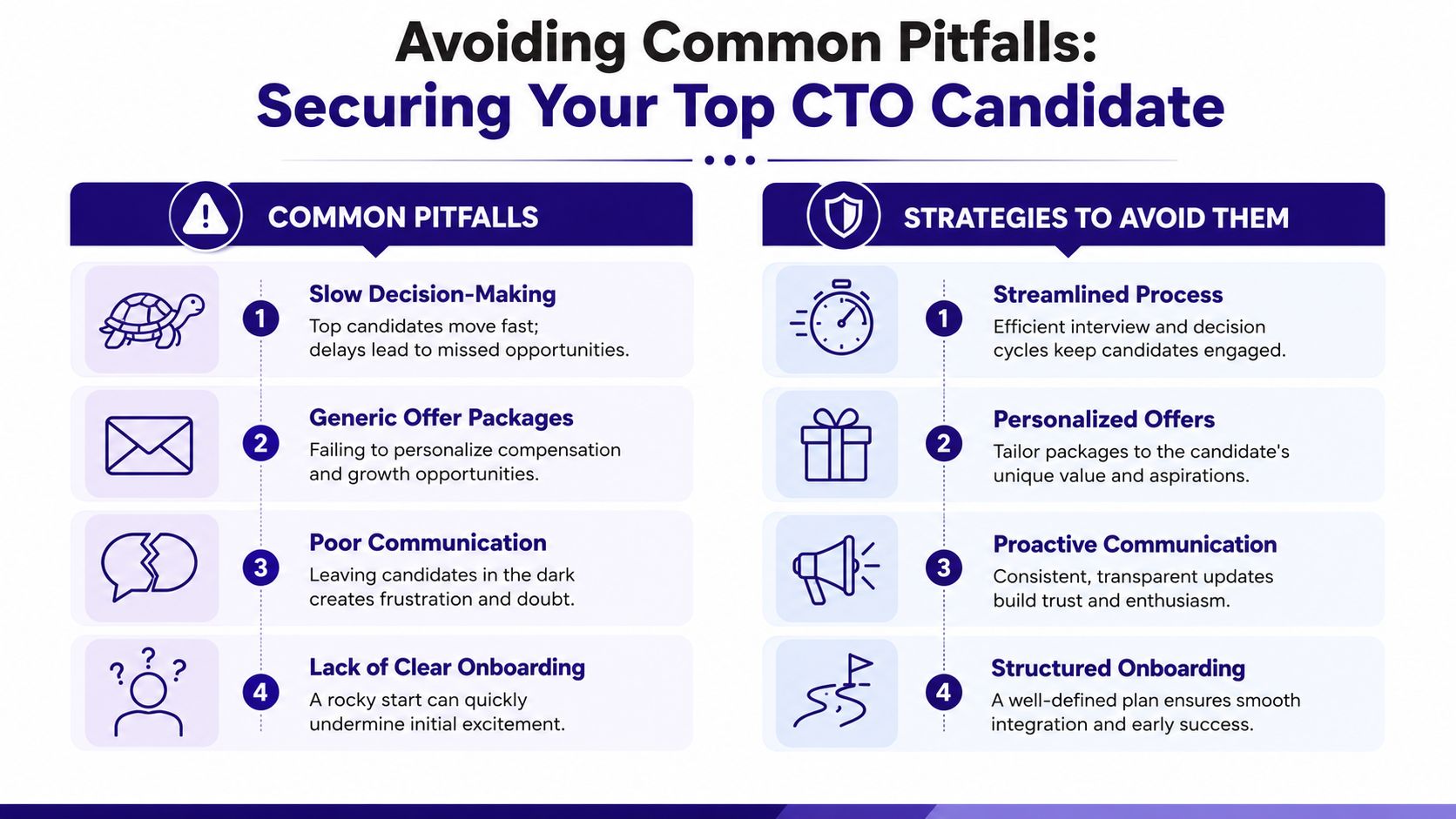
The first pressure point is compensation. As noted earlier, many executive searches fail because compensation is misaligned with the market. By the time a finalist is in play, it’s too late to discover that the board wants one profile while the budget supports another.
The second is process drag. A CTO candidate who has completed multiple rounds expects timely decisions and coherent feedback. Silence, rescheduling, or contradictory signals create doubt. Senior leaders interpret that behavior as a preview of how the company operates internally.
A final pre-flight checklist
Before extending an offer, the company should review four items:
- Compensation is internally approved: no last-minute debates over cash, equity, title, or reporting line.
- Decision rights are closed: everyone who matters has weighed in, and no hidden veto remains.
- Candidate concerns are surfaced: unanswered questions about team quality, board chemistry, or strategic scope rarely disappear after signature.
- Onboarding has substance: the candidate should know what the first stretch of the role looks like and how success will be judged.
One more pitfall deserves attention. Companies often sell the candidate on opportunity while hiding friction. That usually backfires. Strong CTOs don’t need a perfect story. They need an honest one. If the platform needs work, say so. If product and engineering are misaligned, say so. If the company needs someone to build a stronger leadership bench, say so. The right candidate will see challenge as part of the mandate.
A successful CTO executive search closes when expectations are explicit on both sides. That’s what keeps the hire from becoming another expensive reset.
When a company needs support on a confidential CTO hire, nexus IT group is one option for CTO and senior technology leadership search. The firm works across specialized IT hiring and executive search, which can help when the mandate requires technical market context, passive candidate outreach, and a tighter hiring process.