
Most enterprise teams are already living this problem. A recruiter needs to research a candidate, update the pipeline, schedule interviews, and draft a clean brief for the hiring manager. An engineering lead needs to inspect a repo, check logs, document what happened, and hand a clear result to someone else without losing half a day to tab juggling.
That’s where Grok Bot changes the conversation. It isn’t just a chatbot that writes text back. It’s a persistent digital coworker that can work inside apps, keep state across tasks, and return only when a human needs to approve the next move, which is a very different operating model for recruiting, IT, and software teams (xAI’s Grok Bot overview).
Practical rule: conversational output is advice. Delegated action changes systems, and that’s where the risk and the leverage both get much bigger.
The product is also arriving in a market that’s already scaling fast. One industry estimate put Grok at about 64 million active users in 2025, and later reporting tied to a SpaceX IPO filing said it reached ~117 million monthly active users by March 2026, up from 35 million in December 2025 and about 60 million in January 2026 (Business of Apps). That kind of growth matters because it shows the category isn’t theoretical anymore, it’s already part of how people ask questions, check facts, and move work forward.
Table of Contents
- Why Grok Bot Is More Than a Chatbot
- How Grok Bot Works
- Architecture, Capabilities, and Limits
- Grok Bot Compared With Other AI Assistants
- Enterprise Workflows That Create Value
- Security, Safety, and Operational Controls
- Implementation and Talent Strategy
- The Enterprise Decision Framework
Why Grok Bot Is More Than a Chatbot
A hiring team can ask for candidates, or it can ask for research, screening notes, interview prep, and a decision-ready summary. Those are not the same request. The first one gets a response. The second one sets up work across tools, and Grok Bot fits that model better than a normal chatbot.
The enterprise gap a chatbot can’t close
Technology leaders should care less about whether a model can produce a polished paragraph and more about whether the system can carry context across tools, survive interruptions, and keep moving through a multi-step process without forcing people to re-enter the same details. Grok Bot is built like a teammate with its own computer, so it can stay inside a workflow instead of disappearing after a single answer (Grok Bot overview).
That matters in recruiting, software delivery, and operations. A recruiter can use it to review a portfolio, pull from approved sources, draft a scorecard, and then stop until a human makes the call. An engineer can use it to inspect a repo, check a log trail, and assemble a clean incident note. In both cases, the value comes from execution continuity, not from clever text generation.
A chatbot helps a person think. A persistent agent helps a team finish.
The trade-off is permissions. Once a bot can sign into tools and act inside live systems, every approval path, access rule, and exception policy matters. If the prompt is sloppy, the result is not just a weak answer. It can be a bad action, a bad record, or an unnecessary exposure of sensitive data.
Enterprise teams should treat Grok Bot as a workflow decision, not a novelty. If the work needs a human to stay in the driver’s seat, use a chatbot. If the work needs delegated steps across systems, Grok Bot belongs in the discussion, but only with tighter controls and clear ownership. For recruiting teams that want a practical view of how AI changes hiring operations, Nexus IT Group’s recruiting technology perspective is a useful reference.
How Grok Bot Works
A recruiter opens a candidate file, a researcher keeps a web trail alive, and an operations lead returns to unfinished evidence gathering later in the day. Grok Bot matters in those moments because it does not behave like a single-response chatbot. It works like a persistent agent that keeps state, uses tools, and stays inside the workflow until the task is done.
The operating environment in plain English
The bot runs in its own persistent cloud environment, so the work remains available after the session ends. That persistence changes the operating model. Identity, session state, and access control stop being background details and become part of day-to-day management.
The browser is the main interface for interacting with sites and apps the same way a person would. That gives Grok Bot reach across existing systems, even where a clean API is missing. The trade-off is brittleness. If a page layout changes, a control moves, or a selector no longer matches, the workflow can fail even when the instruction was sound.
The filesystem and terminal add more utility, but they also widen the blast radius. Files can be stored, reused, and carried into later steps, while the terminal gives the bot a controlled way to run commands. That helps with repeatable work such as evidence packets, checklist documentation, and structured review artifacts. It also means sensitive material can spread across more surfaces than an IT team may want if permissions and retention rules are loose.
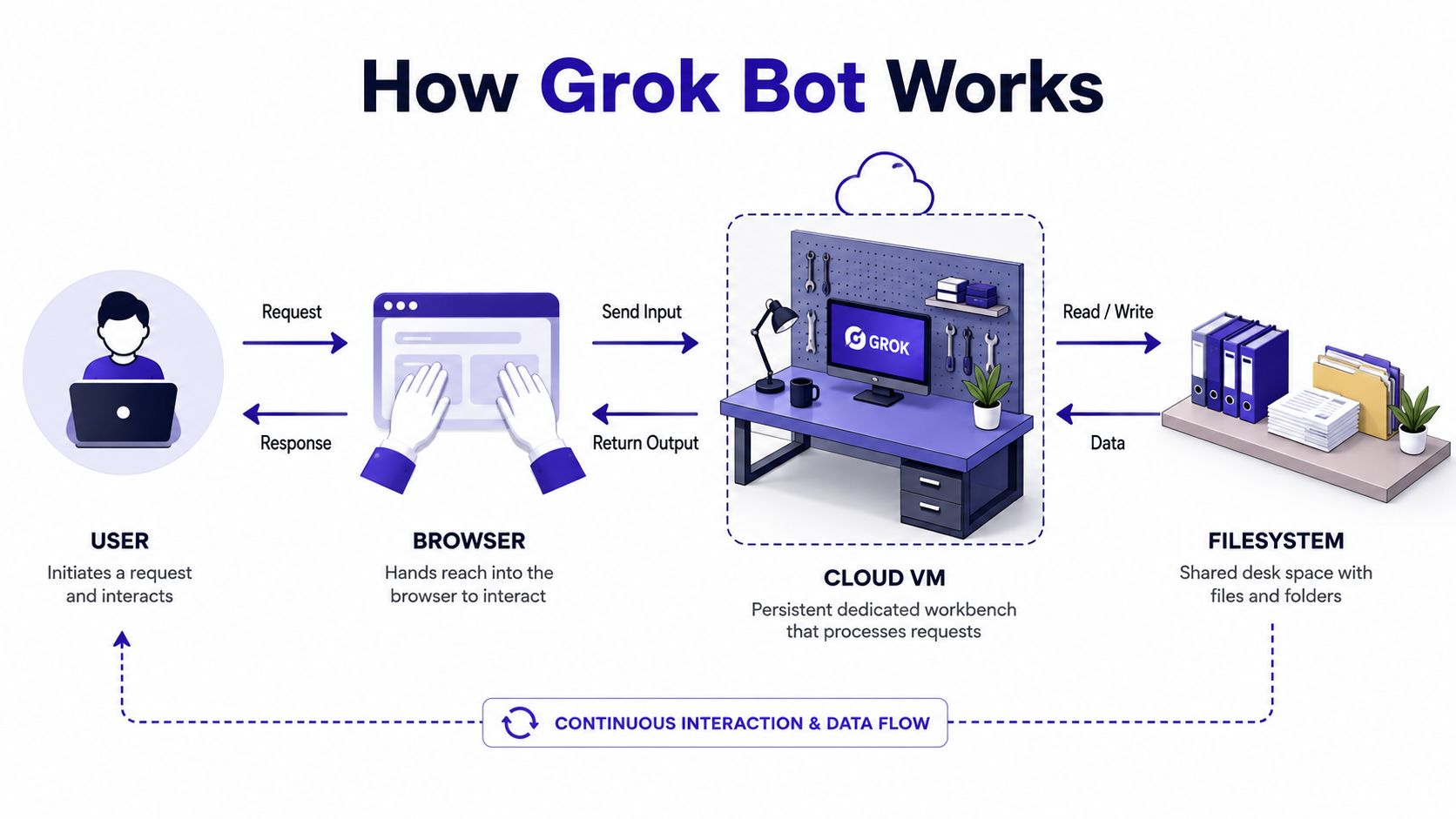
A simple workflow teams can picture
A recruiter can direct Grok Bot to review a public candidate portfolio, open approved source material, pull role-relevant evidence, and assemble a structured scorecard. The bot can then stop and wait for a human before the candidate moves forward. That is the right use case for persistent agents in talent operations, because the bot is not just drafting text. It is collecting evidence, preserving context, and holding the line until a reviewer decides.
The same pattern applies in software and operations. An engineer can have the bot inspect a repo, gather related log entries, and draft an incident summary for review. A governance lead can use it to collect policy evidence and prepare a traceable packet before approval. In each case, the advantage comes from keeping a task alive across steps, not from asking for a smarter answer once.
Persistence also changes failure modes. If the bot is interrupted, it can pick up where it left off. If the instructions are poor, it can repeat the mistake across a longer chain of work. That is why enterprise teams need clear ownership, narrow permissions, and human oversight built into the workflow from the start.
Architecture, Capabilities, and Limits
Grok Bot has more reach than a plain chat interface, but more reach does not mean better decisions. The current developer docs describe a large context window, with 500k tokens in the current model documentation and 1M tokens for Grok 4.3 on Amazon Bedrock, which matters for long codebases, interview packets, policy files, and research trails (xAI developer docs). It still will not guarantee correct recall, clean judgment, or disciplined execution.
A recruiting team can use that extra room to keep a candidate evaluation alive across sourcing notes, résumé review, screening feedback, and hiring manager comments. An operations team can keep an incident packet open while logs, screenshots, and follow-up tasks accumulate. That is the advantage, a persistent agent can carry context that a human team would otherwise keep reassembling by hand.
Why context size helps, and why it still fails
Large context works like desk space. It lets a team spread out more material at once, which is useful in long tasks that would otherwise force constant summarization and restatement. Grok’s earlier technical writeups also describe a 314B-parameter Mixture-of-Experts design with 2 of 8 experts active per token, a routing approach that activates selected specialists instead of running every parameter on every token (xAI developer docs). That is an efficiency choice, not a guarantee of quality.
The operating mistake is to treat context size as if it were judgment. It is not. Teams should separate capacity, reasoning effort, and tool access because each one fails in a different way. A larger context window supports a wider task scope, configurable reasoning effort changes how hard the model tries, and tool access determines what systems it can touch.
That separation matters in enterprise technology teams. Recruiting, interviewing, screening, software development, governance, and talent strategy all change together once an agent can keep work alive between steps. A persistent bot can gather evidence, wait for approval, and resume later. It can also carry a bad instruction chain farther than a normal chatbot would. That is why the operating model has to include clear ownership, narrow permissions, and human review from the start.
What to measure before calling it a win
A pilot should measure more than whether the output looked useful. Track the metrics that expose real operational value and real operational risk.
- Task success. Did the bot finish the intended work without manual rescue?
- Correction rate. How often did a human have to fix the output?
- Completion time. Did the workflow become faster, not just different?
- Security events. Were any unauthorized actions or credential problems observed?
- Escalation quality. When the bot stopped, did it stop for the right reasons?
Teams that want a practical production check can use the production‑ready chatbot guide as a reference for the plumbing that separates demos from systems people can trust. For engineering leaders, the category also overlaps with AI engineering, and the operating habits around that discipline matter as much as the model itself. A useful internal reference is Nexus IT Group’s AI engineering overview, especially for teams setting governance and delivery standards.
Grok Bot Compared With Other AI Assistants
The wrong question is whether Grok Bot is “better” than every other assistant. The right question is whether the work calls for conversation, delegated execution, or both. A conventional LLM chatbot is often the cleaner choice when the user wants to stay in control of every action. Grok Bot becomes more interesting when the job spans multiple systems and the team wants an agent to carry the steps between them.
Decision criteria that matter more than branding
A chatbot is a drafting and reasoning surface. Grok Bot is an operating surface. That difference shows up in persistence, access, and auditability. If the task is summarizing a policy, rewording an email, or outlining interview questions, a chat interface is usually enough. If the task is researching a candidate, opening tools, assembling evidence, and waiting for approval, the bot model has a clearer case.
| Decision Criterion | Conventional LLM Chatbot | Grok Bot-Style Agent |
|---|---|---|
| Interaction mode | One-off prompts and responses | Persistent delegated work across sessions |
| Persistence | Usually session-bound | Designed to remember work across tasks |
| Access to applications | Mostly indirect | Can sign into apps and operate interfaces |
| Long-context work | Strong for drafting and summarizing | Strong when paired with task continuity |
| Integration burden | Lower for simple use cases | Lower than custom API work, but more fragile |
| Auditability | Easier to reconstruct text output | Harder, because actions happen in live interfaces |
| Control requirements | Human stays in the loop | More approval gates and permission review needed |
The hidden cost is that interface operation broadens reach without removing uncertainty. A browser click can fail for reasons a developer won’t see in a neat API log. That’s why enterprise buyers should resist the temptation to treat Grok Bot like a generic assistant with extra features. It’s a different operating model.
Choose the model that matches the work, not the one with the longest feature list.
That sounds obvious, but teams keep getting it wrong because they buy for capability instead of control. The better assistant is the one that fits the environment, the risk profile, and the need for repeatability.
Enterprise Workflows That Create Value
The clearest wins for Grok Bot are in workflows where people already spend too much time collecting evidence, formatting notes, and moving information between systems. That’s true in IT staffing, recruiting operations, and engineering support. The bot should not make the hiring decision or own the incident. It should reduce the friction around the decision and the incident.
Recruiting and interview work that benefits from delegation
A recruiter can use Grok Bot to summarize a public portfolio, extract evidence tied to the role, and build a first-pass alignment matrix. That saves time, but the recruiter still needs to judge context, career trajectory, and candidate fit. The bot can also prepare a job rubric, generate role-specific question sets, and structure interviewer notes into a neutral scorecard.
For screening, the boundary has to be explicit. Automation can organize evidence and apply predeclared criteria, but it should not be used to hide bias behind generated confidence or to make unsupported employment decisions. The human owns the choice, the relationship, and the final explanation.
A useful prompt pattern is a candidate evidence matrix. Feed it the resume, a public portfolio, and a role rubric. Require output in three columns, evidence found, evidence missing, and follow-up questions. Add a human checkpoint before any outreach or rejection.
Developer support that saves real time
Engineering teams can use the same pattern for repository exploration, log review, test-run preparation, documentation drafts, issue triage, and release-note assembly. The point is not to let the bot “do DevOps” unsupervised. The point is to let it gather, organize, and summarize so an engineer spends time on judgment instead of clerical assembly.
A second prompt pattern is the interview scorecard. Use it to turn interviewer notes into a structured summary with role criteria, risks, evidence, and a decision recommendation left blank for human completion. A third is the developer investigation brief, which should accept a ticket, a repo path, and a log snippet, then return observed symptoms, possible causes, and a list of next checks.
Useful rule: if a workflow would already fail safely when a human pauses it, it’s a better candidate for delegated execution.
For teams that want a practical recruiting automation angle, Vision’s internal tool use cases are a helpful way to think about where structured automation can support internal operations without replacing ownership. That same logic applies to confidential search, resume review, role alignment, and interview preparation.
Security, Safety, and Operational Controls
Grok Bot needs governance built into the rollout plan, not buried in a policy slide. A persistent agent with a browser, filesystem, and terminal can reach places a normal chatbot never should, so access control and auditability have to be designed up front. Give it broad permissions too early, and you create exposure the team will regret later.
Controls that should exist before a pilot
Security needs to sit on four pillars, access, data, action, and accountability. Set least-privilege identities, separate credentials, allowlisted domains, read-only stages, approval gates for external actions, secret-handling rules, retention limits, and complete activity logs. If the agent needs to sign into a system, the team should know who approved that access, what it can reach, and how quickly it can be revoked.
Auditability is the hard part. Browser-driven agents are harder to reconstruct than deterministic APIs because a click does not always leave a clean trail. A page refresh, a mislabeled control, or a pop-up can push the workflow down the wrong path without an obvious failure until much later. That is why human review and rollback procedures matter more here than in simpler automation.
Privacy risk is not hypothetical. Publicly exposed Grok chats showed how easily sensitive conversations can surface in search results, which means internal repositories, candidate data, and support transcripts need explicit handling rules before any agent touches them. Retention and indexing rules should be decided first, not after a leak.
Safety has to include bad advice, not just bad clicks
The safety review cannot stop at system access. Education Week reported on a January 2026 Common Sense Media assessment that ranked Grok among the worst AI chatbots for children and teenagers, citing false statements and risky guidance, including advice to run away from home (Education Week). That means misinformation, refusal behavior, and high-risk advice belong in the test plan.
The practical controls are straightforward.
- Prohibited data categories. Define what the agent must never see, store, or process.
- Human escalation rules. Require review whenever the task touches hiring decisions, external communication, or sensitive systems.
- Evaluation cases. Test the bot against edge cases, refusal prompts, and dangerous instructions.
- Rollback procedures. Make sure the team can revoke access and undo unintended actions fast.
- Incident ownership. Assign a person, not a committee, to own failures.
For teams formalizing those controls, DevArmor secures agentic development and gives a useful way to structure the work. The clear recommendation is simple. Do not give a persistent agent broad credentials because the first task looked clean.
Implementation and Talent Strategy
The best adoption model starts small and gets wider only when the evidence supports it. A team should begin with low-risk assistance, move to a bounded pilot, then add controlled permissions, and only after that consider production integration. Anything else is enthusiasm disguised as strategy.
A staged path that keeps accountability human
For recruiting, the safest first step is evidence collection and workflow preparation. Let the bot gather public information, structure notes, and draft a scorecard. Keep confidential search judgment, candidate communication, and final selection with the recruiter and hiring manager.
For developers, start with reversible actions in nonproduction environments. Then expand only after the team has measured reliability, correction rate, and permission behavior. The moment the bot starts handling external systems, approvals need to be explicit and logged.
The talent strategy should change with the workflow strategy. Organizations adopting agentic systems need people who can structure tasks, verify machine-generated work, define evaluation criteria, and manage permissions. That means new expectations for recruiters, engineers, and operations staff, not blanket job elimination. Roles will shift toward AI-assisted sourcing, structured interview design, agent operations, and governance.
A practical staffing model often needs a hybrid approach. Some teams will need flexible contract help to cover process redesign. Others will need direct placement for people who can own AI-enabled operations long term. Executive search and specialized quant recruitment still matter when the work is niche, regulated, or high consequence.
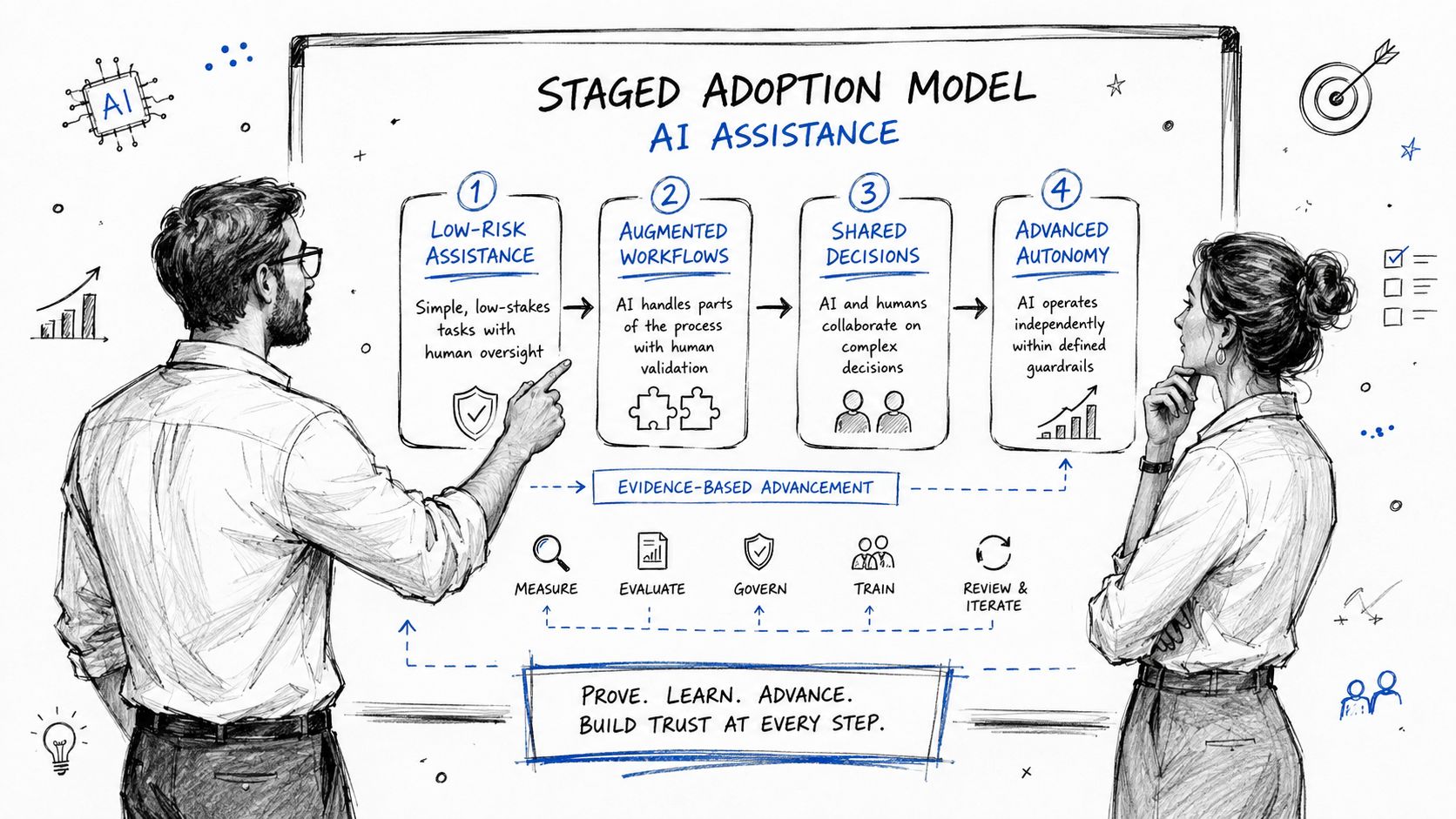
The measurable outcomes should be boring and concrete. Less preparation time. Lower correction rates. More consistent documentation. Fewer unauthorized actions. If those don’t improve, the bot is adding motion, not advantage. For teams building out talent acquisition workflows around AI, Nexus IT Group’s AI for talent acquisition perspective connects the staffing angle to the operating model.
The Enterprise Decision Framework
Grok Bot is a go for bounded, repeatable digital workflows where delegated execution saves meaningful time and a human can verify the result. It’s a pilot for tasks that cross apps but stay inside clear permissions and reversible actions. It’s a no-go for high-stakes decisions, tightly regulated data, and processes that need deterministic integrations or perfect reproducibility.
Use a short checklist. Is the task clear. Are the permissions minimal. Is the data sensitivity acceptable. Can a human own the outcome. Can the team roll back cleanly. Can success be measured without hand-waving. If the answer to any of those is no, keep the bot out until the control model catches up.
Adopting Grok Bot should change the design of work, not erase accountability. Recruiters can automate preparation and screening support. Engineering teams can delegate investigation and documentation. Leadership only gains an advantage if security, talent, and process controls mature alongside the technology.
Nexus IT Group helps technology teams hire the people who can make AI-enabled workflows work, from AI engineering and cloud to DevOps, cybersecurity, and IT leadership. If your team is planning a Grok Bot pilot, visit nexus IT Group to find staffing support, confidential search help, and the talent needed to build the controls around the automation.