
A single benchmark alters how many organizations consider it director salary. PayScale’s 2026 data places the average salary for an Information Technology Director at $131,670, with a median of about $132,000, a 10th-to-90th percentile range of roughly $81,000 to $186,000, and total pay reaching about $205,000 when bonus, profit sharing, and commission are included, according to PayScale’s 2026 IT Director salary data_Director/Salary).
That spread matters more than the headline average. It tells candidates that the title alone doesn’t define compensation. It tells hiring managers that under-budgeting the role can happen fast when the job also includes cybersecurity ownership, infrastructure modernization, vendor management, and executive reporting.
An IT Director doesn’t merely keep systems running. Strong directors translate technical risk into business decisions, assign priorities across competing initiatives, and give the rest of leadership a credible operating view of technology. That’s why salary conversations at this level have to move beyond a single number and into scope, market, and total rewards.
Table of Contents
- The Strategic Value of IT Leadership in 2026
- IT Director Salary Benchmarks for 2026
- Key Factors That Drive IT Director Compensation
- Deconstructing the Full Compensation Package
- How to Negotiate Your IT Director Salary
- A Hiring Manager’s Guide to Budgeting and Recruiting
- Future Trends in IT Leadership Compensation
The Strategic Value of IT Leadership in 2026
The most expensive mistake in IT leadership hiring isn’t paying too much. It’s paying for a director role while defining a manager job, or the reverse. Compensation gets distorted when companies treat IT leadership as overhead instead of operational control.
At the director level, the work sits at the intersection of service reliability, governance, security, budgeting, procurement, and business continuity. Candidates who understand that can position themselves around outcomes instead of tools. Employers who understand it can build a realistic compensation band that reflects actual accountability.
A useful way to frame the role is through ownership. If the director is accountable for incident response escalation, cross-functional planning, and presenting tradeoffs to finance or the executive team, then the role carries business risk, not just technical execution. That distinction is why two jobs with the same title can justify very different pay.
Practical rule: The faster a company needs an IT Director to reduce uncertainty for the rest of leadership, the less useful a generic salary average becomes.
Real searches also show that context drives urgency. A public-sector or mission-driven organization may need a leader who can modernize infrastructure while working inside tighter process constraints and stakeholder complexity, as reflected in this IT director search for a municipal library district in Colorado. The title stayed the same. The operating environment changed the hiring bar.
For candidates, that means the strongest compensation argument often starts with business fluency. For hiring managers, it means salary should follow the role’s decision rights, not a recycled job description.
IT Director Salary Benchmarks for 2026
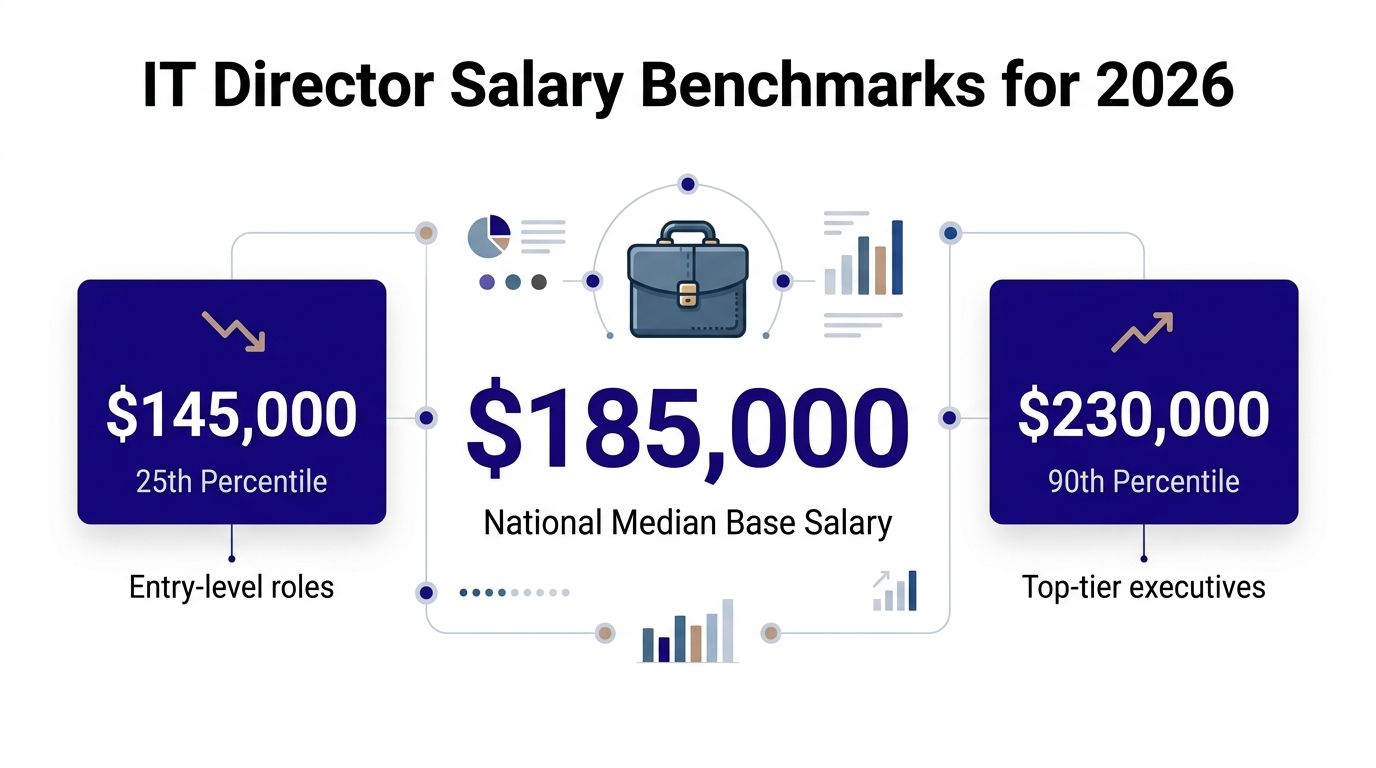
A national average of $131,670 is useful, but hiring decisions rarely happen at the average. Earlier benchmark data in this article places the median for IT Directors at about $132,000, with base pay stretching from roughly $81,000 at the 10th percentile to $186,000 at the 90th percentile. Total compensation extends higher once bonus, profit sharing, and commission are included.
Interpreting the Benchmark Data
The midpoint matters less than the spread.
For candidates, a wide percentile range signals room to argue from scope instead of title. For employers, the same range is a warning against setting a budget from a generic market average and assuming it will hold through offer stage. An IT Director running a stable internal support function should not be priced the same way as one inheriting vendor consolidation, audit exposure, and a modernization roadmap.
The median helps anchor the center of the market. The 10th and 90th percentiles are more useful in practice because they show how far compensation moves once the role carries broader authority, higher risk, or stronger commercial impact.
2026 IT Director Salary Benchmarks
| Metric | Base Salary (Annual) | Total Compensation (Annual) |
|---|---|---|
| Average | $131,670 | Higher once incentives are included |
| Median | About $132,000 | Not separately specified |
| 10th percentile | About $81,000 | Included within total pay span |
| 90th percentile | About $186,000 | Included within total pay span |
| Reported overall span | Reflected through percentile range | About $80,000 to $205,000 |
Used well, this table supports better decisions on both sides of the market.
- For candidates: Treat the benchmark as a reference point. If the role includes budget ownership, executive reporting, security governance, and service-level accountability, your case for the upper half of the range should rest on business outcomes you can prove.
- For hiring managers: Build the salary band before opening the search. If the position will own multi-site operations, compliance, or a major change program, budgeting near the market midpoint often creates delays, weaker finalist pools, or a reset after the first round of interviews.
SMB employers should also pressure-test internal equity before finalizing a band. A simple method for calculating comparative ratio for SMB pay scales can show whether your planned offer is aligned with the midpoint you intend to pay for similar leadership roles.
A title can stay constant while the economic value of the job changes sharply. That is why strong compensation planning starts with benchmark data, then adjusts for mandate, reporting exposure, and the cost of getting the hire wrong.
Key Factors That Drive IT Director Compensation
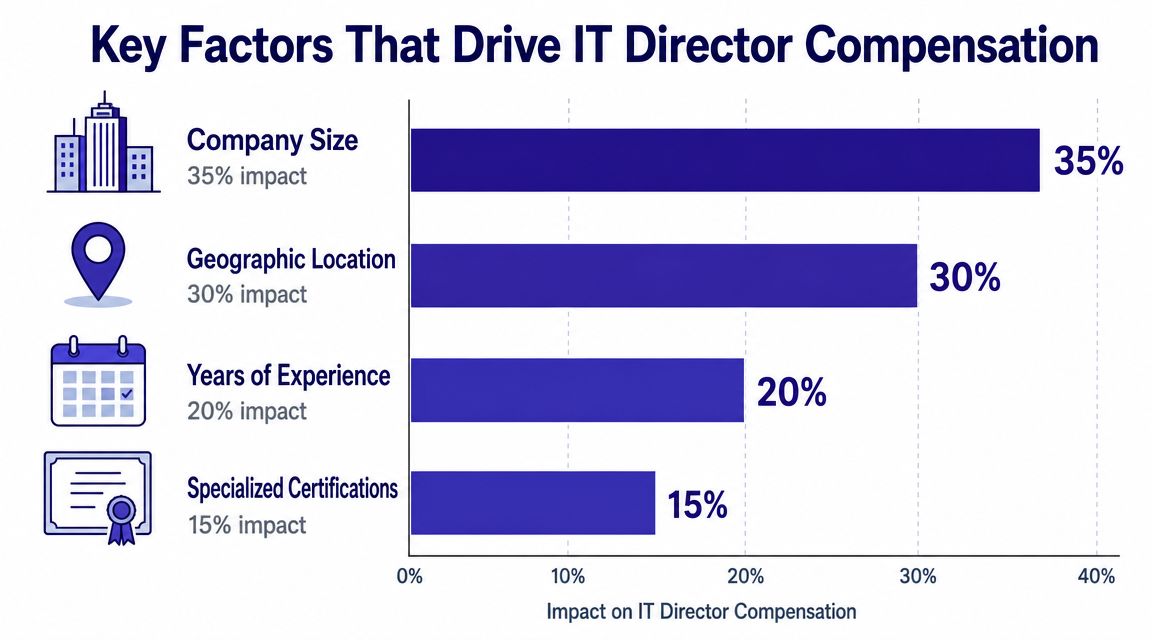
Compensation spreads widen quickly at the director level because employers are not buying a title. They are buying judgment across systems, risk, spending, and business continuity. That is why two roles called IT Director can sit in very different salary bands.
Geography changes the math fast
Location still has a measurable effect on pay. CBT Nuggets cites nationwide IT Director pay of about $133,749 and lists metro averages of $200,000 in San Francisco, $195,000 in San Jose, $190,000 in New York, and $188,000 in Seattle, with high-end offers above $230,000 in the strongest markets, according to CBT Nuggets’ IT Director salary analysis.
The pattern is not just a cost-of-labor story. Large tech hubs often expect broader operating range from the same leader. A director may need to oversee cloud architecture decisions, vendor contracts, incident response, and executive reporting in one role. Higher pay reflects both local competition and the cost of replacing someone who can cover that span.
Remote hiring does not erase geography either. Many companies still anchor offers to the office market, the reporting structure, or the scale of the systems the director will support.
Scope is the primary driver of compensation
Scope creates the clearest salary separation. Recruiters usually see four variables matter most:
- Team structure: Is the director leading individual contributors, department managers, or multiple technical functions?
- Operational exposure: Does the job carry accountability for uptime, recovery planning, cybersecurity incidents, and audit support?
- Budget control: Is the person advising on purchases, or setting vendor strategy and approving meaningful spend?
- Business visibility: Does the role report into a CIO, partner with finance, or serve as the top technology leader in the company?
Each layer changes the economic value of the job. A director who owns infrastructure and service delivery is different from one who also carries security governance, board-facing reporting, and integration work after acquisitions.
This is also where adjacent talent markets matter. Companies competing for leaders with heavy cloud, data, or AI exposure are often benchmarking against more than traditional IT operations roles. In some searches, pay pressure overlaps with specialist markets such as AI engineer salary trends in the U.S., especially when the IT Director is expected to guide automation strategy or AI infrastructure policy.
Company size and industry change the risk profile
A smaller company can offer a narrower salary band or a surprisingly aggressive one. The difference usually comes down to business dependence on technology.
In a regulated healthcare group, manufacturer, or financial services firm, one director can sit at the center of compliance, resilience, and vendor concentration risk. In a simpler environment, the same title may focus more on internal support, SaaS administration, and network oversight. The title stays fixed. The cost of failure does not.
Hiring managers should budget for risk, not just headcount. Candidates should probe for it in interviews. Questions about audit exposure, site count, integration projects, and security ownership usually reveal whether the role is priced correctly.
How employers should use market data
Market data only works when the company first defines the role with precision. Mid-sized employers often create avoidable hiring friction because one IT Director title covers several different jobs. One incumbent may manage support and business applications. Another may own infrastructure, security, governance, and long-range planning. A single pay band for both usually produces weak calibration and drawn-out searches.
An internal check such as calculating comparative ratio for SMB pay scales helps employers compare current or planned pay against the midpoint of the intended range. That method is more useful when paired with a role scorecard that spells out team size, budget authority, risk ownership, and executive exposure.
For candidates, the lesson is practical. Do not negotiate from title alone. Quantify the scope you will carry. For hiring managers, the parallel lesson is just as clear. Price the operating mandate first, then assign the title.
Deconstructing the Full Compensation Package
For IT Director hires, weak offer design usually shows up after acceptance. The candidate discovers that the bonus is discretionary, the equity has a long cliff, or the retirement match trails the market. The employer then learns that a role priced on base salary alone can still lose to a better-structured package.
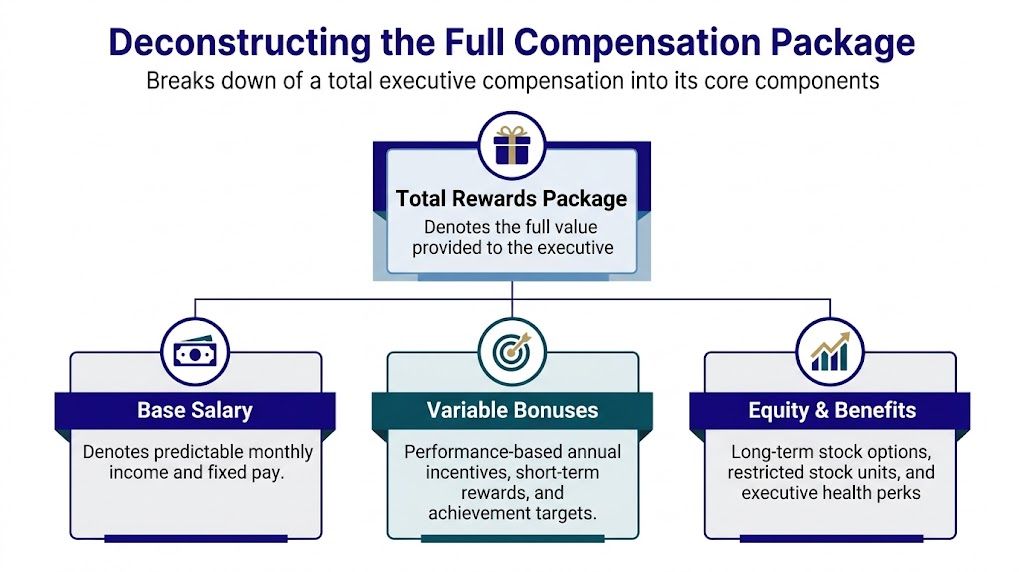
Three building blocks of total rewards
Base salary carries the most weight because it is fixed and easy to benchmark. It also affects future earnings more than candidates sometimes realize, since annual raises, bonus targets, and severance formulas are often tied to base pay. For hiring managers, this is the anchor that signals how the company values the role before any upside is discussed.
Variable pay determines whether performance upside is real or theoretical. At director level, bonus plans often include company, department, and individual goals. That structure matters. A 15 percent target bonus tied mostly to enterprise EBITDA is less controllable than a 10 percent bonus tied to uptime, project delivery, and budget discipline. Candidates should ask for target percentage, historical payout range, and who approves final results. Employers should document those mechanics early, because unclear incentive plans create distrust and slow close rates.
Equity and benefits shape retention and risk-adjusted value. In private companies, equity can be meaningful, but only if the grant size, vesting schedule, exercise terms, and liquidity path are clear. In established firms, strong health coverage, retirement matching, paid leave, and development budgets often carry more practical value. An offer with a smaller base can still compete if those components are explicit and easy to quantify.
What candidates and employers should examine closely
The cleanest way to compare offers is to read them as a full rewards statement rather than a salary line. A broader framework such as this comprehensive total compensation guide helps organize cash compensation, incentives, and benefits in one place.
Candidates should review the package in three passes:
- Guaranteed compensation: Base salary, sign-on bonus, relocation support, and any contractual severance.
- At-risk compensation: Annual bonus target, payout history, equity vesting, and retention awards.
- Career value: Scope growth, board or executive exposure, training budget, schedule flexibility, and decision-making authority.
Hiring managers should run the same analysis from a budgeting angle. If base salary is capped, the offer can still become more competitive through a defined bonus plan, a sign-on payment, extra PTO, or a stronger retirement contribution. Those levers only work when they are concrete. Vague language about future upside rarely changes a director-level decision.
This matters more in technical markets where scarce skills compress decision timelines. The pattern is visible in adjacent leadership and specialist hiring. This AI engineer salary in the US guide shows how employers often have to frame offers around total value, not salary alone. IT Director hiring follows the same logic, especially when the role includes security, infrastructure modernization, or enterprise application ownership.
Offer test: If the package cannot be explained clearly in three minutes, candidates usually discount the unclear components and compare offers on base salary alone.
How to Negotiate Your IT Director Salary
Negotiation at the director level works best when it feels like role calibration, not conflict. The strongest candidates don’t argue that they “deserve more.” They show why the job, as defined, carries a certain market value and business expectation.

Build the case before the offer arrives
Preparation should start well before the compensation conversation. Candidates need a clean summary of what they’ve owned, what they’ve improved, and what business problems they’re equipped to solve. That includes areas such as vendor governance, cloud operations, security leadership, cross-functional planning, and people management.
A useful negotiation file usually includes:
- Role-to-role alignment: A side-by-side view of the target job against prior scope, especially team leadership, budget oversight, and executive-facing responsibilities.
- Business outcomes: Concrete examples of improved stability, governance maturity, process discipline, or faster decision-making. If precise internal metrics can’t be shared, the candidate can still describe the operational impact qualitatively.
- Market framing: A reasonable compensation range based on the role’s market, level, and complexity.
Candidates often put themselves at a disadvantage when they discuss salary too early without enough scope clarity. They also put themselves at a disadvantage when they wait until the very end and react emotionally to the first number.
Negotiate the package, not only the base
Most employers expect some discussion. The candidate’s job is to keep it structured. Instead of saying the offer feels low, it’s stronger to explain where the package appears misaligned with the breadth of responsibility.
A practical negotiation sequence looks like this:
- Confirm the scope. Restate the role as understood. Team size, strategic ownership, security exposure, reporting structure, and near-term priorities all matter.
- Anchor to fit. Connect prior leadership work to the company’s current needs.
- Address compensation. Frame the requested adjustment around alignment between scope and market, not personal preference.
- Expand the discussion. If base salary is constrained, discuss bonus structure, title, review timing, remote flexibility, or professional development support.
Strong negotiation language stays specific: “Given the scope across infrastructure, security, and leadership reporting, the current package appears tighter than the role itself.”
Language that keeps the discussion strategic
Candidates don’t need aggressive tactics. They need clean language.
Examples that often work:
- When the base is light: “The package is close, but the role’s breadth suggests a higher base would better match the leadership expectation.”
- When bonus details are vague: “Before responding, there should be clarity on how incentive payout is measured and how often that target is achieved.”
- When title and scope don’t match: “The responsibilities read at a director level. If the title remains narrower, compensation and growth path should account for that.”
- When the employer hits a limit: “If base salary is fixed, there may be room to improve the overall package through review timing, bonus structure, or other long-term components.”
Candidates should also know when to stop. A company that stays transparent, explains constraints, and shows commitment to the role may still be offering a strong opportunity even if it doesn’t meet the candidate’s ideal scenario. The actual goal is clarity, not theatrical bargaining power.
A Hiring Manager’s Guide to Budgeting and Recruiting
The hiring market already signals that IT Director pay lives well above general tech averages. Salary.com reported that as of March 1, 2025, the average annual salary for an Information Technology Director in the United States was $207,866, with typical pay ranging from $188,509 to $230,627. In contrast, Dice’s 2025 tech salary report found the average technology professional earned $112,521, up 1.2% year over year, according to Salary.com’s benchmark for Information Technology Director salary. Hiring managers should read that gap correctly. They’re not recruiting a stronger individual contributor. They’re recruiting a leader whose judgment shapes multiple functions.
Start with role design, not salary guesswork
Many hiring processes break before sourcing begins. The business asks for an IT Director, but the brief combines daily operations, infrastructure modernization, security oversight, procurement discipline, and strategic planning without deciding which of those are essential.
A better approach is to separate the role into decision categories:
- Must-own responsibilities: The work that can’t be delegated without creating risk.
- Important but shared work: Responsibilities that may sit with peers, vendors, or a CIO.
- Nice-to-have depth: Skills that improve the hire but shouldn’t control the salary band if they aren’t central to success.
This exercise helps finance, HR, and technology leadership align before candidates enter the funnel. It also prevents the common problem of posting a broad executive-style role with a budget built for a senior manager.
Write a brief that matches the pay band
A job description should justify compensation through scope. If the company wants a leader to own vendor strategy, coach managers, handle executive communication, and stabilize service delivery, the brief should state that clearly. Serious candidates read omissions as signals.
Hiring teams that need outside support with leadership search can review specialized IT leadership recruiters and executive search support to understand how targeted search firms segment the market and define role scope. That’s useful even for internal teams that plan to run the process themselves.
A strong brief usually answers four candidate questions fast:
- Who does this leader report to?
- What kind of team and environment will they inherit?
- Which business problems need immediate attention?
- How much authority comes with the title?
Avoid the common budgeting error
The most common budgeting error is focusing on salary alone while ignoring the cost of delay, a weak hire, or a title-scope mismatch. If a company underprices the role, the likely outcome isn’t just a slower search. It’s a narrower candidate pool, more compensation friction, and higher risk of compromise on leadership quality.
Under-budgeting an IT Director role often forces the company to choose between experience and availability. The strongest searches usually avoid that tradeoff.
Employers don’t need to lead every market. They do need internal consistency. If the role’s scope is ambitious, the pay band, interview process, and decision speed all need to communicate that the company understands the level it’s trying to hire.
Future Trends in IT Leadership Compensation
IT Director pay in 2026 will track role scope more closely than title. That is the clearest trend employers and candidates should plan for.
The reason is straightforward. Many IT Director roles now sit at the intersection of infrastructure, security, vendor management, AI policy, and executive communication. Two jobs can carry the same title and command very different compensation because the business risk is different. A director overseeing internal support and endpoint management is not priced the same way as a director accountable for cloud governance, incident response readiness, and ERP stability across multiple locations.
That distinction matters to both sides of the hiring table. Candidates need to present their value in terms of business ownership, not just years in IT. Hiring managers need to budget for the actual scope of the job, not the label attached to it.
Three shifts are shaping compensation decisions now:
- More pay tied to cross-functional ownership: IT Directors are increasingly expected to translate technical tradeoffs for finance, operations, legal, and executive teams. Compensation rises when the role includes decision authority across departments.
- Security responsibility keeps expanding: Even with a CISO or security manager in place, many IT Directors still own control execution, escalation paths, disaster recovery coordination, and vendor risk follow-through. That added accountability affects salary bands.
- Wider talent markets create pricing pressure: Remote and hybrid hiring give employers access to stronger candidate pools, but they also expose below-market pay ranges faster. Candidates can compare opportunities across regions. Employers cannot assume local benchmarks will hold if the role can be done from multiple markets.
A fourth trend is easy to miss. Boards and executive teams are asking IT leaders to evaluate AI tools with more discipline. In practice, that means policy design, procurement review, data handling controls, and implementation oversight often sit with IT leadership before a dedicated AI governance function exists. Directors who can handle that work credibly will have stronger compensation cases. Employers who need that skill set should price for it upfront rather than trying to add it after the search starts.
The next phase of it director salary decisions will not center on a single national average. It will center on scope clarity, business exposure, and decision-making authority.
For candidates, the practical move is to document outcomes that show enterprise impact. Examples include reducing audit findings, consolidating vendors, improving recovery readiness, or leading a major platform transition without business disruption. For hiring managers, the parallel move is to define which of those outcomes the role owns, then build a pay band that matches that level of responsibility. Compensation gets more accurate when both sides discuss risk, authority, and expected results in specific terms.
nexus IT group helps employers hire hard-to-find technology leaders and supports candidates handling high-stakes career moves across IT leadership, cloud, cybersecurity, AI, and other specialized functions. Teams that need a search partner, or professionals exploring the next step in their career, can learn more at nexus IT group.