A senior platform-engineering role has been open for a quarter. Internal recruiting has already contacted the obvious candidates, the hiring manager is still waiting for a credible shortlist, and leadership wants to know why delivery slipped. Bringing in an IT staffing agency can help, but only if it fixes the core issue: finding people who can do the work, not sending more résumés.
That distinction matters most in hard-to-fill searches across AI, cloud, cybersecurity, and quantitative technology. A weak agency adds interviews and noise. A strong one clarifies the role, validates candidates against its real demands, and helps the employer choose an engagement model that fits the work and the risk.
Table of Contents
- The Hiring Moment That Puts Agencies on the Map
- What IT Staffing Agencies Actually Do
- Engagement Models Compared
- Pricing, Contracts, and the Costs No One Mentions
- Skills Validation Over Sourcing Volume
- How to Evaluate and Select an IT Staffing Partner
- Working With Agencies as a Candidate
- Putting It All Together With the Right Partner
The Hiring Moment That Puts Agencies on the Map
The pressure is familiar. A senior platform engineer has been missing from the team for months, an internal recruiter has exhausted the obvious channels, and a release or migration is slipping. The hiring manager is spending time reviewing candidates who look right on paper but haven’t demonstrated the production experience the job requires.
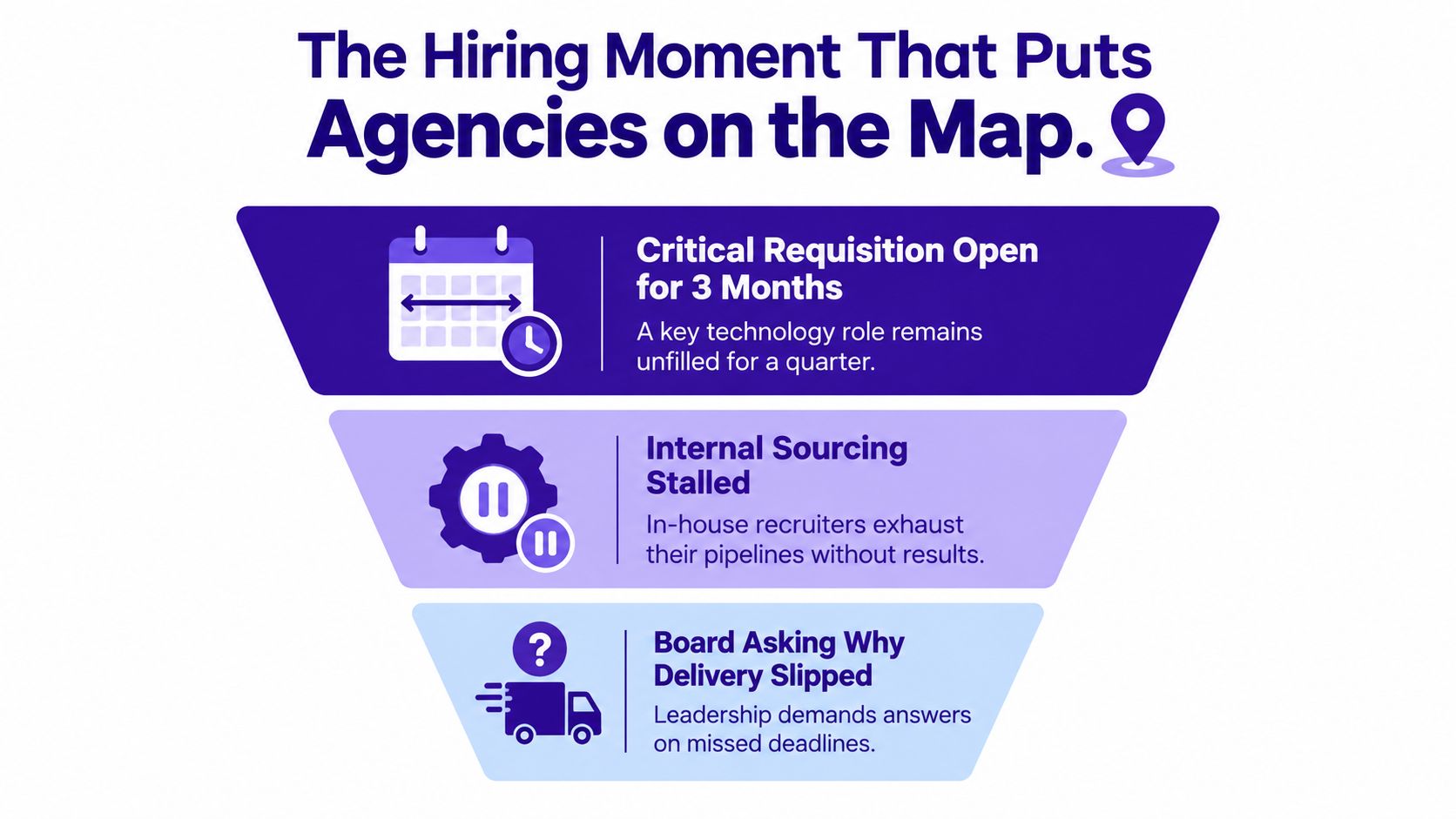
This is when companies turn to IT staffing agencies. Not because internal recruiting has no value, but because a specialized search may call for market knowledge, candidate relationships, and technical screening capacity that the in-house team doesn’t have ready. External support can also give a hiring manager a clearer view of the talent market: which requirements are narrowing the search, where adjacent skills could work, and what candidates are likely to expect from the role.
The alternative isn’t free. An unfilled position can delay delivery and leave existing engineers covering work outside their priorities. A rushed hire can create a different problem if the person lacks the skills to own production systems, respond to incidents, or make sound security decisions. In cybersecurity, a résumé full of tools and certifications isn’t proof that a candidate can analyze an incident or assess security controls.
The agency choice therefore carries strategic weight. A recruiter who treats the search as a keyword exercise may fill the calendar with interviews while leaving the actual capability gap untouched. A partner who calibrates the role with the hiring manager and explains how candidates were assessed can help the team make a better decision, even if the right answer is to adjust the job description or choose a different engagement model.
Buying rule: Don’t hire an agency just to increase résumé volume. Hire one when it can bring better market access and a defensible way to validate skills.
What IT Staffing Agencies Actually Do
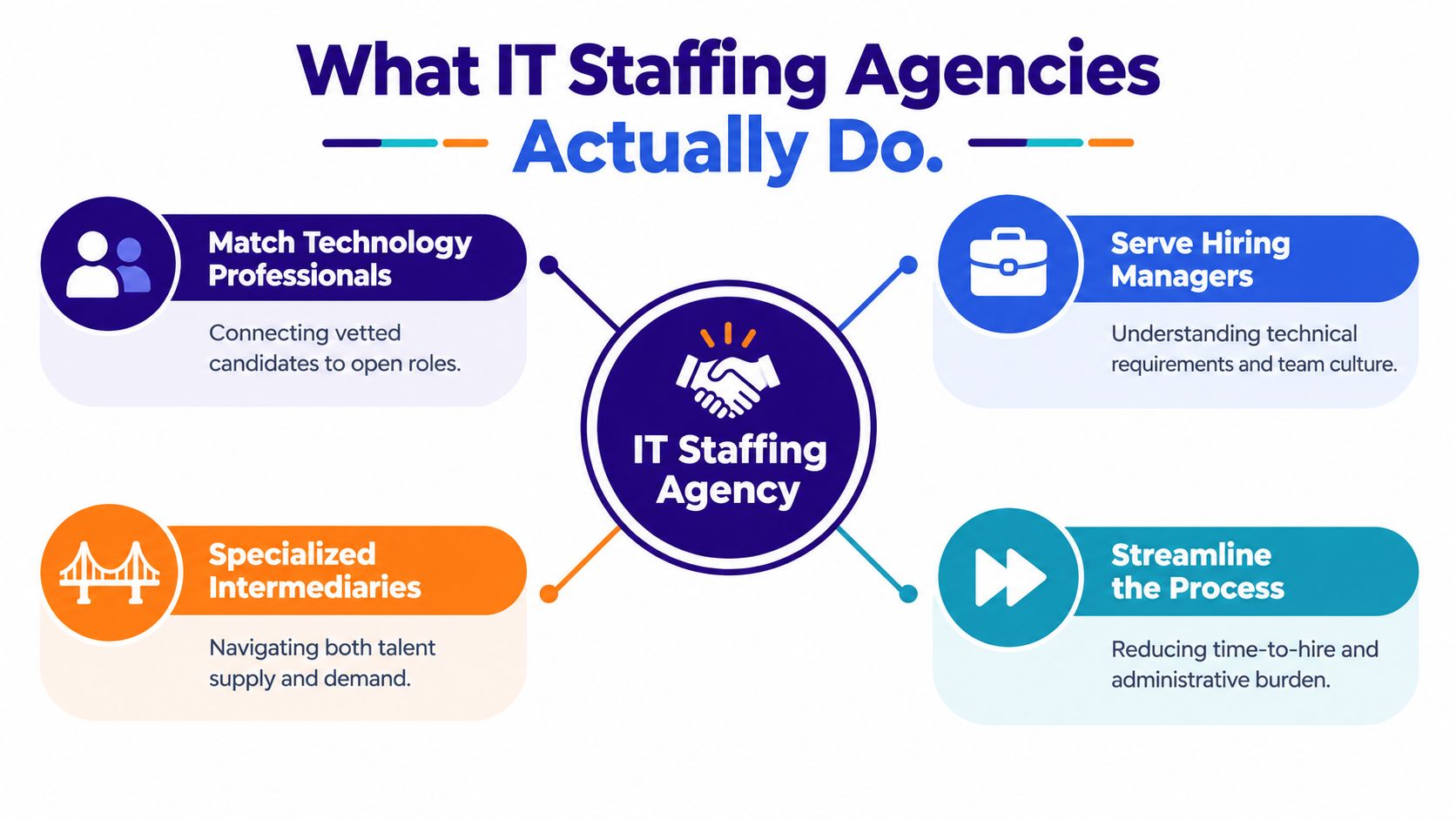
An IT staffing agency is a specialized intermediary connecting technology professionals with employers that need their capabilities. Its value isn’t access to résumés. The agency should translate a hiring manager’s needs into a focused search, assess candidates against those needs, and keep the process moving through interviews and offers.
That specialization matters because technology work exists across industries. OECD research found that ICT-using occupations account for more than 20% of total employment in most countries, showing that demand for digital skills reaches well beyond technology companies (OECD research on ICT skills and employment). A healthcare employer may need a cloud security engineer; a financial firm may be competing for data engineers; a manufacturer may need developers who understand automation. A specialist recruiter should understand both the technical profile and the business setting.
What the agency should own
A capable partner starts with intake calibration. The recruiter asks what the hire will deliver, which skills are essential, and what can be learned after joining. From there, the agency sources candidates, screens them, presents evidence of fit, coordinates interviews, supports offer discussions, and follows up after placement.
A generalist agency may handle technology roles among many other job families. Internal talent acquisition understands the company, its culture, and its hiring process, but may not have deep networks in every specialist market. An IT-focused agency should bring more relevant candidate relationships and a sharper understanding of role differences. A cloud engineer who builds infrastructure is not interchangeable with one who operates it, even when both résumés name the same platforms.
Ask for the work, not the pitch: The agency should be able to show how it turns a job description into screening criteria and how it reports evidence back to the hiring team.
Useful adjacent services may include market mapping, compensation benchmarking, confidential search, or resume review. Those services are only valuable when they help answer a real hiring question. For recruiters conducting structured interviews, a practical resource on AI interview tips for recruiters can help sharpen interview design and candidate evaluation.
Engagement Models Compared
The role’s duration, urgency, and uncertainty should determine the engagement model. Buyers often get this backward: they choose a familiar fee structure first, then try to fit the role into it. Start with the work and the business risk instead.
| Model | Typical Fee | Timeline | Best Fit |
|---|---|---|---|
| Contract staffing | Bill rate includes the contractor’s pay and agency margin | Often suited to a defined project start | Temporary capacity, such as a cloud migration |
| Contract-to-hire | Contract bill rate, with conversion terms set in the agreement | Contract period followed by a potential permanent offer | Testing a DevOps engineer’s fit before a permanent hire |
| Direct placement | Placement fee, commonly structured as a share of base salary | Search and hiring process depend on role and interview pace | A senior software developer joining permanently |
| Executive or quant search | May use retained or contingency terms, depending on the search | Usually requires a focused, consultative search | A head of data science or specialist quant researcher |
Contract staffing suits project work with a defined scope, such as a cloud migration needing temporary expertise. The employer pays for capacity without making an immediate permanent commitment. The trade-off is that continuity and knowledge transfer need deliberate planning.
Contract-to-hire makes sense when both sides need to assess fit in the actual work environment. For a DevOps engineer, the agreement should spell out conversion terms, including any buyout charges or restrictions. It’s not a free trial. The candidate deserves clarity, and the employer needs to understand the full cost before signing.
Direct placement is generally the clearer route for a permanent senior software developer when the role and team needs are well defined. For a deeper comparison of these options, review direct hire versus contract staffing.
Executive search and quant search need a more focused discussion. A retained approach can make sense when the role is confidential, leadership-critical, or difficult to reach through an ordinary contingent search. A quant researcher or machine-learning engineer for a trading firm may require assessment of mathematical reasoning, research judgment, and production implementation, not just title matching. A contingency model can create misalignment if several agencies compete to submit candidates quickly without agreeing on the profile or validation standard.
Choose retained search when exclusivity, discretion, and deep market mapping matter. Don’t pay for that level of process when a clearly scoped role can be filled through a focused direct-placement search.
Pricing, Contracts, and the Costs No One Mentions
Agency pricing is negotiable, but the agreement must make the economics legible. Contract staffing generally uses a bill rate that includes the worker’s pay and the agency’s margin. Permanent placement commonly charges a fee based on the candidate’s base salary. Retained search uses an agreed fee schedule, often tied to search milestones. Ask the agency to show what’s included and what can appear as a separate charge.
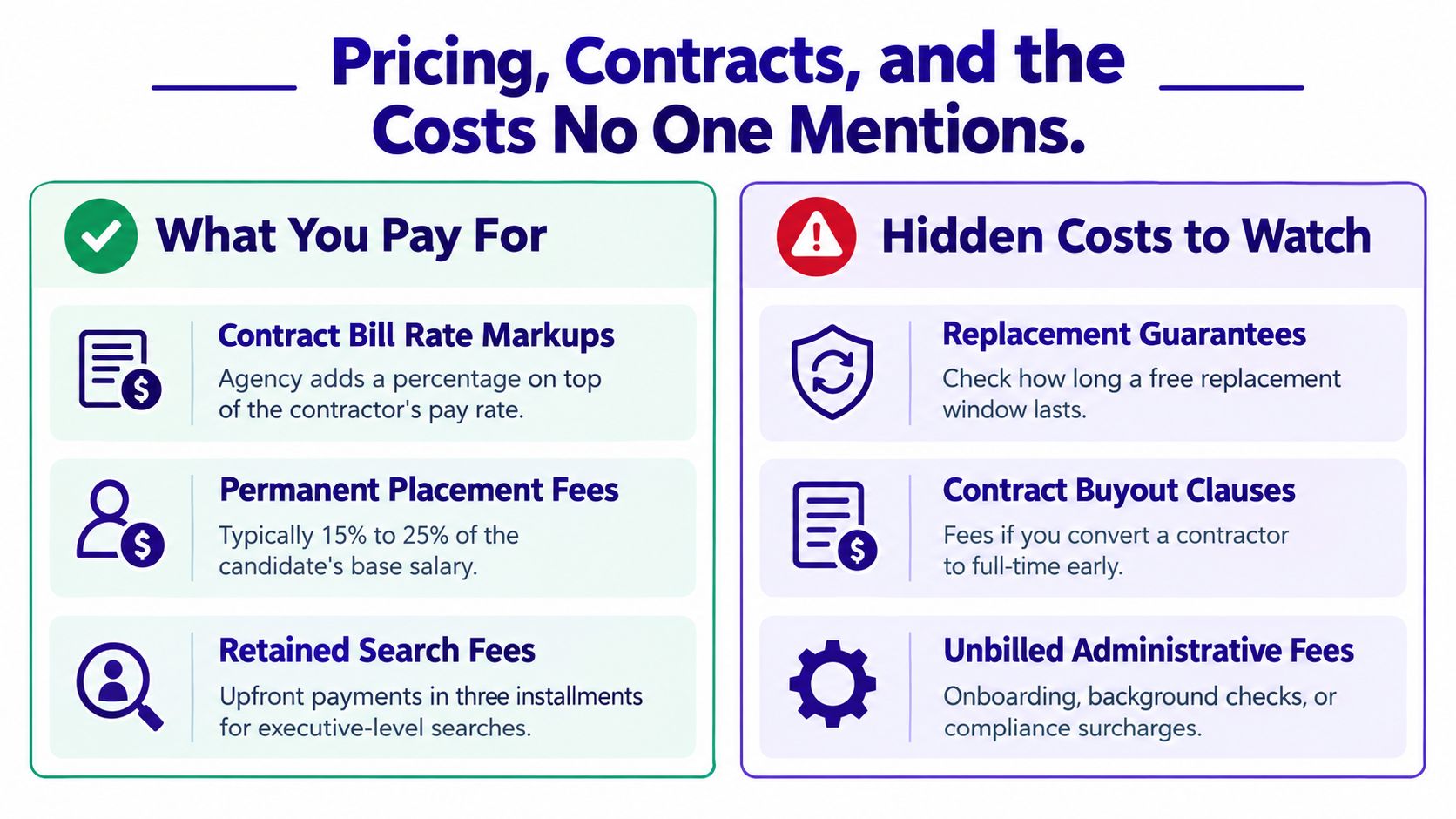
One essential distinction is gross margin versus bill rate. The client pays the bill rate; the agency’s margin is not the same as the contractor’s pay. Ask for a transparent breakdown, including any administrative, compliance, or onboarding charges. For permanent searches, confirm whether the fee applies to base salary alone or includes other compensation.
Put contract terms under a microscope
Read the clauses that govern what happens after a placement, not just the headline fee. Confirm the replacement guarantee’s duration and conditions, the conversion window for a contractor, early-termination rules, and any buyout if a contract worker becomes a full-time employee. Clarify who handles background checks and whether those costs are included.
A replacement guarantee isn’t automatically protective. It may exclude departures caused by a changed job, delayed onboarding, or a compensation mismatch. Get the conditions in writing and ask who decides whether the guarantee applies.
The actual cost also includes the hiring team’s time. Calibration meetings, interview panels, repeated searches after a counter-offer, and the ramp-up period all consume resources. A placement fee should be evaluated against those costs and the impact of leaving a critical position open, not in isolation.
One constraint deserves attention: contingent staffing demand can shift with the economy. The U.S. temporary-help-services sector peaked in March 2022 and contracted by 453,000 jobs, or 14.2%, by May 2024, illustrating the cyclical nature of temporary workforce demand (BLS temporary-help-services employment data). For buyers, that makes flexibility useful, but only when the contract spells out the cost of changing course.
Skills Validation Over Sourcing Volume
A larger candidate pool doesn’t solve a skills problem. The meaningful test is whether candidates can perform the work in the environment the employer runs. Cybersecurity offers a clear example: recent workforce research found 60% of organizations identify skills gaps as a greater challenge than headcount shortages (SANS cybersecurity workforce research).

Translate the job into evidence
The NIST NICE Framework gives cybersecurity teams a useful shared language. It separates work roles from the tasks, knowledge, and skills needed to perform them. Instead of asking for a generic “security engineer,” a hiring manager can specify work such as incident analysis, security-control assessment, secure software development, or risk management. The recruiter can then ask candidates for evidence tied to those tasks, such as a relevant project, work sample, or structured technical interview (NIST NICE Framework).
Use the same principle for other specialties. In data engineering, ask how a candidate designed and operated data pipelines, not whether a tool appears on a résumé. For cloud and DevOps, explore deployment practices, observability, security decisions, and incident response. In AI and MLOps, distinguish familiarity with models from the ability to evaluate them, integrate them into a system, and monitor their behavior. A quant developer should be assessed on the actual mix of software engineering and quantitative reasoning the role requires.
A useful screening sequence is straightforward:
- Define must-haves: Identify the capabilities needed on day one and separate them from skills that can be developed.
- Use structured screens: Ask every candidate comparable questions tied to the role’s core tasks.
- Request work evidence: Use a relevant work sample or detailed project walkthrough, with an appropriate scope and clear expectations.
- Calibrate together: Have the recruiter and hiring manager review what counts as strong evidence before submissions begin.
Candidates exploring software roles can use backend jobs on JobGlance to see how role descriptions express different expectations. Employers can also sharpen their evaluation process with this guide to testing IT candidates in the era of AI.
A smaller shortlist is often more useful than a large stack of loosely matched profiles. Before signing, ask the agency to explain its technical screen and show a sample scorecard. If it can’t connect its process to the role’s real work, it’s selling sourcing volume, not validation.
How to Evaluate and Select an IT Staffing Partner
Evaluate the partner on three things: whether it can prove candidate capability, whether its process fits the hiring team, and whether it manages risk responsibly. A polished presentation doesn’t demonstrate any of them.
Proof of capability: Ask how the recruiter screens candidates for the specific stack and what evidence accompanies each submission. Request examples of comparable placements and a redacted sample scorecard. For cybersecurity searches, ask whether the agency can map candidate evidence to NICE tasks, rather than relying on job titles.
Operating fit: Find out who owns intake, how often the agency reports progress, and what information appears in a candidate submission. A useful profile should explain why the candidate fits, what remains unverified, and what the interviewer should probe. Ask who handles scheduling, feedback, and offer coordination.
Risk management: Review the written terms for replacement guarantees, conversion, confidentiality, and background checks. The EEOC says staffing firms and their clients are often joint employers of temporary or contingent workers and may share responsibilities under the Americans with Disabilities Act (EEOC guidance on contingent workers and the ADA). Assign responsibility for accommodation requests in writing, keep medical information confidential, and ensure interviewers don’t ask disability-related questions before an offer.
Questions for the shortlist call
- How do you translate this job description into must-have skills and trainable skills?
- What does your technical screening cover for this specific role?
- What evidence will accompany each candidate submission?
- Can you share a sample scorecard with identifying details removed?
- How would you assess candidates against task-level expectations, including NICE tasks where relevant?
- Who will recruit the role, and what experience do they have with this technology area?
- What happens if a placed candidate leaves during the replacement period?
- What are the conversion, termination, and buyout terms?
- How will you protect confidentiality and handle accommodation responsibilities?
- Can the relationship begin with one role before the employer commits to broader use?
Watch for clear red flags. The agency submits anyone whose résumé contains the right keywords, refuses to show its screening method, or pushes direct placement without discussing whether contract staffing better fits the work. Claims about recruiter expertise should be backed by specific examples, not broad assurances.
Start with a single-role trial or paid pilot. Agree on the role profile, submission standard, communication cadence, and review point before the search begins. That gives both sides a fair test without turning a vendor presentation into a long-term commitment.
Working With Agencies as a Candidate
An agency relationship should improve a candidate’s position in the market, not take control of it. A good recruiter clarifies the role, explains what the employer needs, helps the candidate prepare, and keeps communication moving. A poor one forwards a résumé without permission or pressures a quick answer before sharing basic details.
There’s meaningful demand for experienced developers: the U.S. Bureau of Labor Statistics projects software-developer employment to grow 17.9% from 2023 to 2033, adding approximately 303,700 jobs (BLS software-developer employment projections). That projection doesn’t guarantee a particular candidate an offer, but it reinforces why experienced professionals should expect a clear explanation of the role and process before agreeing to representation.
Keep control of submissions
Before sharing a résumé, ask the recruiter to name the employer or explain why the search is confidential, describe the team and responsibilities, and confirm the compensation structure if available. Require written permission before the recruiter submits the candidate. If multiple agencies contact the candidate about the same position, clarify who has authorization and avoid duplicate submissions that could create confusion.
A recruiter can help frame experience for a hiring manager. For example, a cloud engineer’s résumé should make clear whether the candidate designed systems, operated them, or supported a migration. Interview preparation should focus on the employer’s stated problems and the candidate’s own examples, not rehearsed claims that don’t hold up to follow-up questions.
For practical guidance on setting expectations with a recruiter, see how to work with a recruiter. Candidates should also agree on confidentiality, exclusivity, and communication frequency before the recruiter starts representing them.
The same care applies to offers. A candidate considering a counter-offer should compare the actual role, manager, growth path, and working conditions, rather than using one offer only to prompt another employer. The recruiter should explain deadlines and terms without pushing the candidate to accept.
Be cautious if a recruiter can’t describe the job beyond the posting, insists on an immediate decision without a clear reason, or disappears after submitting the résumé. A credible partner gives direct answers, respects consent, and stays engaged through the decision.
Putting It All Together With the Right Partner
Match the engagement model to the work, then require a validation process suited to the role. Contract staffing can add temporary cloud or DevOps capacity; contract-to-hire can let a team assess a platform engineer in the working environment; direct placement suits a defined permanent need; executive or quant search calls for deeper market mapping and evidence of specialized judgment.
Technology hiring remains structurally competitive. BLS projects computer and mathematical occupations to grow 10.1% from 2024 to 2034, compared with 3.1% for all occupations. Within that outlook, data scientist employment is projected to rise 33.5%, and information security analyst employment 28.5% (BLS projections for technology-related occupations). Treat those searches as skills-validation work, not routine requisitions.
Nexus IT Group offers contract staffing, direct placement, executive search, and quant recruitment, with confidential search and resume review among its services. Buyers can also use its job description templates and blog resources to clarify role requirements before engaging a partner. Those offerings matter only if the agency can show relevant candidate evidence, communicate clearly, and stand behind its screening process.
Nexus IT Group supports employers hiring across AI engineering, cloud, cybersecurity, data, DevOps and SRE, software development, and quant roles through flexible staffing and placement services. Review its hiring resources, clarify the skills the role must prove, and visit nexus IT group to discuss the right engagement model for the search.
