
A Forward Deployed Engineer is a hybrid software engineer and consultant who embeds directly with customers, often traveling 20 to 50% of the time, to build and deploy custom production-grade solutions inside the customer’s environment. The role has surged because standard product engineering often stops short of the messy work required to make complex platforms and AI systems deliver results in real operations.
That shift is easier to understand when looking at hiring demand. FDE roles have grown by over 800% while traditional software engineering listings have dropped by 70% in 2025 to 2026, according to Invisible Technologies. For a CTO, that signals a staffing pattern change. For a senior engineer, it signals a career path that rewards people who can code, diagnose ambiguity, and operate well with customers under pressure.
Most articles stop at the definition. That’s not enough. The important question isn’t only what is a forward deployed engineer. It’s why companies suddenly need them, what they do all week, where the role breaks down in AI deployments, and how to tell a true FDE role from a dressed-up solutions engineer title.
Table of Contents
- The Rise of the Customer-Facing Coder
- Defining the Forward Deployed Engineer Role
- Core Responsibilities and Essential Skills
- FDE vs Software Engineer vs Solutions Engineer
- Industry Contexts and Real-World Use Cases
- How to Hire a Great Forward Deployed Engineer
- Finding Your Next FDE with a Staffing Partner
The Rise of the Customer-Facing Coder
The market is rewarding engineers who can stay close to the customer problem instead of waiting for a clean product requirement to arrive. That’s the backdrop for the FDE boom.
The headline number matters because it captures a real change in how software gets adopted. Forward Deployed Engineer roles increased by over 800% in Q1 2025 while traditional software engineering job listings dropped by 70%, as discussed in this market view on FDE demand. The title isn’t trendy because it sounds elite. It’s growing because many companies learned that selling AI or enterprise platforms is easier than getting them working inside a customer’s security, data, process, and political constraints.
Why this role exists now
A standard product team builds generalized capability for many customers. That model works when customers can adapt their workflows to the product.
It breaks when the environment is tangled. AI platforms, cloud migrations, data tooling, and internal workflow systems often hit resistance at the point of deployment. The product might be good. The architecture might be solid. The customer still can’t get to usable outcomes without someone who can translate business pain into code, then ship inside the customer’s actual environment.
Practical rule: If the product only works in demos, a company doesn’t have a product advantage. It has a deployment problem.
What this means for hiring and career planning
For employers, the rise of the customer-facing coder means some roles should no longer be staffed as pure backend, platform, or solutions positions. The work sits in between, and the wrong title produces the wrong candidate pool.
For engineers, this shift creates a path for people who want more ownership than a narrow feature team offers. FDE work is demanding, but it’s close to adoption, revenue, and product truth. Engineers who want clean abstractions and minimal meetings usually won’t enjoy it. Engineers who like shipping under real constraints often will.
Defining the Forward Deployed Engineer Role
Forward deployed engineering became a recognized category because enterprise software kept hitting the same wall. Products could demo well, sell well, and still fail during deployment once they met customer security rules, messy data, and real operating processes.
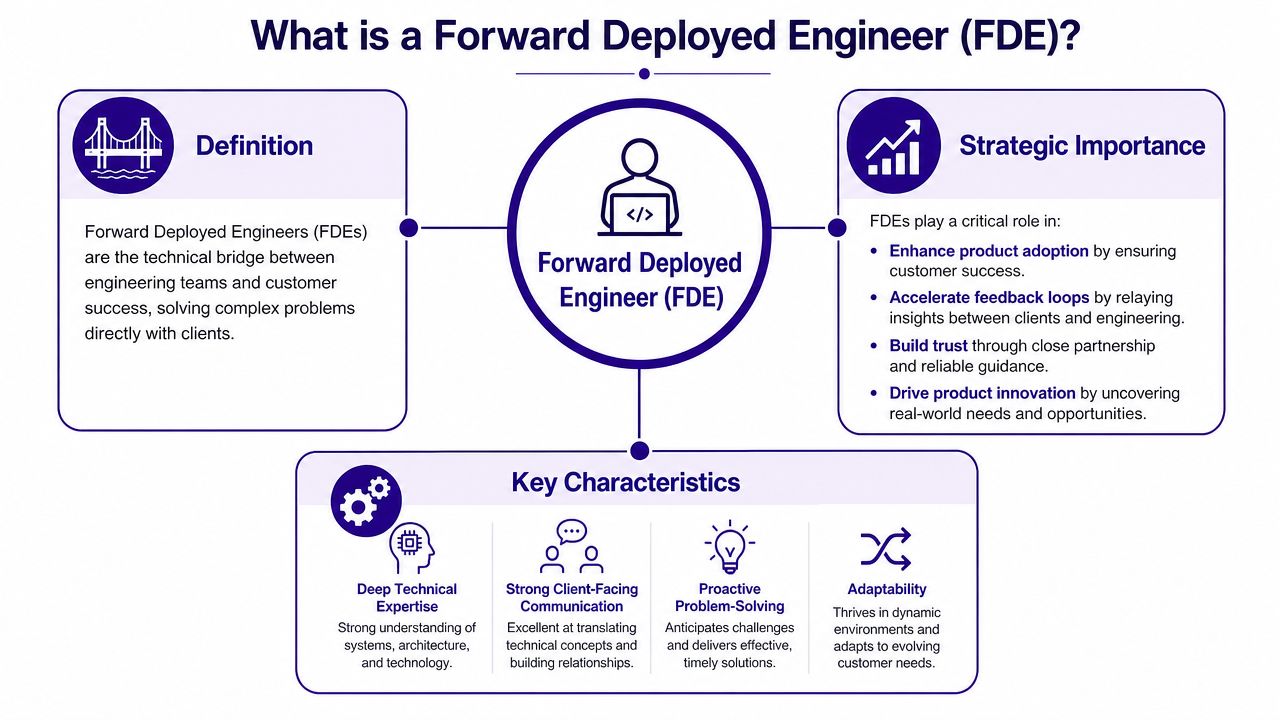
The clearest definition is simple. A forward deployed engineer is a software engineer who works close to the customer, ships code against live constraints, and closes the gap between what the product can do in theory and what the customer can use in production.
Why the role emerged
The usual explanation is customer proximity. That is true, but incomplete.
A key reason the role keeps expanding is the AI last mile. Models, APIs, and platforms are easier to buy than to operationalize. The hard part starts after procurement. Retrieval quality breaks because source data is inconsistent. Access controls block the model from the systems that matter. Evaluation is weak, so teams cannot tell whether output quality is improving. Human workflows do not match the way the product was designed. An FDE handles those gaps in code, architecture, and process instead of treating them as implementation noise.
That changes the job in a material way. FDEs are not only configuring software or relaying requests to product teams. They are often building adapters, orchestration layers, internal tools, guardrails, and customer-specific workflows that make an AI or enterprise product usable under real conditions.
Why companies embed engineers instead of handing off to services
Hiring managers usually make a mistake here. They assume this work belongs to either professional services or a strong product engineer with some client exposure.
In practice, those options break for different reasons. Services teams can document a rollout and manage stakeholders, but they often stop short of owning hard technical decisions. Core product engineers can build scalable features, but they usually are not staffed or incentivized to sit inside a customer problem long enough to resolve edge cases, internal politics, and ugly integration details. The FDE role exists because some revenue-critical deployments need one person or a small pod to do all three jobs at once: diagnose, build, and push to adoption.
This is also why the role gets confused with customer-facing titles that sound adjacent. A technical evangelist job description centers on education, adoption, and external technical communication. An FDE is judged on whether the system works in production, whether the customer gets to value, and whether the product team learns what must change to make the next deployment easier.
From a recruiting standpoint, that distinction matters. If a company writes the role like a solutions consultant, it will attract presentation-heavy candidates who do not want to own production code. If it writes the role like a backend engineer, it will attract strong builders who may dislike ambiguity, travel, customer friction, or implementation pressure tied directly to revenue.
The best definition is operational. An FDE is the engineer a company sends when the product is promising, the account matters, and the last mile is still too manual, too brittle, or too customer-specific for the standard team structure to handle.
Core Responsibilities and Essential Skills
FDE work gets hard at the AI last mile. The model may perform well in a demo and still fail once it meets real permissions, messy source data, slow human review loops, and customer systems that were never designed to support modern automation. That gap is where strong FDEs earn their keep.
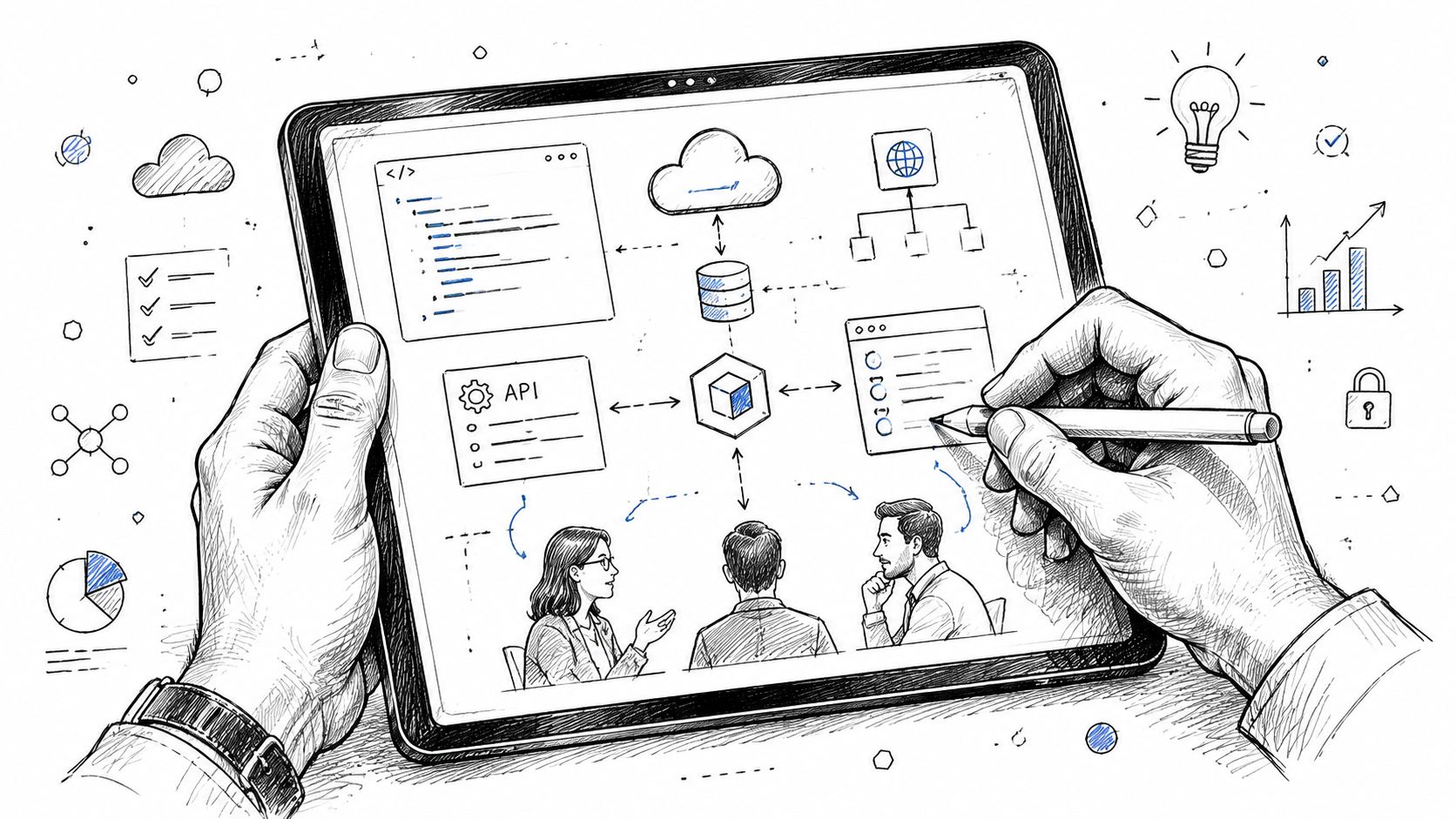
An FDE owns the deployment work that sits between product promise and production reality. That usually means embedding closely with the customer team, working inside their data and process constraints, and shipping code that closes gaps the core platform does not yet cover, as described in this guide to the role.
What an FDE owns
The day-to-day work is broader than many hiring managers expect. The best FDEs do not just implement tickets. They define the core problem, ship the fix, and feed the lessons back into the product.
Typical ownership includes:
- Problem framing: Customer requests often arrive as symptoms, not requirements. FDEs turn vague asks into a scoped technical plan with clear trade-offs.
- Production engineering: They write APIs, workflow logic, integrations, internal tools, data pipelines, and lightweight UI layers when the deployment needs them.
- Customer-specific integration: Identity systems, security reviews, procurement limits, cloud policies, and legacy data models often shape the architecture more than ideal design does.
- AI last-mile adaptation: In AI deployments, the work includes prompt and workflow tuning, evaluation setup, human-in-the-loop controls, fallback logic, and instrumentation for failure cases that only appear with live customer traffic.
- Iteration after launch: Version one usually exposes issues nobody saw in discovery. FDEs stay close enough to adjust quickly.
- Internal product feedback: Repeated workarounds signal missing product features, weak tooling, or an onboarding process that does not scale.
That last point matters for hiring. A company that treats FDEs as isolated firefighters gets short-term wins and long-term product debt. A company that uses them well turns customer deployments into a structured source of roadmap input.
Technical depth that matters
The technical bar is high because the job mixes shipping speed with real operational risk. An FDE has to move fast without creating one-off code that the company regrets six months later.
A practical hiring screen should look for evidence in four areas:
| Capability | What good looks like |
|---|---|
| Application engineering | Builds and modifies backend services, APIs, and thin frontends without heavy supervision |
| Cloud deployment | Ships on AWS, Google Cloud, or Azure and can handle containers, auth, networking, and environment setup in customer contexts |
| Data handling | Works inside incomplete, messy, permission-constrained customer data and still produces reliable outputs |
| AI implementation | Operationalizes existing models with evals, guardrails, monitoring, and workflow design, not just demos or prompt experiments |
For AI-focused FDEs, one skill gap shows up constantly. Plenty of engineers can call a model API. Far fewer can make that system reliable once latency spikes, source documents are inconsistent, users ignore the prescribed workflow, and the customer asks for auditability. That is the tooling gap in the market right now. Core AI frameworks help with experimentation, but many teams still lack strong tooling for evals in customer-specific environments, failure tracing, prompt version control tied to outcomes, and handoff from prototype to supported product behavior.
Soft skills that affect delivery
Soft skills are not secondary in this role. They directly affect whether the deployment ships, stalls, or turns into a custom services trap.
What matters most:
- Clear communication under pressure: FDEs explain trade-offs to operators, managers, security teams, and senior technical stakeholders without sugarcoating risk.
- Judgment with customers: Good FDEs listen carefully, then push back when a requested solution adds fragility, delay, or avoidable scope.
- Ownership: They keep momentum when requirements shift, dependencies slip, or the customer organization cannot make decisions quickly.
- Context switching: The role moves between coding, debugging, meetings, architecture reviews, and stakeholder management in the same day.
I would screen for these skills with scenario interviews, not just coding tests. The failure mode in FDE hiring is rarely “could not write Python.” It is “could not reduce ambiguity, make a sound trade-off, and keep a revenue-critical deployment moving.”
The strongest FDEs combine builder instincts with field judgment. That mix is rare, which is why companies that hire well for this role usually separate must-have technical ability from trainable domain knowledge, then test candidates on real deployment friction instead of idealized engineering puzzles.
FDE vs Software Engineer vs Solutions Engineer
Title confusion is expensive here. Hiring teams often post an FDE role when they need a solutions engineer, an implementation engineer, or a strong product engineer who can join customer calls. The result is predictable. Candidates enter the process with the wrong expectations, and the company hires for the wrong failure mode.
That mismatch gets worse in AI companies because the hard part is rarely the demo. The hard part is the last mile. Models need to work inside messy customer environments, connect to brittle internal systems, and produce outputs that operators will trust. The engineer handling that work needs stronger production judgment than a typical pre-sales role and stronger customer judgment than a typical backend role.
Role comparison at a glance
| Role | Primary Focus | Core Activities | Code Ownership | Customer Interaction |
|---|---|---|---|---|
| Forward Deployed Engineer | Customer-specific deployment success | Scope, build, integrate, deploy, iterate | High. Owns production-grade code in customer context | High |
| Software Engineer | Generalized product capability | Build platform features, services, internal systems | High. Owns product code for many customers | Low to moderate |
| SRE | Reliability and operational resilience | Observability, incident response, automation, platform reliability | Moderate to high, focused on ops tooling and reliability systems | Low |
| Solutions Engineer | Pre-sales technical alignment | Demos, technical discovery, proof of concept, solution design | Low to moderate, often limited to prototypes or configuration | High |
The cleanest comparison is FDE versus software engineer. Both write real code. The difference is where that code has to survive.
A software engineer usually builds reusable product capabilities with clear ownership boundaries, internal tooling, and a roadmap shaped by many customers. An FDE writes code that has to work inside one customer account with odd permissions, partial documentation, legacy systems, procurement constraints, and business pressure tied to a live deal. In AI, that often includes retrieval setup, evaluation wiring, prompt and workflow tuning, fallback logic, and instrumentation that product teams have not standardized yet.
The solutions engineer comparison is where hiring teams make the most mistakes. A good solutions engineer can run technical discovery, map requirements, build a proof of concept, and help close a deal. An FDE carries responsibility further downstream. The role usually owns production implementation details, handles integration risk directly, and stays engaged until the deployment is stable enough to hand off or formalize.
SRE is a different center of gravity. SREs care about uptime, incident response, platform reliability, and operational discipline across internal systems. FDEs care about whether a customer-specific deployment works in the field. Reliability still matters, but it is reliability in service of adoption, workflow fit, and business outcomes at the account level.
A simple hiring test helps. Ask what happens after the demo succeeds.
If the role is expected to design the proof of concept, support sales, and guide implementation without owning much production code, that is usually a solutions engineering role. If the role is expected to ship code, handle integration edge cases, debug failures in the customer environment, and close the gap between product promise and operational reality, that is an FDE role.
For candidates, the career trade-off is just as important. Software engineering usually offers deeper specialization in systems, product architecture, or platform ownership. Solutions engineering usually offers more influence in pre-sales, discovery, and technical storytelling. FDE sits in the middle and is often harder than either title suggests. It gives engineers unusually fast exposure to customers, product gaps, and executive priorities, but it also asks them to absorb ambiguity, context switch constantly, and make sound trade-offs without the shelter of a clean roadmap.
For hiring managers, the title should match the operating model. If the company needs someone to own the AI last mile, write real production code, and work directly with customers under deadline pressure, call it FDE and build the interview loop around that reality. If those conditions are absent, a different title will produce a better match and a better hire.
Industry Contexts and Real-World Use Cases
Forward deployed engineering shows up in one kind of environment over and over. The product is promising, the sale is real, and the customer’s systems, data, and workflows are messier than the core product team can reasonably handle from a distance.
That is why the role appears so often in AI deployments.
At a financial services company, an FDE may need to connect a model-driven workflow to approval chains, permissions, internal data sources, and audit requirements. The customer is not buying a chatbot. They are buying a system that has to behave correctly inside an existing operating model. If the model produces useful output but cannot fit the firm’s controls, the deployment stalls.
Healthcare looks similar for different reasons. A hospital or insurer may want the value of an AI or data platform, but getting there usually means building custom pipelines, mapping identity systems, fitting the product into staff workflows, and collecting feedback from operators who care more about speed and accuracy than model architecture. In that setting, the FDE creates value by turning a technically plausible product into something teams can use repeatedly.
The same pattern shows up in logistics, manufacturing, and enterprise software. The hard part is rarely the demo. The hard part is making the product work inside brittle APIs, inconsistent data, local workarounds, and decision chains that were never designed for modern AI systems. Hiring leaders who already recruit software engineers for high-complexity environments usually recognize this quickly. The engineering work is inseparable from customer context.
The AI last mile problem is real
This is the part hiring teams and candidates should assess with clear eyes. Companies often describe the FDE as the answer to the AI last mile. In practice, the role succeeds only when the company has enough product maturity, tooling support, and ownership clarity to let the engineer solve customer-specific problems instead of compensating for every missing internal system.
TSIA’s analysis of forward deployed engineering in the AI era highlights a pattern many teams already feel on the ground. AI implementations run into more post-sale friction than traditional software, and many forward deployed teams are working in customer environments without strong eval frameworks. That gap matters. An FDE can tune prompts, configure orchestration, trace failures across systems, and patch weak integration points. An FDE cannot reliably prove model quality, safety, and workflow fit if the company still lacks disciplined evaluation methods.
The tooling gaps are where the role gets hard fast.
A customer asks why retrieval quality drops after a document update. Another wants agent behavior explained to a compliance team. A third needs outputs routed into a brittle internal workflow that has no clean API. None of those problems are solved by generic AI enthusiasm. They require engineers who can write production code, debug in unclear conditions, and make good decisions with incomplete information.
Three use-case patterns come up repeatedly:
- Enterprise AI rollout: FDEs connect models to internal systems, set up guardrails, and adapt workflows so real users can trust the output.
- Regulated deployments: FDEs handle identity, auditability, data movement, and approval logic that standard product teams often cannot generalize in advance.
- Platform gap filling: FDEs build temporary tooling, integration layers, and operational workarounds while product teams decide what should become part of the core roadmap.
That last case deserves honesty. Sometimes the FDE is accelerating adoption. Sometimes the FDE is carrying product debt in front of the customer.
For hiring managers, that distinction changes the profile you need. For engineers considering the role, it changes whether the job feels like high-growth product work or a long sequence of custom patches. The best FDE environments still involve pressure and ambiguity, but they also give the engineer enough tooling, authority, and product partnership to solve the AI last mile without becoming the permanent workaround.
How to Hire a Great Forward Deployed Engineer
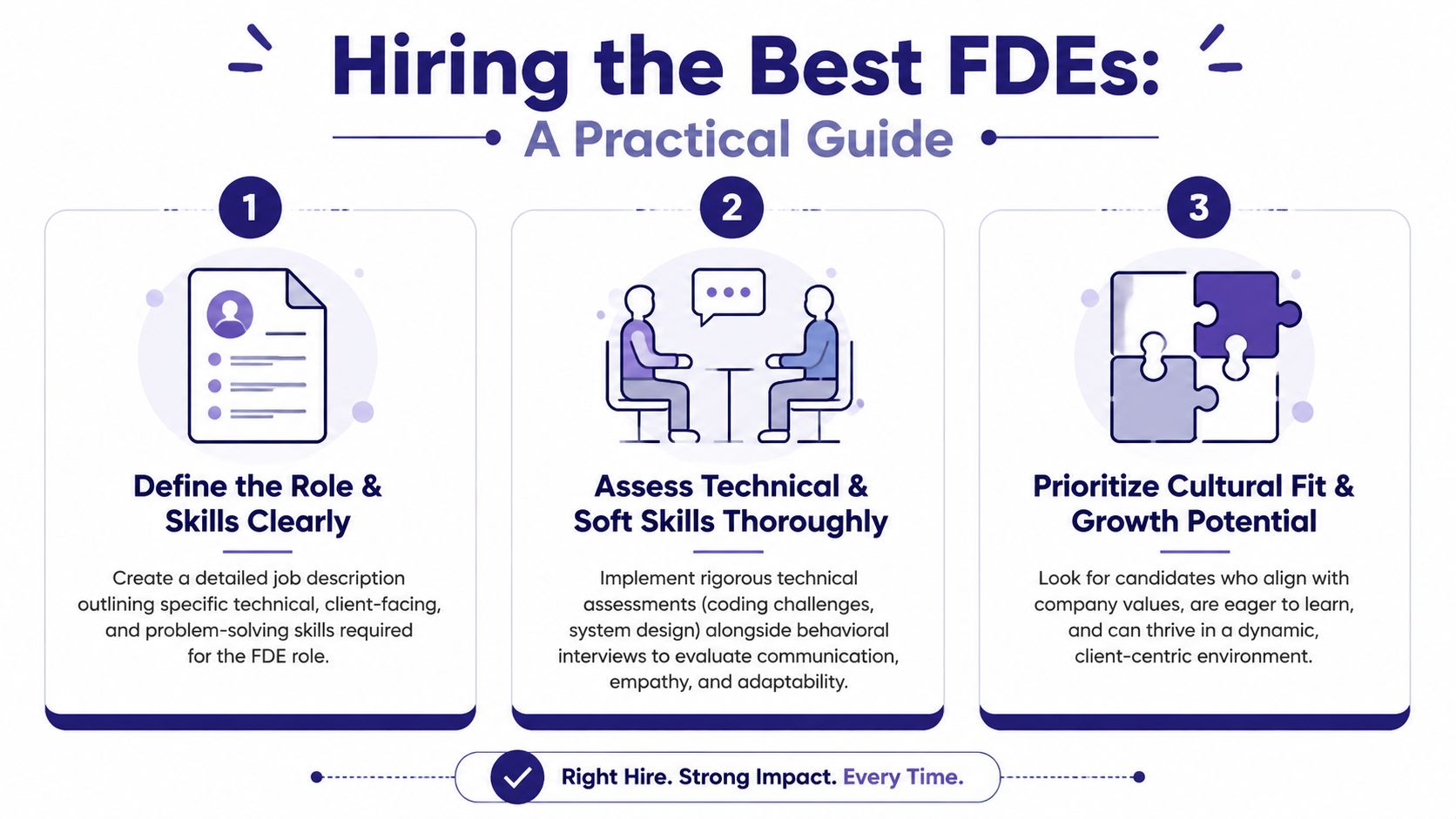
Hiring teams usually miss on FDE searches for one of three reasons. They write a vague hybrid role, they interview like it’s a standard software job, or they benchmark compensation too close to conventional engineering bands.
Write the role like an engineering job, not a vague hybrid
A strong job description should make four things unmistakable:
- Customer context: State whether the role works onsite, inside customer Slack channels, or directly in customer infrastructure.
- Build expectations: Say what the engineer will ship. APIs, integrations, data pipelines, internal tools, AI application layers, or deployment workflows.
- Ownership boundaries: Clarify whether the role owns post-launch iteration and incident response.
- Travel reality: Don’t hide it. People who hate travel will self-select out, which is useful.
The best descriptions read like engineering roles with situational complexity, not consulting roles with loose technical language. Teams that need help shaping that process often use internal recruiting playbooks such as these software engineer recruiting strategies, then adapt them for the heavier customer-facing requirements of FDE hiring.
A simple foundation looks like this:
Role summary: Build and deploy production-grade solutions inside customer environments using the company platform. Own scoping, integration, implementation, and iteration for high-stakes customer workflows.
Interview for judgment, not just coding speed
The interview loop should test whether the candidate can move from ambiguity to deployment. That means the loop needs more than a coding challenge.
Useful evaluation areas include:
-
Problem framing round
Give the candidate a vague customer brief. Ask what they’d clarify, what they’d prioritize, and what they’d defer. -
Architecture and integration round
Present a messy stack. Legacy database, cloud platform, identity constraints, and a business process that doesn’t cleanly map to the product. -
Customer communication round
Ask the candidate to explain a technical compromise to a non-technical stakeholder. -
Execution review
Walk through a real project they shipped. Press on ownership, blockers, and what happened after launch.
Questions worth asking:
- How did the candidate handle a deployment when the customer’s stated requirements were wrong?
- What did they build themselves versus coordinate through others?
- When did they push back on a customer request, and how did they do it?
- How do they tell when a repeated custom ask should become a product feature?
Compensation and market positioning
FDE compensation is high because the talent profile is narrow. According to this discussion of FDE compensation, senior-level FDEs at firms like Palantir earn between $180,000 and $350,000 annually, with a $50,000 to $150,000 premium over standard software engineer positions.
That premium makes sense. The role requires engineering depth, consultative maturity, and the ability to ship under direct customer scrutiny.
Hiring teams should also be realistic about sourcing. The best candidates often come from software engineering, platform engineering, solutions architecture, or technical consulting backgrounds, but not everyone in those pools can make the jump. Some employers use specialist firms, including Nexus IT Group, when the search combines AI fluency, enterprise deployment experience, and customer-facing credibility in one role.
Finding Your Next FDE with a Staffing Partner
Forward deployed engineers are difficult to find because the role compresses multiple disciplines into one job. The candidate has to code well, communicate clearly, operate calmly in customer environments, and make sound decisions when the product doesn’t fit cleanly out of the box.
That combination rarely shows up through generic keyword sourcing alone. A staffing partner can help when the hiring team needs sharper calibration on title, interview design, and candidate signals. For companies weighing permanent hires against flexible deployment models, these Rite NRG staff augmentation insights offer a useful framework for thinking through where augmentation fits and where direct ownership matters more.
When the search is specifically for hard-to-fill hybrid engineering talent, IT staffing support for specialized technical hiring can help narrow the field to candidates who meet the role’s requirements instead of just matching the title.
Companies hiring for forward deployed engineers and engineers considering the move both need a clear read on the role. nexus IT group works on specialized technical searches across software, cloud, AI, data, and related hiring challenges, which makes it a practical resource when an FDE search needs market calibration, candidate assessment, and targeted outreach.