
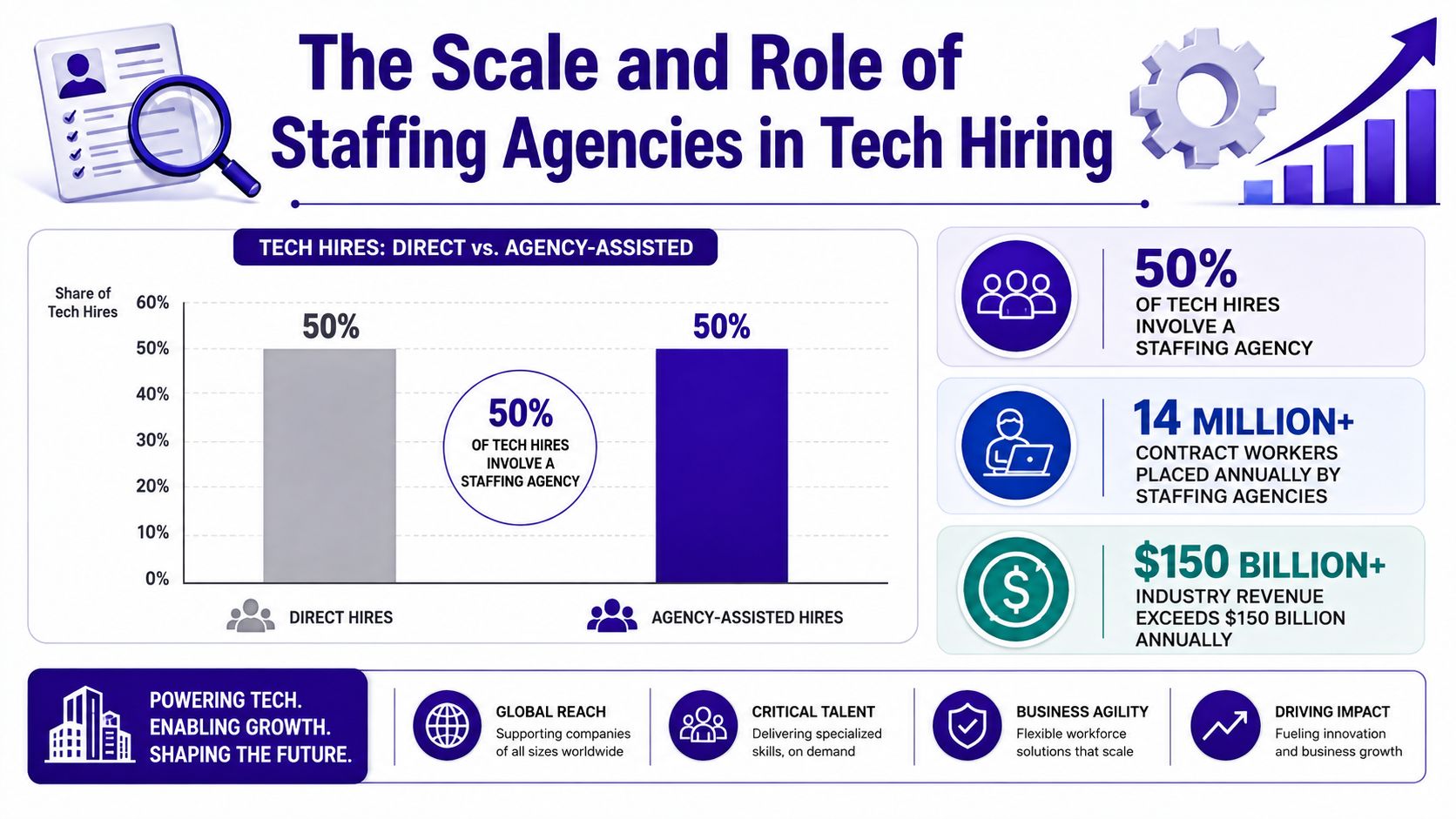
Staffing agencies sit in the middle of a labor market that’s much bigger than most hiring teams realize. In the U.S., staffing and recruiting firms operate about 39,000 offices, more than 3 million temporary and contract employees work through those companies in an average week, and nearly 15 million temporary and contract workers are hired over the course of a year, according to the staffing statistics compiled by Labor Works USA from the American Staffing Association’s reporting on 2024 employment opportunities (staffing agency temporary labor statistics). That scale matters for tech hiring because the agency model isn’t a side channel, it’s one of the main ways companies move fast when they need engineers, analysts, DevOps talent, or cybersecurity support now.
For IT leaders, the core question isn’t whether staffing agencies exist. It’s how they work, what they cost, and when they’re worth the markup compared with building the search in-house. The answer is usually hiding in the cost stack, the legal employment model, and the recruiter’s ability to translate a hard technical need into a workable hiring process.
Table of Contents
- The Scale and Role of Staffing Agencies in Tech Hiring
- The Three-Party Workflow Behind Every Placement
- IT Staffing Models and When to Use Each One
- Understanding Fee Structures and True Hiring Costs
- How Agencies Source and Screen IT Candidates
- How to Choose the Right IT Staffing Partner
- What Employers and Candidates Should Expect
The Scale and Role of Staffing Agencies in Tech Hiring
Staffing is already a major part of how companies fill roles. One industry source estimates the U.S. staffing market at $274.6 billion, with a 3.1% five-year compound annual growth rate, while temporary workers represented about 2.1% of the U.S. workforce, or roughly 3.1 million people on any given day. That scale explains why hiring managers keep running into agencies even when they would rather hire directly. The firms are already embedded in the labor market, and they are built to move volume fast.
For tech teams, that scale shows up in a different way. Agencies that understand software, cloud, data, and security are not just forwarding resumes, they are maintaining candidate pools, screening technical backgrounds, and responding to urgent hiring windows that internal HR teams often cannot absorb alone. A delayed cloud migration, a security audit that needs immediate coverage, or an engineering team waiting on a critical hire can create real operational cost, because the project does not pause while a requisition sits open. Staffing becomes a working tool, not a fallback. this overview of staffing agency benefits is useful context for employers weighing that trade-off.
Why tech staffing is different
The mechanics are the same across industries, but the screening burden is very different in tech. A recruiter filling a warehouse shift can prioritize availability and reliability. A recruiter filling a senior DevOps role has to understand CI/CD pipelines, AWS or Azure context, incident response patterns, and whether the candidate owns production systems or only supported them.
That difference is why specialized agencies do better when the role is narrow and the buyer knows what good looks like. A startup hiring its first data engineer may need speed and market mapping more than a broad employer brand campaign. A larger enterprise may need a partner that can compress a long shortlist process without losing technical depth. Tech staffing works when a recruiter can convert a business problem into a precise candidate profile.
Practical rule: If the role requires specialized tools, certifications, or production accountability, the agency has to know the stack well enough to screen for it, not just source keywords.
The Three-Party Workflow Behind Every Placement
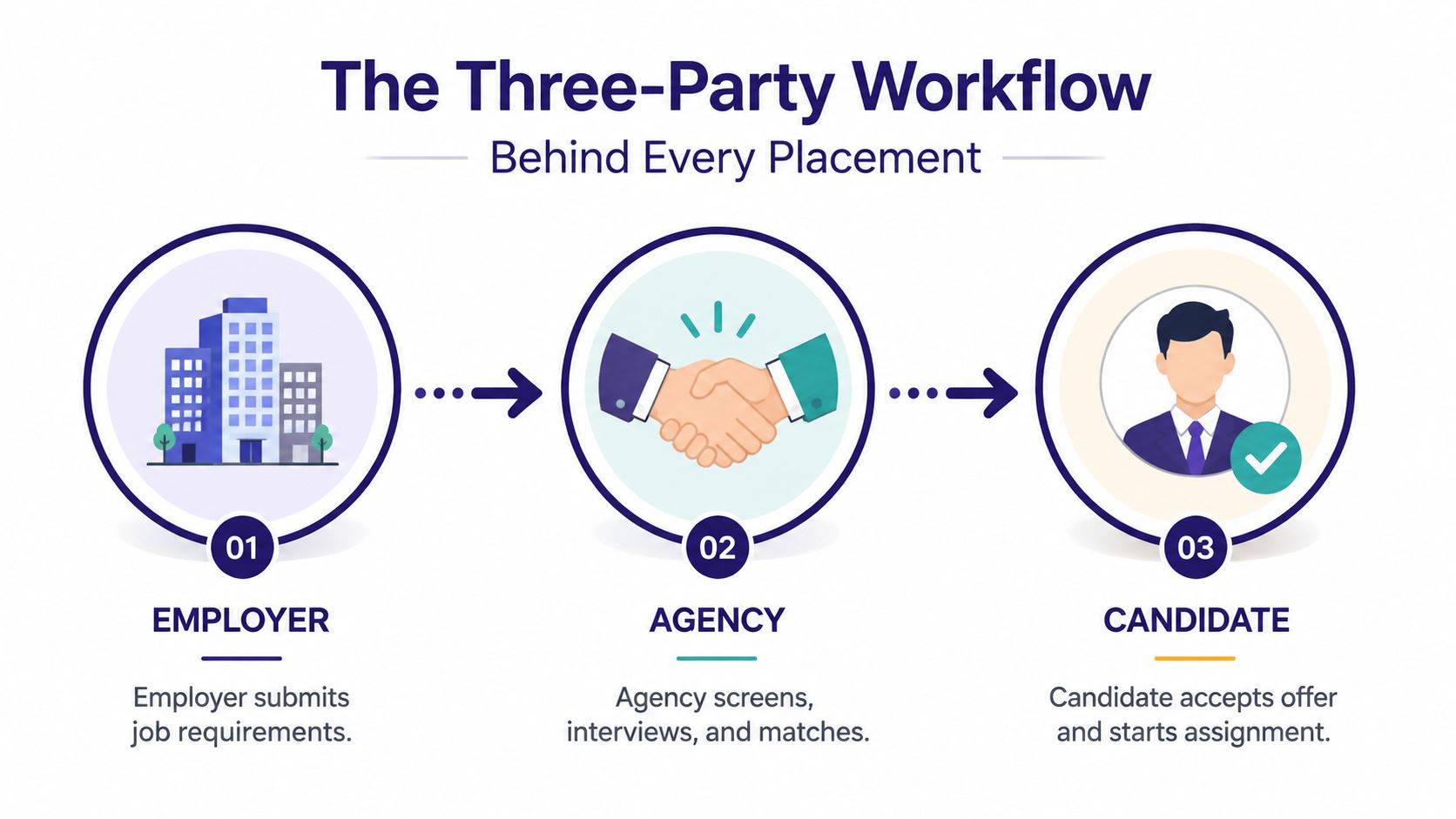
A staffing agency works by separating labor, legal employment, and daily supervision across three parties. The client defines the need, the agency runs the search and handles employment administration, and the worker performs the job at the client site or inside the client’s operating environment (how staffing agencies work). That structure is what makes contract hiring workable without forcing every short-term assignment into an internal HR process.
A six-month DevOps contract is a good example
A hiring manager needs a senior DevOps engineer for a six-month cloud migration. The manager gives the agency the role scope, assignment length, required tools, and pay expectations, then the agency turns that into a search brief and service agreement. The agency sources candidates, screens for fit, and sends a shortlist. The employer still makes the final call on who gets interviewed, who gets accepted, and whether the candidate fits the team.
Once the candidate is approved, the assignment begins. For temporary or contract roles, the worker is typically employed by the staffing agency rather than the company where the work is done, while the client directs the day-to-day tasks and technical priorities (how do staffing agencies work). That split matters because the agency, not the client, handles payroll, benefits administration, and the compliance work tied to contingent labor. It also affects how the engagement is billed, which is part of the cost structure employers need to understand before they approve the requisition. For employers using staff augmentation services, that separation is usually the reason the model can move faster than an internal hire.
Who owns what in practice
The client owns the work output and the technical direction. The staffing agency owns the employment file, billing terms, and administrative follow-through. If the engagement ends, the agency usually handles the employment side of the separation, while the employer decides whether the project slot continues or closes.
The three-party model only works cleanly when ownership stays clear. The client owns deliverables, the agency owns the employment wrapper, and the candidate knows who gives feedback, who approves time, and who handles the paperwork.
IT Staffing Models and When to Use Each One
The wrong staffing model can cost time, money, and political capital. Contract staffing, direct hire, executive search, and quant recruitment solve different problems, and good agencies are clear about which one fits the need instead of trying to force every requisition into the same container. A company hiring a backend engineer for a migration has a different use case from a fund hiring a quantitative researcher, and both are different again from a board looking for a CIO.
| Model | Best For | Typical Timeline | Example Roles |
|---|---|---|---|
| Contract staffing | Project-based needs, urgent backfills, surge capacity | Fast-moving, often used when speed matters most | DevOps engineer, cloud engineer, data engineer |
| Direct hire | Permanent roles where retention and team fit matter | More deliberate than contract search | Software engineer, security analyst, product data lead |
| Executive search | Senior leadership hires with confidential scope | Slower and more targeted | CIO, CTO, VP of Engineering |
| Quant recruitment | Specialized roles in hedge funds and proprietary trading | Highly selective and niche | Quant researcher, machine learning engineer, low-latency software engineer |
How to match the model to the need
Contract staffing makes sense when the work is defined, the timeline is finite, and the team needs someone who can contribute quickly. That’s why it shows up so often in cloud migrations, platform hardening, analytics builds, and release-heavy engineering work. The agency can move faster because the role is tighter, the deliverable is clearer, and the employer is buying output more than long-term headcount.
Direct hire makes more sense when the company wants permanence and culture fit. The agency still sources and screens, but the business is really investing in a lasting employee relationship. Executive search is different again, because the recruiter has to manage confidentiality, stakeholder alignment, and high-stakes leadership evaluation. Quant recruitment is its own world, where the agency has to understand trading systems, research rigor, and the performance demands of niche financial environments.
A useful distinction is that not every search benefits from augmentation. Some roles need a short-term specialist. Others need a leader. If the company is trying to extend an internal team without committing to a permanent hire, staff augmentation is often the more accurate lens than general recruiting language.
Understanding Fee Structures and True Hiring Costs
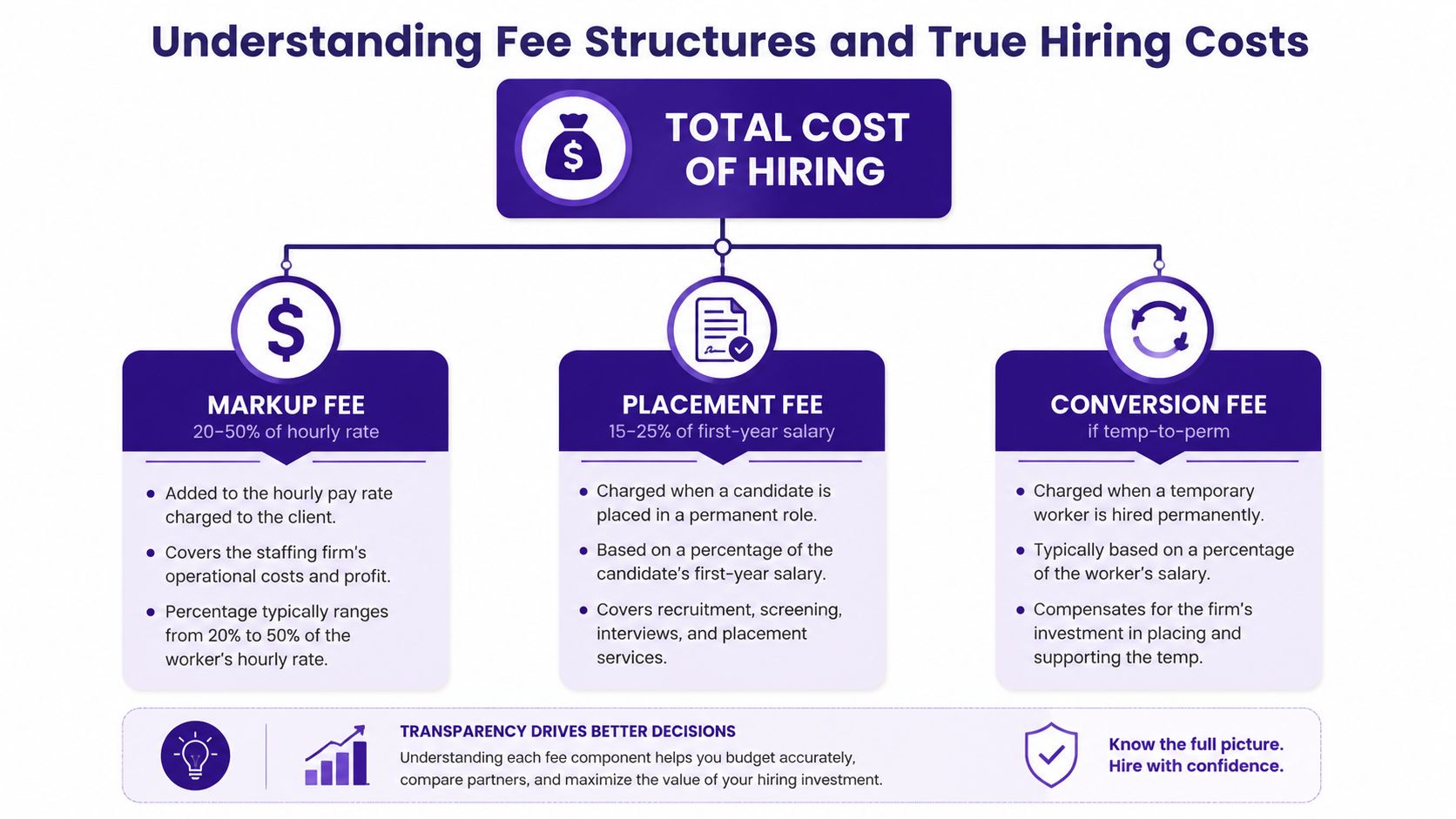
A lot of explainers stay fuzzy on pricing, and that leaves employers guessing. A staffing agency does not add a casual markup to a worker’s wage. In contract staffing, the bill rate usually includes the worker’s pay rate, payroll taxes, workers’ compensation, unemployment insurance, benefits, and administrative overhead, with gross margin added on top (how staffing agencies work). That cost stack is why the bill rate and the worker’s hourly pay can look far apart on paper.
What employers pay
In temporary staffing, wages and benefits for placed workers usually consume about 60 to 70 percent of revenue, leaving gross margins around 23 to 25 percent and average EBITDA margins near 10 percent for the agency (how staffing companies make money). That is not just a pricing detail. It explains how the business works. Agencies need volume and speed because the margin room is real, but not huge.
For contract placements, the bill rate is built from several layers. The worker’s pay sits at the base, then the agency adds the mandatory cost stack and its operating margin. For direct hire, the structure is different. The employer usually pays a one-time placement fee, and if a temp worker later converts into a permanent employee, the service agreement often spells out the conversion fee and the billing terms for that transition (staffing agencies work, how staffing agencies work).
When staffing saves money and when it doesn’t
Staffing saves money when the company values speed, reduced recruiter workload, and lower admin burden more than it values a purely in-house search. It can also be the smarter move when the need is temporary, the scope is project-based, or the team cannot afford to slow down because one role stays open too long. In those cases, the agency is absorbing sourcing, payroll, and compliance work the employer would otherwise have to staff internally.
It becomes less attractive when the company wants to build permanent capability in a role with a predictable hiring pattern and strong internal referral flow. A mature in-house recruiting team can sometimes beat an agency on total cost for repeatable hires. The deciding factor is rarely the headline fee alone. It is the blended cost of recruiter time, manager time, vacancy risk, and compliance burden.
A useful way to pressure-test the economics is to compare the agency fee against the internal cost of search. For a technical role, that means looking at sourcing effort, screening time, interview coordination, offer management, and the cost of leaving the seat open. A detailed view of technical sourcing methods helps employers see why two roles with the same salary can carry very different hiring costs.
Bottom line: If a hiring manager cannot explain who pays for payroll taxes, benefits, or the conversion event, the staffing agreement is probably not fully understood yet.
How Agencies Source and Screen IT Candidates
A strong IT staffing agency doesn’t just post a role and wait. It starts with a targeted search, usually because the recruiter already knows which engineers, analysts, or security professionals are likely to be open to a move. That’s why specialized agencies often outperform generalists on hard-to-fill roles. They’re not hunting for anyone with a matching job title, they’re narrowing in on people who can do the work.
What a real screening flow looks like
A candidate usually enters the pipeline through outreach, a referral, or an application. The recruiter then checks the basics first, skills, location, compensation expectations, and career direction. If the profile fits, the recruiter moves into technical validation and client alignment, which is where weak agencies usually fall apart.
A solid recruiter can tell the difference between someone who has supported a cloud platform and someone who built and operated one. They can also tell whether a data scientist has shipped models into production or only worked in notebooks. That kind of screening takes more than keyword matching. It takes a structured conversation, a real understanding of the role, and enough technical fluency to ask follow-up questions that matter.
For teams evaluating sourcing discipline, task automation with GPT for Work can be a useful reference point for how recruiters and operations teams think about reducing repetitive work without losing judgment. The technology can help with admin, but it cannot replace the recruiter’s responsibility to validate skill, motivation, and fit.
What candidates should expect
Candidates should expect screening calls, skill checks, and regular contact before anything gets submitted to a client. The recruiter should also explain the role clearly, including whether it’s contract, direct hire, or a temp-to-perm path. If the recruiter can’t explain the team, the stack, or the assignment with precision, that’s usually a warning sign that the submission process is shallow.
The best agencies keep the candidate informed before submission and after client feedback. The worst ones blast resumes to multiple companies and hope something sticks. For tech hiring, that approach wastes everyone’s time.
How to Choose the Right IT Staffing Partner
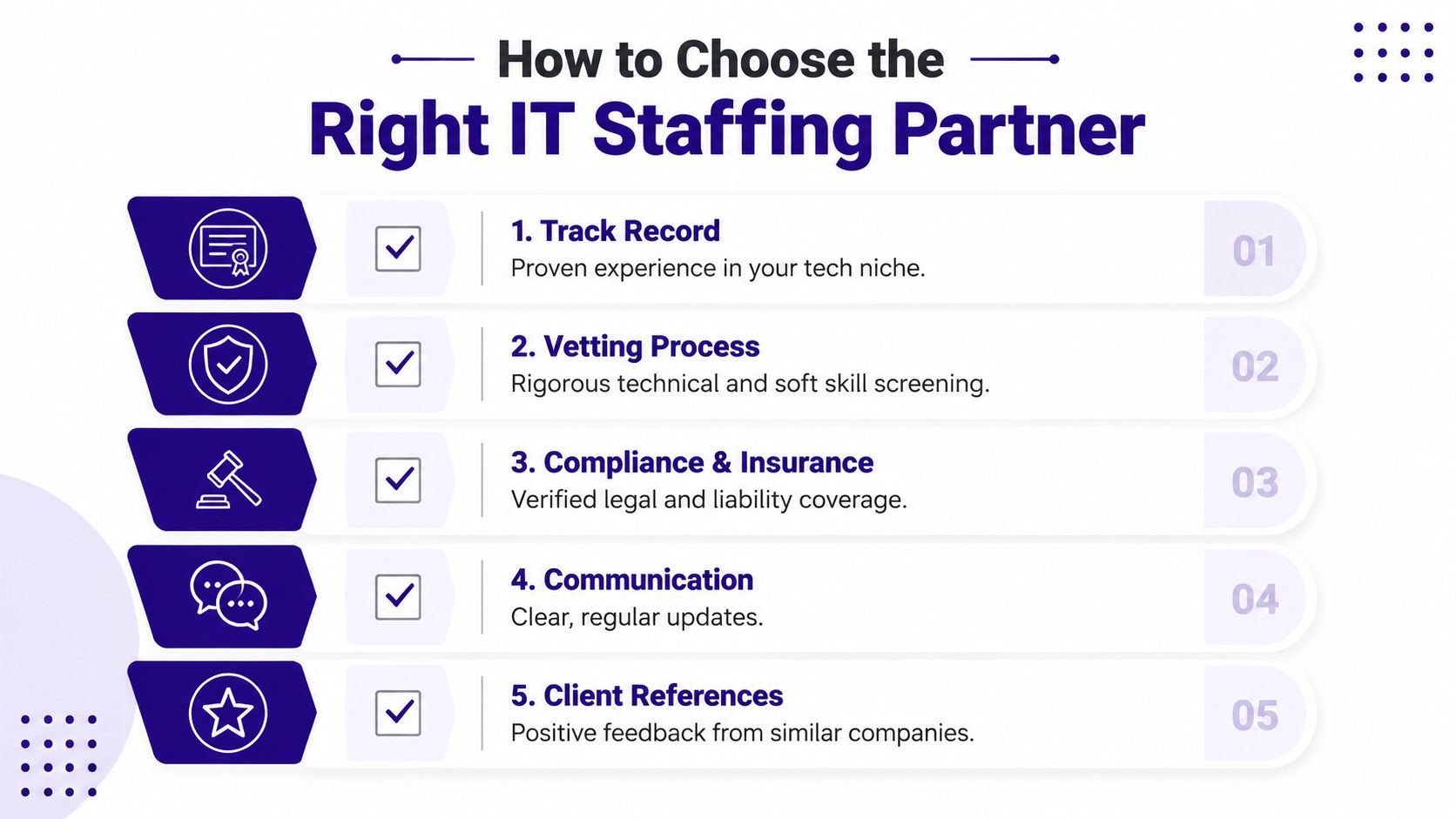
A staffing agency is a vendor decision, and it should be treated that way. The partner needs real familiarity with the relevant tech stack, clear communication, and the ability to explain pricing and compliance without vague answers. If the recruiter cannot discuss the actual work, the relationship usually starts to fray as soon as the client asks a technical follow-up.
Choosing well also means understanding the cost mechanics. Employers are not just paying for résumés. They are paying for screening time, recruiter judgment, payroll handling, risk management, and the speed of filling a role before the vacancy turns into lost delivery time. A cheaper rate can still be expensive if the agency sends weak candidates or slows the process enough that the team keeps burning internal hours.
Green flags and red flags
Green flags
- Relevant domain depth. The recruiter understands the stack, the role family, and the hiring pressure behind the request.
- Transparent pricing. The agency can explain the bill rate, placement terms, and conversion language without dodging the question.
- Strong screening discipline. Candidates come in with context, not just resumes.
- Clear communication. Feedback loops are consistent, and submissions do not disappear into a black box.
- Compliance capability. The agency can handle the employment side cleanly and explain it plainly.
Red flags
- Vague fee answers. If pricing changes every time it gets discussed, the deal is not structured well.
- High recruiter churn. A revolving door usually means weak process and inconsistent candidate quality.
- Shallow technical language. If every role sounds the same, the agency probably is not specialized.
- Pressure without specificity. Fast talk is not the same as speed.
- No real references from similar clients. Generic praise does not tell a hiring manager much.
How to test the partnership
The most practical filter is a small pilot. Give the agency one difficult requisition and watch how it handles intake, calibration, candidate quality, and feedback. The first search usually shows whether the recruiter can listen, ask the right follow-up questions, and keep the process moving without wasting time.
That test also reveals the fee structure in practice. A good partner can explain whether the role is priced as a direct placement, a contract arrangement, or a conversion path, and what each option means for cost and risk. For employers, that matters because the comparison is not agency fee versus no fee. It is agency fee versus the cost of a slow internal search, a bad hire, or a role that sits open while the team absorbs the gap.
For a company comparing vendors and workflow support, a service like nexus IT group can fit into the broader evaluation list because it focuses on contract staffing, direct placement, executive search, and quant recruitment for technology roles. The useful question is not whether a firm sounds polished, it is whether it can translate a hiring need into a search that produces usable candidates.
For teams evaluating sourcing discipline, task automation with GPT for Work can be a useful reference point for how recruiters and operations teams think about reducing repetitive work without losing judgment. The technology can help with admin, but it cannot replace the recruiter’s responsibility to validate skill, motivation, and fit.
What Employers and Candidates Should Expect
The first month with a staffing partner should feel organized, not vague. Employers should expect intake questions about scope, skills, timing, and budget, followed by candidate submissions that reflect that brief. Candidates should expect a recruiter who explains the role, prepares them for interviews, and keeps communication moving rather than disappearing after the first conversation.
The first 30 days matter
A good employer relationship starts with crisp feedback. If a submission is close but not right, the agency needs to know whether the miss was technical, cultural, or compensation-related. That feedback is how the recruiter improves the next slate. When the employer gives fast, specific responses, the search tightens quickly.
Candidates should expect the agency to help with role alignment, resume positioning, and interview prep. Good recruiters don’t promise outcomes they can’t control, but they do reduce noise and help candidates present the right experience for the opening. Contract roles are not dead ends by default, either. They can be the fastest route into a team when the need is immediate and the candidate has the right skill set.
For candidates who want a profile presentation that matches the market, headshots for actors and real estate is a reminder that presentation still matters in digital hiring, even though the core decision always comes back to experience and fit. In staffing, the agency should still put substance ahead of polish, but a clean presentation helps.
When the partnership works, both sides know who owns the next step. Employers know who to call for feedback and escalation. Candidates know who is representing them, who is negotiating, and who is handling the logistics. That clarity is the core value of a staffing agency.
Nexus IT Group works with employers that need specialized technology talent, from contract staffing and direct placement to executive search and quant recruitment. If your team needs help translating a hard-to-fill IT role into a focused search, visit nexus IT group and review how its recruiters support hiring for technical roles that can’t wait.