A CIO at a mid-sized fintech loses three senior developers to a large investment bank’s quant platform team within six months. The internal recruiter can identify the bank, but not the hiring manager, budget owner, or vendor path behind the requisitions. That is the operational problem with treating bulge bracket investment banks as finance employers only.
These banks compete for the same engineers, data specialists, infrastructure leaders, and cybersecurity professionals that technology companies need. They also represent valuable staffing clients, but access is controlled by procurement, vendor management, internal talent teams, and highly specialized technical leaders. A staffing firm that understands the bank’s structure can respond with precision. One that treats every opening as a generic software role will lose before the first call.
Table of Contents
- Why Tech Hiring Leaders Should Care About Bulge Bracket Banks
- What Makes a Bank Bulge Bracket
- The Eight Bulge Bracket Banks in 2026
- Bulge Bracket vs Middle Market vs Boutiques
- Tech Roles Bulge Bracket Banks Actually Prioritize
- How Bulge Bracket Recruiting Really Works in 2026
- 2026 Compensation and the Narrowing Wage Premium
- Engaging Bulge Bracket Banks as IT Staffing Clients
Why Tech Hiring Leaders Should Care About Bulge Bracket Banks
Bulge bracket banks matter to technology hiring leaders for two separate reasons. First, they are formidable competitors for scarce technical talent. Second, their operating complexity creates demand for specialized external recruiting, contract staffing, executive search, and project delivery.
A bank’s technology organization supports trading, risk, research, lending, payments, regulatory reporting, data platforms, and client tooling. That breadth changes the recruiting conversation. A developer who appears to be a conventional backend engineer may be qualified for market infrastructure, low-latency systems, or regulated data workloads. A cybersecurity candidate may bring experience that is far more valuable to a financial institution than to a general enterprise.
Practical rule: A hiring team should map the bank’s technology domain before benchmarking salary or competing for a candidate.
The competitive threat is also easy to underestimate. A fintech may compete against a bank for the same C++ engineer, cloud architect, or security specialist, but the bank may present a different career proposition. It can offer exposure to trading, capital markets, risk, and global financial infrastructure. That brand and platform breadth can pull experienced professionals away even when the fintech offers more autonomy.
Treat the bank as a talent market, not a logo
Recruiting leaders should build a competitor map that includes:
- Technical clusters: Quantitative engineering, cloud platforms, data engineering, cybersecurity, SRE, and application development.
- Decision structure: Business technology heads, engineering managers, talent acquisition partners, and vendor management offices.
- Candidate motivations: Technical complexity, compensation mix, brand value, regulated-scale experience, and future mobility.
- Vendor barriers: Preferred supplier lists, procurement reviews, master services agreements, and internal referrals.
The opportunity is not limited to direct placement. Banks may need contract-to-hire support, project-based security teams, confidential searches, and redeployment of professionals who already understand financial systems.
A staffing leader who waits for a public requisition will usually arrive late. The stronger approach is to identify the platform, trading, risk, and security groups first, then build relationships around recurring capability gaps. Bulge bracket banks should be tracked as both high-value clients and aggressive competitors for technical talent.
What Makes a Bank Bulge Bracket
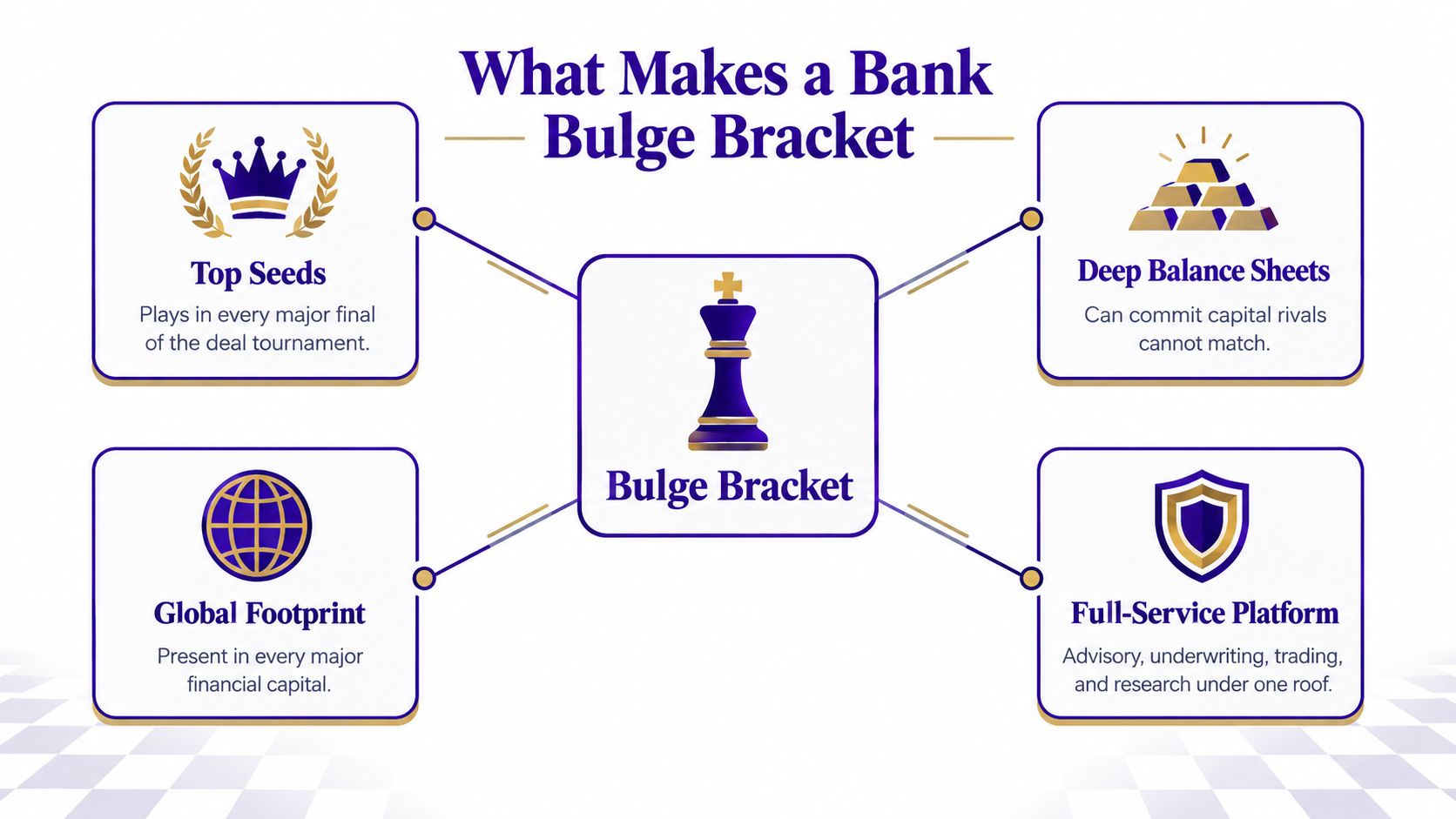
If investment banks were a chess tournament, bulge bracket firms would be the top seeds appearing in the most important finals. Their status doesn’t come from a single product, office, or impressive brand name. It comes from the combination of deal leadership, capital capacity, global reach, and full-service execution.
A bulge bracket bank typically operates across M&A, equity and debt underwriting, sales and trading, lending, and research. Its balance sheet allows it to underwrite very large transactions, commit principal, warehouse risk temporarily, and distribute exposure through syndication and market-making. That capability gives large issuers more certainty when a transaction spans several markets or requires financing alongside advice.
The four tests that matter
A bank earns the label through a pattern of institutional capabilities:
- League-table relevance: It regularly competes for the largest global M&A and capital markets mandates.
- Full-service coverage: It can advise, finance, underwrite, hedge, trade, and distribute securities through connected businesses.
- Balance-sheet strength: It can support transactions that exceed the practical financing capacity of smaller advisory firms.
- Global footprint: It can coordinate execution across the Americas, EMEA, and APAC for multinational issuers and investors.
A firm that excels in only one category may be a respected boutique, regional leader, or middle-market specialist, but that doesn’t automatically make it bulge bracket. The label reflects the combined platform.
The roster has changed over time. The top tier in the late 1960s and early 1970s was described as Morgan Stanley, First Boston, Kuhn, Loeb, and Dillon, Read. By 1975, Morgan Stanley’s definition had replaced Kuhn, Loeb, and Dillon, Read with Merrill Lynch, Salomon Brothers, and Goldman Sachs. By March 2023, after UBS acquired Credit Suisse, the roster had settled into eight banks: Bank of America, Barclays, Citigroup, Deutsche Bank, Goldman Sachs, JPMorgan Chase, Morgan Stanley, and UBS. The historical evolution of the bulge bracket shows why the category should be treated as a market position, not a permanent legal classification.
Buy-side clients and CFOs reinforce the tier by awarding repeat mandates to institutions that can execute reliably. That repeat business strengthens league-table position, attracts senior bankers, and supports larger technology and operations organizations. For recruiters, the implication is direct: a bank’s technical hiring needs reflect the scale and risk profile of the platform behind its advisory franchise.
The Eight Bulge Bracket Banks in 2026
The accepted eight-bank roster entering 2026 is JPMorgan Chase, Goldman Sachs, Bank of America, Citigroup, Morgan Stanley, Barclays, Deutsche Bank, and UBS. The list is more useful as a strategic recruiting map than as a rigid ranking. Each firm has a different mix of regional strength, product emphasis, technology demand, and internal decision-making.
Goldman Sachs and JPMorgan are the clearest examples of concentration at the top of major M&A mandates. In the first quarter of 2026, Goldman led announced M&A advisory volume with $267.9 billion, followed by JPMorgan with $212.5 billion. The reported M&A positioning of bulge bracket banks illustrates why recruiters should expect intense competition for the engineers supporting these platforms.
A recruiting view of the roster
- JPMorgan Chase: A broad, globally integrated platform with substantial demand across infrastructure, cybersecurity, data, trading technology, and enterprise applications.
- Goldman Sachs: A high-profile franchise with strong capital markets and trading relevance. Its technology organization is closely tied to quantitative systems, engineering productivity, data, and internal financial platforms.
- Bank of America: A large universal banking environment where technology hiring spans markets, corporate systems, lending, risk, and security.
- Citigroup: A cross-border institution whose geographic complexity creates demand for integration, resilience, compliance, and data professionals.
- Morgan Stanley: A major advisory and markets platform with technology needs across wealth, research, trading, risk, and client systems.
- Barclays: A global bank with significant relevance in the UK, EMEA, markets, and capital markets technology.
- Deutsche Bank: A major European platform with recurring requirements tied to regulated infrastructure, trading, risk, and cross-border operations.
- UBS: A global institution whose post-acquisition structure creates complex integration, platform rationalization, data, and control requirements.
The exact M&A rank, defining transaction, technology headquarters, and technologist headcount requested in many comparison guides aren’t contained in the verified data available for this article. A responsible staffing team shouldn’t fill those gaps with estimates presented as fact.
| Bank | 2025 M&A Volume (USD bn) | Strongest Region | Approx. Tech Headcount |
|---|---|---|---|
| JPMorgan Chase | Not provided in verified data | Global, with major Americas activity | Not provided in verified data |
| Goldman Sachs | Not provided for full-year 2025 | Global, with major Americas activity | Not provided in verified data |
| Bank of America | Not provided in verified data | Americas | Not provided in verified data |
| Citigroup | Not provided in verified data | Global and cross-border markets | Not provided in verified data |
| Morgan Stanley | Not provided in verified data | Americas and global markets | Not provided in verified data |
| Barclays | Not provided in verified data | EMEA and global markets | Not provided in verified data |
| Deutsche Bank | Not provided in verified data | EMEA | Not provided in verified data |
| UBS | Not provided in verified data | EMEA and global wealth and markets | Not provided in verified data |
HSBC and Credit Suisse have appeared in older discussions of the category. Credit Suisse was removed from the current roster after UBS acquired it. HSBC's status is more contested in informal market discussions, which is a reminder that bulge bracket terminology can shift with league-table performance, mergers, and the scope of the source being used.
Bulge Bracket vs Middle Market vs Boutiques
The practical difference between bank tiers is not prestige. It is what the counterparty can finance, distribute, and execute when the transaction becomes complicated.
Bulge bracket banks combine advisory with underwriting, lending, trading, and distribution. Middle-market firms typically provide strong advisory execution with a narrower product menu and less balance-sheet capacity. Boutiques usually specialize in sectors or advisory mandates and generally don't provide the same financing platform.
| Criterion | Bulge Bracket | Middle Market | Boutique |
|---|---|---|---|
| Deal profile | Largest global and cross-border transactions | Mid-sized transactions and specialist processes | Sector-focused or board-level advisory |
| Balance sheet | Can commit capital, underwrite, lend, and hedge | More dependent on syndication and partner financing | Typically no balance sheet |
| Service coverage | M&A, ECM, DCM, trading, lending, research, and distribution | Selected advisory and capital markets services | Primarily advisory |
| Client trade-off | Highest execution certainty and global reach | Strong process coverage with focused teams | Senior attention and fewer financing conflicts |
A company considering a transaction above $1 billion needs to examine financing certainty, geographic coverage, and the ability to coordinate several investor groups. The full-service operating model of bulge bracket banks explains why their advantage is structural rather than merely reputational.
Middle-market firms are often the workhorse option for companies that need an experienced process team without a global universal bank. Boutiques can be the better choice when senior partner involvement, sector expertise, or advisory independence matters more than committed financing.
The decision rule for a $200 million-plus software company
A $200 million-plus enterprise software company should select the counterparty based on transaction needs:
- Choose a bulge bracket bank when acquisition financing, cross-border distribution, hedging, or execution certainty is central.
- Choose a middle-market firm when the company needs a focused process team and the transaction doesn’t require a broad balance sheet.
- Choose a boutique when senior strategic advice and independence outweigh financing capability.
For IT staffing leaders, the tier also predicts the buying environment. Bulge bracket banks have more formal procurement and control layers. Middle-market firms may offer faster access to decision-makers. Boutiques may need fewer vendors but can require unusually precise sector and seniority matching.
Tech Roles Bulge Bracket Banks Actually Prioritize
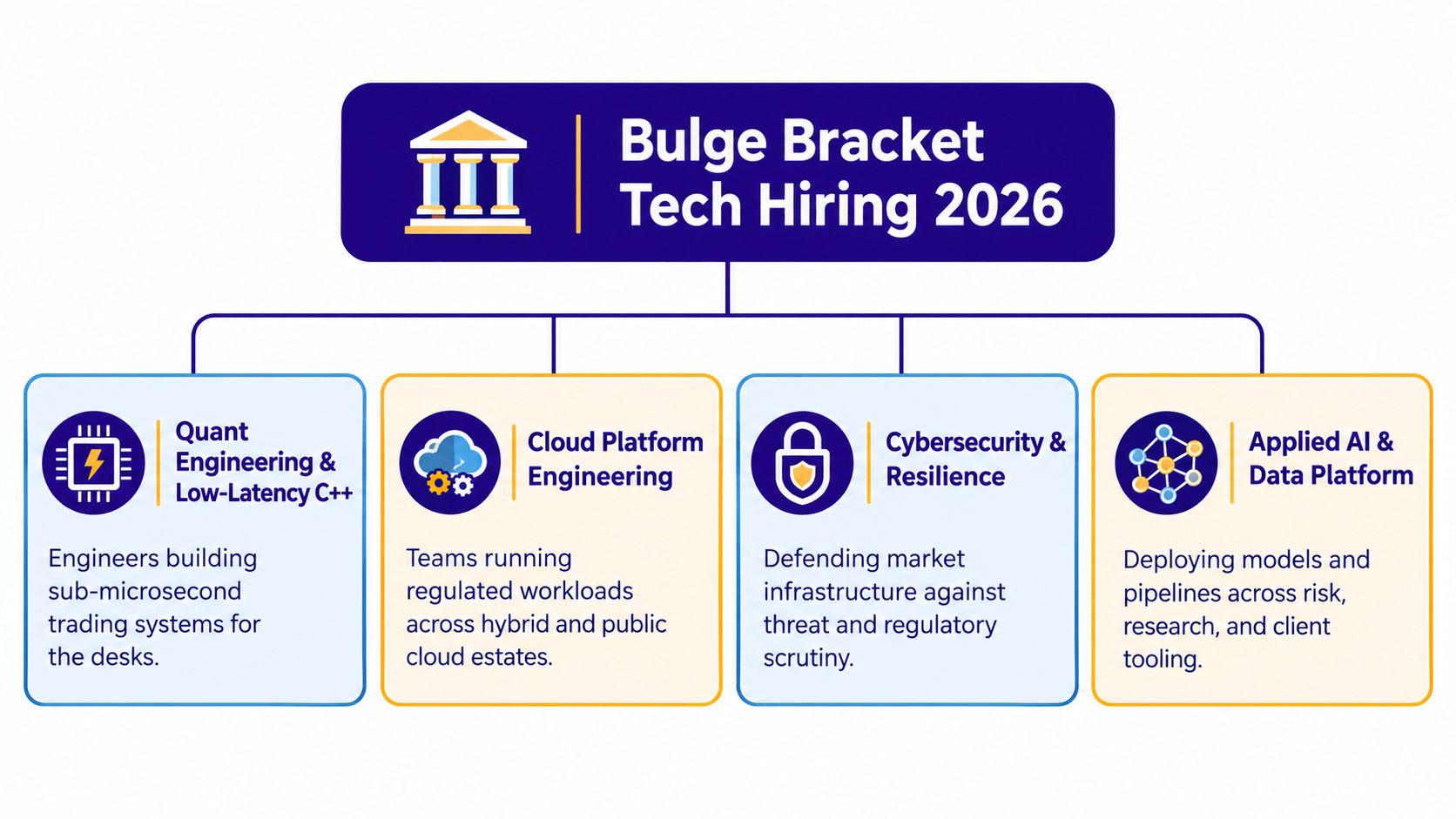
Generic software engineering searches are a poor fit for bulge bracket banks. The strongest demand clusters around technology that protects trading performance, supports regulated infrastructure, secures sensitive systems, or feeds analytical products.
Four high-value talent clusters
Quant engineers and low-latency C++ developers remain difficult to recruit because trading desks connect technical performance directly to revenue and risk. Candidates need more than modern C++. Recruiters should test for concurrency, memory management, network performance, market data, exchange connectivity, and production support under pressure.
Cloud platform engineers support OpenShift, Anthos, hybrid cloud, container orchestration, observability, and infrastructure automation. Banks adopt cloud architecture within strict control frameworks, so a candidate who understands migration sequencing, identity, resilience, and auditability is more valuable than a general cloud certificate holder.
Cybersecurity specialists need experience with zero-trust architecture, incident response, identity, resilience, and SEC Rule 17a-4 compliance. Financial institutions also value candidates who can explain control evidence to auditors and translate technical risk for legal, compliance, and executive stakeholders.
Data engineers build lakehouse architectures using platforms such as Databricks and Snowflake. Their work supports risk, research, client analytics, operational reporting, and applied AI. A strong candidate understands data quality, lineage, access controls, orchestration, and model-ready pipelines rather than just moving data between systems.
The priority order depends on the bank and desk, but a recruiter should expect the fastest response for candidates who combine deep engineering skill with financial-services context. Internal initiatives such as Goldman’s GS AI platform and Morgan Stanley’s @AskResearchMO are examples named in the hiring brief, but the available verified data doesn’t establish their current staffing levels or hiring volumes.
Candidates who need market-specific preparation can also review investment management technology roles. Hiring teams should assess portfolio evidence, production ownership, and regulated-environment judgment before relying on title matching.
How Bulge Bracket Recruiting Really Works in 2026
Bulge bracket recruiting has several filters, and candidates who treat the process as a single interview usually misread the power structure. The HR screen checks eligibility, communication, compensation alignment, and résumé fit. The hiring manager determines whether the candidate can solve the team’s technical problem. The final panel tests depth, judgment, and the ability to operate under institutional constraints.
The sequence generally includes:
- HR screening: Résumé review, recruiter questions, and basic role alignment.
- Hiring-manager interviews: Technical discussions with the desk or platform team that owns the headcount.
- Technical panel or superday: Several interviews that test engineering depth, systems thinking, communication, and team fit.
- Approval and offer: Compensation, risk, compliance, and business approvals before the candidate receives terms.
The image URL above contains a transcription error in the supplied asset path, so it cannot be altered or replaced while preserving the mandatory character-for-character requirement. However, the recruitment logic remains clear: the person with the requisition matters more than the recruiter who first contacts the candidate.
What candidates and vendors should verify
Workload isn’t uniform across bulge bracket banks. Coverage on junior analyst hours notes that JPMorgan has used an 80-hour cap for most junior bankers, with live deals exempted. The discussion of investment banking analyst workload is a useful warning against treating a single schedule as representative of every group or technical function.
Technology recruiting also differs by desk. A low-latency trading team may prioritize immediate technical proof. A security team may require control and incident experience. A data platform group may care more about architecture, lineage, and production operations than algorithm puzzles.
Candidates should ask who owns the headcount, where the team works, what the approval path is, and whether the role is permanent, contract, or contract-to-hire. A staffing firm should document those answers before presenting talent. For a more focused vendor approach, investment banking recruiting support can help frame the search around the actual banking function rather than a generic IT job title.
2026 Compensation and the Narrowing Wage Premium
Compensation comparisons need discipline. The verified data supports a broad first-year analyst total-compensation range of $150,000 to $225,000 across multiple 2026 sources, but it doesn’t support a complete technology compensation grid by analyst, associate, VP, and senior vice president. The 2026 investment banking career review places that analyst range in context and also describes active movement between large banks.
| Role Level | Base Salary Range | Total Comp Range | Signing / Deferred |
|---|---|---|---|
| First-year analyst | Not provided by verified data | $150,000 to $225,000 | Structure not provided |
| Associate | Not provided in verified data | Not provided in verified data | Not provided in verified data |
| Vice president | Not provided in verified data | Not provided in verified data | Not provided in verified data |
| Senior vice president | Not provided in verified data | Not provided in verified data | Not provided in verified data |
That gap in public detail matters to recruiters. A candidate evaluating a bank offer isn’t comparing base salary alone. The package may include annual bonus, deferred stock, sign-on terms, work-location requirements, promotion timing, and the perceived value of experience on the résumé.
The available data also reports 18 bankers moving from one bulge bracket to another in a 2026 mid-year recruitment review, while bulge bracket firms accounted for 19% of senior banker additions. Those figures concern banker mobility, not technology compensation, so they shouldn’t be used to price an engineer. They do show that movement between large institutions is active enough to make counteroffer planning essential.
Compensation rule: Recruiters should present total value, not a headline base number.
A technology candidate moving from a fintech or middle-market bank should receive a role-specific comparison. The discussion should cover technical scope, on-call burden, office expectations, bonus variability, deferred awards, promotion evidence, and the manager’s ability to protect the role. A modest base increase can lose against a stronger engineering mandate, while a large sign-on payment may not offset a weak long-term platform.
Engaging Bulge Bracket Banks as IT Staffing Clients
Staffing leaders should stop pitching bulge bracket banks with a broad claim about access to developers. That message sounds interchangeable. The credible pitch connects a specific talent pool to a specific control, platform, or delivery problem.
The first targets should be CTOs, heads of platform engineering, cybersecurity leaders, technology vendor management offices, and diversity sourcing leads. Procurement matters, but procurement rarely creates the technical demand. A business sponsor creates the demand, and vendor management determines whether an external firm can fulfill it.
Lead with defined delivery offers
- Contract-to-hire support: Useful for trading platform builds, cloud migration teams, and infrastructure programs where the bank needs proof before making a permanent commitment.
- SOW-based cybersecurity delivery: Appropriate for focused security, resilience, compliance, and remediation work with clear outcomes.
- Alumni redeployment: Valuable when professionals with financial-services experience become available after a project, restructuring, or platform transition.
- Specialist search: Quant engineering, low-latency C++, data platforms, security architecture, and technology leadership require domain screening rather than keyword matching.
Procurement objections are predictable. A bank may already have preferred vendors, require a master services agreement, or assume direct hiring is sufficient. The response should be evidence of candidate quality, compliance readiness, speed, and specialization, not a discount.
A recruiter should also connect staffing to regulatory pressure without overstating what any specific rule requires. DORA and SEC cyber disclosure rules can shape demand for resilience, security, documentation, and incident-response expertise. The bank still needs a defined role, scope, and accountable hiring owner.
Leaders can position IT staffing agency services around those requirements, then follow a practical cadence: discovery with the technical owner, qualification with vendor management, a small proof assignment, documented delivery metrics, and an MSA discussion after the first successful engagement. The objective is not to become another résumé supplier. It is to become the specialist partner for roles the bank cannot fill through its standard channel.
Nexus IT Group provides contract staffing, direct placement, executive search, and quant recruitment for difficult technology roles across engineering, cloud, cybersecurity, data, DevOps, and IT leadership. Technology leaders assessing bulge bracket talent competition or building a bank-focused hiring program can connect with nexus IT group to discuss specialized recruiting support.
