
Data science hiring stays expensive because demand is strong, title inflation is common, and two roles with the same name can produce very different business value. That is why salary conversations around data science jobs salary often break down once the discussion moves past a single market average.
At this point, generic averages lose their utility. A data scientist who owns experimentation, production models, and decision support will not be paid like someone focused mainly on reporting and dashboard maintenance. I see this constantly in hiring loops. Companies say they want a “data scientist,” but the compensation range usually reflects the scope of ownership, the revenue impact of the work, and how hard that skill mix is to replace.
Location changes the number too. So does industry. So does the difference between a role with real product influence and one that functions as an analytics support seat. For teams comparing international hiring options, resources like Latam data scientist salaries 2026 add useful context without pretending one global average can explain the market.
This guide focuses on the numbers, the forces behind them, and the practical decisions that follow for both candidates and hiring managers.
Table of Contents
- Setting the Stage for Data Science Salaries in 2026
- Data Science Salary Benchmarks by Experience Level
- Decoding the Full Data Science Compensation Package
- How Location and Industry Affect Your Paycheck
- The Skills and Trends Driving Top-Tier Salaries
- Actionable Strategies for Salary Negotiation
- Building Your Team and Career with Confidence
Setting the Stage for Data Science Salaries in 2026
A single national median can hide six-figure gaps in real offers.
As noted earlier, federal wage data puts data science in a well-paid, fast-growing category. That matters, but the more useful takeaway is what sits underneath those top-line figures: employers are paying for scarce combinations of statistics, software, business judgment, and production ownership. That pressure shows up differently in startups, large enterprises, and remote-first teams trying to hire from multiple regions, including markets tracked in Latam data scientist salaries 2026.
Here is where candidates and hiring managers usually get compensation wrong. They treat “data scientist” as one market price, then act surprised when quoted numbers do not match. In practice, the title covers very different jobs. One role is heavy on SQL, dashboards, and experiment readouts. Another expects model deployment, feature engineering, stakeholder management, and the judgment to decide when not to build a model at all.
That difference drives pay more than title hygiene.
I see the same pattern in hiring loops every year. Teams write a broad data scientist job description, post a salary band based on a generic average, and then interview candidates who belong in three different compensation tiers. Candidates do the mirror image. They benchmark against a title match instead of comparing business scope, technical depth, and how close the role is to revenue, product, or risk decisions.
Practical rule: Salary data is only useful if it is tied to scope, decision-making level, and the difficulty of replacing that skill set.
For candidates, that means benchmarking the job you are being asked to do. For hiring managers, it means defining the work before setting the band. Miss that step and the result is predictable: overpay for reporting work, underprice production ML talent, or lose strong applicants because the offer was built on the wrong comparison set.
Data Science Salary Benchmarks by Experience Level
A candidate at 10+ years can clear $215,000+, while the reported market average sits closer to the mid-$160,000s. That spread explains why generic salary averages break down fast in data science.
One 2026 salary outlook puts U.S. data scientist pay at about $152,000 for 0 to 1 years, $167,000 for 2 to 3 years, $181,000 for 4 to 6 years, and $215,000+ for 10+ years. The same report places the U.S. average at roughly $166,000 in Q1 2026, and cites Glassdoor at $155,580 average total pay with a $120K to $194K range, as summarized in this 2025 to 2026 data scientist salary outlook.
A practical benchmark table
| Experience Level | Years of Experience | Typical Base Salary Range |
|---|---|---|
| Junior or Entry-Level | 0 to 1 years | Around $152,000 |
| Early Mid-Level | 2 to 3 years | Around $167,000 |
| Mid-Level | 4 to 6 years | Around $181,000 |
| Lead or Principal | 10+ years | $215,000+ |
Use this table as a pricing starting point, not a final answer.
In hiring, experience only predicts pay well if scope rises with it. A 3-year data scientist who has shipped models, worked with engineering, and handled messy production data can command more than a 5-year candidate whose background is limited to dashboards, one-off notebooks, and low-stakes analysis. That gap is exactly why title matching fails. Salary follows business impact, replacement difficulty, and the level of trust attached to the role.
What each tier usually buys an employer
0 to 1 years: employers are paying for foundation and learning speed. Strong entry-level candidates usually bring Python or SQL fluency, statistics basics, clean communication, and enough judgment to avoid breaking a workflow. The mistake I see is teams posting junior salaries while expecting production-ready ML work.
2 to 3 years: this is often the first true autonomy tier. Candidates here start to earn more because they can frame a problem, choose a method, validate results, and deliver work with less supervision. If they also have cloud, MLOps, or experimentation depth, they can price closer to adjacent roles like AI engineers. For reference, the AI engineer salary market in the U.S. shows how quickly compensation moves once deployment skills enter the picture.
4 to 6 years: Compensation begins to separate solid practitioners from high-value operators. Employers pay more for people who can influence roadmap decisions, handle ambiguity, and connect model work to product, revenue, or risk outcomes.
10+ years: senior pay reflects ownership, not just tenure. These hires are expected to set standards, pressure-test strategy, lead cross-functional decisions, and prevent expensive mistakes before they happen.
The better salary question is simple. How much risk can this person remove without close supervision?
That framing helps both sides. Candidates should describe impact in terms of decisions owned, systems improved, and business stakes. Hiring managers should write bands around actual scope, then test candidates against that scope instead of defaulting to years alone.
Decoding the Full Data Science Compensation Package
A salary offer is a package, not a number. Candidates who focus only on base pay often misread the stronger deal. Employers who talk only about salary often undersell what they’re offering.
Why base salary is only part of the deal
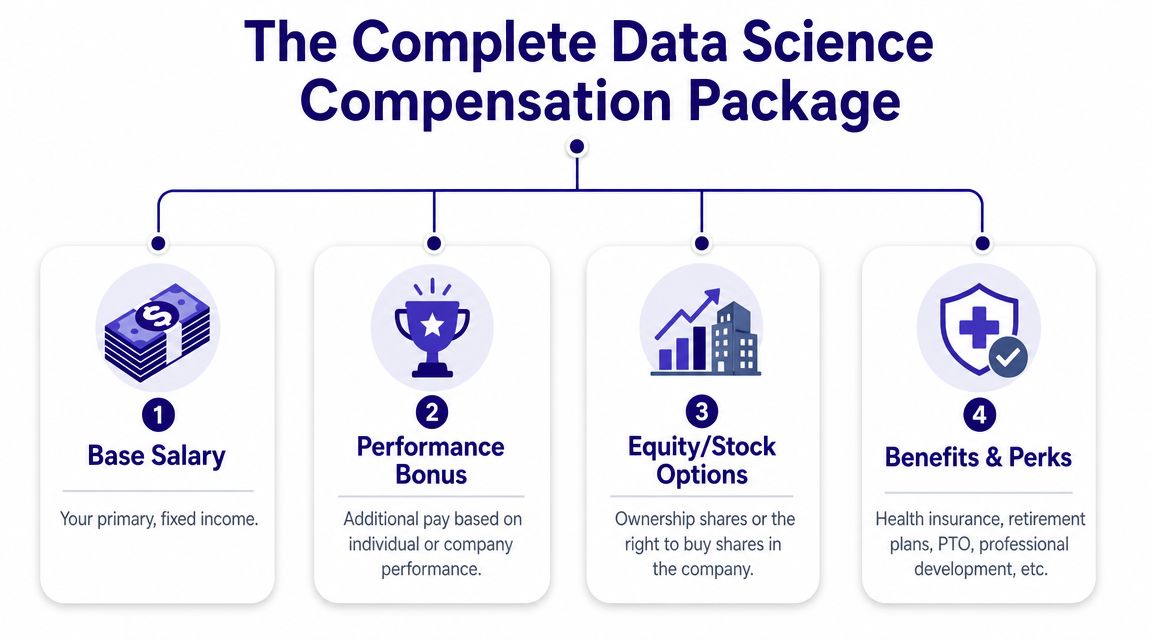
Think of compensation like a four-part stack.
- Base salary is the fixed layer. It covers day-to-day certainty and usually drives how candidates compare offers first.
- Performance bonus adds a variable layer. This matters more in companies that tie payout to company goals, product milestones, or individual output.
- Equity or stock options create upside. Public-company RSUs are usually easier to value than startup options, but startup equity can still matter if the candidate understands the risk profile.
- Benefits and perks affect real take-home value. Health coverage, retirement match, paid time off, learning budget, and flexibility all change how attractive a role feels.
A lower base salary can still be the better deal if equity is meaningful, benefits are strong, and the role creates better promotion velocity. On the other hand, candidates shouldn’t accept vague promises in place of cash unless the employer can explain the package clearly.
How candidates and employers should evaluate offers
Candidates should ask direct questions.
- What portion is fixed cash
- How is bonus earned
- What exactly is the equity type
- What does vesting look like
- Which benefits reduce personal cost
Hiring managers should present the offer the same way. Broken out clearly. Not buried in verbal selling.
For readers comparing adjacent roles in AI-heavy teams, this guide to AI engineer salary in the US is useful because it highlights how compensation differs once infrastructure, deployment, and model engineering responsibilities become central.
A weak offer often isn’t just low. It’s unclear.
How Location and Industry Affect Your Paycheck
Two candidates can have similar resumes and still see very different offers. Geography is one reason. Industry is the other.
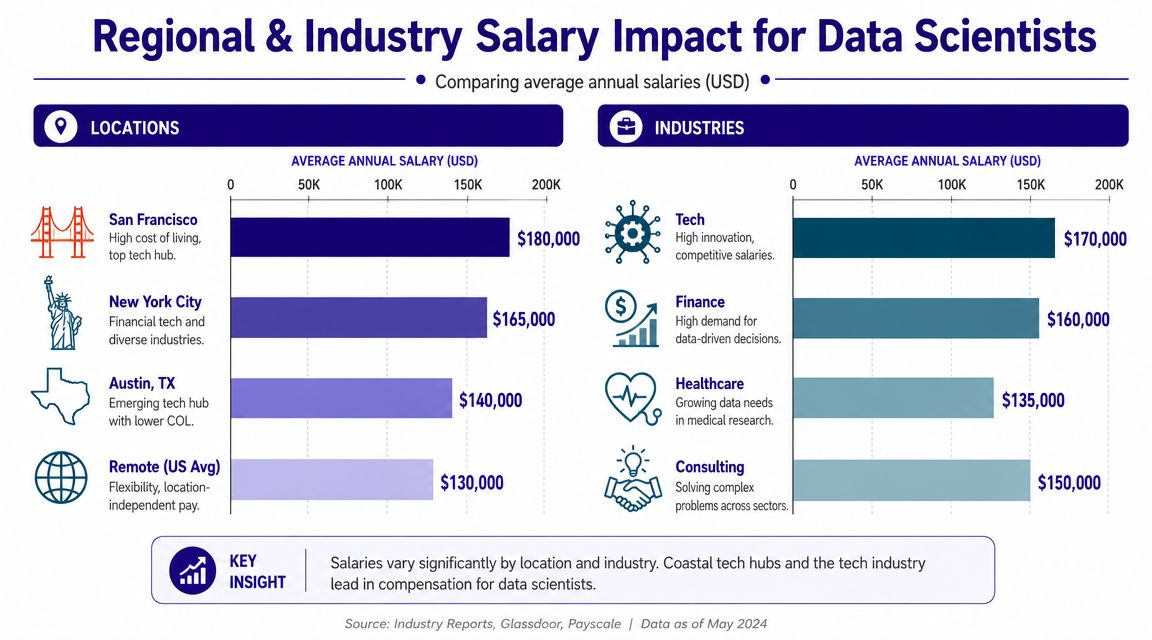
The location gap hasn’t disappeared just because more teams hire remotely. Recent guidance shows West Coast Level 3 data scientists at $155,000 to $200,000, compared with $145,000 to $182,500 in the Middle U.S. and $145,000 to $180,000 in the Northeast. The same salary guide also notes that Charlotte is emerging as a hotspot, with salaries ranging from $96,000 to $133,000 and lower living costs than San Francisco or New York, according to this data scientist salary guide by region.
Geography still changes the number
High-paying markets usually expect more than technical competence. They often expect stronger communication, faster decision-making, and comfort working with product and engineering at speed. That’s why candidates comparing offers shouldn’t ask only, “Which city pays more?” They should ask, “Which role gives better buying power, career momentum, and scope?”
A few patterns matter:
- West Coast roles often carry the highest nominal ranges, but housing and local competition can erase part of that advantage.
- Middle U.S. and Northeast ranges can be lower on paper while still offering stronger net value depending on the city and company.
- Emerging hubs like Charlotte can appeal to candidates who want a lower-cost market without stepping out of serious data work.
Industry changes how employers value the role
Industry changes pay because it changes how directly the role connects to revenue, risk, or operational efficiency.
A data scientist in a product-led software company may be tied to experimentation, activation, or retention. In finance, the role may influence pricing, forecasting, or risk models. In healthcare, the stakes may center on compliance, quality, and operational precision. Those aren’t interchangeable environments.
That’s why the same title can produce different salary outcomes. Employers price for impact, not just for skills listed on a resume. Candidates who understand the business model behind the role usually negotiate better because they know where their work sits in the value chain.
A remote offer isn’t automatically the best offer. The better question is whether the company pays for the role’s business value or only for its zip code.
The Skills and Trends Driving Top-Tier Salaries
The title “data scientist” hides a wide spread in actual market value. Benchmark data shows that Glassdoor reports average U.S. total pay of about $155,580, while the U.S. BLS median annual wage was $112,590 as of May 2024. Coursera also notes that pay rises with tenure, from about $133,000 at 0 to 1 years to $234,000 at 15+ years, in this data scientist salary guide from Coursera. The practical implication is simple. Employers should benchmark against scope such as experimentation, causal inference, MLOps, and stakeholder ownership, not just title.
Scope beats title
Hiring teams routinely lump different jobs into one req. That’s one of the biggest reasons salary bands get messy.
A candidate who mainly cleans data, writes SQL, and supports dashboards isn’t usually competing in the same compensation tier as someone who can:
- Design experiments and defend methodology
- Work through causal questions when simple correlation won’t hold
- Own MLOps handoff or production collaboration
- Translate technical findings into decisions executives can act on
That broader scope is what pushes salary upward. It also explains why some “senior data scientist” postings attract the wrong people. The title says one thing. The responsibilities say another.
Skills that consistently move offers upward
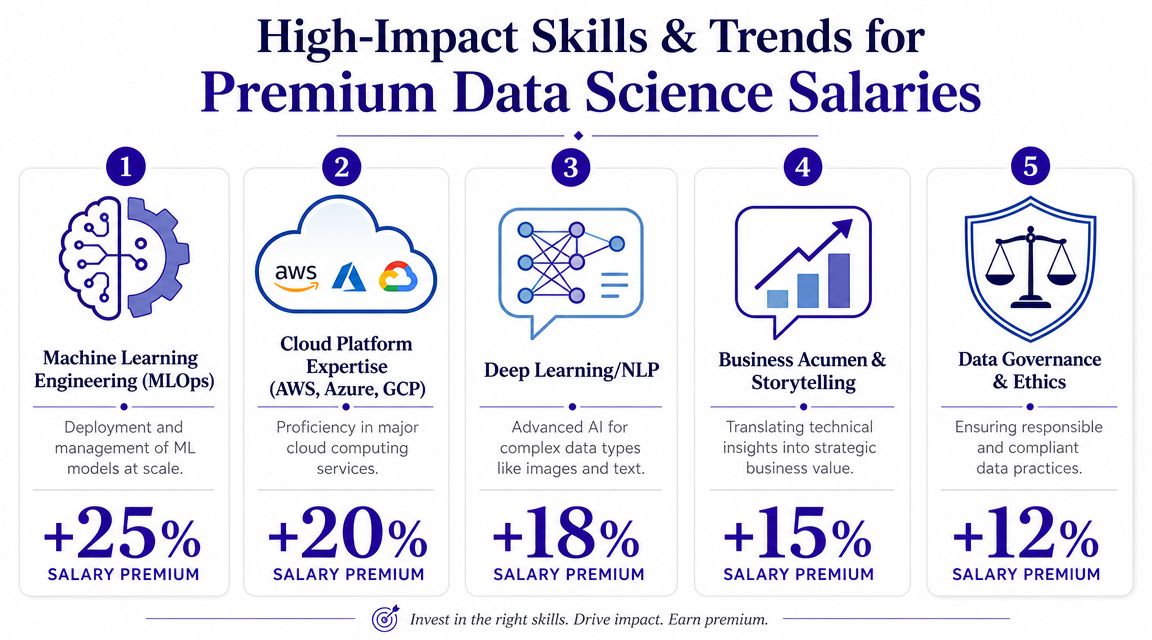
The market pays more for skills that reduce ambiguity and make models usable for practical implementation.
Experimentation and causal reasoning matter because companies don’t just want predictions. They want evidence that a decision changed an outcome.
MLOps and deployment fluency matter because a model that never ships has limited commercial value.
Stakeholder ownership matters because strong data scientists don’t stop at the notebook. They influence what gets prioritized and how results get interpreted.
For professionals planning their next move, this article on the future of data science careers and predictions for the next decade is a useful companion because it looks at where the role is broadening beyond traditional analytics.
What tends not to work? Chasing buzzwords without depth. Listing every modern library on a resume doesn’t command premium pay if the candidate can’t explain trade-offs, production constraints, or business implications.
Actionable Strategies for Salary Negotiation
Negotiation in data science works best when it stays concrete. Candidates lose their advantage when they talk only about effort, education, or general enthusiasm. Employers lose candidates when they treat every objection like a compensation problem instead of a role-design problem.

Motion Recruitment’s 2026 salary guide estimates mid-level data scientists at roughly $138,000 to $175,000 nationally, with senior roles around $157,000 to $194,000. It also estimates Los Angeles mid-level pay at about $154,000 to $196,000, while remote roles still command about $141,000 to $180,000, according to its 2026 data science salary guide. That spread reflects both market location and the level of statistical or machine learning autonomy expected.
How candidates should frame the discussion
Candidates should anchor on fit and scope first, then on money.
- Use role-matched benchmarks: Don’t say “data scientists make X.” Say the role appears to require independent modeling, experimentation, and cross-functional influence, which places it in a higher market tier.
- Tie skills to business outcomes: Mention production deployment, experiment design, forecasting ownership, or model governance. Those are stronger than broad claims about being “results-driven.”
- Negotiate the package, not just base: If salary won’t move, ask about bonus target, equity, title level, remote flexibility, or a sign-on structure.
A useful answer to the salary-expectations question is usually a range tied to responsibilities, not a single defensive number. That keeps the conversation grounded and gives room to adjust if the package is stronger elsewhere.
What hiring managers should do differently
The fastest way to weaken an offer is to hide the level. If the job expects ownership of model design and production collaboration, the salary band should reflect that from the start.
Hiring managers also need to separate must-have skills from wishlist items. A posting that asks for research depth, cloud deployment, experimentation, and stakeholder leadership while paying like a support analytics role won’t close strong candidates.
One option teams use when they need help calibrating market expectations is a specialist recruiter. For example, Nexus IT Group’s data science recruiting practice focuses on hiring analytic, AI, machine learning, and data talent, which can help employers benchmark role scope before compensation conversations go off track.
Strong negotiation usually isn’t adversarial. It’s a clearer conversation about scope, risk, and value.
Building Your Team and Career with Confidence
Data science jobs salary decisions get easier when both sides stop chasing a single average. Candidates grow earnings by choosing roles with real ownership, building skills that affect decisions rather than just reports, and evaluating offers on total compensation. Hiring managers compete more effectively when they define scope clearly, benchmark against the actual work, and explain the package in plain terms.
The strongest candidates rarely optimize for base salary alone. They look at promotion path, technical depth, team quality, and whether the company will let them do meaningful work. Employers should think the same way. Compensation matters, but so do problem quality, manager strength, and the credibility of the data environment.
For professionals exploring distributed opportunities, curated lists of remote companies can help identify teams that hire beyond traditional hubs. That’s useful context when comparing local offers against remote roles with different compensation philosophies.
The market is still competitive. That won’t change just because more salary data is available. What does change outcomes is using the right benchmark, asking sharper questions, and treating salary as a reflection of scope, not just title.
Nexus IT Group helps technology employers hire for specialized roles across data science, AI, cloud, cybersecurity, software, and IT leadership, and it supports candidates navigating high-stakes career moves in those same markets. Companies that need hard-to-fill talent and professionals weighing their next move can learn more through nexus IT group.